Cruising
pp. 126-128 · Read in the full issue
Yachts
• MAI AW A, 40 ft American sloop with R. E. Fisher, Harold Lloyd Conway and Gary Dalton, recently reached Auckland, NZ, after a rough four-week trip from Rarotonga, Cook Islands, En route off the NZ coast, Malaga’s mast was broken in a storm but she reached Auckland safely under engine power.
Maiawa reached Rarotonga on April 27 from Honolulu and Fanning Island. • SNORIS, Bob and Claire Hay mos’ 37 ft Swiss ketch, left Vila, New Hebrides, on July 9 for Port Moresby, Papua, after a six-month stay in Hebridean waters. On a circumnavigation, Snoris was last reported in Papeete ( PIM, Dec., 1967, p. 117).
• Heather George, 93 Ft
former trawler, with her owner captain Alan Macleod and his family, is to take up commercial fishing in NZ waters. She made news last year in the Cook Islands when she success fully salvaged a cutter, Tally Ho, wrecked at Manuae {PIM, ' Nov., 1968, p. 111). • LONGSHIPS, Mervin Lippiatt’s 50 ft catamaran, reached Rarotonga, Cook Islands, on July 25 from Tahiti after a stormy passage. With Mervin, were his wife, May and their 13-
months old daughter.
The Lippiatts intend to settle either in New Zealand or Australia.
Their cruise has taken them to the Galapagos Islands, the Tuamotus and Tahiti. Next calls will be Aitutaki and Suva. 9 NOMAD, Bruce Baker’s 39 ft cutter was being careened at Avatiu harbour, Rarotonga, Cook Islands, in late July.
It was lifted out of the water by a big works’ crane and installed in a newly-built cradle.
Nomad’s sails were blown out on May 20 when Bruce ran into bad weather 75 miles from Rarotonga.
He was sailing single-handed and direct for New Zealand.
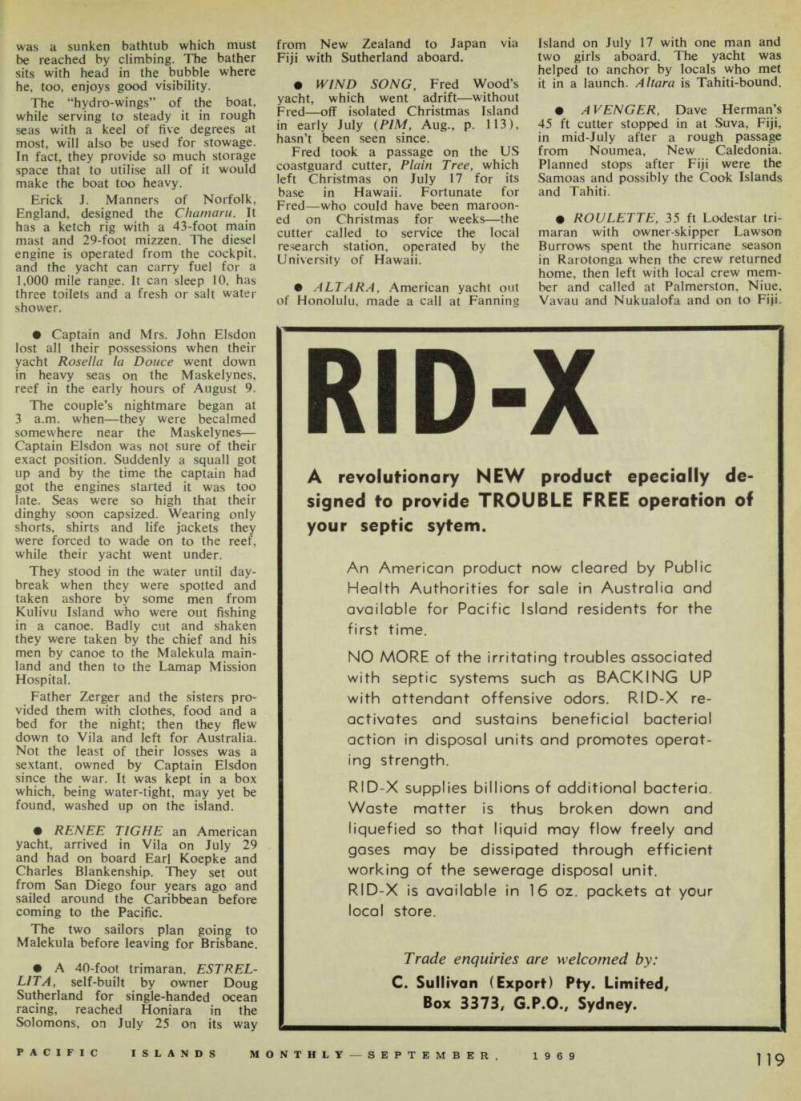
• CHAMARU, a 49 foot ketch rigged trimaran, arrived in Saipan skippered by its owner US Navy Commander Charlie Sturkey in June, on its way round the world.
The Chamaru was built in Japan under the supervision of now retired US Navy Commander Sturkey.
Commander Sturkey plans a three to four year world cruise and after leaving Saipan expects to call at Guam, Truk, Ponape, Kusaie, Nauru, Ellice Islands, American Samoa, Western Samoa, Tonga, Fiji, New Caledonia, New Hebrides, Norfolk Island, New Zealand (for Christmas and New Year) and then on to Australia, Torres Strait, Bali (plus other Indonesian ports), Singapore, Suez and beyond to the Mediterran ean Europe, and then to the United States.
The cruise has been in the making since October, 1965, when Cdr.
Sturkey, 52, began his last naval duty as ship repair officer at Fleet Activities, Sasebo. During this time the yacht was hand-crafted in Sasebo of Japanese, American and British materials.
To the untrained eye, the two most outstanding features of the triple hulled boat are the plexiglass bubbles above both the indoor navigation area and the bathtub.
The enclosed navigation area was designed by Cdr. Sturkey, a former naval architect. He conceived the bubble idea so that the navigator can operate controls from inside the cabin with visibility through the bubble.
Because the port side had a bubble, Cdr. Sturkey said it was decided that for proper symmetry the starboard side should also have one. The result
Mr. Sturkey's
"Chamaru" is a 49 ft ketch built in Japan of local, American and British materials.
The navigator can operate controls from inside a bubble on the port side, while the bubble on the starboard is used as a sunken bathtub.
was a sunken bathtub which must be reached by climbing. The bather sits with head in the bubble where he, too. enjoys good visibility.
The “hydro-wings” of the boat, while serving to steady it in rough seas with a keel of five degrees at most, will also be used for stowage.
In fact, they provide so much storage space that to utilise all of it would make the boat too heavy.
Erick J. Manners of Norfolk, England, designed the Charnaru. It has a ketch rig with a 43-foot main mast and 29-foot mizzen. The diesel engine is operated from the cockpit, and the yacht can carry fuel for a 1,000 mile range. It can sleep 10, has three toilets and a fresh or salt water shower, • Captain and Mrs. John Elsdon lost all their possessions when their yacht Rosella la Douce went down in heavy seas on the Maskelynes, reef in the early hours of August 9.
The couple’s nightmare began at 3 a.m. when—they were becalmed somewhere near the Maskelynes— Captain Elsdon was not sure of their exact position. Suddenly a squall got up and by the time the captain had got the engines started it was too late. Seas were so high that their dinghy soon capsized. Wearing only shorts, shirts and life jackets they were forced to wade on to the reef, while their yacht went under.
They stood in the water until day break when they were spotted and taken ashore by some men from Kulivu Island who were out fishing in a canoe. Badly cut and shaken they were taken by the chief and his men by canoe to the Malekula main land and then to the Lamap Mission Hospital.
Father Zerger and the sisters pro vided them with clothes, food and a bed for the night; then they flew down to Vila and left for Australia.
Not the least of their losses was a sextant, owned by Captain Elsdon since the war. It was kept in a box which, being water-tight, may yet be found, washed up on the island. • RENEE TIGHE an American yacht, arrived in Vila on July 29 and had on board Earl Koepke and Charles Blankenship. They set out from San Diego four years ago and sailed around the Caribbean before coming to the Pacific.
The two sailors plan going to Malekula before leaving for Brisbane. • A 40-foot trimaran, ESTREL LITA, self-built by owner Doug Sutherland for single-handed ocean racing, reached Honiara in the Solomons, on July 25 on its way
from New Zealand to Japan via Fiji with Sutherland aboard. • WIND SONG, Fred Wood’s yacht, which went adrift—without Fred—off isolated Christmas Island in early July ( PIM , Aug., p. 113), hasn’t been seen since.
Fred took a passage on the US coastguard cutter, Plain Tree, which left Christmas on July 17 for its base in Hawaii. Fortunate for Fred—who could have been maroon ed on Christmas for weeks—the cutter called to service the local research station, operated by the University of Hawaii, • ALTARA, American yacht out of Honolulu, made a call at Fanning
Island on July 17 with one man and two girls aboard. The yacht was helped to anchor by locals who met it in a launch. Altara is Tahiti-bound. • AVENGER, Dave Herman’s 45 ft cutter stopped in at Suva, Fiji, in mid-July after a rough passage from Noumea, New Caledonia.
Planned stops after Fiji were the Samoas and possibly the Cook Islands and Tahiti. • ROULETTE, 35 ft Lodestar tri maran with owner-skipper Lawson Burrows spent the hurricane season in Rarotonga when the crew returned home, then left with local crew mem ber and called at Palmerston, Niue, Vavau and Nukualofa and on to Fiji.
His most exciting moment during the trip was when he was reported missmg while tied up at Rarotonga for a week m July, 1968. • WILD GOOSE, Australian-built ketch, owned and skippered by Ken Matson with wife, two sons and a daughter, spent the hurricane season at Papeete, then Cooks, in May and on to Niue Island. On way from Cooks they called at Beveridge Reef, which is seldom visited, and stayed two days. Left early August for Pago Pago and will reach NZ before the next hurricane season cp a m.nn „ . , ™hZhi A ff S v A v*u 11 ’ 3 1 ft ketch winch left Yokohama, Japan, on May 11 with singlehander American
housewife, Mrs. Sharon Adams, reached San Diego, California in late July. It was a successful attempt to be the first woman to sail ? lone acr ° ss th « North Pacific {PIM, c£’ p ' a • 6 'Tu 8 rmn ent -i y ou *, contact d £ nng MOO-mile sail. In 1965, -f T P nly u five learning to sa ! ’ • e , ° ec Ts ? e fil ? woman to J? 1 singlehanded from Los Angeles, Callforma > to Hawaii, • WASHKISH, the tri which made news in early 1967 when she drifted, unmanned, 2,700 miles from Ua ' Pou ’ Marquesas, to Lakeba, Fiji, has been repaired and re-painted by a couple of energetic Fijians
The Fijians, Uraia Sorovakatini and Tabuisulu Kilikilimapolo, were given the battered Washkish by the Fiji Receiver of Wreck when the tri’s owner, a Canadian, Mrs. J. A.
MacCutcheon, failed to claim her ( PIM, Apr., 1967, p. 22).
Washkish’s mast, sails and other gear were taken by Fiji Customs and auctioned. The Fijians received her hull, where it is now, refurbished, on Tubou Beach, Lakeba, in the Lau Islands of Fiji. • BELEENA, 52 ft motor yacht out of Sydney, reached Suva in late July en route to Tahiti. Seven Aus tralians were aboard. Beleena can carry 10 passengers and five tons of cargo. Its range is 4,000 miles. • TA MAHAE, a 67-year-old sailing schooner refurbished as an Islands trader, was in the New Hebrides recently after a trip from New Zealand, via the Loyalty Islands.
Her master, Captain Anthony Robb, intends to use her for trading around the condominium. • JAY EL, New Zealand trimaran, was sailing through the Fiji Islands in July-August, after three weeks at the Tradewinds Hotel marina, Suva.
She is skippered by John Ibbotson and crewed by his wife. • CUTTY SARK, 60 ft cutter from Wellington, New Zealand, arrived at Rarotonga on July 17 after sailing the 2,180 miles in 16 days.
Built by old seadog Burnie Jones she carried skipper-owner Basil Fleming, Graeme Adams, Graeme Bailey, Ray Donaldson, Jim McGregor, Derek Howells, Kevin Gibbs, Tony Hole, Paul Wilson, Ruth Hobday and Sheila McMeekin.
Basil Fleming, from Brisbane, plans to sail to Tahiti, possibly the Marquesas, then Samoa, Fiji and the New Hebrides. He plans to reach Brisbane by Easter to contest the Brisbane-Gladstone yacht race. • ISO, 42 ft sloop, arrived at Rarotonga from New Zealand on July 19 with skipper-owner Gerry Hansen and four NZ passenger crewmen.
Stops after Rarotonga were to be Tahiti and US. • MYONIE, yacht, owned and skippered by A 1 and Helen Gehrman of the USA visited the small sawmill village of Monga on the island of Kolombangara in the Solomons on its way to Cairns from Bougainville.
The island is managed by an Aus tralian, Brian O’Keeffe, an old timer of the Solomons. The Gehrmans leave Cairns soon for Mauritious and then sail to Durban in South Africa.