Pacific Shipping
pp. 121-124 · Read in the full issue
Cook Islands
Bid To Enter
Tuna Fishing
Business
From a Rarotonga correspondent
After years of discussion and some earlier plans which came to nothing, the Cook Islands are to make another effort to get into the tuna fishing business.
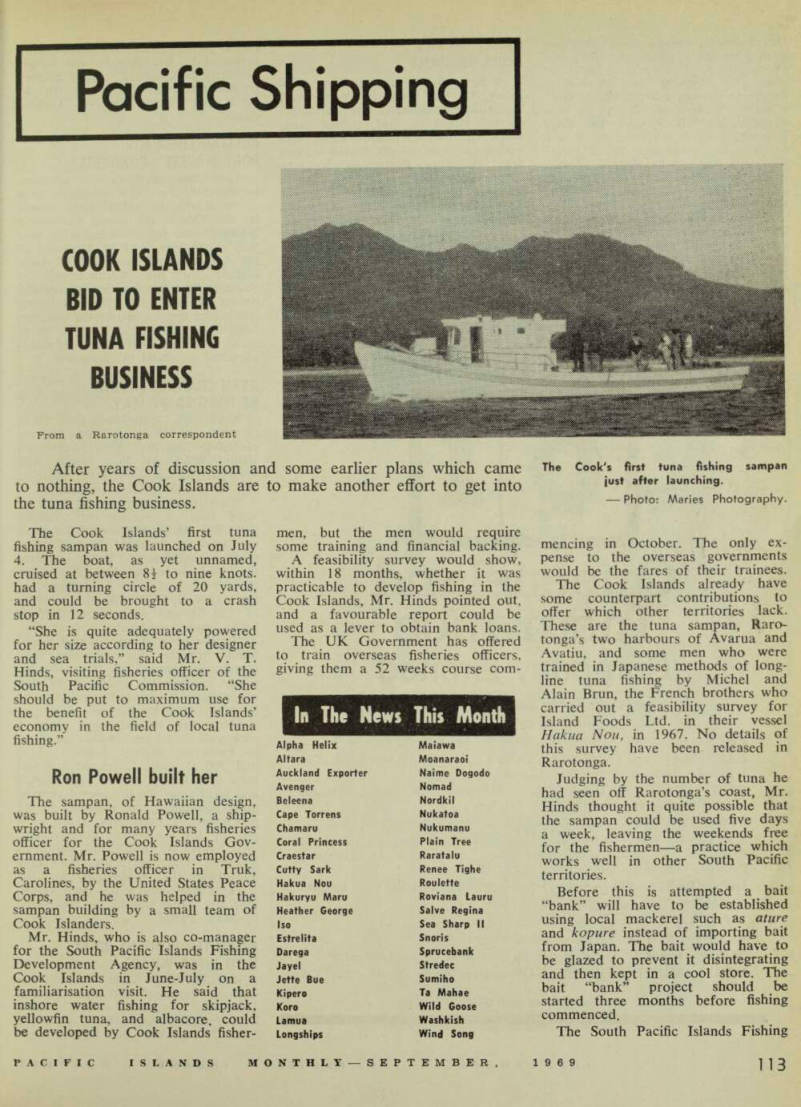
The Cook Islands’ first tuna fishing sampan was launched on July 4. The boat, as yet unnamed, cruised at between 8i to nine knots, had a turning circle of 20 yards, and could be brought to a crash stop in 12 seconds.
“She is quite adequately powered for her size according to her designer and sea trials,” said Mr. V, T.
Hinds, visiting fisheries officer of the South Pacific Commission. “She should be put to maximum use for the benefit of the Cook Islands’ economy in the field of local tuna fishing.”
Ron Powell built her
The sampan, of Hawaiian design, was built by Ronald Powell, a ship wright and for many years fisheries officer for the Cook Islands Gov ernment. Mr. Powell is now employed as a fisheries officer in Truk, Carolines, by the United States Peace Corps, and he was helped in the sampan building by a small team of Cook Islanders.
Mr. Hinds, who is also co-manager for the South Pacific Islands Fishing Development Agency, was in the Cook Islands in June-July on a familiarisation visit. He said that inshore water fishing for skipjack, yellowfin tuna, and albacore. could be developed by Cook Islands fisher
men, but the men would require some training and financial backing.
A feasibility survey would show, within 18 months, whether it was practicable to develop fishing in the Cook Islands, Mr. Hinds pointed out, and a favourable report could be used as a lever to obtain bank loans.
The UK Government has offered to train overseas fisheries officers, giving them a 52 weeks course com-
mencing in October. The only ex pense to the overseas governments would be the fares of their trainees.
The Cook Islands already have some counterpart contributions to offer which other territories lack.
These are the tuna sampan, Raro tonga’s two harbours of Avarua and Avatiu, and some men who were trained in Japanese methods of long line tuna fishing by Michel and Alain Brun, the French brothers who carried out a feasibility survey for Island Foods Ltd. in their vessel Hakua Non, in 1967. No details this survey have been released in Rarotonga.
Judging by the number of tuna he had seen off Rarotonga’s coast, Mr.
Hinds thought it quite possible that the sampan could be used five days a week, leaving the weekends free for the fishermen—a practice which works well in other South Pacific territories.
Before this is attempted a bait “bank” will have to be established using local mackerel such as ature and kopure instead of importing bait from Japan. The bait would have to be glazed to prevent it disintegrating and then kept in a cool store. The bait “bank” project should be started three months before fishing commenced.
The South Pacific Islands Fishing
The Cook's first tuna fishing sampan just after launching. -Photo: Maries Photography.
Development Agency is investigating a number of projects in other terntones, such as green turtle management and farming, and developing brown turtles for the tourist industry.
Edible oysters are cultivated near Sydney, Mr. Hinds said, but there is growing water pollution there and, as there is a minimum of water pollution in the South Pacific Islands, oyster cultivation could develop into an important new occupation allied with the tourist trade. there was a large Asian demand for and this trade could be built; also the pearl shell industry and the development of pearl shell lures for skipjack fishing.
Direct Service
rpnwi pcdmamv
• Germany
A new direct service from Ger many to the Western Pacific will begin in November. The privately owned Hamburg Sud, parent com pany of the Columbus Line, will operate a four to six weeks service from Hamburg, Rotterdam, northern Continental ports and London through Panama to Noumea, Port Moresbv Lae, Madang and Rabaul and return via Panama, To inaugurate the new service the 1,400-ton, 16-knot Heinrich Witt, fly ing the German flag, will arrive in Noumea about mid-November De
tailed freight schedules were being prepared in late August and would be “most competitive” said a Sydney representative of Colombus. Breck woldt and Co. will be New Guinea agents.
Russian Liner For
Port Moresby Congress?
Australian scientists are planning to charter the New Russian liner Shota Rostaveli, 20,000 tons, owned by the Odessa Steamship Co., as a floating hotel for participants at next year’s congress in Port Moresby of the Australia and New Zealand Asso ciation for the Advancement of Science. The Russian line offered the lowest charter rates of the shipping companies approached by the congress organisers. The liner would carry more than half of the 1,500 scientists expected to attend the congress.
Asau Channel Should
Be Finished By May
Work to complete the Asau channel in Western Samoa is ex pected to cost over $W5750,000 and should finish by May, 1970, said Western Samoan Finance Minister Mr. G. F. D. Betham in August.
“Early in the year tenders were in vited from a number of overseas firms for the completion of the work on the Asau channel,” he said. “The work, by Wilkins and Davies involves the dredging of a channel through the coral reef for a distance of approximately 2,600 ft with a width of 225 ft and a depth of 31.5 ft below mean sea-level.
“Following a survey, which neces sarily provides for a wider bell mouth opening at the entrance for safety reasons, an estimated 397,000 cubic yards of material requires to be removed from the sea bed.
“This will be deposited along a rock wall stretching towards the shore to form an airstrip 4,000 ft long and 300 ft wide. Estimated contract price is in the vicinity of $W5720,000 and local costs for the use of govern ment equipment and expenses in the processing of explosives, given as a gift by the Australian Government, are likely to cost an additional $50,000. The contractors have now assembled the equipment for the work at Asau, and it has been agreed that the work should be completed by May, 1970.”
Freighter Ploughs 20 Ft
Into Kieta Wharf
Bougainville’s Kieta Wharf was severely damaged and its adjoining copra shed crushed, when a Bank Line freighter Sprucebank ploughed over 20 ft into the wharf while
docking in late July. No one was injured.
The accident is doubly unfortunate because, in its first 18 months of operation the steel and concrete wharf and its facilities have been greatly over-taxed.
Most of the big local production of copra and cocoa goes through the wharf to Rabaul, New Britain, and the mining equipment and as sociated goods for the CRA copper project nearby have had to be handled.
Storing facilities for inward goods and many exports have simply not been there. Only one ship a time can berth at the 250 ft wharf and other waiting ships have had to stand off.
Businessmen have repeatedly com plained and asked for additional sheds to be constructed.
Small Ships Hit
Reef Hazard
Small ships have been making news in the Solomons. Three went aground on reefs, another casualty was strip ped of all her equipment, and Conzinc Riotinto’s “mini-aircraft carrier” was at anchor at Wagina, while mining men examined nearby bauxite deposits.
Gizo businessman Chan Cheong’s trader Roviana Lauru, grounded on Vatoro Reef, between Baga and Vella Lavella Islands and it was 10 days before another vessel, Salve Regina, floated her off with empty fuel drums.
Raratalu, a mission vessel, joined the Cape Torrens, aground on Alite Reef near Malaita. Another vessel, Lamua, went to Raratalu's aid and became grounded herself.
Lamua freed herself and yet another inter-island vessel. Coral Princess, arrived to free Raratalu and the three retired for repairs at nearby Auki, Malaita.
Cape Torrens, now no more than a rusting hulk, went aground on Alite Reef in May and last word was salvagers were awaiting her insurers to declare her a “write-off”.
Conzinc Riotinto’s helicopter-equip ped research vessel, Craestar, a familiar sight throughout Melanesia in recent years, went to Wagina for early evaluation work on bauxite deposits. After Wagina, plans were to work other local areas.
Bougainville Trading
Company Sells "Nukatoa"
Bougainville Trading Company, the New Guinea planters’ group operat ing shipping and trading operations
in the NG Islands, sold its 650-ton trader Nukatoa recently for an un disclosed sum to a new Port Moresby based company, Kinley Navigation Company.
The 20-year-old Australian E Class vessel, built at Maryborough, Queens land, by the Australian Government for the Australian National Line, has served Bougainville Trading in and around the NG Islands for about nine years.
With a long hold, hatches and a 550-ton general cargo capacity, she can carry short logs.
Kinley’s plans for her are un announced, but she could go on a “milk run” schedule out of Moresby to the NG Islands.
Bougainville Trading’s Nukatoa sale follows the sale last year of another company ship, Nordkil, of 450-tons, to a Noumea, New Cale donia, shipowner, Captain Manner, who now operates services around the Caledonian coast and to Wallis Island and Fiji with Nordkil and another ship, Darega.
Both Nordkil and Nukatoa’s sales were handled through ship-brokers, Captain W. L. Kennedy Pty. Ltd.
Bougainville Trading still has a sister vessel, Nukumanu, of 650-tons, working the NG Islands. Shipping connections in the area are much improved—and more competitive. As a result fewer traders than ever need their own vessels.
Moanaraoi Now Taking
Passengers To The Gilberts
Moanaraoi, the Gilbert and Ellice Islands’ hardy government-owned trader which has been showing its face in ports such as Suva, Majuro and Santo, as well as its regular copra-calls throughout the GEIC, is now offering passages for three “adventurers” out of Sydney.
Rates for the three berths—one first class and two second class— are, Sydney-Tarawa, $l5O (first class) and $75 (second class) one way. The trip usually takes 11-12 days with
no stops en route and next runs out 2 f , Syd " ey w i". be starting in late September and late December. tu i ... n ? rI ? al ™ n . to primitive S3S? 3 Thes e travellers, of course, would need time to spare and “sealegs”.
Moanaraoi is less than 1,000 tons.
The ship’s master is Captain Peter King and her Sydney agents are Kerr Brothers.
Amplex To Call At
Wilelo And Bakada
Amplex NG Line, which operates a three-weekly cargo service out of Sydney to Rabaul, Lae and Fulleborn (New Britain), in New Guinea, with its freighter Jette Bue, is including two further calls on New Britain.
The calls are at Wilelo and Bakada, on the island’s north coast, to service associated companies’’ timber operations and pick up sawn timber for NG and Australian markets.
Amplex, which belongs to Sydney jeweller and businessman, Mr. M. W.
Orr, and his family, owns the Golden Pine Sawmilling Co. Pty. Ltd. of Bulolo. Jette Bue picks up Golden Pine’s sawn timber at Lae.
At Lae, Amplex also has a half interest in Huon Shipping Line Pty.
Ltd., which runs two traders, Sumiho and Kipero, both of about 150 tons, around the Huon Gulf.
On New Britain, Amplex has three major timber leases of about 100,000 acres at Wilelo and Bakada, 30 miles apart, and at Fulleborn on the south coast where there is also a sawmill and cocoa plantation operated by Fulleborn Plantation Ltd. Amplex has a majority shareholding in Fulleborn, with some shares held locally, Amplex is also exporting logs to Japan and Japanese freighters have been calling for loads on a monthly schedule since May. All sawn timber is going to NG or Australia.