Smter? 1
pp. 53-57 · Read in the full issue
Centenary Of
'The Fiji Times'
A hundred years old, and once printed its own stamps
When George Hamilton Griffiths arrived on Levuka, Ovalau Island, 100 years ago this September to start the country’s first news paper, there was no form of government whatever in Fiji.
But Mr. Griffiths was a man of tested character and ability and within months his Fiji Times was playing an important part in the preservation of order on the island »9 va !^ U: £r- . , Mr. Griffiths was destined to give his newspaper 40 years’ service as owner and editor but those early days were tough. All the material for the production of the paper was imported in small and irregular sailing craft from England and New South Wales and hurricanes and probleras U he eS had' to comba*° ° f problems tie bad to combat.
He wasnt a man to mix his words arid, unhampered by the strict application of libel laws, he had this to say about the British Consul of 1870, Mr. March: ...
Whlte elephanr
“Eastern monarchs had a way of ruining their influential followers by presenting them with a ‘white elephant’, a royal animal which it was death to correct; an animal that had to be fed on the choicest the land could produce and was allowed to trample down crops and make a nuisance of himself as he pleased without remonstrance or hindrance. u u '. sending Mr. March as sentative have saddled their subiects in Fiji with a ‘white elephant’.” .. i Then the newspaper makes its posttion clear. We are quite aware that
in again making Mr. March the sub ject of an article, we are liable to be accused of alliteration, and would prefer leaving him alone in his glory, with his cloak of supercilious reserve about him, but it is impossible.
“Of all the people in Fiji we are the greatest sufferers by our Consul’s ungracious and over-bearing austerity.
"fWnlar nnn»"
k-OHSUiar Ogre
of , h|s consular ogre a * nd l^ en visd us dai *y in a hi 8 h slat « of excitement, goaded to madness by some acri monious brusquerie, and declaim withering invective against constituted authority in general and the British Consulate in particular, till our very ‘devils’ (boy printing workers) leave the press in affright.
“We are inundated with letters on the same subject so full of vitupera tion an d ornamental exasperation as to be unintelligible.”
Right from the start there was a steady demand for better mail services and it was not long before Mr, Griffiths found a way of speed *ng U P distribution of his paper. He set U P . his OWI ? P°st office a * Levuka and printed his own stamps at The Fiji Times. iT^ ey WCre s j mp^e a ff a i fS on plain w^lte P a P e r a type then known
Smter? 1
printers type. Mr. Griffiths also established an “express” mail de livery.
The service came into being on November 11, 1870, and a Fiji Times editorial said: “Letters need no longer remain in the consulate till they are yellow with age or devoured by rats.
“The Fiji Times Express will secure many of the advantages and com forts of the old country and the Colonies, where prompt delivery of letters and papers brings near the distant and keeps people in corn munication with other parts of the world “We shall no longer be put out side the walls of Creation, but in regular and frequent communication with the great centres of civilisation; we shall feel ourselves to be one w hh the great human family, no longer cut off and isolated, but with the Fi F Times Express we can keep U P 1 ? aa d constant communica tlon Wlth the most distant members of the great fami ly ”
Stamp Service
. e \ l J l Times stamps were in de nominations of Id, 3d, 6d, and 1/-, in Fiji there were agents of the Tiji Times Express at Rewa, Suva, Nadroga, Nadi, Kadavu, Vuna, Wairiki, Savusavu, Lomaloma, Bua, Dreketi, the Ra Coast and Ba River.
The service lasted until May, 1872, when the Cakobau Government, having s t arted its own postal service, stepped in and stopped this private intervention”. But the Fiji Times Express had serve d its purp ' ose> and
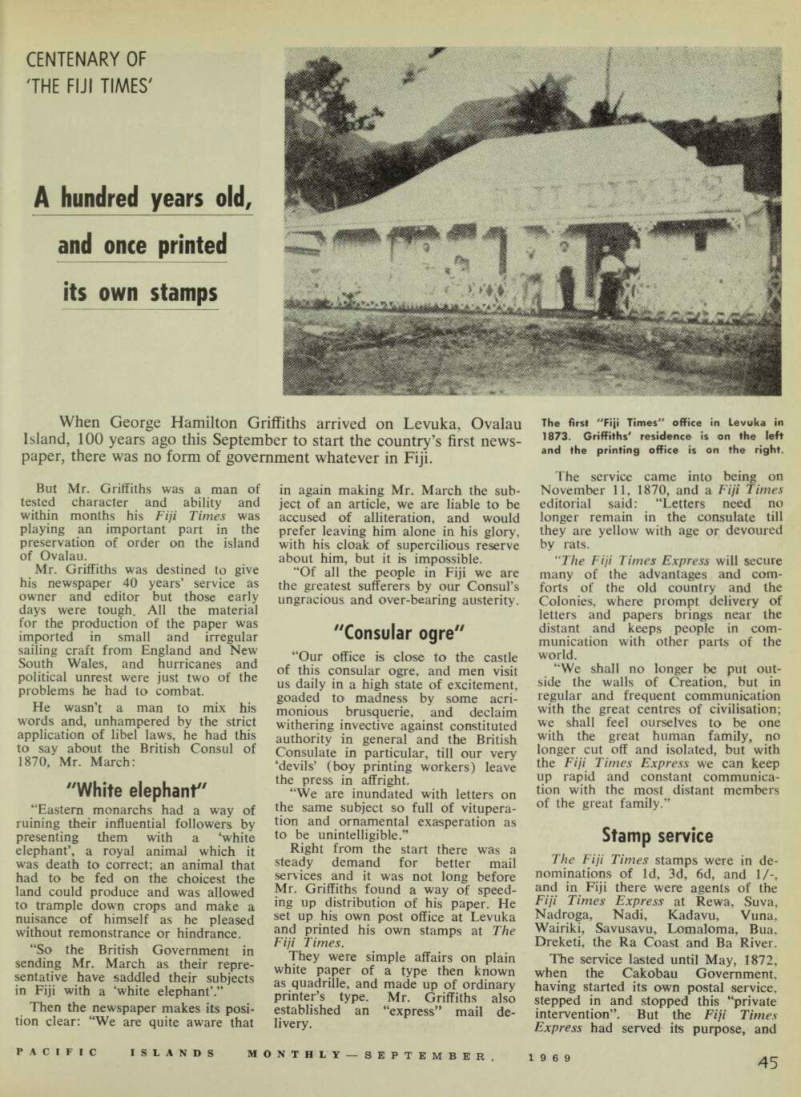
The first "Fiji Times" office in Levuka in 1873. Griffiths' residence is on the left and the printing office is on the right.
It shaped opinion
Derrick’s History of Fiji sums up the results: “Not only was the service appre ciated by the planters, but it also pro vided a means of distributing the newspaper to the men in the outlying islands; thus The Fiji Times was able to reflect and shape public opinion in all parts of the group, and it played an important part in the political turmoil of the following four years.”
The stamps were reprinted later, to meet a demand from collectors, but this issue was on a different paper, and the stamps were not used for actual postal purposes.
In 1887 The Fiji Times was trans ferred to Suva and continued un contested until 1901 when The Western Pacific Herald began.
During World War I, Mr. Griffiths died and from this point The Fiji Times met hard times culminating in a successful take-over by The Western Pacific Herald. It became The Fiji Times and Herald and Mr.
Alport Barker, founder of The Herald, remained director for more than 50 years.
In 1951, Mr. Barker was knighted for his service to the country and later he formed his own newspaper and printing company, The Fiji Times and Herald Ltd. In 1956 all the shares of the company were bought by Mr. R. W. Robson on behalf of his Sydney company, Pacific Pub lications Pty. Ltd.
Over some 30 years Mr. Robson had built up the Pacific Publications company to produce PIM and the Pacific Islands Year Book, both of which he founded and edited.
With a lifetime of experience behind him Mr. Robson took a long look at Fiji and came to three major decisions. He needed a modern plant to produce the new Fiji Times (having decided to go back to its original name), the editorial and reporting staff would have to be increased and to to take full advantage of the colony’s ever growing air services, he decided to publish in the morning instead of in the evening, as it hitherto had been published.
In its pioneering days The Fiji Times had to depend on the arrival of ships for news and the “latest intelligence” was often several weeks old. It was not until 1920 that the Pacific Cable Board established a cable station at Suva—and from then on if news was brief it was at least prompt.
The Fiji Times compensated for the brevity of its news by large head
lines. On January 4, 1914, this was a cable item:
The Bolshevist Danger
One Report
Activity Reduced
Melbourne, Thursday.
The Bolshevist danger has been some what reduced.
Another on January 9:
The Hohenzollerns
In Better Health
The Ex-Kaiser And His Wife
Melbourne, this day.
The ex-Kaiser and the ex-Kaiserina have recovered their health.
In 1918 the cable service was sup plemented by a radio link through Honolulu and on Monday, June 30, 1919, The Fiji Times contained the following proud paragraphs: “Our cablegram announcing the signing of the Peace Treaty by Germany was received by us from Paris, via Vancouver, at 3.45 o’clock yesterday morning.
“The actual signing, according to the official cablegram to his Ex cellency the Governor, was at 4 p.m. on Saturday, and, allowing for the difference in time between Paris and Suva, the cable conveying the news reached us within half an hour of the actual occurrence in France “At a few minutes after six o’clock yesterday, as soon as it was daylight, we issued an ‘extra’ notifying the event, which was distributed in town, whilst the outlying subscribers were notified by telephone.
“The official confirmation of the news, to his Excellency the Governor, arrived about midday several hours after our rush message.”
Local news gathering in the early days of The Fiji Times depended, as now, on staff reporters and part-time correspondents.
News by pigeon
From outside Levuka, news arrived by ship, either by letter or in the personal reports of passengers or the ship’s company.
When the capital moved to Suva, the need for speedy communication with the new port, and with govern ment headquarters, arose, and a pigeon service was established. It was an efficient service, too, with 22 minutes a normal time for a message to get from Suva to Levuka.
The shipping news in The Fiji Times in the latter days of Levuka publication carried the sub-heading: By Pigeon Post from Suva.
For The Fiji Times “pigeongram” service, lofts were fitted to the roofs of the Suva and Levuka offices.
Mr. C. W. Caldwell, assistant manager for James McEwan and Cos.,
(Contlnued <rti p. 49)
was a pigeon fancier, and in the latter years of the 19th century he regu larly flew his birds from Des Voeux Road house at Suva to Levuka and elsewhere in the group with press and other messages.
When telephone and telegram services developed, they helped in the gathering of news from the scattered islands of the colony.
In 1961, The Fiji Times established a branch office at Lautoka, and in June, 1962, the Suva and Lautoka offices were linked by teleprinter— the lines and equipment being hired from the post and telegraphs depart ment.
And to bring The Fiji Times in line with the most modern of the world’s newspapers a $100,000 web-offset printing installation was set up on March 3 this year.
It's Been Microfilmed
For Posterity
An interesting aspect of the cen tenary of The Fiji Times is that the files of the newspaper contain the history of the British Crown Colony of Fiji. The Deed of Cession, under which the country was handed over by the ruling chiefs of Fiji to Queen Victoria, was signed in 1874, five years after the newspaper was estab lished.
Fiji Times and Herald Ltd. has arranged to have the 100-years’ file of the newspaper microfilmed, and copies, together with a microfilm reader, are being presented for use by the University of the South Pacific, in Suva, the Suva Public Library, and similar institutions.
Also, as part of its celebrations, the company is establishing a scholar ship for the training of typographical technicians; making a bonus payment to its Fiji staff (now over 200); and entertaining leading Fiji residents at a formal dinner party on September 3, and at a cocktail party (estimated 600-700 guests) on September 4.
Members of the family of the late Mr. G. L. Griffiths (who edited the paper for over 40 years) and of the late Sir Alport Barker (in control for 38 years) will be among the guests.
Congratulations on its centenary have been received by The Fiji Times from leaders around the world, in cluding Queen Elizabeth, the King of Tonga, the Prime Ministers of Australia, New Zealand and Western Samoa.
A 60-page centenary supplement is being published on September 4, The Fiji Times' 100th birthday.