Unfinished Story Of The
pp. 47-174 · Read in the full issue
Bougainville Affair
From a Port Moresby correspondent
What has now become the Bougainville land affair had quietened down at the end of August after being launched at the be ginning of the month in a blaze of Australian newspaper headlines.
Two-inch type shouting “Australia’s Shame” and “Bloody Thugs”, stirred the letter writers and the politicians.
The debate in both chambers of the Australian Parliament on the Bougainville affair, forced by the Labour Opposition, offered very little constructive advice. The Bougain ville matter is complicated. It has developed over some years of admin istrative mismanagement. It can’t be explained in newspaper headlines.
The trouble surrounds efforts of Bougainville Copper Pty. Ltd., operat ing company for the giant Conzinc Riotinto of Australia Ltd., to set up a huge copper development on Bougainville which will give the P-NG Administration between SA2OO m. and S3OO m. in the first 10 years of operation, and an export income in excess of $lOO m. a year. The Ad ministration also has the option of a 20 per cent, equity in the project.
For several years the Administra tion has been acquiring land around the Panguna area in the mountains about 16 miles from Kieta, to go ahead with the project. The people weren’t very co-operative. With some outside advice, they demanded a share in any royalties in the copper.
The government said they could have no royalties—merely an occupa tion fee—because to give royalties in such circumstances wasn’t Aus tralia’s way of doing things.
Resentful
The local people were already re sentful of the way the government had approached them over the land and finally their resentment over the proposed mine site was so strong that the Administration had to re verse its decision not to give royalties to the landowners.
This was a victory which made the government more enemies—for it had, in fact, been proved wrong.
But things in the Panguna area are now going better for everyone. The trouble that won the headlines in August started in the Kieta area, the result of a sudden announcement in March by the Administration that it would acquire the rich European owned Arawa plantation and some nearby native land for a town and port site for the copper project in the mountains, Mr. F, R. McKillop, who owns Arawa 50/50 with Mr. F. J. Salisbury, through their respective companies, Bovo Pty. Ltd. and F. J. Salisbury Pty. Ltd., fought back against the resumption with a team of legal ad
(Continued on p. 164)
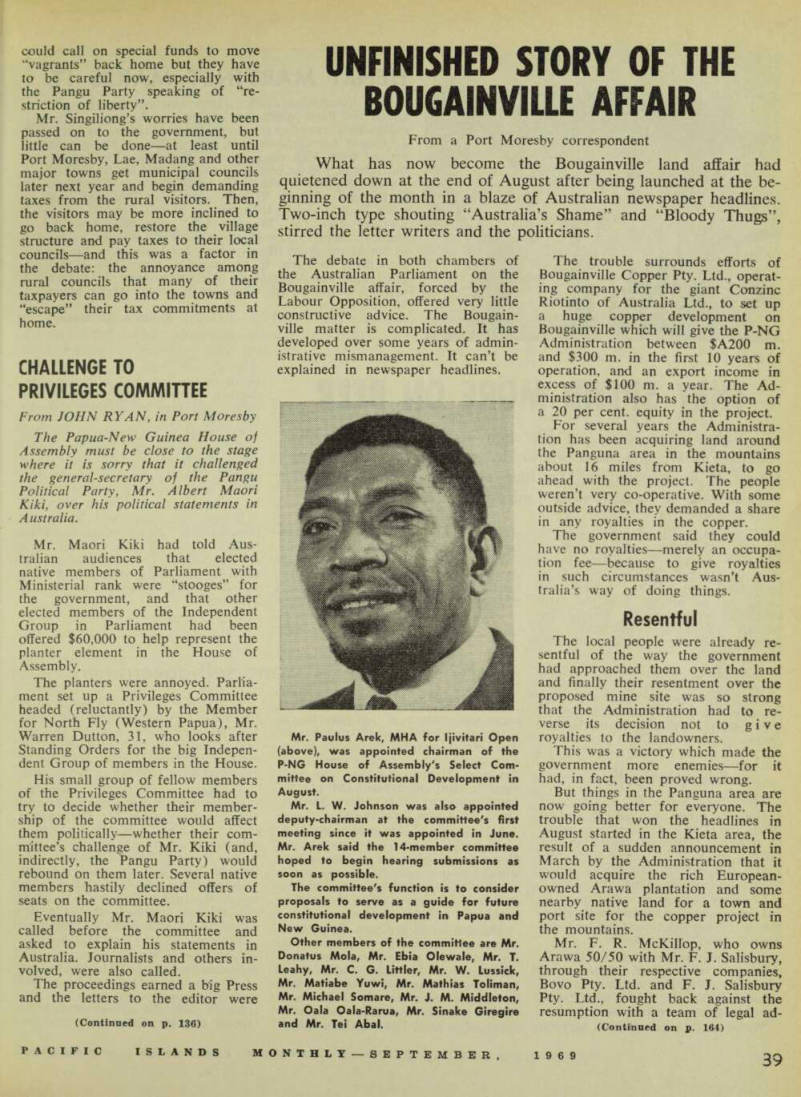
Mr. Paulus Arek, MHA for Ijivitari Open (above), was appointed chairman of the P-NG House of Assembly's Select Com mittee on Constitutional Development in August.
Mr. L. W. Johnson was also appointed deputy-chairman at the committee's first meeting since it was appointed in June.
Mr. Arek said the 14-member committee hoped to begin hearing submissions as soon as possible.
The committee's function is to consider proposals to serve as a guide for future constitutional development in Papua and New Guinea.
Other members of the committee are Mr.
Donatus Mola, Mr. Ebia Olewale, Mr. T.
Leahy, Mr. C. G. Littler, Mr. W. Lussick, Mr. Matiabe Yuwi, Mr, Mathias Toliman, Mr. Michael Somare, Mr. J. M. Middleton, Mr. Oala Oala-Rarua, Mr. Sinake Giregire and Mr. Tei Abal.
visers. Mr. McKillop, who has per sonally built the plantation to be one of the territory’s best in the 17 years of the partnership, didn’t want it to go at any price.
But he and his partner lost. In late August, under threat of resump tion, the Administration bought the plantation, which is to cease to operate from September 1.
In the meantime with no lawyers to dispute the issue, a lease was issued by the Administration to
Bougainville Copper Pty. Ltd. over 175 acres of nearby native land at Rorovana. The Rorovanans fought back their own way.
On August 1, the day after the lease was granted, surveyors moved in to mark the boundary of the land, and local women took away a con crete survey peg in protest. On August 5, a bulldozer clearing scrub for the survey team was confronted by a group of about 65 local men and women—who in turn found them selves confronting 70 police especially brought in.
In the words of the Minister for Territories, Mr. C. E. Barnes, address ing Federal Parliament on August 12: “The officer in charge warned the
people to disperse on at least two occasions. He then ordered a group of 15 police carrying shields and batons to move in front of the bull dozer, and attempt to push the crowd away with their shields.
“There was a general melee and at this point the officer in charge decided to attempt to disperse the crowd with teargas. The teargas used is non-toxic. It was only partially effective. After further warnings police were ordered to use their batons about the legs of the natives and after a very short time the crowd dispersed. There were no injuries other than one man who appeared to have grazed his leg falling over a log. No one was injured by the police. Minimum force was used.”
This was the incident which sparked the “Bloody Thugs” headlines. The stories below the headlines failed to point out that as Australia believes in the rule of law, there could hardly be any shame on the police for at tempting to uphold the law. Political and administrative mismanagement which brought the situation about was not police responsibility.
The Kieta episode, like the Pan guna one in its early stages, was mismanaged because the Administra tion failed to tell the landholders what they were about. They merely announced they were acquiring land.
The explosion from both McKillup and Rorovana—came after the Ad ministration’s unexpected announce ment had angered them. If there had earlier been less of the kiap at titude and more dialogue, the con frontation with the police would not have happened.
At month’s end, even the Admin istration realised the problems they had helped create can only be solved through careful discussion, and all parties were then in discussion.
Footnote : Arawa’s owners will get 5A400.000 initially in the sale, plus $200,000 to be put into trust against further payments, to be estimated on the mean price of copra and cocoa over the next five years. If prices rise the partners will get increased pay ments.
Since average cocoa prices have been high in the past 10 months, and there is a cocoa shortage, total pay ments on the plantation assets and potential should top at least $1 mil lion. In addition, there is a separate agreement involving Mr. McKillop’s tropical research work and collection of more than 100,000 orchids, only per cent of which Mr. McKillop feels he will be able to move. This will be put to arbitration.