volleyball
p. 40 · Read in the full issue
French take over in volleyball
Volleyball, another ball team sport in which the French dominated, was a rough and tumble affair. Construction of the two asphalt outdoor courts ended only hours before play was to start and coaches from several teams protested that the courts should have been further apart, indoors and built with timber floors to avoid injuries when players dived low.
Their protests were all too late, so the organisers declared the courts not of international standard and staged the matches anyway.
Builders hastily built an inadequate windguard around one court but the strong winds continually upset moves and the proximity of the courts fre quently led to confusion over whistle decisions by referees feet away while two separate games were in progress.
Standards, then, weren’t as high as hoped but vigorous play by both women and men always attracted a great crowd to the Teachers’ College site.
The male Wallis and Futuna team came from behind with great fighting back teamwork to provide more than its share of upsets and took second place behind the French. The New Caledonians were extremely strong and were the best trained, although they didn’t have much fighting spirit.
The French Polynesians, initially a trifle nervous, were always well in the hunt.
The smaller Guam team, great battlers, was overwhelmed by the taller and more constructive French; Western Samoa was slow.
New Guinea, with little practice behind it and less knowledge of the rules, was thoroughly trumped, but the experience won’t hurt.
Women’s volleyball attracted many onlookers, including many “bird watching” New Guineaites, and again the three French territories—Wallis and Futuna, New Caledonia and French Polynesia—were in a class of their own. Year-round training, game procedure and teamwork paid off.
The small Guam girls were great triers and would have dearly pre ferred some indoor games, where they would have fared better. Gusty winds hurt them and they rarely got a run in the court with the wind break.
With the ball extremely light and susceptible to tiny pockets of wind, volleyball is essentially an indoor sport. When it becomes one—at Tahiti in 1972 —the Guam girls should have a better chance. • Port Moresby is wondering how it will continue to utilise the main Games arena now that the Games are over. It was built for the Games and will need to be kept in top condition if it is to be used for major attrac tions. Regular sport in Port Moresby doesn’t need the ground.
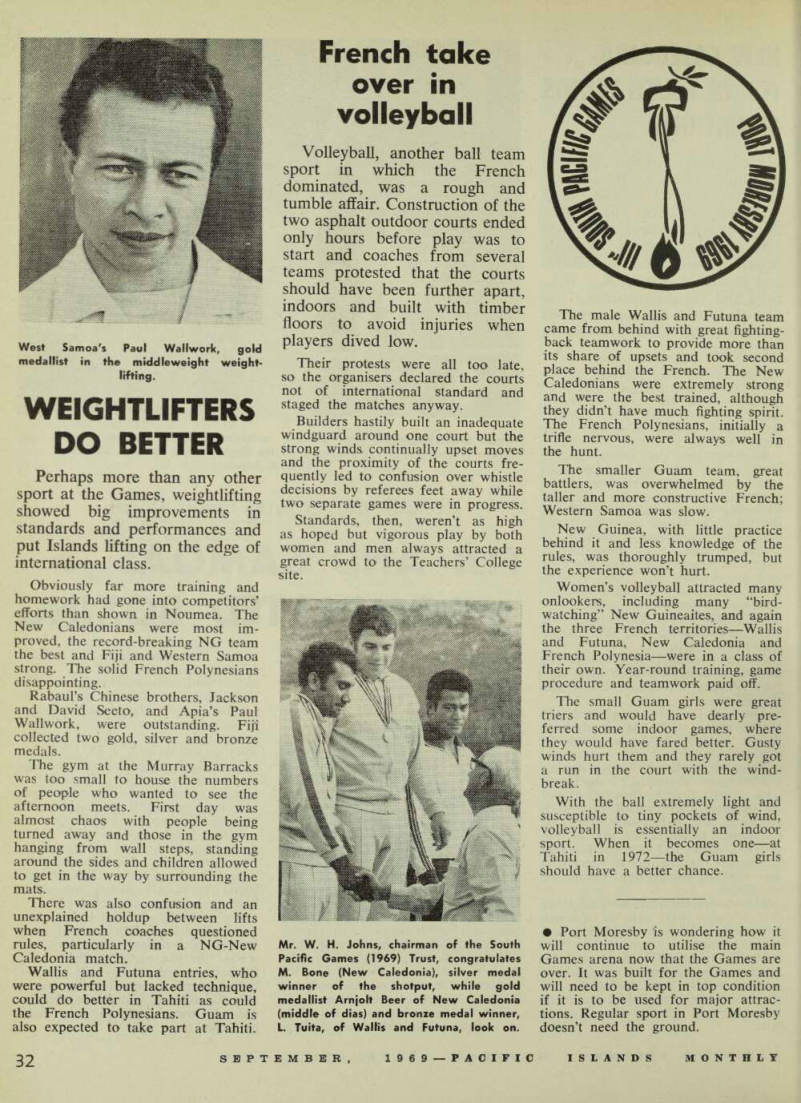
Mr. W. H. Johns, chairman of the South Pacific Games (1969) Trust, congratulates M. Bone (New Caledonia), silver medal winner of the shotput, while gold medallist Arnjolt Beer of New Caledonia (middle of dias) and bronze medal winner, L. Tuita, of Wallis and Futuna, look on.