Tonga's and P-NG's young
pp. 36-37 · Read in the full issue
athletes strike gold
On a slow new track battling strong winds, athletes from P-NG and Tonga were the most improved of the Games. They notched six gold medals each and NG runners collected several silver and bronze medals as well.
If the young “finds” of these two territories (and not forgetting the depth in sprinters shown by the New Hebrides) can maintain training programs and get regular competi tion, athletics records in Tahiti will go in many events.
Long, hard hours of training paid dividends for the New Guineans and
Tongans, most important of all, they showed that Islanders can make the grade, provided coaches can give them the clues and arrange regular local meets where competition in evitably helps.
As expected. New Caledonia, with its strength in non-running events, and Fiji, with its best in men’s middle and long-distance running, took most of the athletics golds.
New Caledonia won all medals in the men’s hammer throw, gold and silver medals in the men’s discus and shot put, the men’s triple jump and pole vault golds and a silver in the javelin. It was more surprised than any one else when it also collected the marathon gold with an epic run by 32-year-old Noumean Auguste Goe.
Goe had before the race said he was running merely for some champagne friends had promised him should he be able to finish the 26 miles. The big French Press Corps on hand took note and didn’t even join the motorcade of cars following the run around the outskirts of Moresby.
Bad tactics
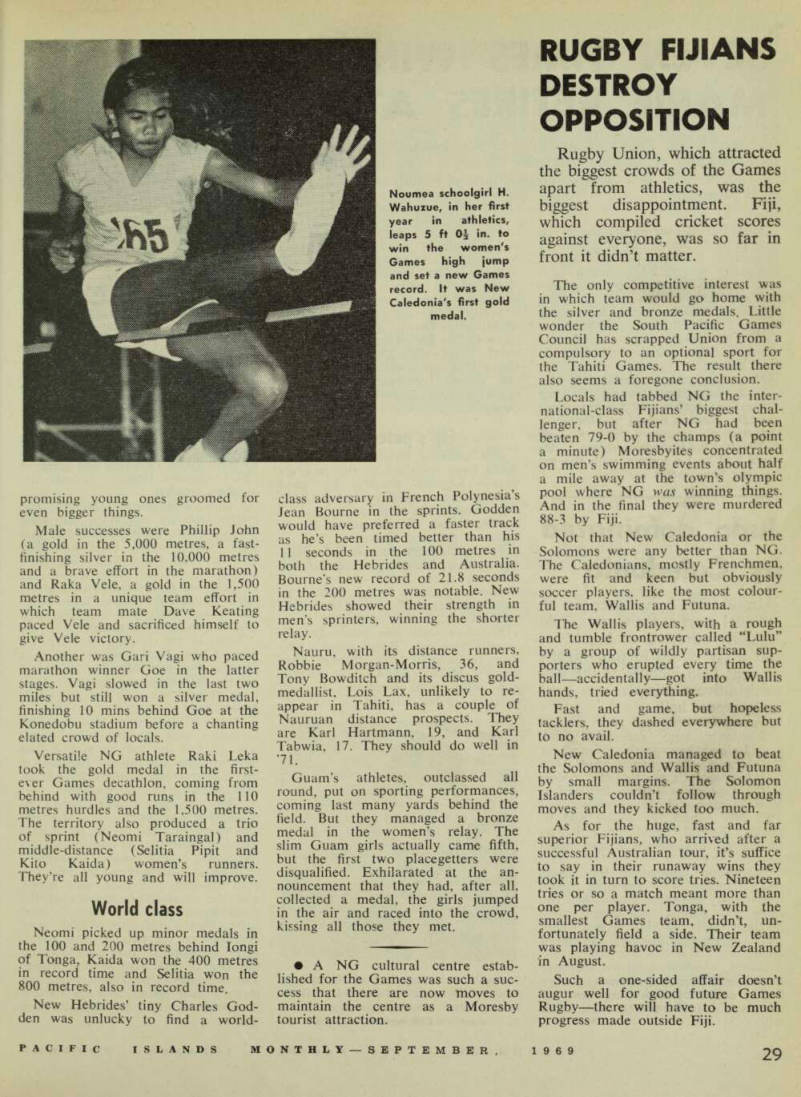
In women’s events, Caledonia couldn't manage a medal in running, but it won golds in the high jump, javelin and shot put. Noumean 14year-old schoolgirl Henriette Wahu zue’s new Games record of 5 ft 0i in. in the high jump was the ter ritory’s first Games gold medal.
For Fiji, runners S. Tamani (400 metres and 800 metres) and Nsaia Sotutu (3,000 metres steeplechase and 10,000 metres) took four men’s gold medals.
Bad tactics cost tiny Sotutu further golds in the 5,000 metres and the marathon. A marathon hopeful, he pulled out at 19 miles with badly blistered feet. He had led the widely spaced field with a fast pace to the 18-mile mark. Fijians said he lost because he discarded his shoes; others said he burnt himself out too early.
But it was Tonga which produced
the two athletics stars. They were 22-year-old Nukualofa student, Keta longi, and top Islands hurdler, P.
Tuipulotu. Keta won the women’s 100 and 200 metre sprints, the 80 metres hurdles and a Games “first”,
the pentathlon. Tuipulotu jumped
unextended to win the men’s 110 and 400 metres hurdles.
Modest and attractive, Keta had mostly trained herself at Nukualofa’s Rugby ground for three months be fore the Games. Her wins came despite several adversities—meagre facilities and no competition back home, strong winds and a spiked leg in Moresby.
It’s now essential that Tonga’s one woman competitor at the Games generates some real interest in athletics in Tonga.
Tuipulotu won the shorter hurdles in Noumea but hadn’t entered the final of the 400 there because it was run on a Sunday—Tongans, owing to strong religious belief won’t compete on Sundays.
In Moresby there were no Sunday troubles, so he made no mistakes about either race, recording a new best of 14.9 seconds for the 110 metres.
Games home team, NG, made some big strides forward in running both for men and women. Hopes are the good work of coach John Cheffers who is, unfortunately leaving, can be kept up and the
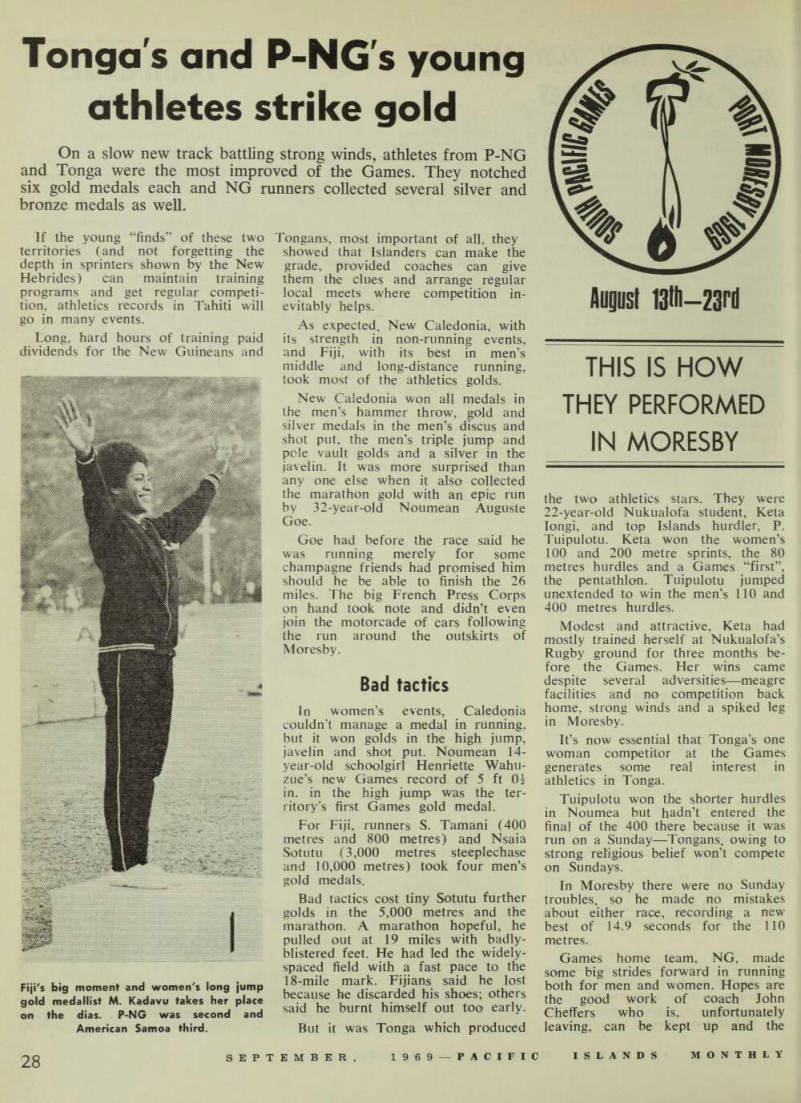
Fiji's big moment and women's long jump gold medallist M. Kadavu takes her place on the dias. P-NG was second and American Samoa third.
promising young ones groomed for even bigger things.
Male successes were Phillip John (a gold in the 5,000 metres, a fast finishing silver in the 10,000 metres and a brave effort in the marathon) and Raka Vele, a gold in the 1,500 metres in a unique team effort in which team mate Dave Keating paced Vele and sacrificed himself to give Vele victory.
Another was Gari Vagi who paced marathon winner Goe in the latter stages. Vagi slowed in the last two miles but still won a silver medal, finishing 10 mins behind Goe at the Konedobu stadium before a chanting elated crowd of locals.
Versatile NG athlete Raki Leka took the gold medal in the first ever Games decathlon, coming from behind with good runs in the 110 metres hurdles and the 1,500 metres.
The territory also produced a trio of sprint (Neomi Taraingal) and middle-distance (Selitia Pipit and Kito Kaida) women’s runners.
They’re all young and will improve.
World class
Neomi picked up minor medals in the 100 and 200 metres behind longi of Tonga, Kaida won the 400 metres in record time and Selitia won the 800 metres, also in record time.
New Hebrides’ tiny Charles God den was unlucky to find a world
class adversary in French Polynesia’s Jean Bourne in the sprints. Godden would have preferred a faster track as he’s been timed better than his 11 seconds in the 100 metres in both the Hebrides and Australia.
Bourne's new record of 21.8 seconds in the 200 metres was notable. New Hebrides showed their strength in men’s sprinters, winning the shorter relay.
Nauru, with its distance runners, Robbie Morgan-Morris, 36, and Tony Bowditch and its discus gold medallist, Lois Lax, unlikely to re appear in Tahiti, has a couple of Nauruan distance prospects. They are Karl Hartmann, 19, and Karl Tabwia, 17. They should do well in ’7l.
Guam’s athletes, outclassed all round, put on sporting performances, coming last many yards behind the field. But they managed a bronze medal in the women’s relay. The slim Guam girls actually came fifth, but the first two placegetters were disqualified. Exhilarated at the an nouncement that they had, after all, collected a medal, the girls jumped in the air and raced into the crowd, kissing all those they met. • A NG cultural centre estab lished for the Games was such a suc cess that there are now moves to maintain the centre as a Moresby tourist attraction.
Noumea schoolgirl H.
Wahuzue, in her first year in athletics,
leaps 5 ft 0½ in. to
win the women's Games high jump and set a new Games record. It was New Caledonia's first gold medal.