Tropicalities
pp. 4-7 · Read in the full issue

They're All
After Tongan
Treasure
Negotiations should be finalised in the near future to allow prospecting for oil (black gold) to begin on Tonga. But now Tongans are startled into thoughts of real gold. The story of an alleged multi-million treasure trove of gold and silver at the bottom of the sea in Tongan waters was splashed across the headlines of papers in NZ, Australia and Fiji in August.
THREE New Zealanders, who estab lished a big game fishing enter prise in Nukualofa last year, heard about the wreck of the English priva teer Port au Prince and began to investigate.
After plundering galleons and town in Spanish South America, the 500-ton privateer arrived in Ha’apai for repairs in 1806. Here Finau, the Paramount Chief, who had recently overthrown the Northern Group, Vavau, saw the chance to conquer the remaining Southern Group, Ton gatapu, with the help of cannon and guns off the privateer.
He lulled the sailors with overtures of friendship and though his plans misfired, he managed to capture the ship and slaughter most of the crew.
After the vessel had been stripped of cannon and other loot she was broken up and set on fire.
Finau later adopted one of the survivors, young Will Mariner, who years later returned to London and produced the now famous and valu able book Mariner's Tonga, in which the whole incident is recounted.
"Bullion galore"
The New Zealanders reported last November they searched the area in a glass bottomed boat and found the wreck off shore of the island of Ha’ano in February this year. This is contested by Tongan Chronicle editor, Jack Riechelmann, who in 1965 with an editor of National Geographic, Luis Marden, dived at the Ha’ano wreck but found no sign of treasure.
Because of the brass fastenings of this wreck, Luis Marden said the ship must have been built in the middle 1800’s.
But the New Zealanders claim to have found at least 10, possibly 30 tons of bullion, coins and priceless artifacts which, they allege, is in a strong box the size of a room and in two smaller chests of steel or iron.
Leader of the party, Mr. C. Prast, has claimed that he photographed this
fantastic find, lifted it from the wreck and hid it elsewhere on the seabed pending negotiations with the Tongan Government for a share in the booty.
Tonga is sceptical of the whole story. Her fishermen and divers in the area said these activities could not have been carried out without their knowledge and are emphatic that there is no truth in the allega tions. A Tongan representative of the big game fishing venture said: “It is all bluff.”
When newsmen approached Prince Tu’ipelehake on his arrival in Auck land, Tonga’s Premier discounted it as a “fish story” and added, “I would like to see this treasure with my own eyes to really believe it, and if there is treasure, what belongs to Tonga, belongs to Tonga.” This has since been substantiated by one of Auck land’s Q.C.’s.
The Deputy Premier said in Nuku alofa a few days later that certain persons who had been granted entry permits into Tonga were subsequently reported to be carrying out unauthor ised activities and their permits were revoked by government.
He added that the government had been aware for some time of the pos sibility of existing treasure in Tongan waters, and on the islands within the group and has, as far back as 1965, been looking into the possibility of conducting an organised search.
In mid-August a diving team under Riechelmann began an official under water search of the Ha’ano area, so the Tongan Government was obviously taking no chances.
The issue was further complicated at the end of August when two Tongan divers claimed to police they had gone down with the New
Zealanders and helped recover strong boxes in the wreck containing gold bars.
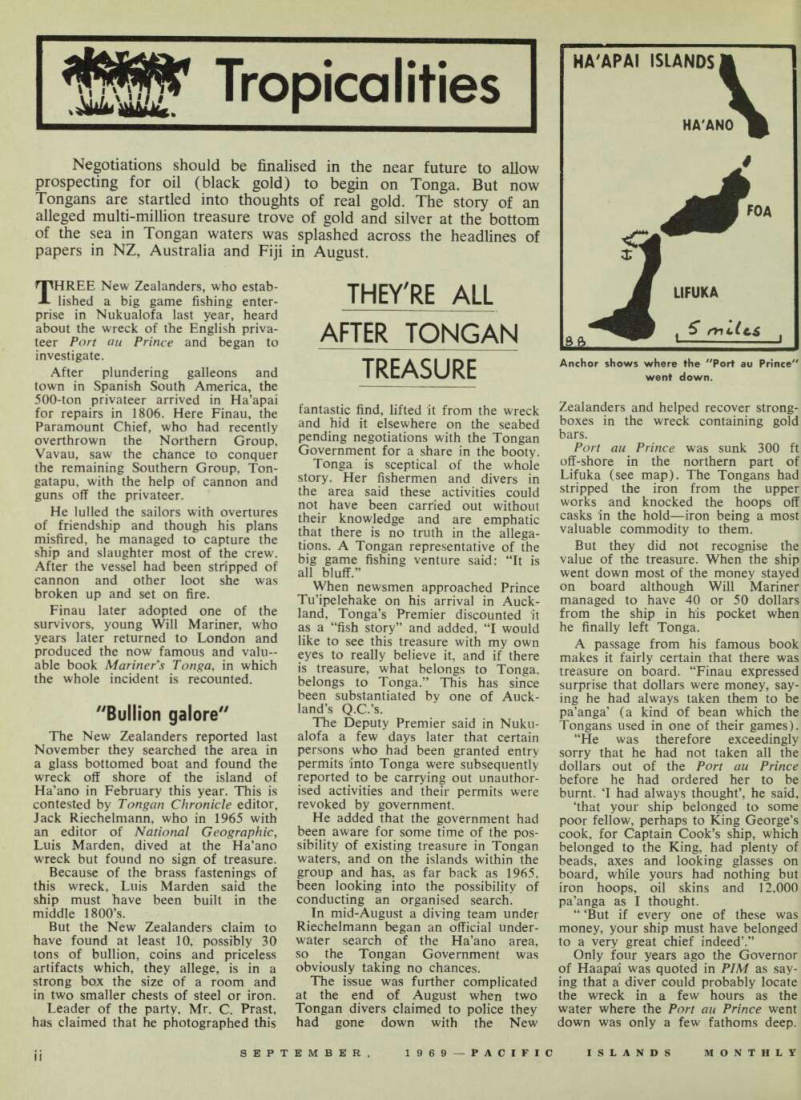
Port au Prince was sunk 300 ft off-shore in the northern part of Lifuka (see map). The Tongans had stripped the iron from the upper works and knocked the hoops off casks in the hold—iron being a most valuable commodity to them.
But they did not recognise the value of the treasure. When the ship went down most of the money stayed on board although Will Mariner managed to have 40 or 50 dollars from the ship in his pocket when he finally left Tonga.
A passage from his famous book makes it fairly certain that there was treasure on board. “Finau expressed surprise that dollars were money, say ing he had always taken them to be pa’anga’ (a kind of bean which the Tongans used in one of their games).
“He was therefore exceedingly sorry that he had not taken all the dollars out of the Port au Prince before he had ordered her to be burnt. ‘I had always thought’, he said, ‘that your ship belonged to some poor fellow, perhaps to King George’s cook, for Captain Cook’s ship, which belonged to the King, had plenty of beads, axes and looking glasses on board, while yours had nothing but iron hoops, oil skins and 12,000 pa’anga as I thought.
“ ‘But if every one of these was money, your ship must have belonged to a very great chief indeed’.”
Only four years ago the Governor of Haapa'i was quoted in PIM as say ing that a diver could probably locate the wreck in a few hours as the water where the Port au Prince went down was only a few fathoms deep.
Anchor shows where the "Port au Prince" went down.
Hard row to hoe for
W. Samoa's
volunteers
The first lot of Peace Corps volunteers to complete their two-year terms in Western Samoa left for home in August. A few, particularly in the Public Works Department, signed on for up to a year or more but most seemed relieved that their stint was over.
Two more batches of volunteers, mainly for education, are arriving in October and January to keep the total of Peace Corps personnel in Samoa at around 100—down from a peak of 160.
Obviously, 100 young highly moti vated volunteers must achieve some thing in two years but to try and pinpoint tangible gains, apart from hundreds of water-sealed toilets around Upolu and Savaii, is very difficult reports R. F. Rankin from Apia.
Initial enthusiasm for the scheme has worn off mainly for two reasons —Samoa’s greatest need in overseas personnel is for experts and most of these volunteers just out of college are far from that.
Secondly, by being forced to live at the village level of income (SWSSO per month) the volunteers have had to watch every penny. This has in evitably led to a reputation of being stingy, and in Samoa there is no crime much lower than stinginess.
Many of the volunteers have worked hard and quietly under con ditions of a monotonous diet and isolation that would test the highest motives. Others who would have liked to work hard have been thwarted by vagueness in the gov ernment programmes they were sup posed to be working under.
The experience of the first two years of the programme in Samoa will no doubt increase the effective ness over the next two years but un til the country can get volunteers who are expert in their various fields, the whole scheme will remain noth ing much more than an experiment in human relationships.
And there is some suspicion in Samoa, however unjustified it may be, that in this two-way process the volunteers are getting the best of the bargain.
Rotui, the man,
conquers his 'peak'
When Mr. and Mrs. Medford Kellum, an American couple, settled on the island of Moorea in 1924, they built their home (prefabricated in California) at the foot of Mt. Rotui,
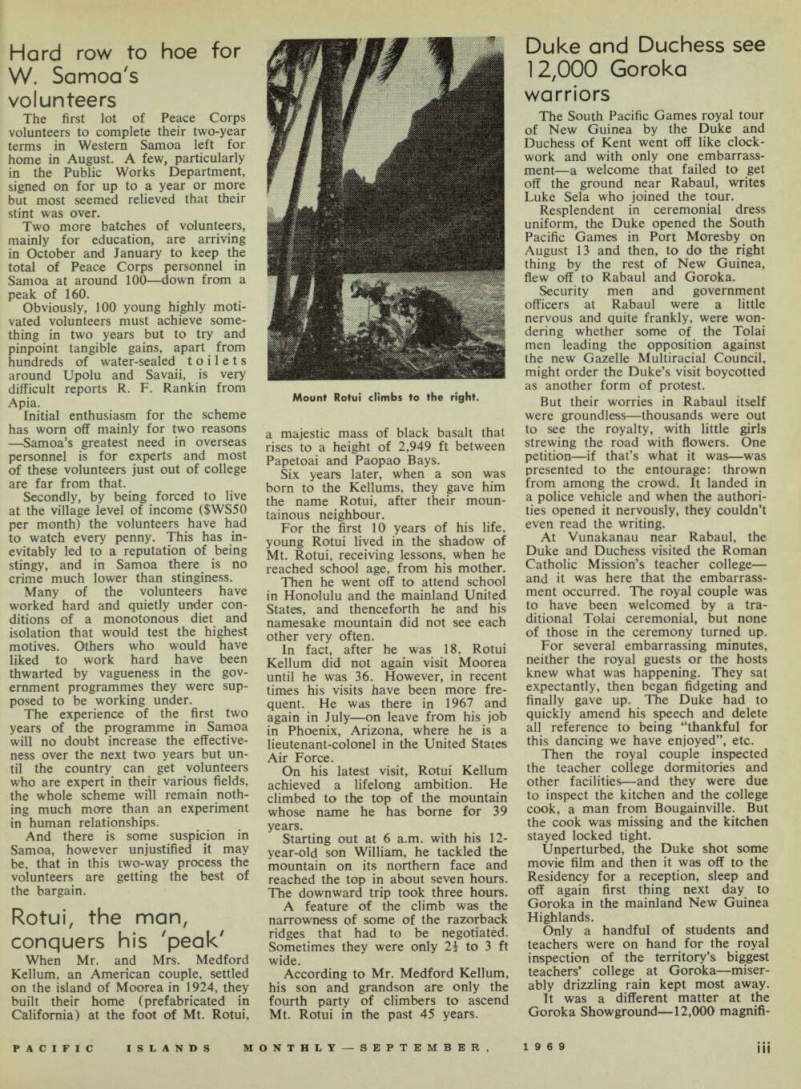
a majestic mass of black basalt that rises to a height of 2,949 ft between Papetoai and Paopao Bays.
Six years later, when a son was born to the Kellums, they gave him the name Rotui, after their moun tainous neighbour.
For the first 10 years of his life, young Rotui lived in the shadow of Mt. Rotui, receiving lessons, when he reached school age, from his mother.
Then he went off to attend school in Honolulu and the mainland United States, and thenceforth he and his namesake mountain did not see each other very often.
In fact, after he was 18, Rotui Kellum did not again visit Moorea until he was 36. However, in recent times his visits have been more fre quent. He was there in 1967 and again in July—on leave from his job in Phoenix, Arizona, where he is a lieutenant-colonel in the United States Air Force.
On his latest visit, Rotui Kellum achieved a lifelong ambition. He climbed to the top of the mountain whose name he has borne for 39 years.
Starting out at 6 a.m. with his 12year-old son William, he tackled the mountain on its northern face and reached the top in about seven hours.
The downward trip took three hours.
A feature of the climb was the narrowness of some of the razorback ridges that had to be negotiated.
Sometimes they were only 2i to 3 ft wide.
According to Mr. Medford Kellum, his son and grandson are only the fourth party of climbers to ascend Mt. Rotui in the past 45 years.
Duke and Duchess see
12,000 Goroka
warriors
The South Pacific Games royal tour of New Guinea by the Duke and Duchess of Kent went off like clock work and with only one embarrass ment—a welcome that failed to get off the ground near Rabaul, writes Luke Sela who joined the tour.
Resplendent in ceremonial dress uniform, the Duke opened the South Pacific Games in Port Moresby on August 13 and then, to do the right thing by the rest of New Guinea, flew off to Rabaul and Goroka.
Security men and government officers at Rabaul were a little nervous and quite frankly, were won dering whether some of the Tolai men leading the opposition against the new Gazelle Multiracial Council, might order the Duke’s visit boycotted as another form of protest.
But their worries in Rabaul itself were groundless—thousands were out to see the royalty, with little girls strewing the road with flowers. One petition—if that’s what it was—was presented to the entourage: thrown from among the crowd. It landed in a police vehicle and when the authori ties opened it nervously, they couldn’t even read the writing.
At Vunakanau near Rabaul, the Duke and Duchess visited the Roman Catholic Mission’s teacher college— and it was here that the embarrass ment occurred. The royal couple was to have been welcomed by a tra ditional Tolai ceremonial, but none of those in the ceremony turned up.
For several embarrassing minutes, neither the royal guests or the hosts knew what was happening. They sat expectantly, then began fidgeting and finally gave up. The Duke had to quickly amend his speech and delete all reference to being “thankful for this dancing we have enjoyed”, etc.
Then the royal couple inspected the teacher college dormitories and other facilities—and they were due to inspect the kitchen and the college cook, a man from Bougainville. But the cook was missing and the kitchen stayed locked tight.
Unperturbed, the Duke shot some movie film and then it was off to the Residency for a reception, sleep and off again first thing next day to Goroka in the mainland New Guinea Highlands.
Only a handful of students and teachers were on hand for the royal inspection of the territory’s biggest teachers’ college at Goroka —miserably drizzling rain kept most away.
It was a different matter at the Goroka Showground—l2,ooo magnifi
Mount Rotui climbs to the right.
cently feathered and painted warriors and their women came to see the im portant couple from faraway Britain, the Duke this time in mufti —blue suit and tan shoes.
A convoy of government vehicles brought the dancers in from far afield. More than 500 sang and danced for the royal couple, making the Highlands a memorable spectacle indeed.
To take home, a bow and a hand ful of arrows were given to the Duke; and for the petite Duchess, a woven mat. From the moment the dancing began, formality went by the wayside —the Duke and Duchess wandered among the people, giving the security men a new headache.
The Duke has had several trips to Africa and has seen some very fine tribal dancing, but the African danc ing must have been exceptional if it was better than that at Goroka. It was a grand finale to a short, but colourful tour —with some interesting sidelights.
Polynesian Airlines
in trouble again
Polynesian Airlines was in trouble again in mid-August with its ill starred DC4. A Mr. Paul D. Martin representing the Charlotte Aircraft Corporation of North Carolina, from whom Polynesian is leasing the plane, chained the wheels and removed some parts not long after the plane landed at Tafuna airport, in Ame rican Samoa, on a flight from Faleolo.
The Charlotte Aircraft Corpora tion has filed repossession papers for the plane, claiming that Poly nesian has not paid its rent.
Polynesian on the other hand claims that work on the plane prior to taking it over had not been done
according to the contract and has filed suit against the corporation.
They say the rent has been paid into a trust fund pending the outcome of the litigation—a fact which has been denied by Charlotte in a full page advertisement in The Samoa Times.
Polynesian’s case was scheduled to be heard in Los Angeles in late August. It was agreed after the chaining episode that until the case is heard the plane was to remain untouched by either party at Tafuna.
The chaining incident sparked off a strong protesting cable from the Government of Western Samoa (now a small shareholder in Polynesian) to the newly-arrived Governor
Haydon of American Samoa, but this brought forth only a promise from Haydon that he would make sure the issue would be expedited if criminal charges were involved.
To the West Samoan public, fed up to the teeth with the unreliable service of Polynesian, its delays and antiquated aircraft, and resentful at the government turning down last year an offer of a twice daily service between American and Western Samoa in modern aircraft by Pan American World Airways, the incident was just another in the long series of misadventures they have come to expect in the country’s air services.
His land is more
mini than maxi
Our story in August about “Mini plantations for Maxi-dollars”—has Fiji real estate man Jim Mair a little anxious.
He asks us to point out the mis print which states that his company, Real Estate of Fiji Ltd., has 10 to 50-acre plantations ranging in price from $15,000. The prices, he says, range in fact from as low as $5,000, and go as high as $20,000.
“I do have plantations on the books at $15,000 —but that’s not the lowest price,” he explains. “I’ll be blackballed for charging outlandish prices if the situation isn’t clarified!”
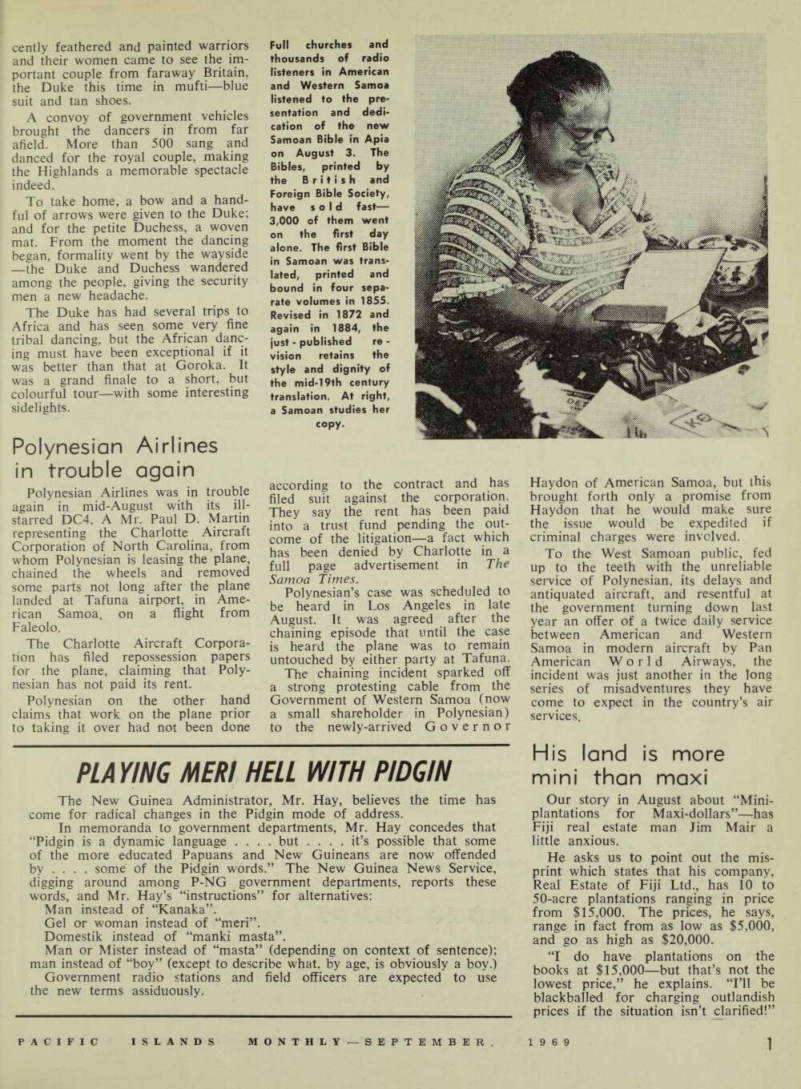
Full churches and thousands of radio listeners in American and Western Samoa listened to the pre sentation and dedi cation of the new Samoan Bible in Apia on August 3. The Bibles, printed by the British and Foreign Bible Society, have sold fast — 3,000 of them went on the first day alone. The first Bible in Samoan was trans lated, printed and bound in four sepa rate volumes in 1855.
Revised in 1872 and again in 1884, the just • published re vision retains the style and dignity of the mid-19th century translation. At right, a Samoan studies her copy.