The Practical Planter
pp. 148-156 · Read in the full issue


Cereals, Grasses And Legumes
Used As Fodder Crops
Last month PIM published the findings of Mr. C. S. Edwards, a senior agronomist with the Papua- New Guinea Department of Agriculture, on grain crops, seeds and fruits used as fodder in the Islands. This month we publish his findings on the use of leafy crops (cereals, grasses and legumes) as fodder. The article was first published by the South Pacific Commission.
Maize, Corn: The entire maize plant may be used for feeding to livestock (as well as crushed maize — PIM, July, p. 137) and as such it is one of the highest yielders of dry matter and total digestible nutrients per acre. If grown as green fodder or for hay or silage, larger yields will be obtained by close planting, but the yield of grain will be much less.
Green maize fodder is widely used for feeding to dairy cattle when the supply of green feed from pastures is short. When cut for silage, maize is almost invariably of good quality.
The crop should be cut when the kernels have started to harden but most of the leaves are still green.
When properly ensiled there should not be excessive loss of nutrients from the crop. Compared with dried forage, maize silage is more palatable and more of the stalks are consumed, so that the feeding value of an acre of maize cut for silage is likely to be greater than if cut for dried forage.
Sorghum: Sorghum is more suited to areas of low rainfall than is maize.
Many sweet sorghum types have been developed for use as fodder, and give a heavier fodder yield than grain sorghum {PIM, July, p. 137).
For maximum feeding value the sorghum should be cut when the grain is in the dough stage. At certain stages sorghum may contain cyano genetic glycosides which can cause poisoning through the formation of prussic acid. The danger of poisoning is lowest when the grain is nearly mature.
Sudan Grass: Sudan grass is an annual species grown mainly for hay or for short-term pasture. As with grain sorghum, feeding value and
yield for hay is highest when the crop is cut fairly late. This also avoids the risk of cyanide poisoning, although sudan grass is reputed to be less prone to this than some other sorghums.
Seed is generally broadcast or drilled in close rows at 10-30 lb per acre. Due to the heavy tillering characteristic of sudan grass, low seed rates will yield as highly as high rates, but high seeding rates will result in a quicker canopy forming, resulting in better weed control.
Rice stubble
Rice: Rice hay and rice stubble may be grazed after the crop is harvested. The nutritive value is low, about the same as for other cereal straw and stubble. Rice stubble is grazed in Fiji after harvest of the grain.
Sugar Cane, Cow Cane: Sugar cane tops and leaves may be fed to cattle during harvesting of the cane where the practice of setting fire to the crop is not carried out. Cane may also be grown specifically as a fodder crop, and special varieties are available for this purpose. In sub tropical and tropical regions sugar cane often yields more green forage per acre than other fodder crops.
For best utilisation the cut fodder should be chopped. Sugar cane silage can make a very satisfactory roughage for cattle if supplemented with a protein concentrate.
Bulrush Millet, Pearl Millet: This tall, stout annual is grown as a drought resistant cereal fodder in the drier parts of tropical Africa, India, and Pakistan. Studies in the Northern Territory of Australia have shown its ability to extract nutrients leached
into the lower horizons of the soil.
It is also cultivated as a summer fodder in southern United States, where considerable breeding work has resulted in the development of promising hybrids. Sowing rate is 4-5 lb per acre, in rows 48 in. apart.
Elephant Grass, Napier Grass: This tall, deep-rooted perennial grass is widely grown in tropical countries as a forage crop and pasture plant. Its habit and ecological requirements are similar to sugar cane. It is more suited to cutting for fodder than for grazing, but under a rotational system of grazing a satisfactory stand can be maintained for many years.
Whether cut for forage or grazed, it is preferable to reduce the plant to a height of 6-9 inches with a frequency of cutting of four to six weeks. Closer cutting is possible, but a longer period (8-12 weeks) should elapse before the next cut, to allow the plants to recover.
Advantage
Yields will drop sharply over suc cessive cuts if a low cutting height is combined with a high cutting fre quency. If the plants are not cut back to a height of less than 1 ft much of the re-growth comes from the upper nodes on the old stalks, rather than in the form of vigorous new shoots from the base of the plant.
Elephant grass is normally estab lished from stem cuttings planted similarly to sugar cane, in rows 2-3 ft apart. Where the crop is not allowed to become overgrown creeping tropical legumes can be established between the rows to good advantage.
The yield of green forage depends upon soil fertility, and on how much
fertiliser is applied. Yields of up to 120 tons per acre have been re corded. Young leafy elephant grass has a low dry matter content (10-15 per cent.).
Para Grass: While commonly used as a pasture grass in rotational graz ing, para grass can also be cut for green fodder or hay. Under heavy fertilisation, yields of up to 100 tons of green fodder have been recorded.
It may be cut at intervals of four-six weeks, comparing well in quality with other tropical fodder crops. It is well suited to very wet, even water logged soils, yet it maintains a higher dry matter content than elephant grass at the same age.
On heavy clay soils para grass can be severely damaged by trampling from grazing stock, and mechanical or hand harvesting may be necessary if the stand is to be maintained for several years. Para grass is also quite well adapted to silty soils in drier regions, provided the dry season is not prolonged. It combines well with creeping tropical legumes such as siratro.
Establishment of para grass is usually by means of runners or cut tings. These may be planted by hand or, when soil moisture is adequate, excellent establishment may be ob tained from cuttings broadcast over the soil and buried by one more culti vation with disc harrows.
Less nutritious
Guatemala Grass: A tall, leafy perennial with leaves similar in ap pearance to maize, guatemala grass is adapted to well-drained soils in high rainfall regions of the tropics. It is not suitable for grazing, and is gener ally regarded as being less productive and nutritious than elephant grass.
Establishment is by rooted culms or stem cuttings.
Pangola Grass: Pangola grass is a creeping perennial. The leaves are soft and succulent. Some seed heads are produced, but no viable seed, so that establishment must be from stem cuttings.
Pangola grass is especially adapted to acid sandy soils or other well drained soils of the sub-tropics and tropics. It has been found not to thrive on alluvial soils of neutral to alkaline reaction, especially where there is a tendency towards poor drainage.
This grass responds very strongly to high levels of nitrogen fertiliser,
when yields can be as high as from elephant grass. It makes good quality cut fodder, hay, or silage, but should be cut frequently (four- to sixweekly), since the nutritive value and intake by livestock decline rapidly as the grass matures. .
Setana: Setana is a stout-tufted, free-seeding perennial. It is adapted to a wide range of soils in tropical and sub-tropical areas with a rainfall greater than 30 inches per year. It is tolerant of waterlogging and withstands heavy grazing. Two varieties commercially available are Nandi and Kazungula.
The Nandi variety has short rhizomes and erect culms up to 5 ft high at flowering. It flowers earlier than Kazungula, approximately one or two months after the commencement of the rainy season. It can flower continuously if not grazed, and becomes very stemmy . This tendency is much less pronounced in the lowland tropics, and is probably de pendent on day-length and temperature. Establishment from seed is rather slow relative to other grasses, but this may be an advantage when combining with a legume.
Kazungula variety is more robust and coarse than Nandi. Plants may reach a height of 7 ft at flowering, with panicles up to 15 in. long. The general appearance of Kazungula is of a pale blue-green, whereas Nandi is a reddish blue. Both hairy and glabrous plants occur in the Kazungula variety.
Under rotational grazing Kazungula has proved to be very productive
in the New Guinea lowlands, on a par with elephant grass. The Nandi variety has a higher dry matter con tent than Kazungula under these con ditions. Seed of Kazungula is fully viable immediately after harvest, whereas seed of Nandi may show considerable delay in germination.
This is thought to be due to some inhibiting factor in the seed coat or glumes, r •
JUpenOr
Setaria is now widely grown through the New Guinea Highlands, where it is superior to native grasses, even without fertiliser. Vegetative propagation is possible by breaking up the plants into individual tillers However, if seed production is de sired, care should be taken to propa gate from a wide range of plants, otherwise the quantity of seed pro duced will be small because of £ lf . incompatibility within clones, Cowpea: This annual is widely cultivated in the tropics and sub tropics as a fodder plant. There are numerous varieties which have been selected for particular purposes. The forage types bear less seed, and the pods tend to ripen unevenly. New varieties resistant to stem rot and other diseases have been developed for humid environments, Cowpeas are frequently grown in rotation with cereal crops and sugar cane, or in combination with sorghum or maize for fodder. The plant thrives on most soil types. The growth habit is indeterminate so that new growth
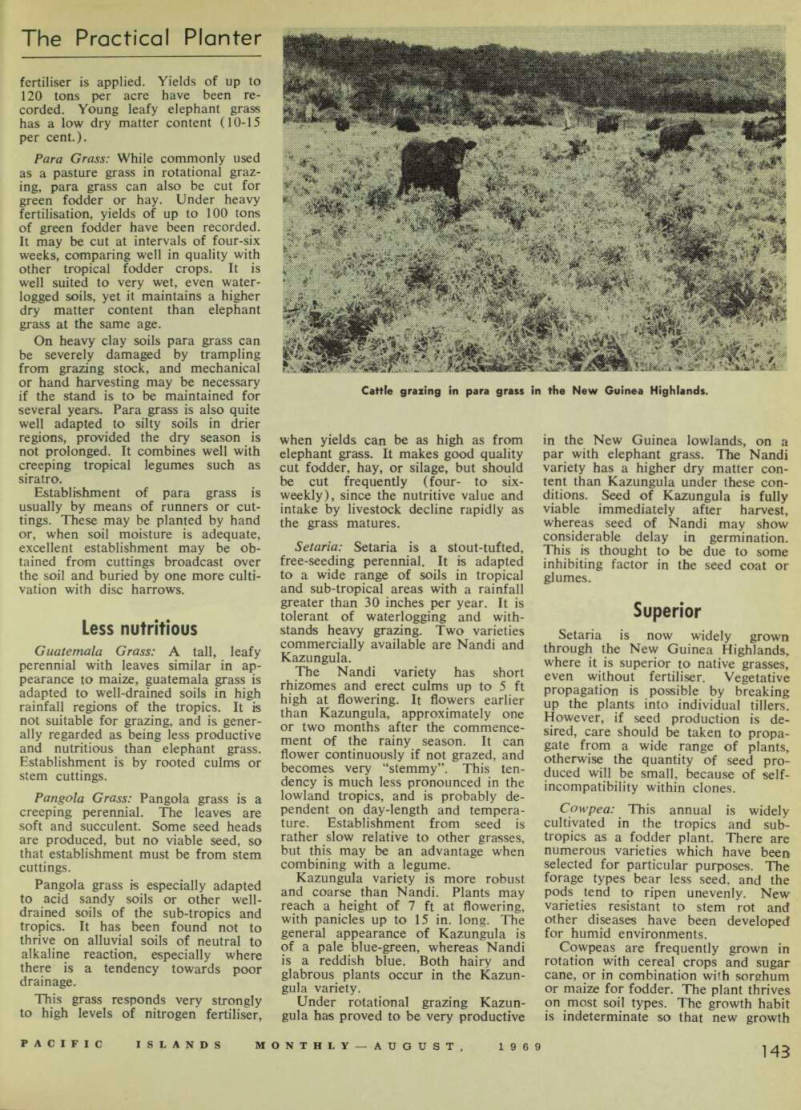
Cattle grazing in para grass in the New Guinea Highlands.
is put out while bearing seed over a long period. Consequently, the time of harvesting or utilising the crop is not critical, and little feeding value is lost if the crop is allowed to stand after bearing its first crop of seed.
The crop is difficult to cure for hay, but it is reputed to be equal in quality to lucerne hay.
The sowing rate for seed is 30-50 lb per acre when broadcast, or 10 lb per acre in drills 2-3 ft apart.
Velvet Bean: The velvet bean is a vine-like annual which grows well on poor, acid, sandy soils. In New Guinea, growth of the velvet bean on neutral to alkaline calcareous soils is inferior to that of cowpeas or dolichos. The seeds are difficult to harvest, as the pods are borne close to the ground under the foliage. This habit also increases the tendency for seeds to rot in areas of high rainfall.
The seeds are large, slightly flattened, about i in. in diameter. In Queens land, the recommended sowing rate is 30 lb per acre broadcast, or 10 lb per acre in drills 4-5 ft apart.
Dolichos, Hyacinth Bean: This widely cultivated perennial has re cently come into prominence in Queensland and the South Pacific as a foliage plant, with the release of the virogous leafy strain, Rongai.
Another strain is grown in Brazil as a forage plant in combination with maize.
Dolichos is a short-lived perennial or annual legume. It forms a vigorous, erect seedling, later putting out long trailing stems, which give a complete ground cover in a few weeks. The plant has very large tri foliate leaves and white, pink, or purplish flowers from which develop broad, flat pods containing two-four seeds. Seeds of the Rongai strain are reddish brown, but the colour of seed of other strains range from almost black, through reddish brown to white. All seed types have a white area around the hilum.
The Rongai strain is resistant to a number of diseases which attack cow pea and velvet bean. Crown rot has been observed in stands grown under high rainfall conditions in New Guinea, but the disease is usually confined to a few plants, and gaps in the stand are quickly filled by run ners from neighbouring plants.
If carefully managed, dolichos provides an excellent short-term fodder crop. The stand generally deteriorates in the second year under rotational grazing. The Rongai strain combines well with sorghum or maize as a companion crop, but the cereal must not be sown too thickly, or it will shade out the legume.
Good seed production is only possible in regions where the mean monthly minimum temperature falls below 64 deg. Fahr. for flower in duction. Recommended sowing rates are 20-30 lb per acre when broadcast, or 10-15 lb per acre drilled in rows 30-36 in. apart.
Soyabeans: Soyabeans are mostly cultivated as a seed crop, but the plant may be used for grazed forage, hay, or silage. Soyabean hay is equivalent to lucerne hay in feeding value, but there can be a wastage of up to 20 per cent, due to the coarse ness of the stems. The greatest yield of nutrients is obtained when the beans are almost fully developed. As a grazing crop soyabeans provide forage for only a short period. If plants are only lightly grazed, satis factory re-growth may be obtained.
Peanuts: This short-lived annual is grown mainly as a cultivated crop for seed production. It can also be grown for hay, silage, or green fodder. The forage remaining after harvesting a seed crop of peanuts can be cured for hay, which is of quite high quality despite its appearance.
As the hay nearly always contains some roots and soil, it should be fed on racks so that livestock can reject coarse stems and roots, and the soil will fall out.
Peanuts are widely used in the US for direct feeding of pigs in the field.
Pigs fed in this way should receive a mineral supplement, especially calcium and salt. This method of rearing pigs, is not recommended for brood sows and very young pigs.
Varies widely
In Florida, pigs have been grazed on Spanish peanuts as the sole diet, on a crop yielding about 1,100 lb of nuts per acre. Half an acre is re quired per pig, and an average live weight gain of 1.6 lb per head per day is obtained.
The sowing rate for peanuts varies widely in different countries. In New Guinea, the White Spanish variety is sown at 30-50 lb per acre of shelled nuts, in rows 28-36 in. apart.
Leucaena: This leguminous tree is naturalised in most Pacific islands, as well as in Malaysia, Indonesia, Central and South America. Selected strains from Peru, Guatemala, and El Salvador have proved to be con siderably more robust and productive for fodder than the strain which is common to New Guinea. This in creased vigour is more marked in lower rainfall areas.
While normally growing as a small tree, leucaena can be maintained in definitely as a hedge by careful graz ing in rotational management. For fodder cropping, the leucaena can be cut at a height of about 12 in,, but a longer interval between harvests is required than when grazed.
For grazing in New Guinea, leucaena is recommended to be grown
A mixture of elephant grass and silverleaf desmodium in the New Guinea Highlands.
in dense hedges 5-10 ft apart, with a sown grass between the rows. The hedges are initially cut back to a height of 3 ft. Where mechanical cultivation is possible, the wider row spacing is recommended.
Under humid tropical conditions leucaena will withstand cutting to 6 in. from ground level every 12 weeks. At the Bubia Plant Industry Centre near Lae, New Guinea, an annual yield as high as 80,000 lb per acre of dry matter has been recorded for the Peru strain of leucaena.
Average protein content (leaves and stems up to pencil thickness) was 18 per cent, of the dry matter.
Leucaena contains the alkaloid mimosine, which is toxic to non ruminants such as horses, pigs and poultry. Mimosine inhibits the function of active hair follicles, and the most obvious external sign of toxicity is loss of hair from the tail and back. Cattle, sheep and goats can adapt quickly to being fed leucaena, and the mimosine is de stroyed by bacteria in the rumen.
Temporary toxicity symptoms may appear in cattle, especially if they have access to many seed pods. The seed has a higher mimosine content than the leaves, and seeds which pass undigested through the rumen may release mimosine in the rest of the digestive tract. Unless leucaena is the sole diet for cattle, toxic symptoms are quite rare and of little concern.
Valuable
For poultry, leucaena leaf meal may be fed at levels up to five per cent, in starter and layer rations, and 10 per cent, in developer or grower rations. While not supplying all the protein requirement, it is a valuable source of vitamins A and K and probably other vitamins as well.
Lucerne, Alfalfa: Lucerne is one of the most widely grown of the leguminous fodder crops; it may be grown for fodder in sub-tropical en vironments, and in highland areas of the tropics. In the humid tropical low lands most varieties of lucerne are susceptible to fungous diseases, and the crop is less productive than the better-known tropical legumes. Even in the tropical highlands it is doubt ful whether lucerne would compare in productivity with tropical legumes such as Desmodium intortum and Glycine jacanica, given identical cul tural treatment.
The sowing rate for lucerne is 10-
30 lb per acre depending upon rain fall, with the heavier rates for higher rainfall areas. Inoculation of seed with the appropriate strain of root nodule organism is important.
Pigeon Pea: The pods and leaves of pigeon pea have good feed value for livestock and may be used for green fodder, hay, or as a browse plant. The plants will not survive under continuous grazing.
Siratro: Siratro is a twining, pros trate perennial legume. The leaves are trifoliate, with a velvety texture.
The deep purple flowers are borne on a long raceme, usually appearing one at a time. Seeds are vari coloured, brown to black, in smooth, narrow, light-brown, cylindrical pods, 3-5 in. long.
This variety, which was bred as a perennial forage legume for sub tropical Queensland, has proved to be widely adapted to the Pacific Islands.
Year-round growth is favoured where temperatures do not fall below about 60 deg. Fahr. At altitudes above 4,000 ft in the tropics, growth rate of siratro is markedly reduced, due to low night temperatures. Siratro has a marked seedling vigour, a feature lacking in many better-known peren nial tropical forage legumes. It is therefore very competitive, and can be established by surface seeding into native grassland, especially if the grass growth is checked by burning or roll ing beforehand.
Most commercial seed is already scarified to improve germination. For rapid establishment of a dense stand, locally harvested seed should be scarified, either mechanically or with sulphuric acid. As a general rule, seed should be inoculated with a suitable culture of root nodule bacteria, although siratro will nodu late freely with most naturally oc curring rhizobia of the cowpea type.
The sowing rate is 2-5 lb per acre of scarified seed. If sown as a pure stand, the higher sowing rate should be used.
Tropical Kudzu, Pueraria, Puero: This creeping perennial is widely used as a cover crop and green manure. It provides excellent grazing for cattle, and is commonly grown under coconuts for this purpose.
Establishment from seed is rather slow. Germination percentage can be improved by seed scarification. When sowing, the seed should only be lightly covered; if rain is plentiful the seed may be left on the surface of the soil. A sowing rate of 4 lb per acre is usual. Pueraria may also
be propagated by cuttings. It is best suited to fairly fertile soils and a high rainfall, although it will withstand drought once established.
Glycine: This legume has come into prominence in recent years as an outstanding legume for the sub tropics and tropics. It has similar soil and climatic requirements to pueraria. Several strains are now available, varying in earliness of flowering and seedling vigour. In the humid tropics some strains produce virtually no flowers, and a cool dry season is necessary for good seed production. The sowing rate is 2-4 lb per acre.
Greenleaf Desmodium and Silver leaf Desmodium: Both of these species are vigorous prostrate forage legumes suited to the tropics and sub tropics. In the New Guinea High lands they are superior to siratro, centrosema, and glycine. They appear to be reasonably tolerant of low phosphate levels in the soil. Silverleaf desmodium has larger seeds and establishes more quickly, while green leaf desmodium, once established, is more productive and persistent under grazing.
A mixture of both species can therefore be recommended for estab lishment of a good stand of forage.
If sown as a pure stand, a dense cover is formed which could be cut regularly for green fodder for cattle or pigs.
Where suitable root nodule bac teria occur naturally in the soil, the desmodium can be established from cuttings during the rainy season.
Both species flower profusely, but seed set and quality may be seriously affected by infestations of sucking insects and weevils. The sowing rate for seed is the same for both species: 1-2 lb per acre.
Dwarf Koa: This forage plant is naturalised in the US Trust Territory and in several other Pacific island groups. It is an upright bush, used for fodder and grazing in Hawaii and Mauritius, but it is not normally grazed unless other more palatable foods are in short supply. Yield and protein content of the fodder is in ferior to that from leuceana.
Crotalaria: Numerous species of crotalaria occur in the South Pacific, many having become naturalised after accidental or deliberate intro duction. Several species have been used as leguminous green manure crops.