Deaths Of Islands People
p. 141 · Read in the full issue
Tributes To
New Guinea's
Frank Henderson
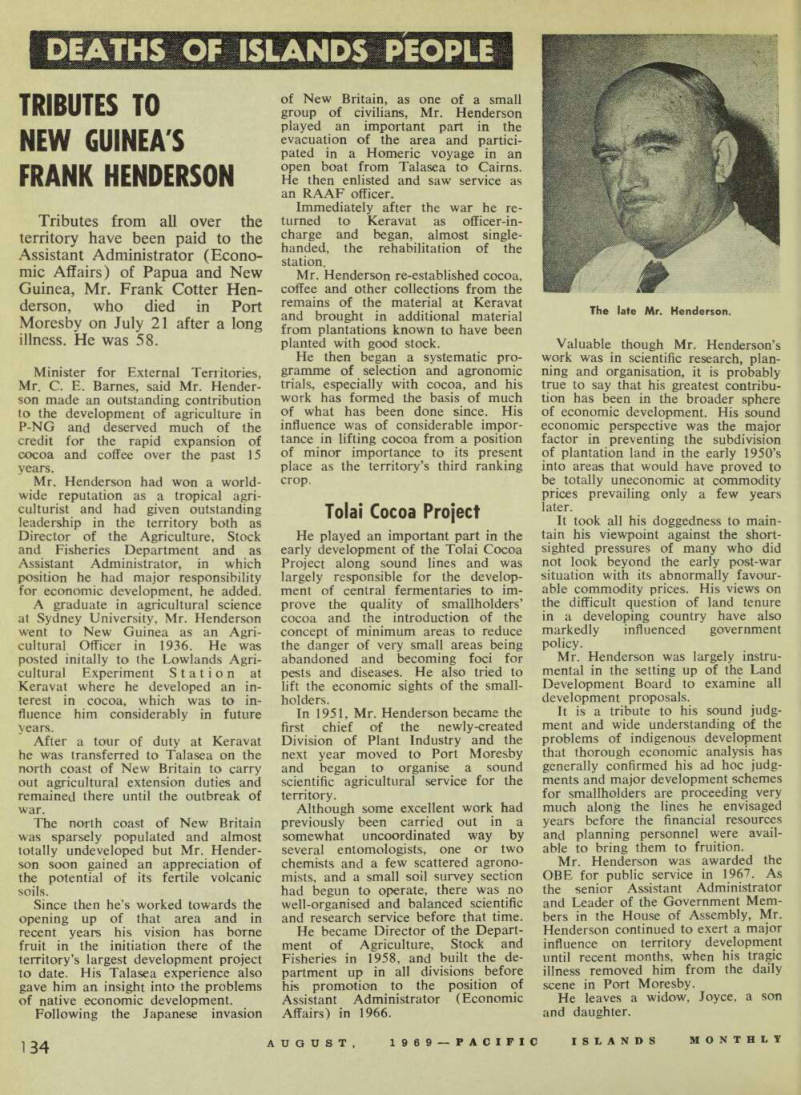
Tributes from all over the territory have been paid to the Assistant Administrator (Econo mic Affairs) of Papua and New Guinea, Mr. Frank Cotter Hen derson, who died in Port Moresby on July 21 after a long illness. He was 58.
Minister for External Territories, Mr. C. E, Barnes, said Mr. Hender son made an outstanding contribution to the development of agriculture in P-NG and deserved much of the credit for the rapid expansion of cocoa and coffee over the past 15 years.
Mr. Henderson had won a world wide reputation as a tropical agri culturist and had given outstanding leadership in the territory both as Director of the Agriculture, Stock and Fisheries Department and as Assistant Administrator, in which position he had major responsibility for economic development, he added.
A graduate in agricultural science at Sydney University, Mr. Henderson went to New Guinea as an Agri cultural Officer in 1936. He was posted initally to the Lowlands Agri cultural Experiment Station at Keravat where he developed an in terest in cocoa, which was to in fluence him considerably in future years.
After a tour of duty at Keravat he was transferred to Talasea on the north coast of New Britain to carry out agricultural extension duties and remained there until the outbreak of war.
The north coast of New Britain was sparsely populated and almost totally undeveloped but Mr. Hender son soon gained an appreciation of the potential of its fertile volcanic soils.
Since then he’s worked towards the opening up of that area and in recent years his vision has borne fruit in the initiation there of the territory’s largest development project to date. His Talasea experience also gave him an insight into the problems of native economic development.
Following the Japanese invasion
of New Britain, as one of a small group of civilians, Mr. Henderson played an important part in the evacuation of the area and partici pated in a Homeric voyage in an open boat from Talasea to Cairns.
He then enlisted and saw service as an RAAF officer.
Immediately after the war he re turned to Keravat as officer-in charge and began, almost single handed, the rehabilitation of the station.
Mr. Henderson re-established cocoa, coffee and other collections from the remains of the material at Keravat and brought in additional material from plantations known to have been planted with good stock.
He then began a systematic pro gramme of selection and agronomic trials, especially with cocoa, and his work has formed the basis of much of what has been done since. His influence was of considerable impor tance in lifting cocoa from a position of minor importance to its present place as the territory’s third ranking crop.
Tolai Cocoa Project
He played an important part in the early development of the Tolai Cocoa Project along sound lines and was largely responsible for the develop ment of central fermentaries to im prove the quality of smallholders’ cocoa and the introduction of the concept of minimum areas to reduce the danger of very small areas being abandoned and becoming foci for pests and diseases. He also tried to lift the economic sights of the small holders.
In 1951, Mr. Henderson became the first chief of the newly-created Division of Plant Industry and the next year moved to Port Moresby and began to organise a sound scientific agricultural service for the territory.
Although some excellent work had previously been carried out in a somewhat uncoordinated way by several entomologists, one or two chemists and a few scattered agrono mists, and a small soil survey section had begun to operate, there was no well-organised and balanced scientific and research service before that time.
He became Director of the Depart ment of Agriculture, Stock and Fisheries in 1958, and built the de partment up in all divisions before his promotion to the position of Assistant Administrator (Economic Affairs) in 1966.
Valuable though Mr. Henderson’s work was in scientific research, plan ning and organisation, it is probably true to say that his greatest contribu tion has been in the broader sphere of economic development. His sound economic perspective was the major factor in preventing the subdivision of plantation land in the early 1950’s into areas that would have proved to be totally uneconomic at commodity prices prevailing only a few years later.
It took all his doggedness to main tain his viewpoint against the short sighted pressures of many who did not look beyond the early post-war situation with its abnormally favour able commodity prices. His views on the difficult question of land tenure in a developing country have also markedly influenced government policy.
Mr. Henderson was largely instru mental in the setting up of the Land Development Board to examine all development proposals.
It is a tribute to his sound judg ment and wide understanding of the problems of indigenous development that thorough economic analysis has generally confirmed his ad hoc judg ments and major development schemes for smallholders are proceeding very much along the lines he envisaged years before the financial resources and planning personnel were avail able to bring them to fruition.
Mr. Henderson was awarded the OBE for public service in 1967. As the senior Assistant Administrator and Leader of the Government Mem bers in the House of Assembly, Mr.
Henderson continued to exert a major influence on territory development until recent months, when his tragic illness removed him from the daily scene in Port Moresby.
He leaves a widow, Joyce, a son and daughter.
The late Mr. Henderson.