Business and Development
pp. 122-132 · Read in the full issue


Drive To Export P-Ng
Timber To S-E Asia
Papua-New Guinea, is to spend $105,000 on two barges and a timber harbour complex at McFarlane Harbour, Marshall Lagoon, Papua-New Guinea, is to spend $115,000 on two barges and a sea-going tug. The three vessels are being built by the Port Moresby and Brisbane divisions of the shipping and wharf contractor, Homi brooks.
The bigger barge, with a carrying capacity of 300 tons, will cost $40,400 and be called Roger D. It will be delivered by November for lighterage operations between Marshall Lagoon and Moresby, 100 miles away up the Gulf of Papua.
The tug, to be called Kapar'i (after the firm’s sawmill), will cost $53,800 and be used to manoeuvre Roger D and its smaller sister barge (which will cost $10,900 and have a carrying capacity of 120 tons).
Pacific Islands Corporation is a subsidiary of ANG Holdings Ltd., which has rubber, coffee and tea interests in P-NG as well as being the owner of Moresby’s celebrated local “skyscraper”, ANG House.
ANG’s timber investments, how ever, far exceed its other interests and the company has a 51 per cent, stake in the Marshall Lagoon project.
Expenditure so far this year has been over $1 million.
S-East Asia
Success of the venture depends largely on winning export orders from South-East Asia, as well as Australia. Sales so far of sawn timber have gone to Australia but later this year pilot shipments of logs from the project will be exhibited through the Toyko offices of Jardine Matheson, which has a 25 per cent, share in the project.
ANG says inquiries have been received from Nationalist China and South Korea but that it will try to place its first Asian sales in Japan.
Along with several P-NG timber firms, Pacific Islands Corporation has been selling timber to operators of the Bougainville copper project and the firm has advantages, particularly
over loggers on Bougainville, in that it can supply sawn timber and not only logs.
ANG would rather sell processed timber than logs. The export of logs to South-East Asia from NG is barely a profitable business because of poor prices offered, particularly by the biggest buyer, but higher profit margins could be had in shipments of sawn timber or wood chips.
Auxiliary facilities
To this end, PIC is rapidly up grading its milling facilities and hastening work on auxiliary facilities, such as roads and harbour facilities.
Its deepships wharf is due to be ready in March next year, about seven months behind schedule.
Since being floated on Australian Stock Exchanges in 1966, ANG’s per formance hasn’t been startlingly good
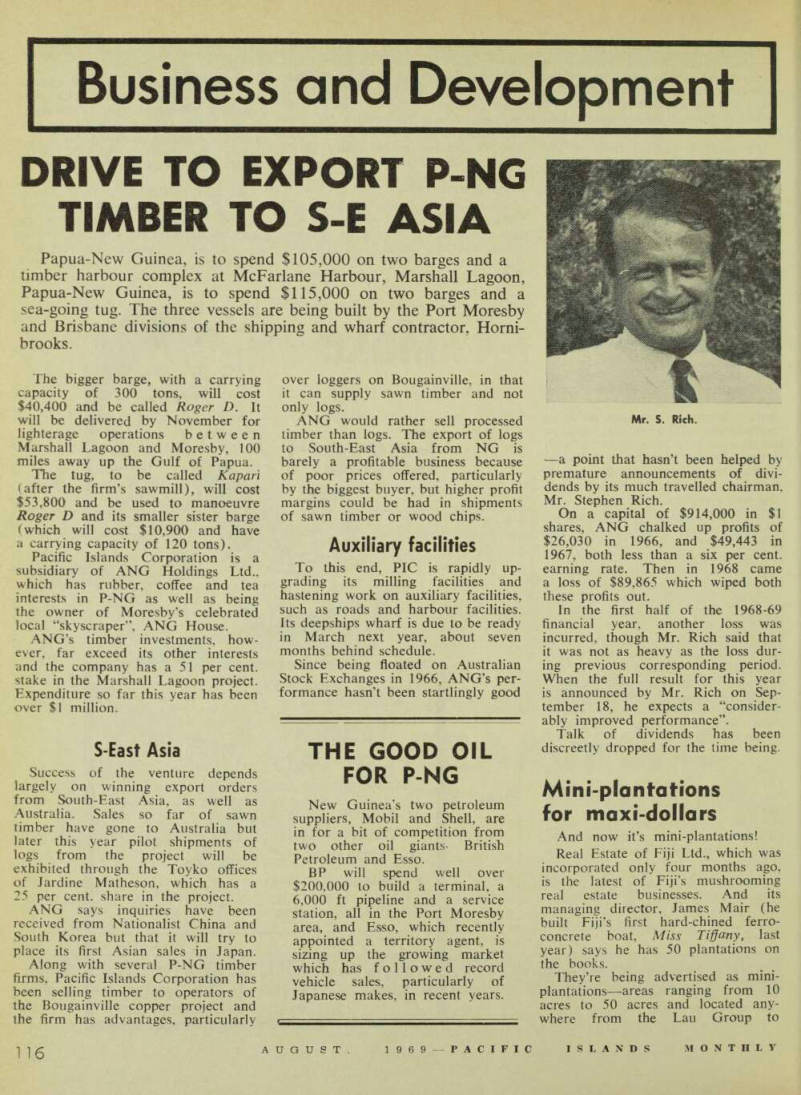
—a point that hasn’t been helped by premature announcements of divi dends by its much travelled chairman, Mr. Stephen Rich.
On a capital of $914,000 in $1 shares, ANG chalked up profits of $26,030 in 1966, and $49,443 in 1967, both less than a six per cent, earning rate. Then in 1968 came a loss of $89,865 which wiped both these profits out.
In the first half of the 1968-69 financial year, another loss was incurred, though Mr. Rich said that it was not as heavy as the loss dur ing previous corresponding period.
When the full result for this year is announced by Mr. Rich on Sep tember 18, he expects a “consider ably improved performance”.
Talk of dividends has been discreetly dropped for the time being.
Mini-plantations
for maxi-dollars
And now it’s mini-plantations!
Real Estate of Fiji Ltd., which was incorporated only four months ago, is the latest of Fiji’s mushrooming real estate businesses. And its managing director, James Mair (he built Fiji’s first hard-chined ferro concrete boat, Miss Tiffany, last year) says he has 50 plantations on the books.
They’re being advertised as mini plantations—areas ranging from 10 acres to 50 acres and located any where from the Lau Group to
Mr. S. Rich.
Taveuni, Viti Levu and Vanua Levu. was being floated as a public com-
The prices range from $15,000 for the mini variety to $600,000 for one 4,000 acre plantation (a maxi plantation?).
It’s a little surprising to see so many plantations on the market. But perhaps people are getting tired of the “planter’s image” and succumb ing to the lure of the American dollar. For there’s no doubt that investment-minded Americans are impressed with the romance of owning a South Seas copra planta tion.
Jim Mair is working towards the plushly-carpeted first floor office in the centre of Suva, is new to the real estate game—but says so are most of the others in Fiji.
“Every law office, architect’s office or engineering firm is dabbling in it now. Most of them are purely speculators, interested in buying and selling land for the most they can get,” he said.
“Ninety per cent, of my interest is in development. With the Suva firm, MacManus and Bradley, as my consultants. I do project develop ment studies for clients interested in resorts and commercial developments.
After the preliminary planning we negotiate for the land on behalf of our overseas clients.
“We have big plans—ranging from multi-million dollar reclamation schemes to the design, development and construction of housing settle ments and island resorts.”
Jim Mair is working towards the establishment of a Real Estate Institute of Fiji—one with rules to which every land dealer, including himself, will have to conform.
“An Institute cannot possibly dic tate to an owner the price at which he sells, but it could regulate who can deal in land. It would prevent large-scale profiteering by property speculators.
“We are preparing a case for an Institute in Fiji, to be presented to the government for both approval and advice.”
New gold-exploration
company for P-NG
Drilling will start in mid-August by a newly-formed minerals explora tions company to assess and develop the Mount Victor and Kathnel gold deposits in the Eastern Highlands of Papua-New Guinea.
The company. Highland Gold Development NL, based at Kainantu, is interested in winning payable lode gold rather than quantities of alluvial gold from the area. Highland in July
pany to residents of P-NG and Aus tralia and listing permission had been granted for Brisbane, Sydney and Melbourne Stock Exchanges.
Chairman was Mr. C. W. Siller, MBE, a Brisbane-based geologist and also chairman of two Australian mineral exploration groups. Exoil and Trainsoil, and the two directors were Messrs. L. W. Doggett, a Bris bane accountant, and E. T. Forster, P-NG operations manager.
Paid-up capital would be about $600,000. of which Exoil and Tran soil would control, with options, over 50 per cent.
Tongan bananas
hit by disease
An increasing number of Tongan farmers are extremely worried about the effect that black leaf disease is having on their bananas.
First experienced in Vavau and Ha’apai, black leaf has taken a heavy toll on the industry in Tongatapu and it may take up to 18 months to combat the disease and restore the industry to normal.
The period of rehabilitation could be shortened, provided growers will co-operate vigorously with depart
mental officers in spraying their plants and keeping their plots clean.
This has been the worst year for black leaf and other leaf-spot com plexes throughout Tonga, and could cost the country dearly in reduced exports.
During the last two years the total export of bananas reached over half a million cases per annum.
This year it could tumble to half that amount.
There is more encouraging news from other sectors of the agricultural front, however.
A machine for the pre-packing of desiccated coconut into 8 oz retail packs is soon to be installed in the Tonga Copra Board’s factory at Havelu, and according to the market ing adviser to Government, Mr. K.
Masters, an initial order has already been received from a well-known New Zealand chain store for 6,000 dozen packs.
A Fiji importer has placed a trial order for 15 cases of Tongan tomatoes which will go by Tofua to the Fiji market.
Share floatation for
new Moresby brewery
A share floatation will be made later this year to residents of Papua- New Guinea and Australia to finance a proposed second brewery in Port Moresby, United Brewery Ltd.
In July work was underway, by businessmen in Moresby and hoteliers in Sydney, to finalise plans for the float. Executives of United, Messrs.
Norman White, Raymond Lord and Geoffrey Martyn, were hopeful their company would gain listing on Aus tralian Stock Exchanges, particularly Sydney.
They had two other jobs— to con tract Japan’s Asahi Brewery to supply technical aid and equipment for the Moresby-based brewery plant and to take over a NG hotel group and obtain outlets for their beer.
Agreement with the Japanese would provide for an annual production capacity of 9,000 kilolitres, and Asahi-patented outdoor beer storage tanks. Asahi would be paid royalties on beer produced.
Meanwhile, through Pacific Ac ceptance Corporation Pty. Ltd., United was arranging to take a major interest in Sangara (Holdings) Ltd., owners of Rabaul’s Cosmopolitan Hotel, the Goroka and Wau Hotels, and the Hotel Cecil, Lae. ( PIM , June, p. 119).
The beer taverns around Moresby, in which Mr. Lord has interests, are possible outlets for new P-NG beer (Mr. Lord, incidentally, is also on the board of Nauru’s controversial Pacific Sporting Pools Ltd., football pools operators).
NG already has two brewing plants, at Moresby and Lae, both controlled by South-East Asian interests.
'No commercial
phosphate' on Palau
Continental Minerals Inc. of the US has ended its exploration of the Palau Islands of the US Trust Territory for phosphate rock. Tests by Continental showed that the lagoon areas didn’t contain phosphate or associated minerals in “com mercial quantities”. The company’s exploration permits had aroused op position from overseas scientists and the Congress of Micronesia. It was feared that the “Rock Islands”, a potential tourist attraction, might be destroyed by exploration. a More commerce on p. 121
Reds share in
W. Samoan trade
Of the 231,800 rounds of small arm ammunition imported last year into Western Samoa, 75,000 came from the Soviet Union and her satellite, Czechoslovakia. And of the 1,432,367 yards of cotton piece goods of which Western Samoans used almost 11 yards each, 420,070 came from Russia. Japan was a close second with 392,320 yards.
This is just a sample of the intriguing information contained in the booklet “Trade, Commerce and Shipping of Western Samoa 1968,” recently issued by the Collector of Customs. Its 70 pages are replete with such items as: Fish is slightly more popular than red meat, as 1,690 tons of the former were imported compared with 1,380 tons of the latter.
Bacon and ham are becoming more popular. Some 10 tons were landed to go with 17,940 dozen eggs from New Zealand.
More than 2,500 tons of cocoa beans were exported but only about 17 tons came back in the form of cocoa in tins, while only four tons of coffee arrived in exchange for 20 tons of coffee beans exported to NZ.
The most important food item im ported is flour and 3,837 tons came in during the year: 2,928 tons from Australia, 781 tons from France, 103 tons from Canada, 22 tons from America and a couple of tons from New Zealand.
Not too much guzzling goes on.
Beer imports were 137,781 gallons, spirits 1,693 gallons and wine 990 gallons. That works out to be slightly more than a gallon per head of population a year.
Fuel for lanterns and cooking
stoves was a big- item—433,336 gal lons.
Making fire by rubbing sticks together is too slow for modern Samoa. Imports of matches amounted to 1,343,328 individual boxes or about 10 for each man, woman and child.
Speaking of heat, the Samoan housewife dotes on her charcoal clothes-pressing iron. She bought 2,520 from England last year.
Despite all the stories about lung cancer, 25,194,000 cigarettes and 734,688 two-ounce tins of tobacco helped to increase the volume of imports.
But Japan supplied most of Samoa’s footwear; 127,719 pairs out of a total of 148,475 pairs of shoes, boots, sandals and the like, Japan also supplied most of the motor vehicles, almost 70 per cent, of the 243 cars,
trucks, buses and motorcycles brought in. USA, Singapore, Indonesia, and Saudi Arabia supplied the 1,197,333 gallons of petroleum products to run them. To keep them on the move, 9,415 tyres were needed. Bicycles needed 3,896 tyres, as well.
Western Samoans are not clock watchers. Only 839 watches and 581 clocks were imported in 1968.
Finally, animals and birds were an item on the list, and 447 tons of animal and bird food. Nine hundred and sixty eight dogs, cats, cattle, sheep, horses, canaries and parrots were imported.
Interesting as this information may be, it is a sad story for Samoans because of the imbalance of trade it represents. Imports for 1968 amounted to 5W55,497,525 while ex ports were valued at only $3,837,828.
The deficit of $1,659,697 is rough on the economy.
Here is the list of the exports for the year 1968;
Copra, 12,623 tons ! 51,880.138 Cocoa beans, 2,587 tons .. 1.276,18£ Bananas. 94,327 cases 268,974 Other Produce 214,139 Coffee beans 8,715 Timber 6,530 Kava to Fiji 4,009 Annatto 3,460 Hides 3,700 Copra Meal 1,080 Western Samoa’s growing ary industries contributed secondsubstantially to export income: Handicrafts $43,214 Ice Cream 31,375 Beverages 24,525 Canned Fruit 21,146 Apparel 4,289 Soap 4.086 Biscuits 1,404 Taro Chips 63 Furniture 50
Enthusiasm over Fiji's
industrial potential
After conducting a survey into the potential of secondary industry in Fiji, a team of industrial advisers from India has come up with some enthusiastic suggestions.
Leader of the team, economist Mr. O. P. Jain, said that compared with “other developing countries with a similar set of conditions”, Fiji had considerable potential— particularly relating to sugar, coco nuts and timber.
Among schemes suggested by the
team was the establishment of small factories in the cane areas for the manufacture of refined sugar. This, it was felt, could lead to a con fectionery industry.
The manufacture of pure alcohol, rum, animal feed and vinegar from molasses was another suggestion; also the manufacture of cardboard and particle board from bagasse, the residue left after sugar cane is crushed. (At present, it is used as boiler fuel).
The team also suggested that a copra oil processing plant and several more coconut fibre factories be established on the island of Taveuni,
which now has one factory produc ing a ton of fibre a day. This is not enough to meet orders.
Other possibilities included using coconut shell to make activated charcoal for filtering processes in chemical industries, the rehydration of fruits and vegetables, manufacture of soap powder and ginger oil and use of local wood to make veneer, plywood, chipboard, flooring, turned parts and pegs.
As Mr. Jain pointed out, technical expertise and know-how for such massive industrial development would have to come initially from over seas. In addition, it would have to be made easier for the man-in-the street to obtain finance to start and operate a small industry.
Upon returning to India in July, the team was to submit a report to the Government of India, which would pass it on to the Fiji Govern ment.
The visit, during which more than 50 factories were inspected, was sponsored by both governments.
Copra report
for July
Mr. lan McDonald, chairman of the Papua-New Guinea Copra Marketing Board, gave the following report on July 21: The June average price for Philip pine copra was $A170.03, almost SA3 per ton better than the May average.
Contrary to expectations, the market commenced to firm about mid-June rising to $182.83 on July 1, but since has fallen to $177 and it seems likely that this level will be maintained for the rest of the month.
Laurie oil supplies have been tight under near conditions over the last month or so, and this, of course, is the reason for the recent firming in the market for copra and palm kernels. However, with heavier supplies of other oils, particularly fish oil and sunflower, becoming available, it is likely that copra will tend to remain fairly steady for the next month or so at around present levels.
They'll lift the
ice-cream ban
Noumea is to be the scene of an “Australia Week” at the beginning of September. This follows the May visit to the territory by Mrs. Beryl Wilson, an Australian Trade Com missioner for the Pacific Islands (the other is Mr. W. R. Carney).
Mrs. Wilson said Australian goods
would be promoted by three lead ing retail stores in Noumea —the Etablissements Ballande, Maison Barrau and Prisunic.
It is expected that special dis pensation will be made to allow the tasting of imported ice cream during “Australia Week”. During these winter months—from June 1 to Sep tember 30—the Administration has prohibited the importation and sale of foreign ice cream, in an effort to protect the locally-manufactured product.
Australian and New Zealand ice cream is normally extremely popular in New Caledonia. More recently the Caledonians have been importing the Italian Motta brand—manufac tured in France. Being a French product, Motta is not affected by the present ice cream ban.
New tax systems
for Cook Islands
Cook Islanders will have to pay two years’ income tax in 1970—for 1969 and 1970. This is a result of the decision by the Cook Islands Government to introduce a pay-as you-earn income tax system on April 1, 1970.
At the same time as the PAYE system is introduced, a welfare tax, payable by all members of the com munity at a rate of 3 cents in the dollar to a maximum of 30 cents, will also be introduced.
The Premier of the Cook Islands, Mr. A. R. Henry, announcing the tax changes in July, said that of the 4,000-odd salary and wage earners in the Cooks only 600 paid income tax.
As a result, the health, education and community development services, now given free, are paid for by New Zealand tax payers.
This situation had to be remedied, Mr. Henry said. Cook Islanders had to contribute more themselves to wards the rising costs of government, and the welfare tax would be a step in this direction.
BP's in tea—but
in Queensland!
Conspicuous by its absence from the several companies developing a multi-million dollar tea industry in New Guinea’s Highlands, Burns Philp and Co. Ltd. has now taken a hand in a joint tea-growing project—in north Queensland, Australia.
On July 1 Nerada Tea Estates Pty. Ltd. was registered in Towns ville with a paid-up capital of $250,000 divided into shares of $l.
The four directors of Nerada are
Messrs. C. R. Taylor and R. W.
Stone (both BP’s Queensland branch managers), Dr. A. P. Maruff, who has pioneered tea planting and mechanical harvesting at Innisfail, and Mr. A. T. Covacevich, a local businessman.
Dr. Maruffs tea gardens will be included in the venture, which will comprise 320 acres in a rain forest area with an elevation of over 100 ft, 20 miles from Innisfail.
First plantings were made in this Nerada area in 1960 and about 92 acres are now planted with other areas cleared and being prepared for tea. Mechanical harvesters will be used (there is one already on the property) and the emphasis will be
on high-grade rather than low-grade tea.
A tea processing factory will be built and be operational by January next year when the first tea will be available.
Tea operations by BP will greatly interest NG growers, particularly Carpenters, who seriously considered using mechanical harvesters for their plucking before rejecting them for several reasons—one of which was NG’s labour costs.
Ironically, this would be one of the reasons BP’s have plumped for mechanical harvesters in Australia— with pluckers downunder due for Australian rates of pay, tea growing would be surely prohibitive.
Trade briefs
• Although many territory busi nessmen would have preferred to see no duty-free set up at all in Papua- New Guinea, at least their worst fears weren’t realised with the July news that NG’s third major airline, Papuan Airlines Pty. Ltd., had won the five year concession to set up a duty-free shop at Port Moresby Airport.
Businessmen, particularly the Chinese, had feared the concession might have gone to a Sydney-based operator— now a NG firm has won what will prove to be a profitable monopoly for cheap cameras, etc.
The hard fact remains, however, that at least $500,000 worth of cameras and similar imports that have been stockpiled by importers in the territory will be doubly difficult to sell, as their prices will be greatly undercut by the Patair operations. • The Cook Islands Government decided in mid-July to resume exports of citrus fruits to New Zealand. A shipment of fruit was due to leave Rarotonga for New Zealand on the Moana Roa some time in the month.
The Cook Islands had cancelled a shipment of citrus fruit to New Zealand in June in protest against the way in which a New Zealand com pany, Fruit Distributors Ltd., mar keted Cook Islands produce. Since then the New Zealand Government has agreed to a Cook Islands request to look into Fruit Distributors mar keting methods. Hence the decision to resume exports. • The Local Government Asso ciation in Papua-New Guinea is con sidering spending up to $lOO,OOO on a block of offices in Port Moresby.
The honorary secretary, Mr. J. K.
McCarthy, says most of the offices will be rented, with the money going back into the local government movement of 142 councils covering nearly two million people.
The association will also shortly publish its first magazine. • Impatient with the government’s lack of action in setting up a tourist organisation for the Solomon Islands, the Honiara-based Solomons Cham ber of Commerce has set up one of its own. IPs known as the Tourist Association.
Mr. J. Curtin, the chamber’s chairman, said Rory Scott, managing director of the Fiji Visitors Bureau, had made a comprehensive investiga tion of tourism prospects in the Solomons and had made recom mendations to set up a tourist organisation. To date, government
had not acted on Mr. Scott’s report, he said.
The first meeting of the Tourist Association was held on June 18 and a list of available hotels and things to do for visitors was drawn up. The accommodation list included: Hotel Mendana, Honiara, 15 bed rooms; Blums Hometel, Honiara, 14 double rooms; Chan Wing Motel, Honiara, 13 bedrooms; Chan Pong Hotel, Gizo, six bedrooms; Wheatley’s Paradise Island, Munda, one bun galow; Tavanipupu Island, Marau, one bungalow; and Tambia Village Tourist Resort, 30 miles from Honiara on Guadalcanal, 24 Islands style cabins. • The World Bank will not con tribute to financing a proposed $6 million hydro-electric project on the Lungga River, near Honiara, on Guadalcanal, Solomon Islands. How ever, it could well contribute to an alternative $BOO,OOO diesel project to meet Honiara’s future power require ments. • Tobacco-growing is picking up in the Chimbu District of New Guinea. Over 50 acres are planted, over 200 lb a month is going to the Madang H. O. Wills factory and plans are to increase the acreage of tobacco.
• Islanders on Kar Kar Island, off Madang, on New Guinea’s north mainland coast, are trying to raise $30,000 for a co-operative cocoa fermentary to process an estimated 1,032,000 lb of wet cocoa beans to be produced by them this and next year. By June, $B,OOO had been collected.
• Aquatane, a French company, is carrying out test drilling opera tions to search for oil in the Maprik sub-district of New Guinea, and Continental Oil, an American com pany, is having a “reflexion” seismic survey done of certain areas around Josephstaal and along the Sepik and Keram Rivers of the Madang District.