Pacific Shipping
pp. 111-117 · Read in the full issue
They've Started The Soft
Sell On Faster Cargoes
The first public screening of a well-made colour film “Cargo Revolution” in the plush reception rooms of a major Sydney hotel in July wasn’t, as few of the uninitiated guessed, another blurb on a bizarre cargo cult springing up in darkest New Guinea or the Solomons.
It was an attempt, financed by New Guinea and Hong Kong interests, to show the big changes in shipping cargo methods in the past couple of years—mainly on the lucrative Aus tralia-New Guinea route.
The film, with more than a few strategically placed “plugs” for its backers (China Navigation, Steam ships Trading, Amott’s Biscuits, etc.), contrasts old cargo handling sling methods with fast unit-sideloading operations. One of the results, the film cleverly points out, is that where once the village people near Madang might have received their Arnott’s biccies in many pieces now they arrive intact! Great stuff.
"Organised confusion"
Well-p ack e d consignments of about a ton each are now being shipped on pallets and removed direct on to the wharf by up to 15 fork lifts operating together in “organised confusion”.
The 18-minute Australian-made film will be released in New Guinea and promoters hope it might also get a run in movie houses in the Solomons, New Hebrides and Fiji.
As PIM pointed out in June (p. 107) two factors—unit cargoes and sideloaders—have speeded up New Guinea cargo in recent years.
This has resulted in intensified competition and has encouraged more Australian exporters to “have a go” at territory markets, once the pre serve of a few.
Australia-NG shipping operations have not yet reached “cut throat” pro portions but certainly a mini ship ping war is in progress, especially
with backloadings to Australia re cently starting to pick up.
Desiccated coconut is begining to come out of Rabaul bound for Aus tralia, there have been recent huge consignments of coffee from Lae, Madang is producing cocoa in big quantities, rubber is picking up out of Moresby, timber is coming out of New Britain, and so on.
Bright future
The future looks even brighter...
Highlands tea via Lae by the ton, palm oil from the Cape Hoskins area of New Britain, and accumu lated quantities of cocoa out of the rich Rabaul area.
Not to mention facilities Wewak is going to get an over seas-handling wharf, as is Cape Hoskins, New Britain; a temporary overseas wharf will go up at Arawa Bay, Bougainville, to relieve some of the current chaos at nearby Kieta wharf caused by inadequate storing facilities; there’s talk of a couple of decent tugs for Lae and Moresby ports and the news of an overseas handling wharf on hand at Papua’s Cape Rodney early next year (see story p. 116).
China Navigation and Australia- West Pacific Line have spearheaded moves into these fields and these two company’s investments in the terri tory are now very large. The China Navigation group, part of the big world-wide Swire consortium, has continued confidence in NG. It in dicates the territory is still well thought of in Hong Kong and other
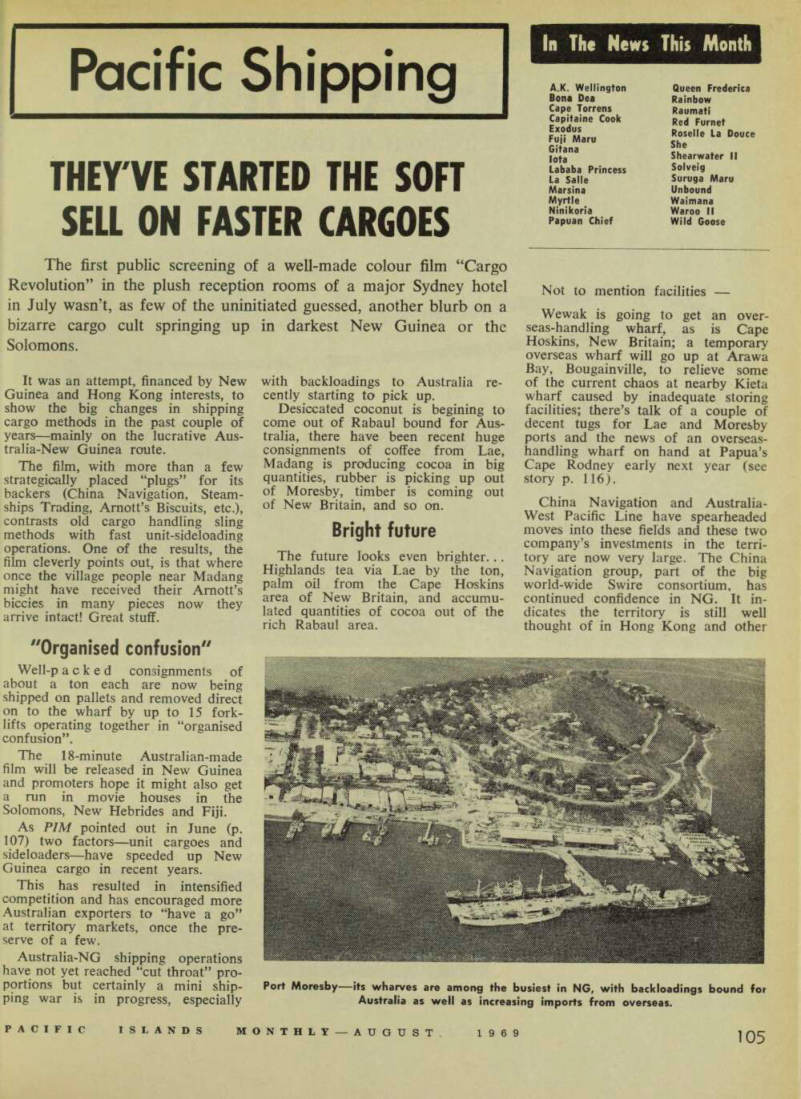
Port Moresby—lts wharves are among the busiest in NG, with backloadings bound for Australia as well as increasing imports from overseas.
Hong Kong investments in NG wouldn’t be a surprise.
China Nav’s success with its side loaders in NG (it scored a first here) goes back to a 1965 lecture in Lon don attended by one of the parent company’s executives, who heard about a Norwegian sideloading idea.
He followed this up, and sideloaders will now be a fact of life in South- East Asia as well.
A mark of the China Navigation Coy’s success is the fact that a staunch competitor in NG. Burns Philp, has chartered a sideloader from China Nav. for its own use in NG. This ship, renamed Marsina, is formerly the Papuan Chief, the Island’s first sideloader.
Fourth Nz-Caledonia
Shipping Service
A fourth shipping service between New Zealand and New Caledonia was to start in mid-July with the loading of the Capitaine Cook in Auckland. The 1,379-ton passenger cargo vessel was to sail for the first time from Auckland to Tauranga (NZ), Noumea (New Caledonia), Vila and Santo (New Hebrides), Suva (Fiji), Wallis Island, Apia (Western Samoa), and return.
Owned by Sofrana (Societe Francaise de Navigation) of Noumea, Capitaine Cook has refrigerated space for 350 tons and accommodation for 12 people.
Her NZ agents are Trans Pacific Marine Ltd., also the agents for the Fiji-NZ group, Reef Shipping Com pany, which operates almost an identical route with its vessel. Other shippers on NZ-New Caledonia runs are the German-owned NZ Export Line and the NZ Holm and Com pany.
Sofrana’s freight rates for NZ- New Caledonia vary from 5NZ3.25 per 100 lb gross, general refrigerated cargo, to $25 a ton for general cargo.
Timber is carried at $4.40 per 100 square ft.
"Ninikoria"—Biggest Ship Ever
To Have Been Slipped In Suva
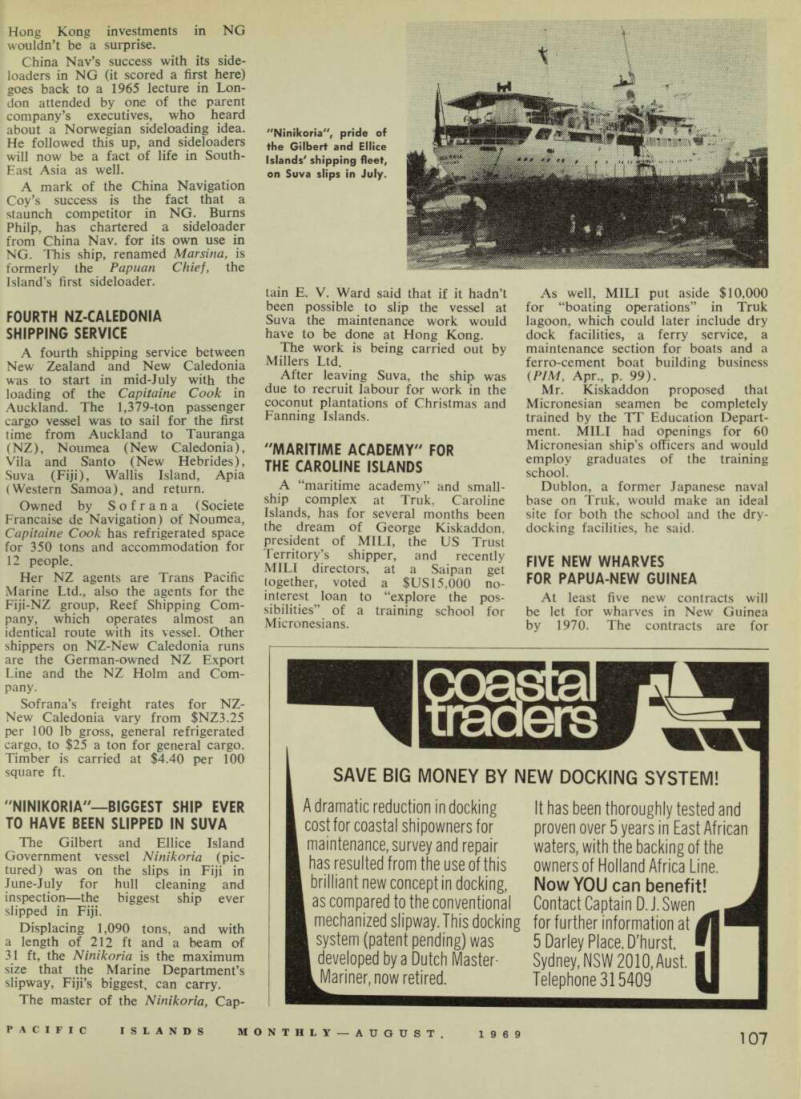
The Gilbert and Ellice Island Government vessel Ninikoria (pic tured) was on the slips in Fiji in June-July for hull cleaning and inspection—the biggest ship ever slipped in Fiji.
Displacing 1,090 tons, and with a length of 212 ft and a beam of 31 ft, the Ninikoria is the maximum size that the Marine Department’s slipway, Fiji’s biggest, can carry.
The master of the Ninikoria, Cap-
tain E. V, Ward said that if it hadn’t been possible to slip the vessel at Suva the maintenance work would have to be done at Hong Kong.
The work is being carried out by Millers Ltd.
After leaving Suva, the ship was due to recruit labour for work in the coconut plantations of Christmas and Fanning Islands.
"Maritime Academy" For
The Caroline Islands
A “maritime academy” and small ship complex at Truk, Caroline Islands, has for several months been the dream of George Kiskaddon. president of MILI, the US Trust Territory’s shipper, and recently MILI directors, at a Saipan get together, voted a SUS 15,000 no interest loan to “explore the pos sibilities” of a training school for Micronesians.
As well, MILI put aside $lO,OOO for “boating operations” in Truk lagoon, which could later include dry dock facilities, a ferry service, a maintenance section for boats and a ferro-cement boat building business (PIM, Apr., p. 99).
Mr. Kiskaddon proposed that Micronesian seamen be completely trained by the TT Education Depart ment. MILI had openings for 60 Micronesian ship’s officers and would employ graduates of the training school.
Dublon, a former Japanese naval base on Truk, would make an ideal site for both the school and the dry docking facilities, he said.
Five New Wharves
For Papua-New Guinea
At least five new contracts will be let for wharves in New Guinea by 1970. The contracts are for
"Ninikoria", pride of the Gilbert and Ellice Islands' shipping fleet, on Suva slips in July.
overseas ships’ wharf at Wewak; a wharf at Vanimo, near the P-NG- West Irian northern border; a wharf at Bogia, near Manam Island in the Madang District; an overseas ships’ wharf in the Cape Hoskins area of New Britain (in association with the palm oil project); and a wharf at Arawa, Bougainville (in associa tion with the copper project).
The US firm designing and con structing the Bougainville mining project, Bechtel-Wke, has already called tenders for a “temporary wharf”, primarily for barge unload ing operations at Arawa. Another Arawa wharf, to handle copper load ing operations, will be 250 ft long and tenders for its construction will be called at a later date.
Chandris Lines For
Norfolk In 1970
The Greek shipping line, Chandris, will conduct four cruises to Norfolk Island next February and March with its line Queen Frederica. She will depart from and return to Syd ney, calling at Melbourne and Norfolk.
There will be three nine-day cruises with fares from $135 and one 11-day cruise with fares from $156.
Two representatives of Chandris Lines were expected on Norfolk in July for discussions on the cruises with local officials.
The success of the cruises will depend on Norfolk’s weather—the island lacks a harbour and passengers must come ashore in small lighters.
Should the seas be rough when the Queen Frederica is anchored, land ing won’t be possible.
The last cruise ship to land pas sengers at Norfolk was the Wanga nella which anchored off Cascade on October 17, 1962. Nearly 100 passengers landed to spend the day visiting the duty free shops and the annual Agricultural and Horti cultural Show. Wanganella was the first liner to call at Norfolk since the end of World War 11.
Shipping Briefs
• Tulagi, the tiny island that was the capital of the British Solomon Islands until it was nearly blown off the map during the Pacific War, is nowadays making something of a comeback as a small-ships dockyard.
In 1968, 56 vessels—lo of them privately owned and the rest govern ment—were slipped for repairs and maintenance at Tulagi and the local
engineering boys worked on over 100 outboard motors during the year, some of them with fuel injection systems.
The Solomons Government marine fleet increased by six new vessels in 1968, while three oldtimers the Myrtle, Raumati and Cape Torrens —were replaced. Meanwhile, Auki, on Malaita, has become the Solo mons’ second boat-repairing centre.
The marine training school on Auki has been disbanded. • Mr. Lyall Price, who ran an inter-island shipping service with the A. K. Wellington in the British Solo mon Islands in 1966, returned to the
Solomons in June with another ship, Waroo 11, to operate a similar service. He said in Honiara that he planned to operate a monthly service out of Honiara from July to the eastern and outer islands, including the Reef and Duff Islands.
Waroo II is a 63 ft steel cargo vessel fitted with Gardner engines.
She can carry 60 tons of cargo and 10 deck passengers. Her agents are Melan-Chine Shipping and Forward ing, Honiara. • The Waimana, a cutter-rigged yacht which has been in and out of service in the British Solomon Islands for 13 years (in recent years
she has been out of service), was recently “re-launched” at Honiara’s Point Cruz Yacht Club. She was first sailed to the Solomons by two New Zealanders in 1956 and sold for $2,400 at Tulagi. Since then she has been sunk and holed and nibbled at by hungry Toredo worms, (The Point Cruz Yacht Club, incidentally, has been completely rebuilt by its new owner, Mr. Ray Wraight.) • The 600-member Kairuku Fish ing Co-operative Society, 75 miles north of Port Moresby in the Gulf of Papua, which early last year won big local catches of crayfish ( PIM, Apr., 1968, p. Ill), is now taking part in a joint venture to build two 31 ft ferro-cement fishing boats with a local firm, Morr Company Ltd. • New Guinea’s extensive 12month transport survey, carried out by the English firm of Sir William Halcrow and Partners, ended in late June and its full report is expected to be presented late this year with a future transport plan (with a close look at coastal shipping operations) and investment recommendations, to the NG Administration, the World Bank and the Australian Government. • Papua-New Guinea Nautical School near Port Moresby expects an intake of 61 Papuans and New Guineans next January to train as marine engineers, seamen and cadet masters. Since the school’s inception in 1962, over 200 Islanders have graduated and been placed in Admin istration jobs or private enterprise. • Under a Japan-Australia Fish eries Agreement, two Japanese re search vessels Fuji Maru and Suruga Maru arrived at Rabaul, New Britain, in July to carry out several months’ survey work of the Bismarck Sea to determine the possibilities of com mercial tuna, skipjack and livebait fishing. o Coastal ships are taking a bigger hand in carrying cargoes between
Papua-New Guinea’s major ports of Port Moresby, Lae, Rabaul, Madang and Wewak—at the expense of over seas ships. In 1967-68 the coastal vessels carried about 70 per cent, of the 70,000 tons carried around these ports . j n 1968-69 coastal vessels carried a b o ut 90 per cent, of the 85,000 tons carried around the same ports.
Coastal P-NG cargoes are grow ing at annual rates of 15 per cent, while general cargoes to P-NG from overseas are increasing at 16 per cent, annually. Mr. G. N. McDonell, P-NG’s Co-ordinator of Transport, released these figures in July.
The former Japanese fishing ship "Fuji Maru No. 28", which was aground in Fiji two years be fore being salvaged by McNicholl Indus tries (Fiji) Ltd. last year, took to the water again in July with the name "Labasa Princess" on her bow. She will operate on a weekly direct service be tween Suva and Labasa, returning to Suva via Natewa Bay.