It 50 Years Ago
p. 101 · Read in the full issue
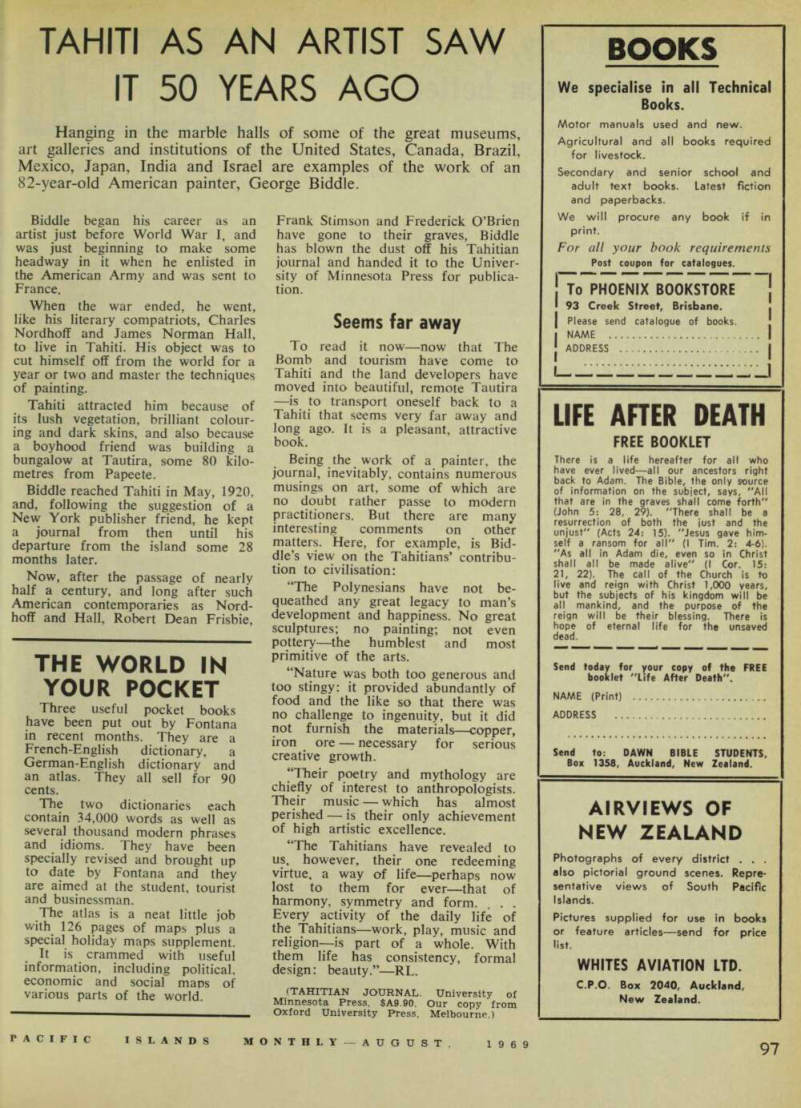
Tahiti As An Artist Saw
Hanging in the marble halls of some of the great museums, art galleries and institutions of the United States, Canada, Brazil, Mexico, Japan, India and Israel are examples of the work of an 82-year-old American painter, George Biddle.
Biddle began his career as an artist just before World War I, and was just beginning to make some headway in it when he enlisted in the American Army and was sent to France.
When the war ended, he went, like his literary compatriots, Charles Nordhoff and James Norman Hall, to live in Tahiti. His object was to cut himself off from the world for a year or two and master the techniques of painting.
Tahiti attracted him because of its lush vegetation, brilliant colour ing and dark skins, and also because a boyhood friend was building a bungalow at Tautira, some 80 kilo metres from Papeete.
Biddle reached Tahiti in May, 1920, and, following the suggestion of a New York publisher friend, he kept a journal from then until his departure from the island some 28 months later.
Now, after the passage of nearly half a century, and long after such American contemporaries as Nord hoff and Hall, Robert Dean Frisbie,
Frank Stimson and Frederick O’Brien have gone to their graves, Biddle has blown the dust off his Tahitian journal and handed it to the Univer sity of Minnesota Press for publica tion.
Seems far away
To read it now—now that The Bomb and tourism have come to Tahiti and the land developers have moved into beautiful, remote Tautira —is to transport oneself back to a Tahiti that seems very far away and long ago. It is a pleasant, attractive book.
Being the work of a painter, the journal, inevitably, contains numerous musings on art, some of which are no doubt rather passe to modern practitioners. But there are many interesting comments on other matters. Here, for example, is Bid dle’s view on the Tahitians’ contribu tion to civilisation: “The Polynesians have not be queathed any great legacy to man’s development and happiness. No great sculptures; no painting; not even pottery—the humblest and most primitive of the arts.
“Nature was both too generous and too stingy: it provided abundantly of food and the like so that there was no challenge to ingenuity, but it did not furnish the materials—copper, iron ore necessary for serious creative growth.
“Their poetry and mythology are chiefly of interest to anthropologists.
Their music which has almost perished —is their only achievement of high artistic excellence.
“The Tahitians have revealed to us, however, their one redeeming virtue, a way of life—perhaps now lost to them for ever—that of harmony, symmetry and form. . , .
Every activity of the daily life of the Tahitians—work, play, music and religion—is part of a whole. With them life has consistency, formal design: beauty,”—RL. (TAHITIAN JOURNAL. University of Minnesota Press, $A9,90. Our copy from Oxford University Press, Melbourne.)