Magazine Section
pp. 87-89 · Read in the full issue

In 1855, Dr. W. H. Harvey, botanist, found more than algae in Tonga and Fiji
By Robert Langdon
Dr. William Henry Harvey, Professor of Botany at Trinity College, Dublin, just over a century ago, had, among other things, a passion for algae. To look for specimens of his beloved algae— whether they were sea-weeds, kelps, pond scums, stoneworts or diatoms—he would walk for miles in the hot sun or wade or paddle for hours in the sea.
When Professor Harvey paid a visit of several months to Tonga and Fiji in the second half of 1855, he found plenty of algae to interest him.
Indeed, he even found a new speci men or two; and when he wrote home to his sister Hannah or his niece Mary in Dublin, he could scarcely conceal his excitement Thus, in writing of a visit to Lifuka, in the Haapai Group of Tonga, Professor Harvey told his sister: “I here collected a very curious algae which (if not a new genus) is a very distinct new species of the curious genus Dictoyospheorid. This is my first discovery at the Friendly Islands”.
Earlier, the professor had confided to his sister that the lagoon at Tonga tapu was “thickly fringed with mangroves which grow out into the water, and on their rope stems and young rope-like radicles, I collected several small algae, not previously met with in Tonga”. Elsewhere, again, Professor Harvey spoke of algae being “few and far between” and of making “many additions to my algae”.
Fleet of war canoes
However, the professor was by no means completely devoted to algae.
He was also interested in tree ferns, sea urchins, star fish (he found one in Tonga as large and as thick as a 4 lb loaf of bread with a five-inch fish inside it), water cresses, molluscs —and people.
Professor Harvey could, in fact, write about people with the same enthusiasm and in the same detail as he could about algae; and so it was that his sister Hannah and his
niece Mary received vivid descriptions from him of a number of events that he happened to witness during his tour of the South Seas, including a couple of most unusual ones.
The first unusual event was a religious revival at Vavau, the northernmost of the Tonga groups; the second was the arrival at Lakeba, Fiji, of a big fleet of war canoes, led by Tonga’s King George I, with 2,000 men, plus women and children.
Describing the first event in a letter to his sister from Sydney on December 12, 1855, Professor Harvey said: “We had hardly well landed (at Vavau) and gone up to
the mission house on the morning after our arrival when a long proces sion of the natives of a distant village was seen slowly wending through the narrow roads and heard loudly singing hymns as it came along. Men, women and children drest in their best and ornamented with leaves and flowers composed it and every one carried something in his arms or on his shoulders, being a present or offering of ‘mea ofa’ (love things) as an expression of gratitude to the missionaries for their teaching.
“One carried a pig, another again a fowl, a piece of native cloth, etc., etc., and a few brought money (a dollar or a shilling as the case might be) and the little children brought
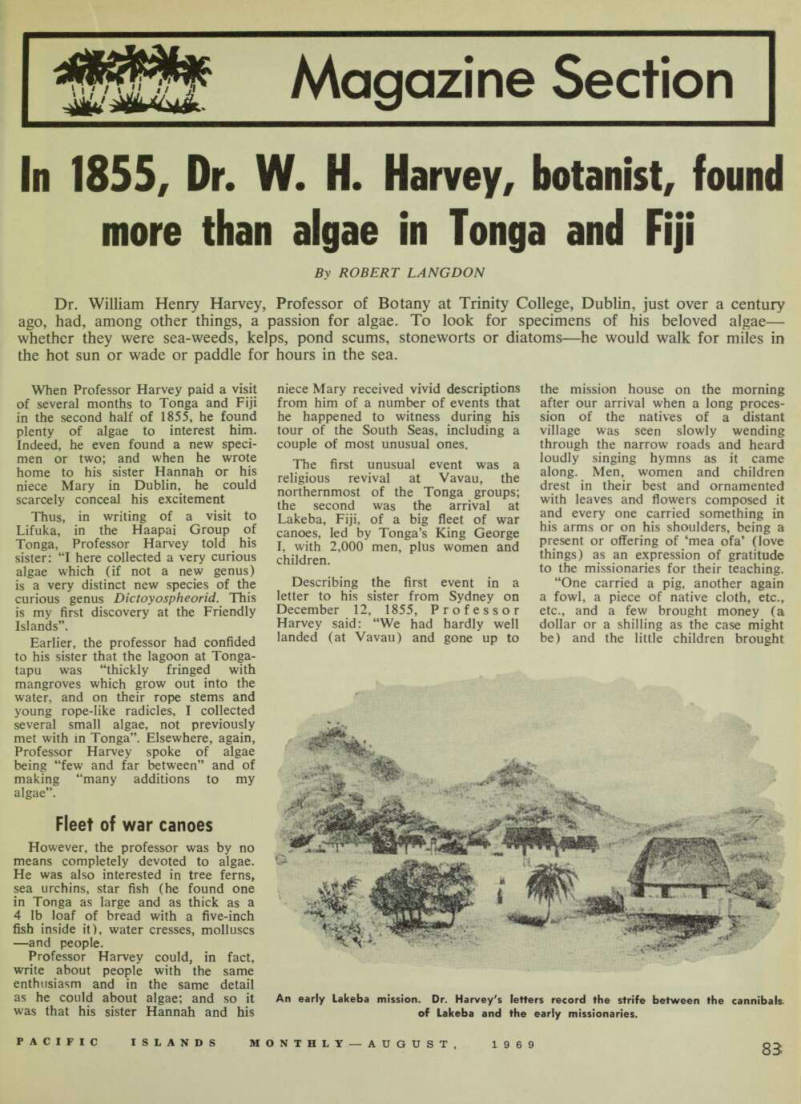
An early Lakeba mission. Dr. Harvey's letters record the strife between the cannibals of Lakeba and the early missionaries.
long wreaths ingeniously made with sweet-scented flowers.
“No one came empty handed. All the offerings were brought to the front of the mission house, where our party stood to receive them, and as each was laid down, the missionary said, ‘faka fatai’ (‘thank you’) to which the natives often repeated ‘faka fatai lesu’ (‘thank the Lord’) and then came forward to shake hands ...
“During my stay of three weeks, there were two or three similar pro cessions from other villages, and on one of these occasions, an old lady with white hair . . . insisted on rub bing noses with us when she came forward to shake hands! This was the first and last of my experiences of that custom, which has nearly disappeared, the shaking of hands accompanied by the expression of ‘chiata ofa’ taking its place. The words ‘chiata ofa’ literally mean ‘small is my love’—it being a favorite idiom of the Tongan language and considered an elegance to say, when speaking in complimentary phrase, the contrary of what you wish your friend to believe . . .
Alarmed by storms
“These processions of ‘mea ofa’, though several have lately taken place, are not common, but are one of the fruits of what is called a ‘revival of religion’ which commenced a few months before our arrival, and was still continued while we re mained and seemed increasing. The immediate cause of the revival ap peared to be from a terrific storm of thunder and lightning which swept over the islands and brought torrents of rain with it, which caused great floods and did much damage.
“The natives were greatly alarmed and many thought that the end of the world was coming. Soon after the storm, some people of very dissolute lives previously began to pray, and confess their sins. This attracted attention to them, the ‘revival’ began to spread among the neighbours, till one village after another took it up, and now it has become general throughout the group.
“While I was at Vavau, the quarter sessions was held and no less than 30 persons (under religious con viction) came forward voluntarily to accuse themselves of misdemeanours and to submit to the penalties of the law . .
Describing the arrival of King George I and his fleet of canoes at Lakeba as “a very pretty sight”, Professor Harvey said: “The double canoe at a little distance looks like a raft, in the midst of which a house
covered with lumber is built, and it is driven along by a top-heavy sail made of matting. The crew and passengers cling on all round and at top, as in a Neapolitan caleche,
carried £ each of’the
sails very dose to the wind and very fast, ploughing the
s pu^
her nose into it ...
The professor said that King George had helped the King of Feejee’ to put down “a formidable rebellion that had nearly upset his authority”. He did not go into details, but added that a month after his departure from Fiji, King George was still at Lakeba “waiting for a favourable wind, as they never put to sea on a long voyage without a leading wind, and the prevalent winds in those parts are contrary”. r. r „ Professor Harvey then went on to talk about Lakeba’s grisly past.
“This town, up to a couple of years back,” he said, “was the chief seat of cannibalism and devilry of all kinds, and perhaps has witnessed more savage crimes than any other spot of its kind on the face of the earth.
“About two years ago, after a continual refusal for the preceding 18 years, a Christian missionary was allowed to find footing here, and the change since that time has been extraordinary. When first he came with his wife and children to live at Bau, the people were all cannibals, not occasionally but habitually.
Thousands of human victims were annually slain, cooked and eaten— as many as 200 bodies having been known to be cooked at a single feast.
There was a row of ovens all round the principal temple, a large building, and nothing was ever cooked in them but human flesh . . . , (Af(er the missionary arrived) and whenever there was a cannibal * e ‘ ow r n ’ ‘ he . “ re ‘ ch f “ sed ° brln 8 UP the cooked limbs to show the flesh before his face with insult ing gestures. Can you fancy a single unprotected man and his wife and two small children going to live in the midst of a scene like this*>” u . , , JVu < *9 es not seem , to record whether Professor Harvey s relatives ! n . P U u, ln ere , to im aguie the fleshly milieu of Lakeba, £ r * a lg ae- coated mangroves of Tongatapu or any of the other things he wrote to them about.
Urt .. Q ... , .. 4 , Ho * e ™ r > J* > s c dear , tbat th /V ued his South Seas letters, for '"1 ° ( 9]f r r s ., that I j le ,. wr ° te , to them from Gibraltar, Malta, Ceylon ?." d , Australia are now among the treasures of Trinity College,
UUDlin -
At the time Professor Harvey wro u te fro ™ th e South Seas he was in 5 1S eai p ort is s ; . He up Professorship at Trinity College soon a to re^ ln 1856, a " d he he , ld that P ost untll his death 0 years laten His South Seas letters, although only four in number, are unusually substantial and of considerable historical interest. The Pacific Manu scripts Bureau has recently had them copied on microfilm for its member libraries.
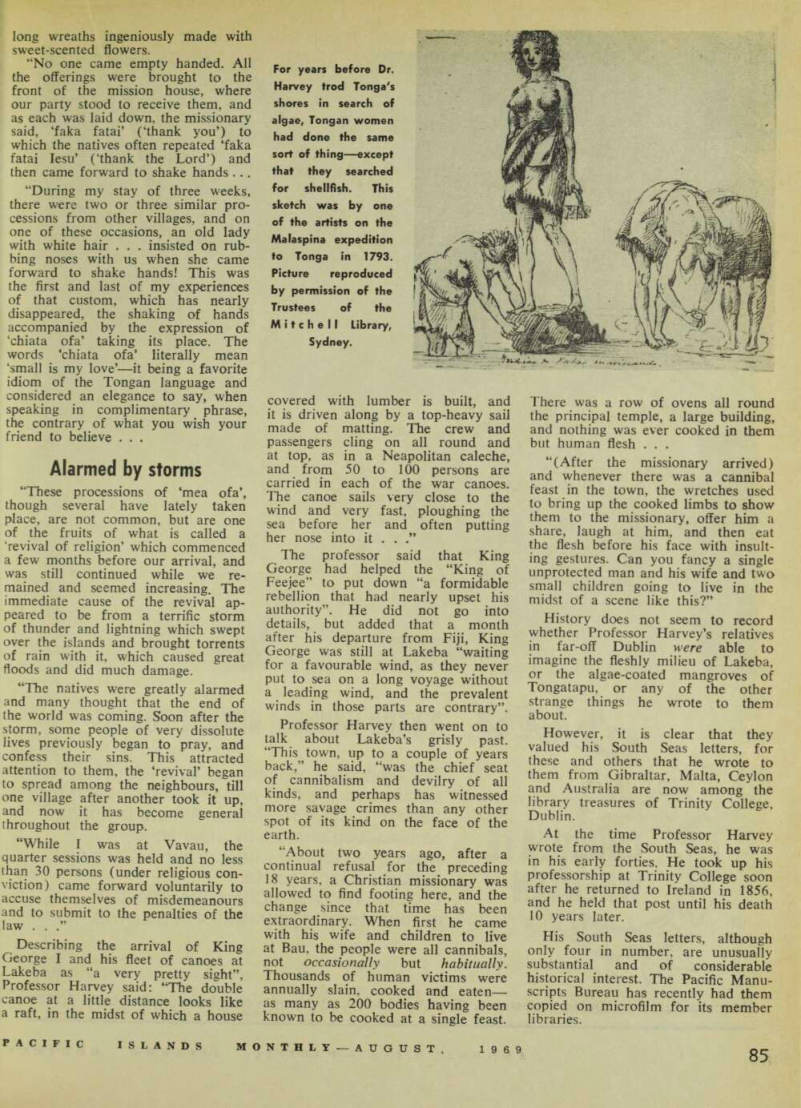
For years before Dr.
Harvey trod Tonga's shores in search of algae, Tongan women had done the same sort of thing—except that they searched for shellfish. This sketch was by one of the artists on the
Malaspina expedition
to Tonga in 1793.
Picture reproduced by permission of the Trustees of the Mitchell Library, Sydney.