Dr. Cairns Sets
p. 58 · Read in the full issue
Some Fiji
Teeth On Edge
“As the wife of an Australian sent to help Fiji, I am disgusted to think that a fellow Australian would come to a country as a guest and make so much mischief in matters that are no concern of his.”
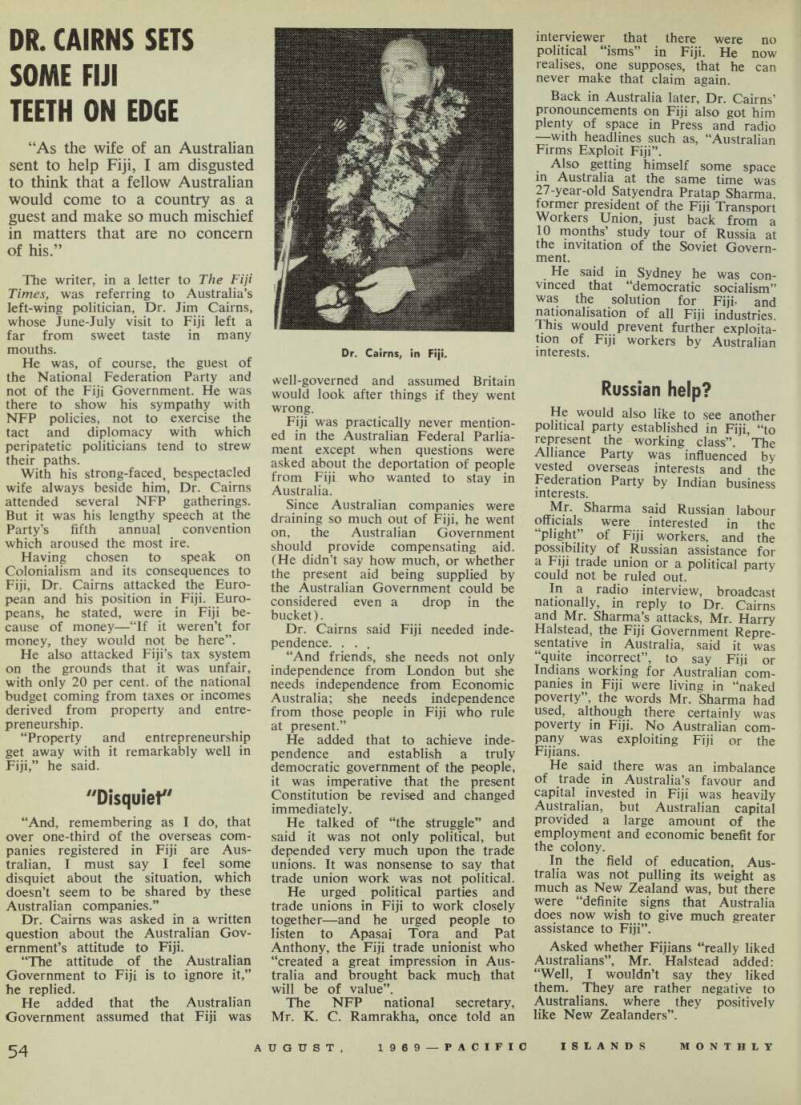
The writer, in a letter to The Fiji Times, was referring to Australia’s left-wing politician, Dr. Jim Cairns, whose June-July visit to Fiji left a far from sweet taste in many mouths.
He was, of course, the guest of the National Federation Party and not of the Fiji Government. He was there to show his sympathy with NFP policies, not to exercise the tact and diplomacy with which peripatetic politicians tend to strew their paths.
With his strong-faced, bespectacled wife always beside him, Dr. Cairns attended several NFP gatherings.
But it was his lengthy speech at the Party’s fifth annual convention which aroused the most ire.
Having chosen to speak on Colonialism and its consequences to Fiji, Dr. Cairns attacked the Euro pean and his position in Fiji. Euro peans, he stated, were in Fiji be cause of money—“lf it weren’t for money, they would not be here”.
He also attacked Fiji’s tax system on the grounds that it was unfair, with only 20 per cent, of the national budget coming from taxes or incomes derived from property and entre preneurship.
“Property and entrepreneurship get away with it remarkably well in Fiji,” he said.
"Disquiet"
“And, remembering as I do, that over one-third of the overseas com panies registered in Fiji are Aus tralian, I must say I feel some disquiet about the situation, which doesn’t seem to be shared by these Australian companies.”
Dr. Cairns was asked in a written question about the Australian Gov ernment’s attitude to Fiji.
“The attitude of the Australian Government to Fiji is to ignore it,” he replied.
He added that the Australian Government assumed that Fiji was
well-governed and assumed Britain would look after things if they went wrong.
Fiji was practically never mention ed in the Australian Federal Parlia ment except when questions were asked about the deportation of people from Fiji who wanted to stay in Australia.
Since Australian companies were draining so much out of Fiji, he went on, the Australian Government should provide compensating aid. (He didn’t say how much, or whether the present aid being supplied by the Australian Government could be considered even a drop in the bucket).
Dr, Cairns said Fiji needed inde pendence. . . .
“And friends, she needs not only independence from London but she needs independence from Economic Australia; she needs independence from those people in Fiji who rule at present.”
He added that to achieve inde pendence and establish a truly democratic government of the people, it was imperative that the present Constitution be revised and changed immediately.
He talked of “the struggle” and said it was not only political, but depended very much upon the trade unions. It was nonsense to say that trade union work was not political.
He urged political parties and trade unions in Fiji to work closely together—and he urged people to listen to Apasai Tora and Pat Anthony, the Fiji trade unionist who “created a great impression in Aus tralia and brought back much that will be of value”.
The NFP national secretary, Mr, K. C. Ramrakha, once told an
interviewer that there were no political “isms” in Fiji. He now realises, one supposes, that he can never make that claim again.
Back in Australia later, Dr. Cairns’ pronouncements on Fiji also got him plenty of space in Press and radio —with headlines such as, “Australian Firms Exploit Fiji”.
Also getting himself some space in Australia at the same time was 27-year-old Satyendra Pratap Sharma, former president of the Fiji Transport Workers Union, just back from a 10 months’ study tour of Russia at the invitation of the Soviet Govern ment.
He said in Sydney he was con vinced that “democratic socialism” was the solution for Fiji, and nationalisation of all Fiji industries.
This would prevent further exploita tion of Fiji workers by Australian interests.
Russian help?
He would also like to see another political party established in Fiji, “to represent the working class”. The Alliance Party was influenced by vested overseas interests and the Federation Party by Indian business interests.
Mr. Sharma said Russian labour officials were interested in the “plight” of Fiji workers, and the possibility of Russian assistance for a Fiji trade union or a political party could not be ruled out.
In a radio interview, broadcast nationally, in reply to Dr. Cairns and Mr. Sharma’s attacks, Mr. Harry Halstead, the Fiji Government Repre sentative in Australia, said it was “quite incorrect”, to say Fiji or Indians working for Australian com panies in Fiji were living in “naked poverty”, the words Mr. Sharma had used, although there certainly was poverty in Fiji. No Australian com pany was exploiting Fiji or the Fijians.
He said there was an imbalance of trade in Australia’s favour and capital invested in Fiji was heavily Australian, but Australian capital provided a large amount of the employment and economic benefit for the colony.
In the field of education, Aus tralia was not pulling its weight as much as New Zealand was, but there were “definite signs that Australia does now wish to give much greater assistance to Fiji”.
Asked whether Fijians “really liked Australians”, Mr. Halstead added: “Well, I wouldn’t say they liked them. They are rather negative to Australians, where they positively like New Zealanders”.
Dr. Cairns, in Fiji.