Tropica lities
pp. 55-57 · Read in the full issue
Seven Bridge Street, Sydney, for nearly 70 years nerve centre of that grand old lady of Islands trading, Bums Philp and Co. Ltd., has been given a $200,000-plus facelift over the last 18 months.
And the beauty treatment continues.
Visitors to BP’s dated but elegant two-storey headquarters have seen it acquire a third floor (by elevating the roof) and a “radical” silent press button lift (replacing its ageing, rope operated “glass cage”).
And, as though these changes weren’t enough, most of BP’s tall, Dickensian desks and chairs have been shortened—in keeping, one supposes, with the company’s trend away from quill pens.
What on earth’s going on, many customers and visitors (especially the more conservative) have asked.
Well, several years ago the firm’s venerable board (with the late Joe Mitchell at the wheel) decided to modernise the building rather than demolish it or rebuild on the same site a glass and concrete skyscraper.
BP’s doesn’t need to make its pre sence felt with 20 storeys of glass and chrome —even if a lot of other companies in the Bridge Street area do.
A third floor
Modernisation began late 1966 when 7 Bridge Street was steam cleaned. In October of the next year the inside shake-up began.
Over 4,000 square feet of new office space was created by adding a third floor to the building. BP’s sub sidiary trustee company moved into this area—the only air-conditioned part of the building.
Next, several departments on the ground floor were relocated, and the inside of the building was scrubbed and polished.
Then, over a long weekend in the middle of last year, BPs traded in their manual lift on a ’6B automatic.
The “glass cage’s” affable operator cum-caretaker. Bob Greig, dis appeared from public view to con centrate on other duties with BPs, and Sydney’s meagre supply of rope operated lifts becomes even more meagre.
Last stage of the modernisation—
Aunty Burns
Philp Has
A Facelift
due to be completed by 1970—is the up-dating of the first and second floors. With air-conditioning out of the question because of the huge rooms on these floors, ventilation systems are being installed. Even the room of BP’s young chairman, Mr.
David Burns, is not air-conditioned —something extraordinary for a man nominally controlling an empire worth well over $lOO million.
Other minor changes have been made, or will be by 1970—and these include an archives-cum-library (this is staff manager Ray Sharp’s baby) and the re-arrangement of the many shell, artefact and ship displays in varying spots in the building.
For the 300-plus staff one major shift will come later this year—BP’s accountants will move to the air
conditioned third floor and the em ployees of its trustee company will move a stone’s throw away—to a six floor $1.25 million building this group “picked-up” earlier this year.
All in all, BP’s renovations are a compromise. Sir James Burns’ think house stays, though her boarders have bought new clothes.
Pacific libraries do
well in Paris auction
The four member libraries of the Pacific Manuscripts Bureau were among the most successful bidders at the auction in Paris in June of an outstanding collection of manu scripts concerning Tahiti and other islands of the French Pacific, says Robert Langdon, executive officer of the Canberra-based bureau.
The collection was previously owned by Father Patrick O’Reilly, the well-known Pacific bibliophile and author. ( PIM , July, p. 73).
A total of 201 items—mainly manuscripts, but including a number of rare printed items—were offered for sale at the auction. More than a third of them were bought by the member libraries of the Pacific Manu scripts Bureau, although a few may be claimed by the French Bibli otheque Nationale under a law which gives it a prior right to literary material of national interest—pro vided it can match the price offered for it by others.
Senior librarians of the PMB mem ber libraries exchanged numerous letters and telegrams before the auction took place in an effort to avoid the prospect of one library
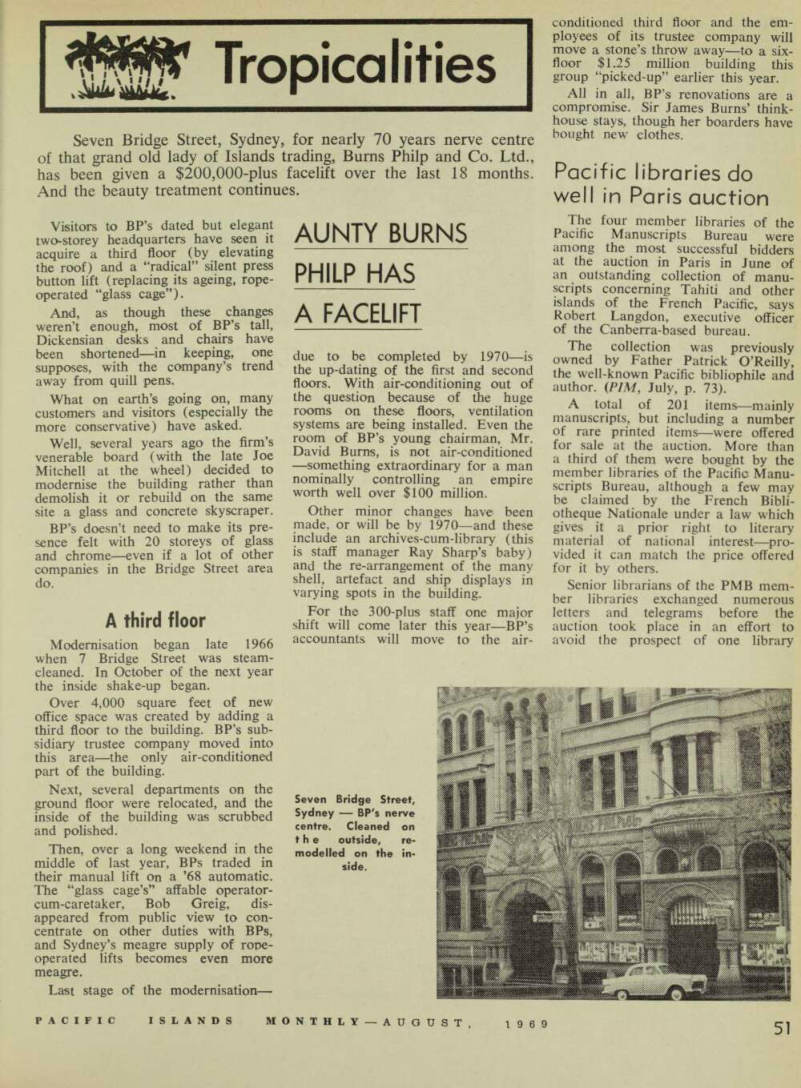
Seven Bridge Street,
Sydney-BP's nerve
centre. Cleaned on the outside, re modelled on the in side.
outbidding another for the same items.
The Mitchell Library, Sydney, which has an exceptionally strong collection of material on the Eastern Pacific, bought 40 items; the National Library of Australia, nine; the Uni versity of Hawaii Library, 13; and 13 others went to the National Library of New Zealand.
Six of the Mitchell Library’s purchases may be claimed by the Bibliotheque Nationale, and there is some doubt over the disposition of a seventh. The University of Hawaii Library may lose one item to the Bibliotheque Nationale.
Twenty items that the Mitchell Library would have liked to acquire went to other, higher bidders. These included a letter from King Pomare II of Tahiti written on July 2, 1817, announcing the adoption of Christi anity in Tahiti; a letter from Queen Pomare IV from Raiatea on May 11, 1846, saying she would never live under the protectorate that the French had established in Tahiti two years earlier; and a notebook in the hand of George Pritchard, the first and most famous of the British consuls in Tahiti, containing copies of 19 letters of great historical in terest of the years 1836-37.
The Mitchell Library was par ticularly disappointed that its “quite high limit” for the Pritchard item was exceeded, and it is now trying to find out who bought it with a view to negotiating the repurchase of it or obtaining a microfilm copy.
Of the 40 items that the Mitchell Library did buy at the sale, 19 are manuscripts, 20 are books or printed items, and one is a pen sketch. One of the books, a privately-printed work by the noted American historian Henry Adams, entitled Memoirs of Marau Taaroa, last Queen of Tahiti, was described in the catalogue as “the rarest book on Tatiti.” Only three copies of the book are known to exist, and two of them are in the Henry Adams Museum in Massa chusetts.
The copy bought by the Mitchell Library has manuscript annotations on 13 of its 109 pages and is thought to be the copy that Adams sent to Queen Marau in 1893.
New Caledonia gets
ready to celebrate
Noumea’s Festival Committee is preparing for New Caledonia’s week of local celebrations to mark the 116th anniversary of the French colonisation of the island, on Sep tember 24, 1853.
Planned activities include petanque
(French bowls) contests, a gymkhana of European cars, fashion parades, women’s cricket and a gruelling round-the-island bicycle race.
During last year’s celebrations, visiting tourists were invited to join the petanque contests, which were held by Anse Vata beach. The bowls used in this sport are solid metal and they are thrown on hard ground.
The latest model European cars accompanied by Paris fashions were also well appreciated at last year’s celebrations.
Finals of the women’s cricket con test are always a boisterous, hilari ous affair, accompanied by pilou pilou war dances from the men.
This year a parade of the colourful “Mother Hubbard” dresses is also planned, with prizes for the most picturesque creations.
The event which most captures the enthusiasm of the Caledonians at this time of the year, however, is the “Tour de Caledonie” bicycle race.
The 700 mile tour is over central mountains and coastal plains where less than one-quarter of the roads are sealed.
This year’s tour will depart Noumea on September 13 and return on September 24 with one day of rest inland.
Six cyclists are expected from
France, Australia and New Zealand.
Rousing welcomes await the men in each inland stopover with bouquets and kisses on both cheeks for the winners of each lap. Prizes are offered en route for the first or last past various landmarks—a village bridge or shop.
There are prizes, too, for the un luckiest—those who suffer the most falls and punctures, while guessing competitions are sponsored for the public to predict winners on each day’s lap.
Back in Noumea there is a tumultuous welcome over the final lap, with hundreds of cars lining the route into the city and thousands awaiting at the Magenta Velodrome, where the finishing cyclists make a triumphal round of the speed track.
$60,000 extension
to Fiji Museum
The Fiji Museum—which houses a Fijian-Melanesian collection re garded as second only to that of Honolulu’s Bishop Museum—is to undergo a $60,000 extension pro gramme.
According to its director, Mr.
Bruce Palmer, the need for expansion has become urgent because of the
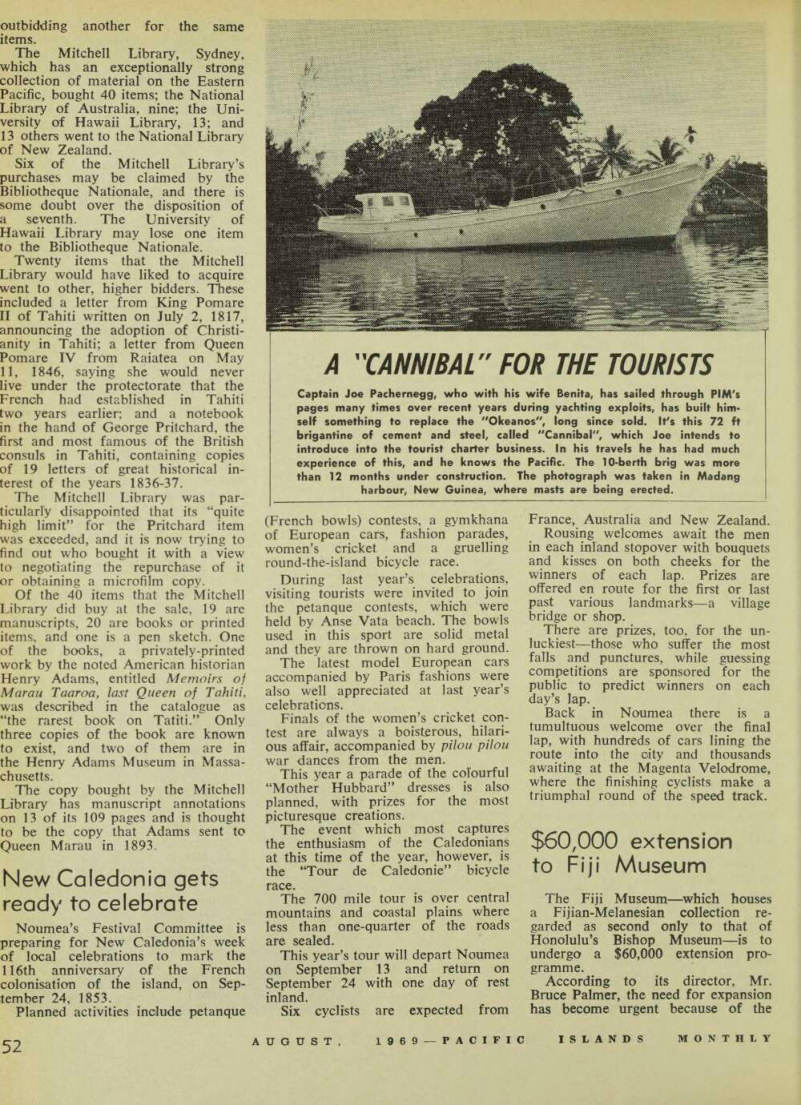
A "Cannibal" For The Tourists
Captain Joe Pachernegg, who with his wife Benita, has sailed through PIM's pages many times over recent years during yachting exploits, has built him self something to replace the "Okeanos", long since sold. It's this 72 ft brigantine of cement and steel, called "Cannibal", which Joe intends to introduce into the tourist charter business. In his travels he has had much experience of this, and he knows the Pacific. The 10-berth brig was more than 12 months under construction. The photograph was taken in Madang harbour, New Guinea, where masts are being erected.
growth of recent research activities, the establishment of a museum education service and the increasing problem of inadequate storage space for valuable additions to the col lection.
Plans for the new extensions to begin towards the end of this year —comprise a ground floor and gallery, containing a laboratory, dark room, research and storage facilities and considerable new display space.
The display area will be known as the “Hall of Man in the South Pacific” and the emphasis will be on the arts of the various South Pacific cultures.
“It is hoped that significant works of art will be on display to enable visitors to appreciate the diversity and richness of the cultures in this part of the world,” said Mr. Palmer.
The Fiji Museum has taken its place in recent years alongside other metropolitan museums in becoming a research centre serving a wide area.
The museum’s education service is becoming increasingly important.
Last year, nearly 20,000 children had lessons from museum staff.
P-NG remembers
Tom Mboya
“You are my brothers” . . . this was how Kenya’s then Minister for Justice, Mr. Tom Mboya, greeted Papua-New Guinea’s political leaders on a flying tour of New Guinea in 1964.
“Africa is watching you.” Mr.
Mboya told the then Member for Milne Bay in the Papua-New Guinea House of Assembly, Mr. John Guise.
In Port Moresby during that tour,
Mr. Mboya said: “This country will have much trouble . . . you need nationalism . . . your village people will have to think of themselves as part of a nation.
“Until then, there will be no strong political parties, and no hope of a strong, nationalistic nation.”
Last month, in Nairobi, a gunman killed Mr. Mboya (minister for economic planning and development) outside a chemist shop, and as the 38-year-old Mr. Mboya’s body was taken home for burial, Kenya’s suspicious tribes, the Luos and Kikuyus, were rioting and blaming one another for the killing.
In Port Moresby, Speaker of Parliament Mr. John Guise com posed a cable of condolences for Kenya’s President Jomo Kenyatta.
It read: “My colleagues and I join you in mourning the grievous loss of Tom Mboya whom we remember with affection and admiration.
“The friends he made here during his brief visit in 1964 feel a great personal loss.”
To observe the niceties of protocol (after all, Australia’s Department of External Affairs officially handles all of P-NG’s dealings with other countries) a carbon copy of the Guise cable was handed to the Administrator.
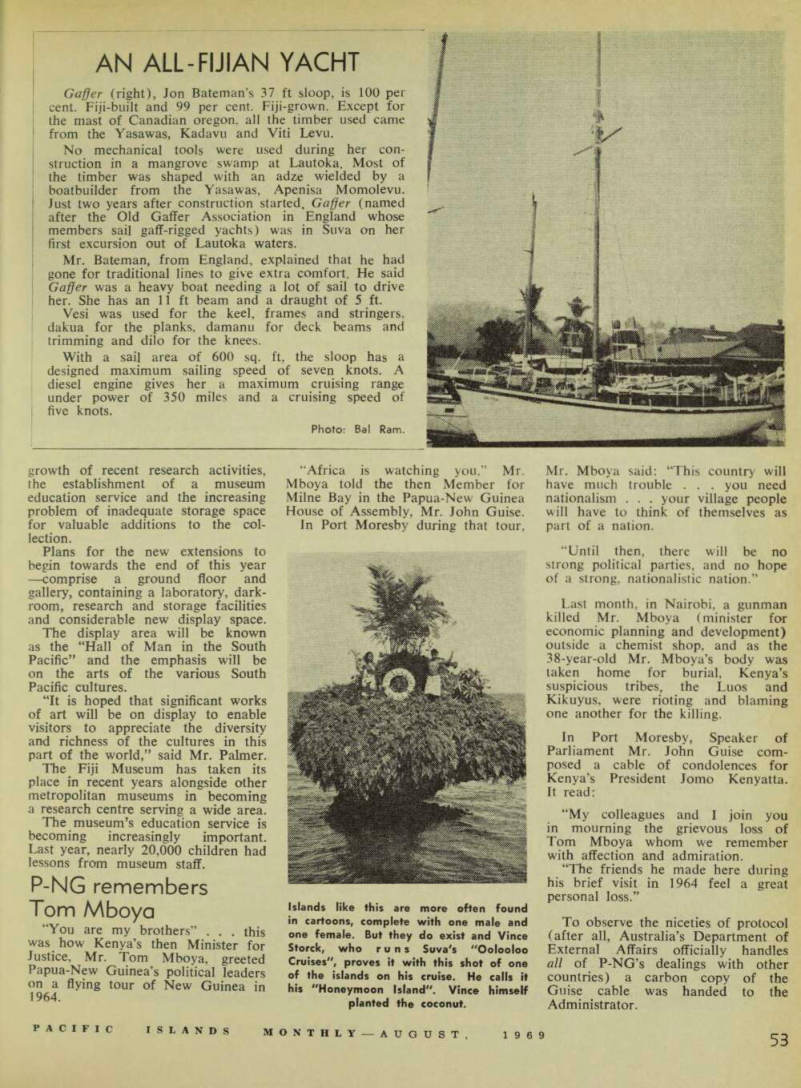
Islands like this are more often found in cartoons, complete with one male and one female. But they do exist and Vince Storck, who runs Suva's "Oolooloo Cruises", proves it with this shot of one of the islands on his cruise. He calls It his "Honeymoon Island". Vince himself planted the coconut.