To the Point
pp. 52-54 · Read in the full issue
Let's Say What We Re Thinking—Irian's
FREE CHOICE IS A FRAUD AND A SHAM
In this month of August, 1969, the thoughts of many, brown and white, in Niugini are turned towards their neighbour, West Irian, some apprehensively, some compassionately and some with vhat they imagine to be realism.
The apprehensiveness of Papuans n P-NG’s Western District, and slew Guineans in the West Sepik District, as they see the earlier rickle of refugees crossing the border becoming a steady stream, md hear of armed Indonesian patrols ■ampaging across the border, is easy o understand.
The compassion, too, is easy to inderstand when one has met some 3f the West Irianese now domiciled in Niugini and heard the stories of athers who have crossed the border in recent months.
Difficult to understand
The realists are a bit more difficult to understand because their realism is so frequently half-baked.
From the point of view of the Indonesians themselves there is. of course, nothing to argue about. West Irian has always been a part of Indonesia and that’s that. Sukarno is said to have looked back to the
To the Point with Percy Chatterton
Majapahit Empire of nearly a thousand years ago to support his territorial claims, but historians are cagey about saying whether the boundaries of that empire did or did not include any part of New Guinea.
In the more recent past, there is the fact that West Irian formed a part of the Dutch East Indies. Its inclusion therein was based on a
recognition of the Sultan of Tidore’s claim to sovereignty over “the Papuan islands in general . . . with out being specifically enumerated” — a very convenient vagueness if Indo nesia should ever want to repudiate the 141st meridian boundary as an invention of the colonialists.
Whatever the Australian Minister for External Affairs, Mr. Freeth, may say now, there is no doubt that back
in 1950 the Australian Government was far from happy about the extent of Indonesia’s territorial ambitions, and the then Minister for External Affairs, Mr. (later Sir Percy) Spender, said so in no uncertain terms.
“The Australian Government,” he said, “does not consider that Indo nesia has any valid claim to Dutch New Guinea, the future of which is of vital importance to the Australian people. ... If the claim of Indonesia were conceded in any degree at all, it would be a matter of time, no matter how genuine may be as surances to the contrary, when the claim will be pushed further so as to include the trust territory of Aus tralian New Guinea and its people.”
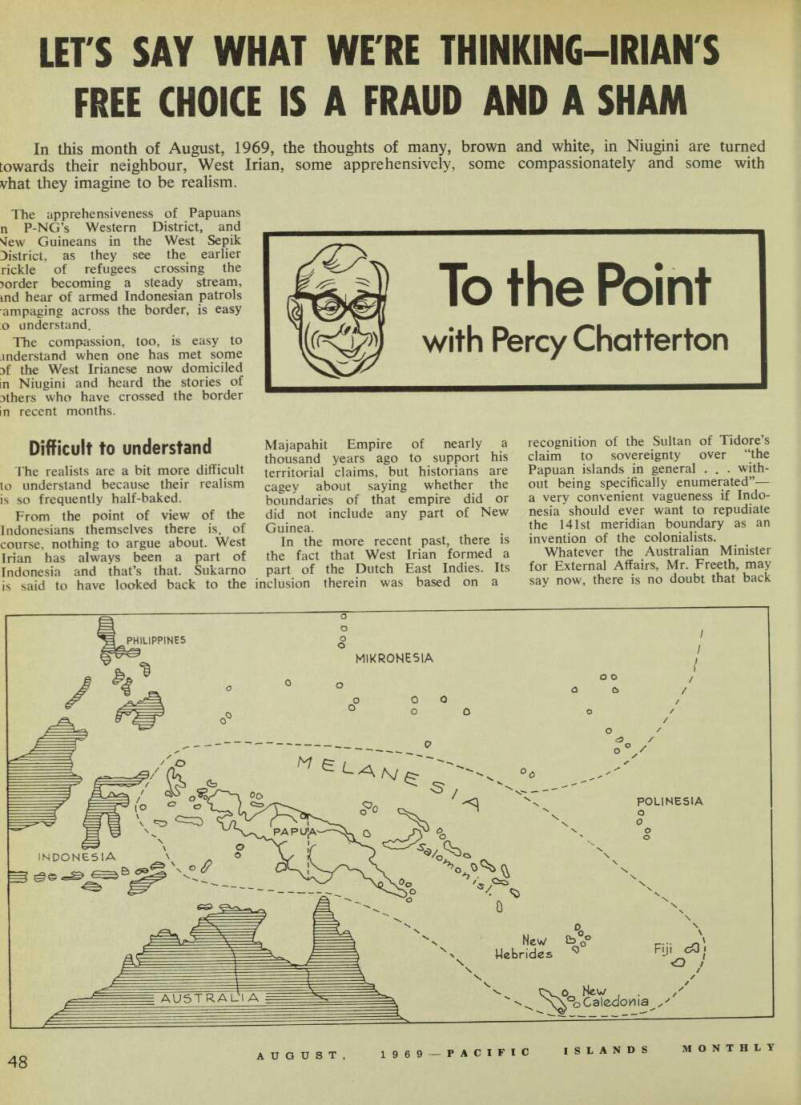
It is beyond dispute that there is a clear ethnological line of division between what may be called Malayan Indonesia on the one hand and what may be called Melanesian or Papuan Indonesia on the other.
The map shown opposite is from West Papua Freedom Movement sources, but, except that the divid ing line is not carried southward to include the island of Timor, it agrees closely with a map published by the English naturalist A. R. Wallace in 1868.
Wallace had spent eight years wandering all over what is now called Indonesia (he called it the Malay Archipelago), and one of the strongest impressions he formed was of the vast difference between the Malay people of western Indonesia
and the Papuan people of eastern Indonesia..
Writing of his arrival in the Ke Islands in 1857 he says: “I now had my first view of Papuans in their own country, and in less than five minutes was convinced that the opinion already arrived at by the examination of a few Timor and New Guinea slaves was substantially correct, and that the people I now had an opportunity of comparing side by side belonged to two of the most distinct and strongly marked races that the earth contains”. He reverts to the differences between the two races again and again in the course of his book.
Two points of view
Wallace lived in the archipelago during the last days of slavery, and was actually there when the Dutch declared the slaves to be free. From what he says about it, it appears to have been a fairly benign and easy going sort of slavery.
But it is clear from the records that the chief interest which the sultans of Tidore had taken in New Guinea up to that time had been as a source of bird-of-paradise plumes and slaves, and New Guinean chiefs had paid their annual tribute to the sultans in these commodities.
It has always seemed to me some what ironic that the passage of a century should have transformed an interest in New Guinea as a source
of slaves into a justification for “liberating” it.
Wallace’s Malay Archipelago was published exactly 100 years ago, in 1869. We live amidst the realities and complexities of 1969, and there are two points of view we can take about the present West Iriam pro blem—the humanitarian and the hard-boiled.
The humanitarian point of view is that the people of West Irian are human beings, with human rights which should not be sacrificed to the alleged “hard facts” of inter national power politics; that they are entitled to decide their own future freely and without fear; that, what ever the virtues of decision-making by consultation and consensus may be in other circumstances, in the circumstances now obtaining in West Irian it cannot be relied on to reveal the real wishes of the West Irianese people; and, that whatever responsibilities the United Nations may or may not have undertaken in 1962 in relation to the “act of free choice”, it now in 1969 has a clear duty, as the avowed champion of self-determination, to see that a genuine act of free choice takes place in West Irian.
This is the humanitarian point of view. It is my point of view, for which I apologise to no one, and which I would have supposed Aus tralians, those ardent apostles of the “fair go”, would have shared.
Lest any Australians should still
be under any illusions about the act of choice currently being enacted in West Irian, I will quote not the spokesmen of the West Papua Freedom Movement but Indonesia’s Foreign Minister, Mr. Malik, who is reported as having said in Singa pore: “The conditions of this act were already decided to be 100 per cent, on the Indonesian side”. These words were spoken a week before the “act of free choice” began.
Now for the hard-boiled approach.
The self-styled realists claim that a West Irianese decision for inde pendence might lead to the collapse of the Suharto regime and possibly to the break-up of the Indonesian Republic; that it is in Australia’s interest that a stable, anti-Communist regime should hold power in Indo nesia; and that we must therefore look the other way or even, like Mr.
Freeth, pretend to approve of what is going on in West Irian so as not to rock the boat.
This is not being hard-boiled; it is being parboiled.
If we are going to look at the situation from the point of view of Australian self-interest, we cannot assume that it is necessarily in her interest to have a powerful, united Indonesia as her neighbour. It might well be to Australia’s advantage to have several small states rather than one big one interposed between her self and South-East Asia.
Particularly it might be to her advantage, and to the advantage of Papua-New Guinea, to have a re public of “Papuan Indonesia”, by whatever name it might be called, as a buffer state between Australia and Papua-New Guinea on the one hand and Malayan Indonesia on the other.
From the point of view of Papua- New Guinea’s self-interests, a genuine act of free choice in West Irian, whichever way it went, might just possibly give us a peaceful border.
The current “act” certainly won’t.
The Freedom Movement will not accept it as final, and if they get no sympathy from the United Nations or from what we optimistically call the free world they may well seek it, and perhaps find it, in the Com munist world—which might not be averse to using West Irian as a springboard from which to avenge the wholesale massacre of Com munists which marked the present Indonesian regime’s access to power.
At the best we can look forward to a border situation which will tax the patience and skill of our Admin istration to the utmost. At the worst we might find ourselves with a neighbour torn by civil war and orientated towards Communism.
The trouble is that when we try to be hard-boiled there are so many things that we just don‘t know.
We don’t know whether a genuine act of free choice in West Irian would result in a decision for inde pendence or for unity with Indo nesia. And it looks as if we never shall know.
We don’t know whether the at tainment of independence by West Irian, if this occurred, would lead to further secessions and to a break-up of the present Indonesian Republic.
We don’t know whether, if this did happen, it would turn out to be to the advantage or the disadvantage of Papua-New Guinea and Australia.
Above all, we don’t know whether Indonesia’s territorial ambitions end at the 141st meridian. In 1945 Sukarno’s slogan was “Atjeh to Ambon”. In the 1950 s it became “Sabang to Merauke”. When this becomes a reality will there be a new slogan, and what will it be?
We do know that less than a decade ago Indonesian assurances that they would not prosecute ffieir claim to Dutch New Guinea by force were followed by the dropping of Indo nesian paratroopers there.
We do know that just recently a restrained Australian reaction to armed Indonesian intrusion into Papua-New Guinea was met, not by comparable restraint, but by wild accusations that we were training West Irianese guerrillas.
We do know that appeasement
never evokes respect, friendship or lasting peace, I am not advocationg bellicosity.
I am not suggesting that we should send troops to the border or gun boats up the Fly. I am not suggest ing that we should go out of our way to antagonise the Indonesians.
We can only wait on events, and try to refrain not only from inter fering but also from jumping to premature conclusions as to what effect any particular outcome may have upon us.
In the absence of effective inter vention by the United Nations, nothing we can do or say is likely to have the slightest effect on the course of events.
But we can say out loud what we are all thinking, namely that the act of free choice now being carried out in West Irian is a fraud and a sham. By saying so we shall retain our own self-respect, and will not forfeit the respect of anyone whose respect is worth having.
In the meantime we have the pro blem of refugees on our hands. Not all those who come across the border are bona-fide refugees; some are seeking relief from stark economic conditions and some no doubt are spivs. The task of sorting them out is a formidable one, and must for humanity’s sake proceed on the principle that it is better to let a few phonies through than to send one man back to an undeserved death.
I believe that by and large the Administration and its officers are doing a good job in a very difficult situation—a situation which calls for cool judgment and humanity, and sometimes for a quite substantial slice of courage.
I wish I were equally happy about the treatment of those who are allowed to stay here. Holding camps for those whose cases are under con sideration are fair enough, and the camps would appear to be well run.
But once they have been granted per missive residence these people should be treated as far as possible like all other citizens. It is reasonable that they should be kept out of the border areas. It is perhaps reasonable that they should be required to notify their movements to authority. But subject to such restrictions they should be allowed to enjoy the same freedom of movement that the rest of us enjoy. A recent disclosure that they are required to undertake not only to refrain from political activity (this we already knew) but also to live where the Administration tells them to live and to stay put there has come as a surprise to many of us— a surprise with rather a sour taste.
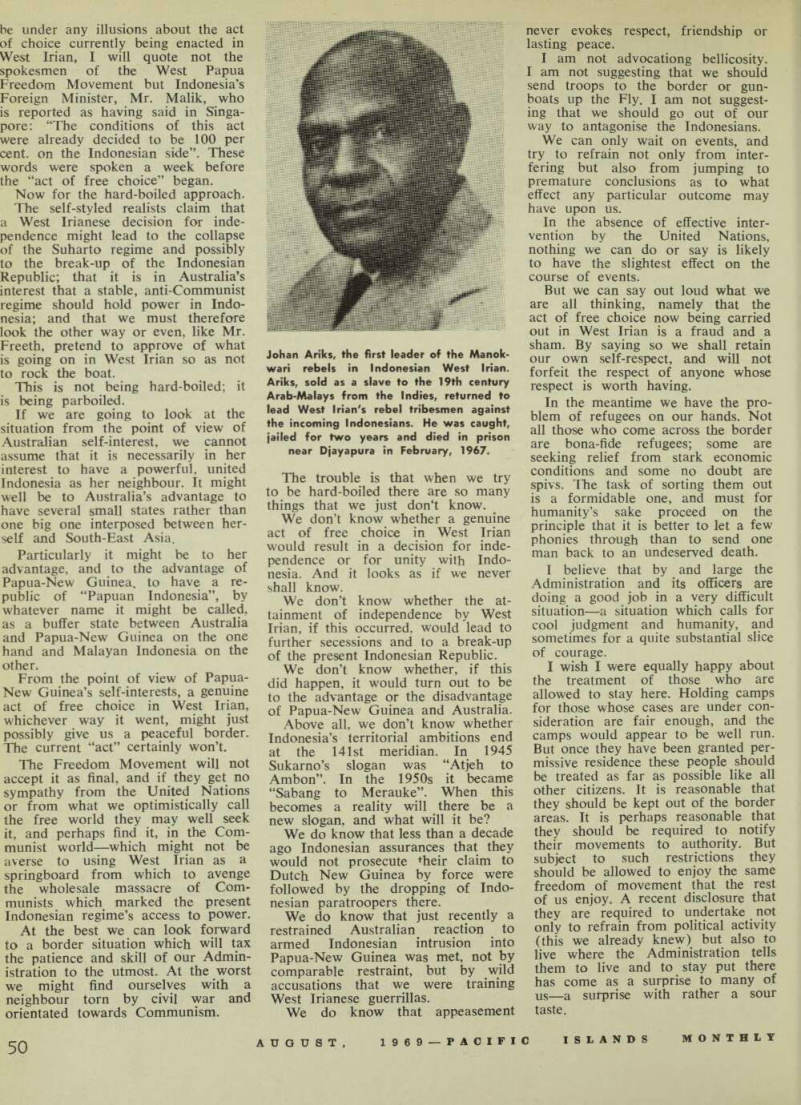
Johan Ariks, the first leader of the Manok wari rebels in Indonesian West Irian.
Ariks, sold as a slave to the 19th century Arab-Maiays from the Indies, returned to lead West Irian's rebel tribesmen against the incoming Indonesians. He was caught, jailed for two years and died in prison near Djayapura in February, 1967.