history
p. 48 · Read in the full issue
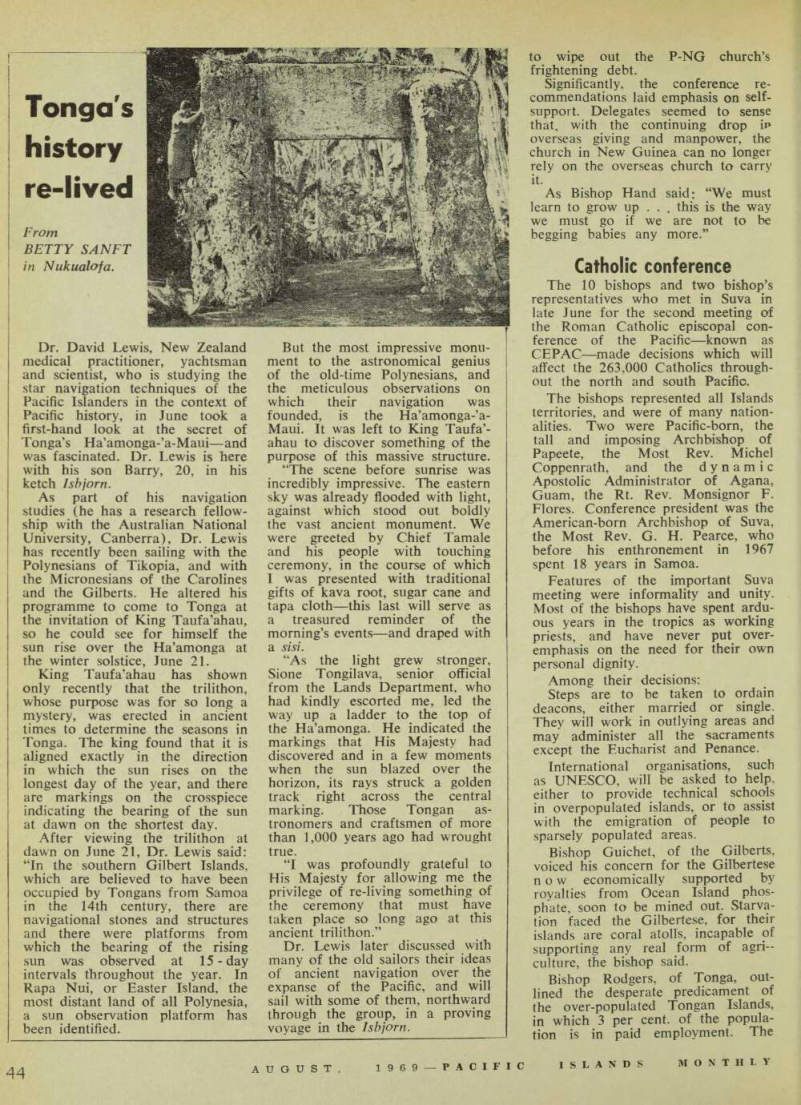
Tonga's history re-lived
Dr, David Lewis, New Zealand medical practitioner, yachtsman and scientist, who is studying the star navigation techniques of the Pacific Islanders in the context of Pacific history, in June took a first-hand look at the secret of Tonga’s Ha’amonga-’a-Maui—and was fascinated. Dr. Lewis is here with his son Barry, 20, in his ketch Isbjorn .
As part of his navigation studies (he has a research fellow ship with the Australian National University, Canberra), Dr. Lewis has recently been sailing with the Polynesians of Tikopia, and with the Micronesians of the Carolines and the Gilberts. He altered his programme to come to Tonga at the invitation of King Taufa’ahau, so he could see for himself the sun rise over the Ha’amonga at the winter solstice, June 21.
King Taufa’ahau has shown only recently that the trilithon, whose purpose was for so long a mystery, was erected in ancient times to determine the seasons in Tonga. The king found that it is aligned exactly in the direction in which the sun rises on the longest day of the year, and there are markings on the crosspiece indicating the bearing of the sun at dawn on the shortest day.
After viewing the trilithon at dawn on June 21, Dr. Lewis said: “In the southern Gilbert Islands, which are believed to have been occupied by Tongans from Samoa in the 14th century, there are navigational stones and structures and there were platforms from which the bearing of the rising sun was observed at 15-day intervals throughout the year. In Rapa Nui, or Easter Island, the most distant land of all Polynesia, a sun observation platform has been identified.
But the most impressive monu ment to the astronomical genius of the old-time Polynesians, and the meticulous observations on which their navigation was founded, is the Ha’amonga-’a- Maui. It was left to King Taufa’ahau to discover something of the purpose of this massive structure.
“The scene before sunrise was incredibly impressive. The eastern sky was already flooded with light, against which stood out boldly the vast ancient monument. We were greeted by Chief Tamale and his people with touching ceremony, in the course of which I was presented with traditional gifts of kava root, sugar cane and tapa cloth—this last will serve as a treasured reminder of the morning’s events—and draped with a sisi.
“As the light grew stronger, Sione Tongilava, senior official from the Lands Department, who had kindly escorted me, led the way up a ladder to the top of the Ha’amonga. He indicated the markings that His Majesty had discovered and in a few moments when the sun blazed over the horizon, its rays struck a golden track right across the central marking. Those Tongan as tronomers and craftsmen of more than 1,000 years ago had wrought true.
“I was profoundly grateful to His Majesty for allowing me the privilege of re-living something of the ceremony that must have taken place so long ago at this ancient trilithon.”
Dr. Lewis later discussed with many of the old sailors their ideas of ancient navigation over the expanse of the Pacific, and will sail with some of them, northward through the group, in a proving voyage in the Isbjorn.
From
Betty Sanft
in Nukualofa.