Fewer Athletes At Games-But Best
pp. 28-33 · Read in the full issue
Yet Times Expected
Port Moresby began to fill up with keyed-up athletes and officials, as well as many hundreds of spectators, with only days to go before the third South Pacific Games, starting August 13.
Although fewer athletes are taking part in the Games, the standard of events is expected to be much higher than in previous years. Officials and competitors have learnt much from previous Games and have been train ing intensively over the past months.
Interest in the Papua-New Guinea capital was tempered only slightly by the news that yet another territory— the Cook Islands—had withdrawn at the last minute, and the Western Samoan team would be reduced be cause of costs.
Eleven Islands’ territories, how ever, with over 1,000 athletes and officials, will be competing for the 760 gold, silver and bronze medals.
Competing territories are the host team, New Guinea, and the Solomons, French Polynesia, Guam, Tonga, Nauru, New Caledonia (including Wallis and Futuna), New Hebrides, Western Samoa, Fiji and American Samoa.
Not competing, besides the colour ful Cook Islanders, are the Gilbert and Ellice Islands, Niue and the US Trust Territory of Micronesia.
July Microlympics
In July, Micronesia held its own Microlympics at Saipan to examine its athletic potential for the next South Pacific Games in 1972, in which it hopes to take part.
The territory has also been en couraged to develop its own native skills and among the events were canoe sailing and paddling, coconut tree climbing, spear throwing, coco nut husking and underwater swim ming and diving.
Sports at Port Moresby will be athletics, Rugby Union, soccer, basketball, swimming, netball, yacht ing, golf (at Lae), tennis, judo, table tennis, boxing, volleyball, weight lifting, and softball.
FinisJiing touches to Games arenas in Moresby are being made, timing equipment is being installed and last minute accommodation arrangements are being made sufficient for Games people and the expected hundreds of
overseas and territory visitors who will fill the town’s pubs, private homes and temporary housing.
Mr. D. O. Hay, P-NG s Admimstrator, has declared the afternoon of August 13 a half-day holiday in Port Moresby, so that public servants and others can see the opening ceremony.
The official opening will be performed by the Duke of Kent.
Competitors’ and managers’ accom- !5,,“ rl~ u l ”"” d These are the last-minute reports on Games chances, specially compiled bv PI M’s Islands correspondents;
Shiomon Islands
suiumun IjLMinl/J The soccer team has improved considerably and is expected to acquit itself well. Sixteen players will be sent under coach manager Jock Basketball is a game that has picked up considerable popularity in
players' wm be sent Tnder Fathir
L T%^rfit in and CO keen m Rugb e y team with lots of fight in it is doing well, The training squad is bringing the team up to the peak of condition.
Fiji dominates this sport, but the
Solomons feel they have a good chance among the others.
Twenty-one players, including David Campbell, at the University of Papua-New Guinea, have been selected, under coach-manager Tom Donovan.
The golf team is represented by John Hall, Deputy-Director of Agri culture, who is a big man, a big hitter, and possessed of a good match temperament.
Whether there are medals to be won or not in netball, the Solomons girls are determined to have a go at the P-NG team. Ten girls are in the team under coach-manager Winnie Duituturaga.
The Chinese lead in table tennis; two of the team of three having previously played in competition table tennis in Hong Kong, winning high reputations.
In athletics, hopes lie for a few individual medals. The team of 11 men includes George Lepping, who won a silver medal for the triple jump in Noumea, and George Fafale, currently doing a course at Rabaul and the present NG record holder.
Both are jumping close to 48 ft for the triple jump, and will also repre sent in the long jump.
Andrew Dakatia, another Solomons student in NG, will take part in the 10,000 metres and marathon, for which he is tipped by Moresby coaches to be a likely medal winner.
The remainder of the team, who are relatively untried, will take part in the sprints, 1,500 metres, 5,000 metres and 10,000 metres. One of the distance men, Lonsdale Bako, competed in Noumea as a 15-year-old schoolboy and now has a lot more strength and stamina.
Team manager is Mike Lee and assistant manager. John Tura. The total team strength is 82, most of whom will travel to Moresby by the RCS Be lama, leaving Honiara on August 6.
The Solomons have participated in both the previous Games but their only success so far has been in the Noumea triple jump, where they took bronze and silver medals.
Fiji
Prior to the announcement of Fiji’s South Pacific Games team, a smattering of onlookers and a deter mined group of athletes braved cold, wet weather to gather at Buck hurst Park for the final trials.
Highlight of the two-day meeting was undoubtedly the magnificent performance from slightly built Usaia Sotutu, who became the fastest 10,000 metres runner in the South Pacific when he ran the distance in 31m. 55.75. His time was 4m. 16.35. out side the world record.
The second and third runners — middle and long distance coach, Mike Joyce and Nowame Vuto of the RKS Old Boys Club—also broke the South Pacific Games record of 33m. 4.65. established at Noumea in 1966 by Morgan-Morris of Nauru.
There were some excellent per formances from a number of other athletes —including girl runner Torika Varo, who starred in the Noumea Games. She was trying out her leg for the first time in serious com petition since undergoing a cartilage operation. The results were good enough to win her a place in the team.
Record breaking
Attractive Mereone Bose, 18, earned her place when she broke Fiji’s discus record twice within five minutes at Buckhurst Park.
Eleanor Phillips took the women’s pentathlon, amassing 3.540 points to Ana Ramacake’s 3,384 points for the five events.
Highlight of the second day’s events was the 5,000 metres tussle between Sotutu and Englishman Mike Joyce, who has been the only pace maker formidable enough to push Sotutu on the track.
Joyce and Sotutu see-sawed in first and second places during the 12 laps of the 5,000 metres but it was only in the final straight that the result could be seen.
Joyce flashed past Sotutu 40 metres from the tape—and the little Fijian grinned as he saw his coach breast the tape first.
Although it seemed in June that girl swim-star Olive Pickering, who represented Fiji in Noumea, wouldn’t compete at Port Moresby, news came in July that she would be in Moresby after all.
She returns to Fiji temporarily from Australia in late July to join the Games team.
Olive’s recent times have been well under the qualifying times set by the Amateur Swimming Association of Fiji.
She has been swimming regularly in Australia, where she has been living since 1967, and has now acquired top coach Vic Arneil who coached Australia’s Michael Wenden to gold medal success at the Mexico Olympics.
Her presence on the team, with Lorraine Emberson (who dominated tle women’s events in the recent Fiji championships), Lyndal Probert and Julie Murphy gives Fiji its best-ever women’s swimming team.
A Games team of nine boxers. five of them 1969 Fiji champions, was chosen during the Fiji Amateur Boxing Association trials held in Suva on July 12.
As no middleweight of sufficient standard was available, Fiji will not be represented in this division, nor will there be anyone in the lightflyweight, as no boxer in Fiji is small enough.
The team is: Flyweight, Subhas Chandra, of Labasa, who won a gold medal at the last Games without having to box for it, because there was no contender; Bantamweight, Chandra Sen, an aggressive young boxer from Lautoka, who won the Fiji title this year; Featherweight, former champion Sakaraia Qoro, of Suva; Lightweight, champion Esala Vula, ah K UVa ’ Wh ° haS been undefeated in t-u l * 8 ’ • Light-welterweight, Isimeli Nuinui, who became the 1969 champion in June;
Welterweight, champion Basedeo, from the Western Division; Light-middleweight, champion Alipate Korovou, of Suva, a silver medallist from Noumea and reigning Fiji champion for the past three years; Light-heavyweight, Salusalu, of Suva and heavyweight, police sub inspector Veramu Dikidikilati, who had been disqualified on a technicality during the June championships when he was clearly ahead on points, Manager Stan Brown says Fiji’s strength lay in the lightweight, light welterweight, welterweight and light middleweight divisions.
“But it’s the same with the other territories,” he added wryly. “Boxing should be much keener at the Games, because P-NG is putting great effort into training and Western Samoa has been working with a NZ trainer for months.
“Tonga and French Polynesia have been meeting regularly in competition bouts—so competition from them will be keen too.
“The New Hebrides team is an unknown quantity of course since it will be its first appearance, “But I’m pleased with our team— they’ve been training hard since the June championships and will continue to do so right up until the Games begin.”
Fiji’s coach is Hector Hatch, trainer of the very successful team which won seven medals at Noumea, If funds can be raised, Moses Evans, ex-Fiji and ex-Games
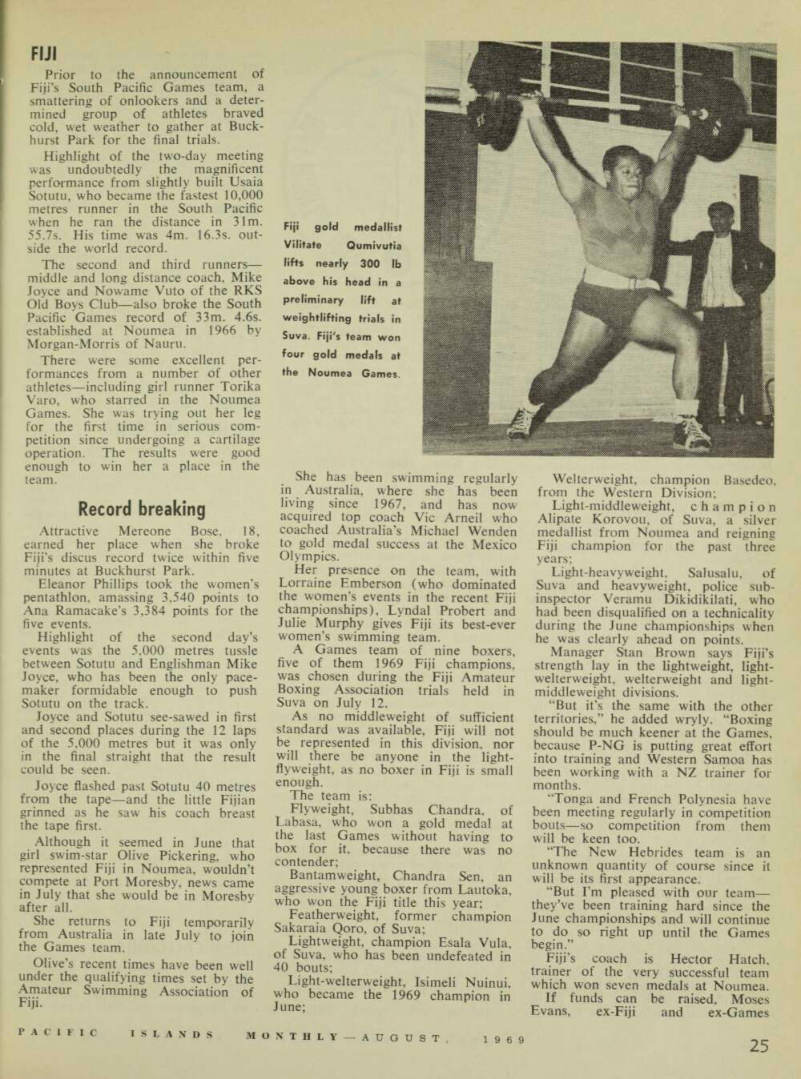
Fiji gold medallist Vilitate Qumivutia lifts nearly 300 lb above his head in a preliminary lift at weightlifting trials in Suva. Fiji's team won four gold medals at the Noumea Games.
champion, will be accompanying the team to Moresby as assistant trainer.
During the Noumea Games, Fiji’s heavyweight gold medallist, hefty Vilitate Qumivutia, scored a total of 765 lb with his three lifts. But he put that score well and truly in the shade when he lifted a total of 815 lb during the Amateur Weightlifting Association trials in Suva a few weeks ago.
Vilitate raised 310 lb in the clean and jerk, breaking his own record of 281 lb, set at Noumea.
In the press, he raised 275 lb above his head, breaking the South Pacific Games record of 253 i lb set by Western Samoa’s F. Sueili at Noumea.
In the middle-heavyweight division, Filimoni Romanu, of Suva, smashed the press record of 2421 lb, held by P. Patel, of New Caledonia, by 27i lb.
The Fiji team, with five veterans of the Noumea Games, looks a formidable one. Team members are: Bantamweight—J. K. Nair; light weight—V. P. Sharma and M.
Hassan; middleweight—S. Vonovono; light-heavyeight M. Sivoi; middle heavyweight—F. Ramanu; heavy weight—Vilitate Qumivutia.
Papua-New Guinea
The host country for the Games by far has the biggest contingent . . . 234 in all.
In Noumea, P-NG’s record for the field events was a great collection of silver medals. This year P-NG enters into the Games with a warning from athletics team coach John Cheffers that “gold medals for New Guinea will be as scarce as hen’s teeth”.
Cheffers, speaking at Rabaul, said New Guinea couldn’t be sure of win ning even one gold medal.
The factors, he said, were the rapidly rising standards in the other Pacific territories and the slowing down of New Guinea athletes in training during the past few days.
“What some of them need is a swift kick in the right place,” Cheffers told a radio interviewer. “Some of our athletes are working (at their training), some are not working too hard, and a few are just not doing anything.”
Cheffers says that now that most of the New Guinea championships are over, the Games team is finding itself hard-put to get enough last minute, serious competition in readi ness for August 13.
“New Guinea athletes just don’t appreciate the strength of the op position—the Games are not going to be a ‘picnic’ for us,” he said.
Cheffers claimed that some of the territory’s section managers had been
boosting the morale of their athletes and players by telling them they would win plenty of medals. “They are in danger of getting carried away with themselves,” said Cheffers.
“We don’t want our athletes to go into these Games too confidently, and then be disillusioned. I’m a pessimist at heart, and despite what I’ve said, I hope that we can—l think we will —win a few medals.”
The best bets?
Kito Kaida (Dam), Salitia Pipit, Geno Pou, Brother Gough, Darius Uvah (Rabaul), Loko Kolore (Port Moresby), Goa Koite (Lae). Cheffers believes that if a medal is almost “certain”, it will be the 4 x 100 metres relay, won by New Guinea at Fiji (1963) and Noumea (1966).
In the 100 metres, four countries, in cluding P-NG, are strong contenders.
The territory’s best time for this event was recorded by Meli Muga at the territory championships, running into a strong wind, at 10.95. Fiji and Naum have recorded times of 10.35. and 10.45.
P-NG has entered in all divisions of the boxing except heavyweight. Its hopes rest with four boxers.
Both men and women’s basketball teams are well in the running for medals.
The P-NG soccer team has every chance of making the top four, who will play off for the three medals.
This time the matches have been arranged in such a way that all teams will play each other. Tahiti is still favourite.
The big threat in Rugby Union is the Fijian team now touring Australia on its way to the territory. Fiji did not participate in Rugby Union at Noumea, and P-NG took out the gold. . .
The territory tennis team received a silver medal . . . going down to French Polynesia. The tennis team is more confident this time, although it sees French Polynesia as a danger still.
Of the table tennis team, the
strength seems to lie with the women, but officials admit they don’t know performances in other territories.
The swimming team has youth and at the moment is undergoing two training sessions daily: it will be in creased to three as the Games draw nearer.
In the weightlifting, the territory has entered in all divisions, but Fiji appears to have the strength.
Guam
Not represented in Suva, and in only three sports in Noumea (athletics, basketball, volleyball), Guam is sending its biggest team to Moresby—loB competitors and officials. They’ll compete in athletics, softball, netball, volleyball, basket ball, swimming, tennis, table tennis, judo, sailing, golf, boxing and weightlifting. It’s a young team, designed to gain experience, but there is strength in the ball games, particu larly in basketball. Guam won a basketball bronze in Noumea.
French Polynesia
French Polynesia has excellent prospects of carrying off several gold medals in the athletics events.
Jean Bourne, the territory’s champion sprinter, seems almost certain to win the men’s 100 and 200 metres. He has spent much of his time in France since the last Games and has done the 100 metres recently in 10.45. and 10.35.
He won a gold medal in Noumea for the 200 metres with a time of 22.45.
Stanley Drollet, the silver medallist in Noumea in the pole vault, could easily go one better this time, as his best recent performance is 4.30 metres (14 ft li in.) compared with the Games record of 13 ft 7i in.
Other good performances recently by French Polynesian male athletes were: Charles Huck, 52.55. in 400 metres; Alexandre Teahu, 1.90 metres (6 ft 3 in.) in the high jump; Pierre Teahu, 1.87 metres (6 ft 2 in.) in the high jump and James Deane, 39.40 metres (129 ft 3 in.) in the hammer throw.
Dominique Chaze, with recent per formances of 13s. for 100 metres and 12.55. for the 80 metres hurdles, looks like being well in the running for a medal or two.
Yvonne Harry (3,350 points in the pentathlon) is also considered a good prospect among the women, as is Yolande Temeharo (3,400 points).
New Caledonia
With the second largest team after the host team at the Games, New Caledonia is expected to really turn on the pace, particularly in swimming
and athletics. Six coaches from France will accompany the team.
In recent weeks Caledonian sports men in various events have been able to match themselves against several overseas teams for worthwhile ex perience. This could well pay off in Moresby.
The best recent performances were: Men 100 metres, Wajieme, 10.95.; 110 metres hurdles, Blameble, 16.45.; 200 metres, Wajieme, 22.35.; 400 metres, Wajieme, 50.95.; 800 metres, Guepy, 2m. 5.35.; 1,500 metres, Guepy, 4m. 12.55.; 3,000 metres steeple. Julien, 10m. 46.85.; 5,000 metres, Feracci, 17m. 9.45. and 10,000 metres, Guepy, 34m. 50s.
Shot put, Bone, 14.59 metres; discus, Bone, 47.5 metres; javelin, Wayo, 58.64 metres; triple jump, Kaddour, 14.73 metres; long jump, Paouta, 6.72 metres; hammer throw, Bone, 38.40 metres; high jump, Belmeda, 1.75 metres and pole vault, Bonnet de Larbogne, 4.20 metres.
Women 100 metres, Kapoui, 13.35.; 400 metres, Guenant, Im. 2.65.; 800 metres, Guenant, 2m. 33.25.; shot put, Lesson, 11.73 metres; discus, Sakoumory, 34.34 metres; javelin, Paniewa, 42.08 metres; long jump, Pine, 5.17 metres and high jump, Maindu, 1.50 metres.
Nauru
The team will include basket bailers, tennis players, softballers, and track and field athletes.
The tennis squad of four men and four women includes four players of Games experience (Graham and Gay Roberts, Kun Menke and Langi Grundler).
Training both on the courts and in organised physical activities takes up at least five sessions per week, so the team should not lack stamina.
In softball, Nauru is fielding an attractive young side. Out of the 12 girls, three are still attending secondary school, so speed and enthusiasm will be more than evident.
Softball is in its third year on the island, and registered players number over 100.
As Nauru ground conditions don’t favour softball, the girls should find the grassy fields of Moresby a wonderful change.
The basketball team is made up of eight Nauruans and four Ellice Islanders. Under the vigilant eye of Queenslander Bob Love, the team is in intensive training.
Lack of height may hinder the team, but speed and ball-handling are features of the Nauruan game, and these latter qualities may more than compensate for the lack of “tall timber” in the side.
If statistics are any guide, Nauru looks certain to collect one gold medal and a string of silver medals.
Mrs. Lois Lax is currently throw ing the discus 20 ft further than the best recorded elsewhere in the South Pacific, and her 145 ft 10i in. may be improved upon at Moresby.
She should make the final of the 80 metres hurdles as she has recorded 12.85. already this year and all her runs have been solo!
Tony Bowditch ran a 9m. 57.45. steeplechase in his first attempt since Noumea and should improve enough to give the Fijian Sotutu another great race.
Tony has twice run 4m. 10.65. for the 1,500 metres on his own, and should break his Games record at Moresby.
He will also run in the 5,000 metres and the marathon.
Robbie Morgan-Morris has started to show some form again with 32m. 59.65. and 32m. 47.25. for 10,000 metres on two consecutive weekends, but is still six seconds behind Sotutu’s best.
The three distance events should be worth watching when these two athletes meet.
Promising junior Karl Tabwia will lead the younger brigade of distance runners from Nauru, and Karl is to run in the 1,500 metres, 5,000 metres, and the steeplechase.
Karl Hartmann lines up for 10,000 metres and marathon, while William Tabwia tackles the 800 metres, 1,500 metres and the steeplechase. Nauru expects these young athletes to bring home a great deal of experience from these Games, and put it to good use by collecting medals in 1972.
Nauru holds five South Pacific Games records in track and field athletics and hopes to improve the tally in Port Moresby.
American Samoa
Boxing and basketball are the two big hopes of the 70-man Samoan team. The territory will also be repre sented in volleyball, weightlifting, softball and tennis.
Boxing, which regularly attracts big crowds to the Lee Auditorium and other arenas near Pago Pago, is extremely popular, particularly bouts between burly athletes from neigh bouring Apia, Western Samoa, and Pago Pago youths.
American Samoans have acquitted themselves well in boxing events in both Games, without taking away full honours, and locals expect their punching boys to return to Tutuila in late August with a few medals.
Favourites for Games include Ve’a, a heavyweight, To’o, a light heavyweight, and Pii Nomaea, a middleweight.
In a recent fight at the Lee Audi torium, Pii scored an easy knockout in the first round against Lauifi Laumoli in an elimination tourna ment for Games selection. The crowd, who had cheered Pii even before the action started, wildly acclaimed Pii a Games “must” when he put Pauifi on the canvas seconds later.
Western Samoa
Western Samoa will send a team of 14 contestants and four officials.
They will fly from Apia to Port Moresby via Noumea, Sydney and Brisbane on August 9.
That independent Samoa would participate was very much in doubt until the middle of July because of the lack of funds. Money-raising projects fell flat.
At last the government came to the rescue, the cabinet granting SWS3,OOO on July 16—half the amount needed.
The rest was by public subscription.
Western Samoa’s team will consist of three weightlifters, two marathon runners, two yachtsmen, six boxers and four officials.
They are, in the same order: Paul Wallwork, middleweight (gold medallist in the Noumea Games); Peko Seuili, heavy (silver medal, Noumea), and Filo Fuata, bantam; Amani Tapusoa and Saialala Gaopoa, who will run in the 5,000 and 10,000 metres and steeplechase in addition to the marathon, and lafeta Suamene, decathlon; Allan Grey and S.
Tefaga; Moli Afatasi, light-welter, who won a gold medal in Noumea.
He was the only boxer selected when this issue went to press. A bantam, welter, feather and middleweight were to have been chosen the last two weeks of July. The officials: Tufuga
S. Atoa, president of the Amateur Sports Federation, general team manager and representative to the Games Council; Floyd Strain, athletics; Alfred Betham, boxing; William Barrett, weight lifting.
Western Samoans won four golds and four silvers with a team of 43 in Noumea, 1966, and a silver and a bronze with a team of 80 at Fiji in 1963. The financial restrictions have curtailed severely the number of contestants for Port Moresby, yet at the same time ensured high quality, so this Games may bring in more medals than the others.
Samoan sports officials believe that their 14 competitors will bring home as many as six gold, two silver and two bronze medals.
Gold medallist middleweight weight lifter Paul Wallwork, now studying in Australia, is considered certain to re tain his title, as is gold medallist light-welterweight boxer Moli Afatasi, who has been showing great form in New Zealand. Officials expect silver medallist heavyweight weightlifter Peko to take the gold medal this time.
Samoa’s third weightlifter, bantam weight Filo, has been lifting in the Commonwealth Games category and is also expected to take a gold medal.
Samoa’s yachting entrants, A. Grey and crewman Tevaga, have been performing consistently well with Apia’s flourishing Yacht Club and should be among the placegetters at Port Moresby. The three-man athletics team comprises two mara thon and distance runners Saialala and Amani who have been clocking around 2h. 40min. for the marathon plus a dccathalon entrant lafeta who has been doing well in New Zealand.
There are any number of out standing boys from whom to pick the other five boxers not already named.
Boxing officials are confident that every boxer who makes the team will be a gold medal prospect.
New Hebrides
High medal hopes are centred on a 14-strong squad of athletes, seven men and seven women which, in spite of its youth (average age is a little under 18), contains some ex perienced members.
Eight of the team have competed overseas before —three men and one woman took part in the Noumea Games —and it is hoped that the territory will be well represented in the finals.
Experience gained by sprinter Charles Godden during a visit to Australia last year was of great benefit and his times during this year
are well up to expectation. He has three times done 10.45. for the 100 metres even though he was beaten into second place during the principal meet of the season by Yves Rollands, both men clocking 10.65. (sprint strength is shown by third and fourth runners in the race, Jean Bai and Seru Korikalo, both being timed at 10.75.).
In the 200 metres, the season’s best time has been 21.85. (Korikalo twice, Godden once) though Rollands recorded 21.45. from five metres in a handicap event.
Best time for the four x 100 metres relay has been 41,95. but this was on a track where the first 200 metres were in very poor condition.
For the same reason it is difficult to assess chances in the 400 and 800 metres events where the best times for the season have been 51s. and 2m. 3.25.
Only one man has been entered for field events and this for the long, high and triple jumps—he has a good chance of reaching the top six in at least one of these events.
The big steps this season have been made by the women athletes, previously not strong. Saria Kaluat, who at 14 reached the final of the 100 metres in Noumea, has had a very good season. She took the 100 metres in 12.65., 200 metres in 26.35., 400 metres in 61.95. as well as a long jump of 16 ft 5 in. and several javelin throws over 112 ft.
Another girl, Merilyn Rose Leo, has a season’s best time of 64.15. for the 400 metres but part of the track was in poor condition.
In field events, Didin Kaltakae is throwing a discus regularly around the 120 ft mark; Leisale Mangawai is reaching 125 ft with the javelin.
Two other girls aren’t far behind with their throws in both events.
Athletics trainer Alan Bell is sure that some medals will be won since such large advances have been made since 1966. However, he’s reluctant to say in which events because it’s been hard to obtain up-to-date information from other competing territories.
For the first time the football team will come from Santo and Vila.
Previously the Hebrides has been represented by either a complete Santo or a Vila team.
Final selection of the 15-man squad was made on July 21 by team manager Mr. Gabrillargues, a pro fessional coach and former inter national player from France, called in for the last two months to weld together players who have hardly met before.
His professional assistance was requested by coach Remy Delaveuve who is not hopeful of Hebrides’ football chances. “With progress made recently by Fiji and Papua- New Guinea, we’ll be lucky to get a bronze medal”, he said, Mr. Delaveuve also hopes to
A dramatic scene at the 1966 Noumea Games as Robbie Morgan-Morris of Nauru, and an official support Fiji's Usaia Sotutu at the end of the 10,000 metres.
Sotutu collapsed after finishing second to Morgan-Morris. Both Sotutu, a hot favourite, and
Morgan-Morris will
run at Moresby.
arrange exchange visits between Hebrides and Australian football teams. This could improve standards enormously.
Boxers have been entered at five weights: middle, light-middle, welter, light-welter and light. The most promising and most experienced is middleweight George Coulon. Boxing is new in the condominium and prospects are hard to assess. Never theless, hopes are high and the ex perience will be of great future value.
In tennis only one event, the mixed doubles, will be played—by Rene- Guy de Gaillande and Evelyne Vallette. Rene-Guy has played at both previous Games, but this will be Evelyne’s first overseas com petition—she’s only 15 but an extremely talented and potentially top-class player.
There is an upsurge of golf interest in Vila, thanks to the superb new course at Erakor (part of the new Lagon Hotel and Country Club).
Previously unknown hazards are steadily raising standards among Vila players who have nearly all managed to eliminate any tendency to hook (three holes have boundary fences on the left which are backed with impenetrable undergrowths).
The three-man golf team for Lae is Mr. Justice Trainor, Rick Coppage, of Vila, and Ken Carpenter, of Santo.
Enthusiasm and interest are mount ing all the time and it was especially regrettable that, thanks to an extra ordinary fit of parochial pique on the part of the Santo Judo Club, it was necessary to cancel the judo entry at the last minute.
Tonga
Tonga will send 13 contestant to the Games, six in boxing and seven in athletics.
The boxers are: heavyweight; Fonomanu Sekona; light-heavyweight, ’Aisea Funaki; middleweight, Sione Ngalu; light-middleweight, Hiva Sekona; welterweight, Setefano Santos and lightweight, Solomoni Nanoa.
The Amateur Boxing Association has put in a long season of hard training and extensive preparation with competitive bouts at home and overseas.
President of the association, Adolph Johansson, who was to manage the boxers, has been called on an over seas course and will be replaced by Hahano Vaha’i, who will also repre sent the Tongan Chiefs.
Usually reticent, Mr. Johansson, speaking on the chances of the boxers, said, “We are expecting medals, since all six boxers are champions in their divisions. Fono manu, Sekona and Hiva Sekona should take the laurels while Setefano Santos should also be in the gold.
“Sione Ngalu could also win his division but this is anticipated to be the toughest and most gruelling section of the boxing. ’Aisea Funaki should stand a good chance of a bronze medal also the late selection, Solomoni Nanoa.”
Athletic team to travel consists of Peni Tu’ipulotu and Sione Havili, hurdlers; Saia Maka, sprinter; ’Alipeti Latu, decathlon: Keta ’longi, girl sprinter; Sanitesi Latu, high jump; and Semi Pulu, runner.
Athletics manager, Alan Nixon, hopes his older, more experienced, contestants will win medals.
Peni Tu’ipulotu is the present holder of the Games records for 110 and 400 metres hurdles and has bettered his time on several occasions since the last Games.
Semi Pulu, at present in New Zealand, has run places in the NZ national championships and has bettered the Games records for 100, 200 and 400 metres. Decathlon ’Alipeti stands a good chance for honours also.
Among the younger group, girl sprinter Keta ’longi has equalled the present Games record while Sanitesi Latu has cleared 6 ft 4 in. in the high jump. Saia Maka and Sione Havili are also promising. • For a review of form over the last two Games, see pp. 30-31.
And for Noumea and Suva records, see pp. 32-33.