The Practical Planter
pp. 141-145 · Read in the full issue

Improve Livestock With The
Right Kind Of Fodder
Many crops are used for animal fodder in the islands of the South Pacific, but very often the technical information on the nutri tional value and methods of these crops is scarce.
Because of this, a senior agrono mist with Papua-New Guinea’s De partment of Agriculture, Mr. C. S.
Edwards, has compiled, on behalf of the South Pacific Commission, infor mation on the fodder crops used in the Islands.
Mr. Edwards begins his compila tion by examining grain crops, seeds and fruits. These are his findings: Maize, corn: Crushed maize grain is an excellent source of highly digestible energy food for cattle, pigs, and poultry. However, since maize grain is deficient in protein, calcium, and phosphorus, it should, when fed to livestock, be supplemented with either mineral and protein concen trates, or with high protein forage.
Sowing rate varies
Maize is susceptible to insect attack, particularly from leaf-eating and ear boring caterpillars. This can seriously hamper grain production unless in secticides are used, and in high rain fall areas this may prove to be costly because of the need for frequent applications. The sowing rate for maize varies greatly according to seed size and locality. In sub tropical Australia, for instance, the rate is 5-10 lb per acre. Generally, a closer spacing is used for a fodder crop than when planted for grain.
This reduces the amount of stem in relation to leaf. For grains the spac ing is generally 3-4 ft between rows, and 1-2 ft apart in the rows.
Sorghum, milo: Sorghums are grown for both grain and fodder.
There are many varieties, including hybrids and dwarf varieties especially
developed for mechanical harvesting.
The sorghums are more tolerant of moisture stress than maize, and are therefore more productive in areas of low rainfall. In humid tropical regions, varieties with a head which is not too compact are preferred, as this renders the ripening grain less prone to attack by fungous diseases.
Grain sorghum is generally re garded as being nearly equal to maize in feeding value for all classes of live stock. Sorghum grain has a white endosperm and therefore does not supply any vitamin A. The grain should be ground or crushed for better utilisation.
Sorghum is usually sown in rows 30-40 in. apart, at a rate of 3-8 lb per acre. Higher rates and closer spacing are advisable in good rain fall areas if grown for fodder. This reduces the need for cultivation against weeds.
A substitute
Rice: Unhulled rice (rough rice or padi) may be used as a substitute for other grain in stock feeding. Be cause of the hardness of the kernels, rice should be crushed. The hulls have a high fibre content, so that it is advisable to grind the grain sufficiently to reduce the hulls to a meal. For fattening cattle and pigs, rice is estimated to be about 80 per cent, of the value of maize. For poultry, rice is about equal to maize in value, and is satisfactory in
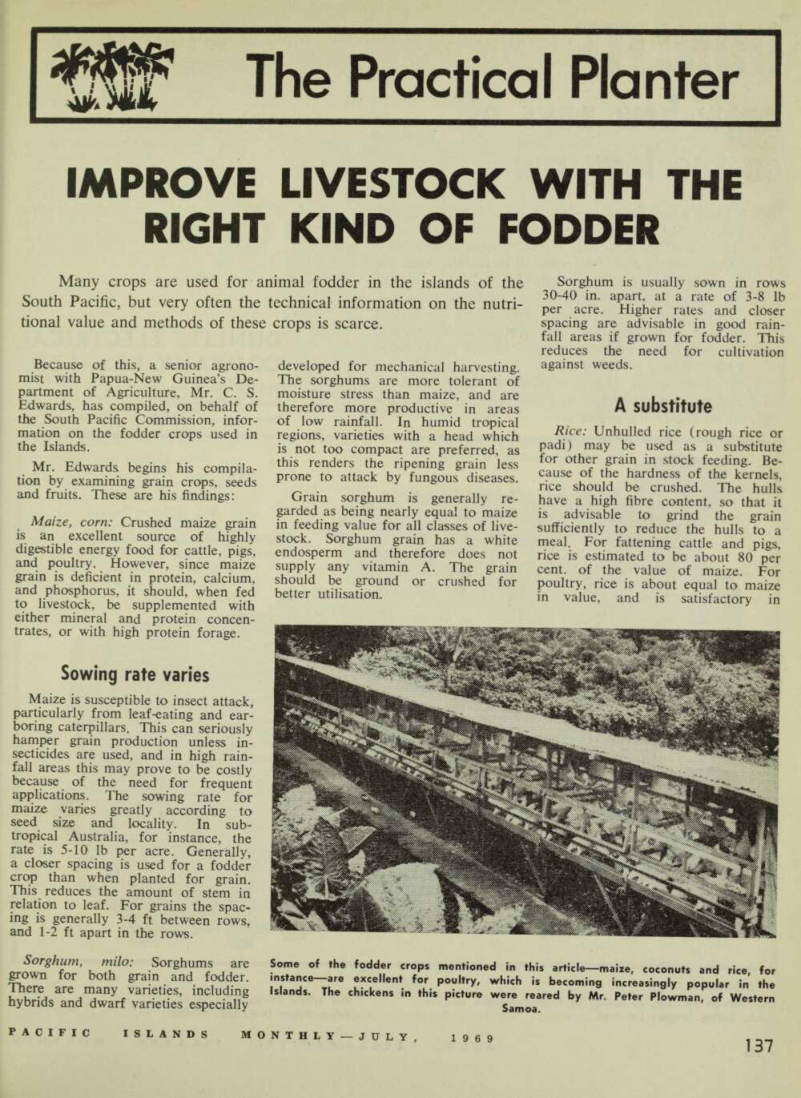
Some of the fodder crops mentioned in this article—maize, coconuts and rice, for instance—are excellent for poultry, which is becoming increasingly popular in the Islands. The chickens in this picture were reared by Mr. Peter Plowman, of Western Samoa.
quantities up to 50 per cent, of the complete ration.
Peanuts: Peanuts can be used in limited quantities as a protein supple ment for livestock. Fed to pigs, whole (unshelled) peanuts are satis factory diet, providing a mineral supplement of salt and calcium carbo nate (ground limestone) is also fed.
Pigs raised on concrete on this diet would also need a source of vitamins, preferably from chopped green feed.
The fat of pork produced by pigs fed on peanuts is soft, but the quality is otherwise good.
To produce firm carcases, pigs should not be fed more than 100 lb of shelled peanuts, and these should only be fed during the early part of the life of the animal. Peanut hulls are unsatisfactory for stock feeding.
They are very low in nutrients, and contain 60 per cent, of fibre.
The sowing rate for peanuts varies from 20 lb to 80 lb per acre depend ing on the row spacing used.
Soyabeans: Soyabeans are a very rich source of protein and fat, and have a higher content of total digestible nutrients than maize. For pigs, poultry, and young cattle, the nutritive value of soyabeans is greatly increased by thorough cooking. Like peanuts, soyabeans fed to pigs tend to produce soft pork, and only limited amounts should be used, pre ferably less than 10 per cent, of the diet.
Limited amounts
For dairy cows and mature beef cattle soyabeans do not need to be cooked to provide a good protein supplement. It is advisable to crush or grind the beans to obtain maxi mum utilisation. As the beans have a high oil content, they should only be fed in limited amounts as a protein supplement. Soyabeans are low in calcium, and only moderately well supplied with phosphorus. A mineral supplement should be fed to pigs, as is the case with peanuts.
The sowing rate for soyabeans de pends on seed size, but soyabeans having 2,500 seeds per lb are sown at about 50 lb per acre when broad cast, or 25 lb per acre in rows 30 in. apart.
Pigeon pea: In some countries pigeon peas are grown for human consumption and for fodder. Dwarf
cent, of a barley/tankage concentrate ratio fed to pigs in Hawaii, daily weight gains were similar to pigs fed an all-concentrate ration. Feed con sumption per pound of gain was 18- 25 per cent, higher when bananas were substituted for part of the con centrate ration.
Papaw: Papaws are fed to pigs and poultry in many parts of the South Pacific. In Hawaii, pigs grew satis factorily on a diet in which papaws replaced 25-33 per cent, of a stan dard concentrate ration of barley and tankage. Feed consumption per pound of liveweight gain was 30 per cent, higher with the ration con taining papaw.
Good for energy
Coconut: Fresh coconut meat may be fed ad lib. to pigs, but the high oil content results in pork with a soft fat. Inclusion of a low-fat source of carbohydrates such as sweet potato tubers in the ration should offset this effect somewhat. Fresh grated coco nut from which the “milk” has been squeezed for use in cooking may be used as a source of energy for pigs and poultry. One authority has sug gested the use of grated dried coco nut for poultry. Assuming half the oil is expelled in the “milk”, and the resulting meal is dried to 10 per cent, moisture content, it will have ap
varieties have been developed in Trinidad for a green pea canning industry. These are very early matur ing and suitable for mechanical har vesting.
In the South Pacific region the pigeon pea is more commonly re garded as a temporary shade or cover crop. Because of its adapta tion to a wide range of soils and rainfalls, there is considerable potential for its use as a fodder and grain crop. As a fodder crop, pigeon pea may be sown together with sorghum, or as a pure stand, usually in rows about 36 in. apart. The sowing rate in various countries ranges from 8-10 lb per acre planted in rows, to 20 lb per acre when broadcast.
Bananas ... for pigs
Banana: Reject fruit of the banana may be fed to pigs, if combined with a supplement containing about 19 per cent, protein together with grain and minerals. Research in Trinidad showed that pigs consumed 5 to 12 lb of bananas per head per day, ac cording to age. If this was supple mented with 3 lb per head of an 18 per cent, protein supplement, a live weight gain of 1.3 lb per day was maintained and pigs reached a weight of 160 lb in 85 days.
When bananas replaced 25-33 per
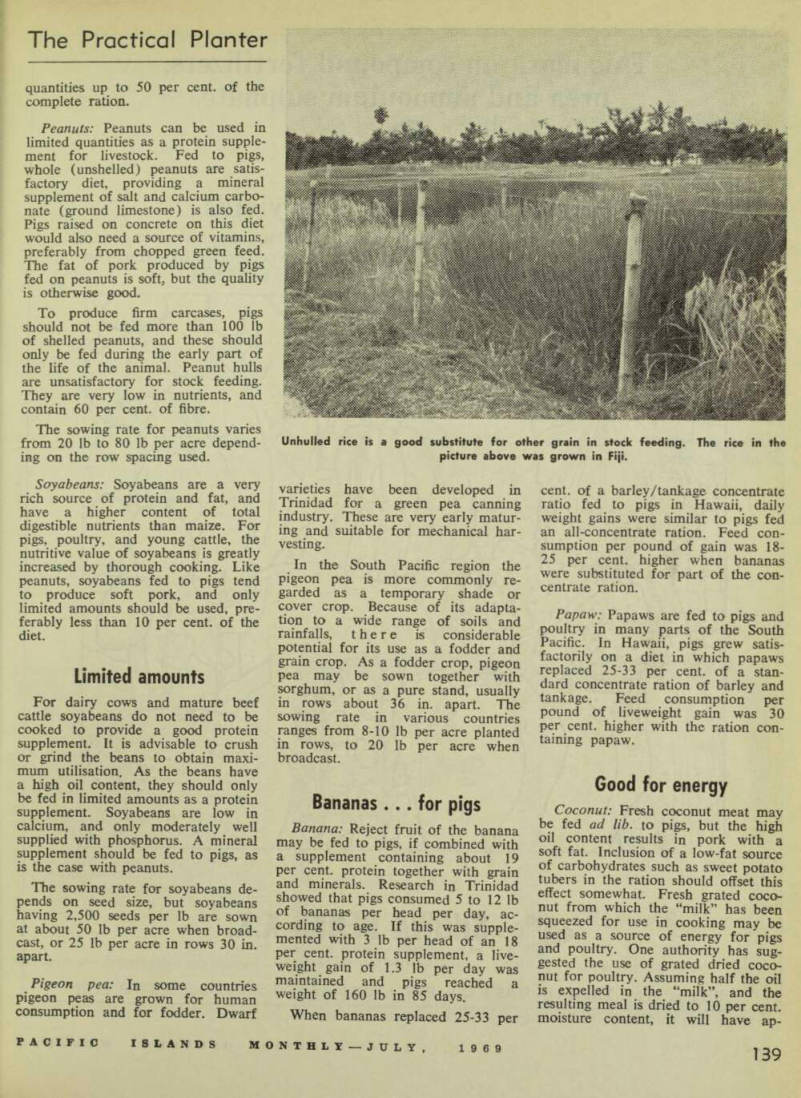
Unhulled rice is a good substitute for other grain in stock feeding. The rice in the picture above was grown in Fiji.
proximately the following compo sition (wet basis): Total dry matter 90.0 per cent.
Protein . . . . 10.7 per cent.
Fat 44.3 per cent.
Fibre 5.4 per cent, N-free extract . 26.9 per cent.
Mineral matter . 2.7 per cent.
This dry meal still has a high fat content and it should not exceed about 20 per cent, of the total ration for poultry.
Relished
The spongy, absorbtive organ of the germinating coconut is relished by pigs and chickens. Its nutritive value is probably quite high, but the amount available for feeding to live stock would be very limited.
Melons and pumpkins: Pumpkins have a low dry matter content (about 10 per cent.), so that their nutritive value per ton is low. They may be fed to pigs in combination with grain and a protein supplement. When fed to pigs 10 lb is about equivalent to 1 lb of grain.
Melons contain even less dry matter than pumpkins, and they are regarded as a very low quality food for livestock.
Protein low
Breadfruit: There are seeded and seedless varieties of breadfruit. In New Guinea, only the seeds are con sumed, and the pulp of the fruit would be available for feeding to livestock. In other islands, at times the supply of breadfruit exceeds human requirements, so that the whole fruit might be used as a source of carbohydrate for pigs and cattle.
The protein content of the fruit is low, and it would be necessary to feed a grain or legume supplement to give a balanced diet. Digestibility of the breadfruit is improved by cook ing, but as with sweet potato, the raw fruit should also be acceptable to livestock. • For more information on fodder for livestock, see next month's Practical Planter section of PIM.