For Nauru Phosphate
pp. 123-124 · Read in the full issue
Hammering Out A Deal
In the 18 months since the mid-Pacific phosphate island of Nauru became the world’s smallest independent republic, its presi dent, Hammer Deßoburt, has spent considerably more of his time in Australia than on Nauru. The president’s long absences from Nauru have brought some comment in the republic, and yet seldom has it been critical comment, for two reasons.
Hammer Deßoburt, as the architect of Nauruan independence, is Nauru’s dominant personality and what he chooses to do with his time is, by and large, all right with Nauru.
Secondly, among those on Nauru who do happen to take a critical interest in the president’s exact where abouts, there is appreciation that his absences are necessary because it is his job to consolidate and protect Nauru’s new-found independence.
President Deßoburt arrived in Australia once again on June 6—only a week or two since his previous visit. He was in Australia to pursue, with his usual dedication, the ques tion of new contracts for the sale of Nauru’s annual phosphate output of two million tons after June next year, when the present contract with Australia ends.
No agreement
Talks aimed at hammering out this new deal with Australia have been going on, intermittently, for more than two months—without any agree ment.
The main discussions have been over price and over a Nauruan re quest to Australia to allow her to sell phosphate direct to Australian manufacturers, in addition to renew ing a separate contract with the British Phosphate Commissioners.
The BPC at present handle all phos phate imported into Australia, under a pool marketing arrangement.
On price, the Nauruans are asking about $l3 a ton f.0.b., which is $1 more than the price they will be getting over the last 12 months of the present contract. The BPC, at the round of talks which ended in May, wouldn’t go higher than $l2 a ton, and the price remains un resolved.
The matter of direct selling is a more vital one for both sides. The Nauruans argue that Australian farmers now get a phosphate cocktail of varying grades from varying sources, including Nauru, but that Nauruan phosphate is superior to any other and would fetch a premium price on an open Australian market.
As proof of this the Nauruans point out that they have signed contracts to sell phosphate to Japan at $l4 and $l5 a ton. They also have let it be known that they can close a contract for at least one million tons at a minimum price of $l3 with one Australian manufac turer without having to go through the pool.
Australia and her pool partners.
New Zealand and Britain, believe the pool system to be orderly, and also that the pool keeps prices at more reasonable levels.
If both the partners and the Nauruans stand firm, then the Nauru
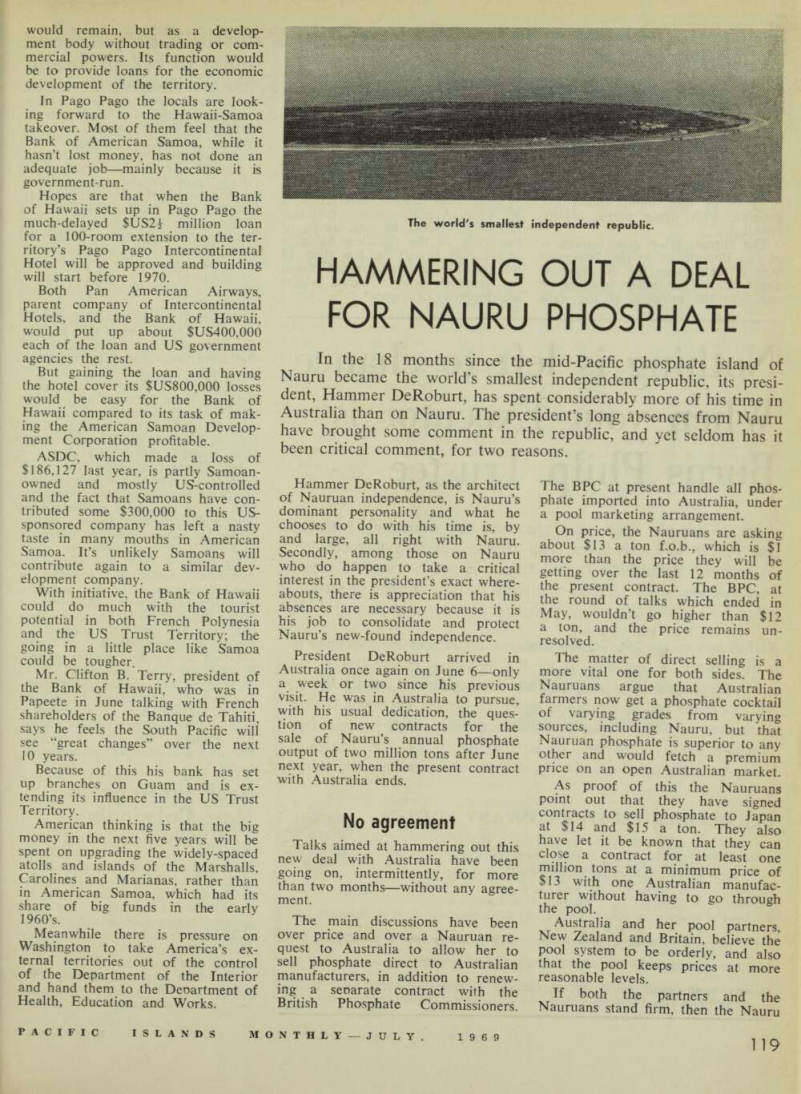
The world's smallest independent republic.
contract will not be renewed and the higher grade Nauruan phosphate, irrespective of its price, will be denied Australia.
A Itfirnatlup marlfPtc Mlierndlive The Nauruans, for their part, would have to find secure alternative markets more quickly than they had contemplated. They would prefer to scale down supply to Australia year by year as they build selling experience with other users, mainly j apan> The current price disagreement is of less importance to the Nauruans than is their desire for the right of direct sale. They relate freedom of sale with the principle of the right
to be free—of their independence, if you like.
The question now is how far Nauru will go towards attacking the pool system in face of Australia’s opposition. Since at least one Aus tralian manufacturer is offering to buy direct at Nauru’s higher price, presumably Australia can stop a breakdown of the pool arrangement only by placing an embargo on the direct import of Nauruan phosphate, Should this happen, that protector of Nauruan independence. President Deßoburt, would be well aware of the irony of the situation Australia would find herself in, less than 18 months after she had granted Nauru her freedom, with all good wishes and promises of support.
Australia plays second
fiddle to NZ in Tonga
Due to her more vigorous market ing, comprehensive prices following devaluation and better shipping com munications, NZ is forging ahead of Australia in trade with Tonga.
This statement was made in Tonga in June by Mr. W. R. Carney, Aus tralian Trade Commissioner for the Pacific Islands. He was returning to Australia from the Samoas.
Mr. Carney said: “There is no re frigerated shipping service from Aus tralia. She does however supply items like flour, sugar and rice also some manufactured items such as corru gated iron which New Zealand does not supply.
“This is not good enough from our viewpoint and we hope that we can stimulate more extensive salesman ship from Australian firms manufac turing other items.”
Earlier Mr. Carney had empha sised the value of trade with Tonga when he pointed out that Tonga im ports $5 million worth of goods a year, of which $3 million worth come from Australia and New Zealand.
Mr. Carney indicated that apart from trade, Australia is interested in the plans for oil search in the king dom and in the recent announcement that conditions for overseas invest ments in Tonga may be improved as a result of new legislation.
He made it clear that visitors to Australia, including businessmen wanting to market Tongan products, were always welcome. This, in spite of the fact that, so far, Australia buys only fresh and desiccated coconut and a quantity of handicrafts from Tonga, although he promised greater interest, if other goods are produced.
“It is no part of Australian policy to have an unbalanced trade with Tonga. Where there is imbalance, it usually derives from natural causes; for example, we grow enough of our own bananas for local require ments.”
Beef shortage in
New Caledonia
The importation of meat into New Caledonia has been liberalised for 45 days from June 1, in face of the current beef shortage on the island.
The French Administration has temporarily lifted taxes on meat imports during this period.
This move follows the shortage of local beef caused by last summer’s severe drought in the territory.
Countries expected to help over come the shortage were New Hebrides, Australia and New Zealand.