Pacific Shipping
pp. 109-114 · Read in the full issue
Holm May Charter New
Ship For Tahiti Run
Directors of Holm Shipping Company of New Zealand were in late June expected to decide to charter a 2,200-ton Danish freighter for an initial period of seven months for service on the company’s monthly Auckland-Rarotonga-Papeete run.
The freighter, the Cooler Scan, is a new ship with a maximum speed of 18 knots.
Her cargo capacity—loo,ooo cu. ft —is nearly 25 per cent, greater than the 82,000 cu. ft capacity of the Pagensand, which currently operates this run for Holm.
Holm currently has three 2,000 tenners on charter Pagensand, Luhesand and Fahmansand and their charters all expire in July.
It’s unlikely that charters on the three will be renewed, and it looks as though the Tahiti-Cooks service will be maintained with the Cooler Scan which Holm says could operate the monthly service alone.
Despite brisk competition, parti cularly against American timber exports. Holm’s cargoes to Tahiti have grown well in recent months, especially with foodstuffs.
But no backloads
Holm ships have collected no backloads to NZ from Tahiti (simply because there hasn’t been anything around), but the company’s manag ing director and master mariner.
Captain John Holm, recently told PIM that coconut meal could pos sibly be carried to NZ. (Tahiti has a small but modern coconut oil mill and coconut meal plant on the artificial wharf area of the Papeete waterfront. An inspira tion of the wealthy and diversified Papeete-based Chinese business house Sin Tung Hing, production started over a year ago from coconuts of the outliers of French Polynesia.) Holm has the NZ traders and shippers, Etablissements Donald, as its Tahiti agent and although this company is a major buyer of NZ imports, NZ goods are sold also by most of the retailers in Papeete.
Holm ships have collected some backloading to NZ from Rarotonga fruit and canned orange juice and Cooks copra when it is available.
Backloading efforts from Noumea, New Caledonia, on the two -weekly service Holm started in April with its NZ-registered Holmburn have been a loss for the same reason as the company’s efforts in Tahiti there’s nothing available.
Exports to Noumea
However NZ exports of timber and foodstuffs, particularly meat and fruit, to Noumea have more than made up for empty homecoming cargo holds.
Commanded by NZ master, Cap tain “Buster” Brown, and crewed with New Zealanders, Holmburn has 10,000 cu. ft of refrigerated space.
Recently, Holm’s 1,000-ton NZ coaster Holmwood, not previously seen by the Islands, made a one-trip passage from NZ to the French island of Wallis (administered from Noumea) with a cargo of bitumen for upgrading the island’s airport.
Plans were to call at Rarotonga on the return trip and pick up a load of orange juice,
First Commercial Order For
Fiji Government Shipyard
The Fiji Government’s Marine Department shipyard has taken its first commercial order, a move which could transform the shipyard into one of the most important in the South Pacific.
The $lBO,OOO contract is for the construction of a 125 ft luxury cruiser for Mr. Claude Millar, who operates Blue Lagoon Cruises in Fiji. She will be called the Blue Lagoon.
The government is also negotiating with the Fiji Maritime Co-Operative Association to build a 150 ft replace ment for the Tui Lau.
News of the Blue Lagoon order and the possible Tui Lau replacement was ann<punced by the Minister for Communications, Works and Tourism, Mr. C. A. Stinson, on June 5, at a ship-launching ceremony at the Walu Bay shipyard.
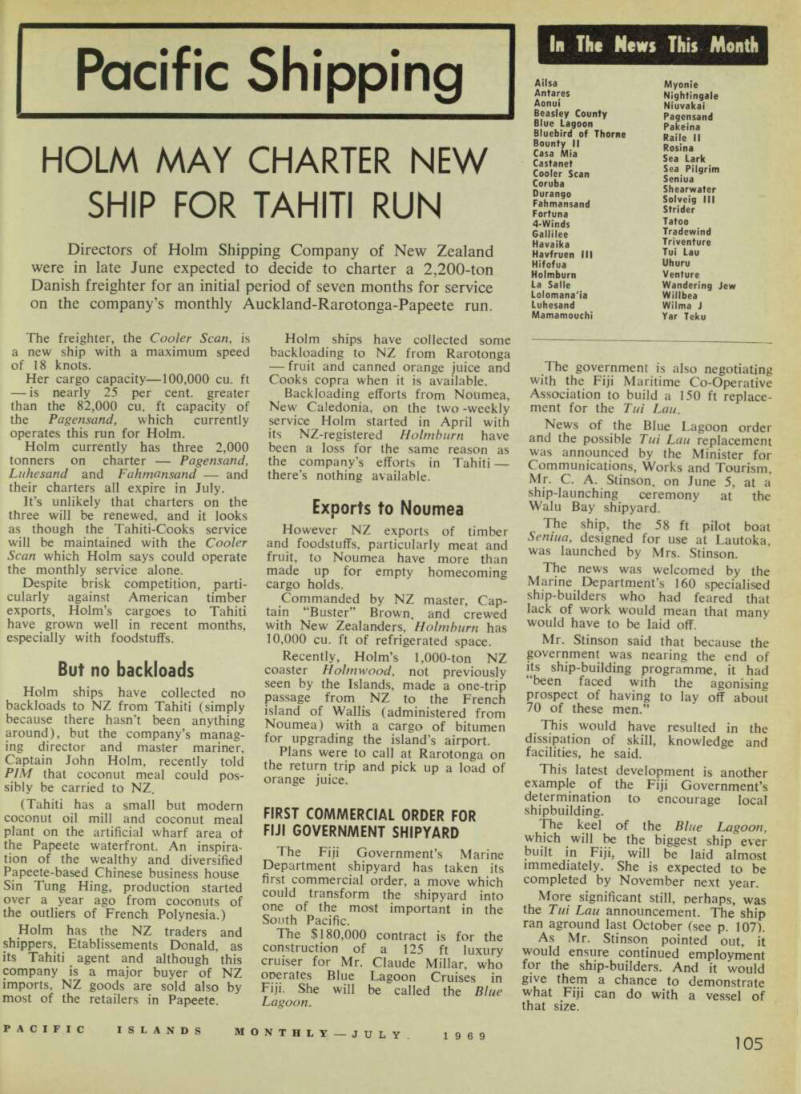
The ship, the 58 ft pilot boat Seniua, designed for use at Lautoka, was launched by Mrs. Stinson.
The news was welcomed by the Marine Department’s 160 specialised ship-builders who had feared that lack of work would mean that many would have to be laid off.
Mr. Stinson said that because the government was nearing the end of its ship-building programme, it had been faced with the agonising prospect of having to lay off about 70 of these men.”
This would have resulted in the dissipation of skill, knowledge and facilities, he said.
This latest development is another example of the Fiji Government’s determination to encourage local shipbuilding.
The keel of the Blue Lagoon, which will be the biggest ship ever built in Fiji, will be laid almost immediately. She is expected to be completed by November next year.
More significant still, perhaps, was the Tui Lau announcement. The ship ran aground last October (see p. 107).
As Mr. Stinson pointed out, it would ensure continued employment for the ship-builders. And it would give them a chance to demonstrate what Fiji can do with a vessel of that size.
The Minister said that the govern ment was satisfied that the final cost of building a Tui Lau replacement in Fiji would be comparable with ships built in Hong Kong and Japan, after delivery costs were taken into account.
The "Bounty" Will Have
To Change Her Name
It seems that the 112 ft Fairmile which Fiji people are already calling the Bounty, but which still carries the name Casa Mia on her bow, must now be known as something else again!
Bounty Cruises Ltd., which operates the luxury cruiser for tourists, has been waiting for the British Board of Trade to approve the name Bounty for the vessel. A considerable amount of money has already been spent on advertising the new cruise programme under that name.
However the board has informed Bounty Cruises that the name Bounty is unacceptable, under British Merchant Act rules, because another ship bears it.
A spokesman for the company said it may be possible to get round the difficulty by renaming the vessel Bounty 11.
Seamanship Training Scheme
For American Samoa
To train American Samoans to handle all seamanship jobs connected with the running of Pago Pago Harbour, the head of the territory’s water transport division, Captain
John Calver, is setting up a training scheme for six selected Islanders, two of whom will be from the neglected Manua Islands.
The scheme—the first to officially train American Samoans in seamanship has the backing of the Governor, Owen Aspinall, and hopes were to get it going by August.
Assistance for the training had been offered by the Ports Authority and the Department of Education and by mid-June over 30 applications had been received from Samoans ranging from 17 to 20 years.
Plans were to start training the six Samoans on maintenance of marine engines and follow this up with work
on the territory’s Marine Railway, Mr. Calver, in Samoa for over a year, had worked in Canada, the US and Queensland, Australia, before basing himself in Pago Pago, from where he has made several trips to the Manua Group, Canton Island and New Zealand for the American Samoan Government. w T « M , A ,.// mat Miiru . CC J inc a. wArc ULM
Left To Salvage
“The Tui Lau is a very sad sight, She is disintegrating fast—groaning and creaking and well on the way to being completely smashed up.”
This description of the 800-ton
The wife of the Minister for Communica tions, Works and Tourism, Mrs. C. A.
Stinson launched the 58 ft pilot boat, "Samoa", at the Marine Department's, Waiu Bay shipyard in June.
Photo: Bal Ram.
Tui Lau came from Mr. Mac Lawrie, of Adelaide, a partner in Underwater Contractors Ltd., after he had viewed the wreck of the once-proud cargo-passenger vessel on Totoya Reef, Fiji.
The Tui Lau went aground on the reef last October and Underwater Contractors Ltd. are salvaging what is left of the remains.
Mr. Lawrie said most of the re maining wreck had been smashed by the surf.
“We hope to recover some winches, anchor and chain—and that’s about all. It’s very disappointing from a business point of view,”
Parts of the Tui Lau's cabins and the engine-room have been washed up to a quarter of a mile away from the wreck, which is broken in half and lying on her port side. The engine has fallen through the bottom of the hull and is lying on the reef.
Work being carried out by six salvage workers is often hindered by surf which dashes over the wreck when the weather is bad, but the company hoped to complete the job by mid-June.
Change In Tongan
Shipping Services
Tonga’s Marine Department and her Shipping Agency, previously linked in many ways, are now run as two separate bodies.
The Marine Department, control led by a harbour master. Captain C. H. Hill-Willis, now implements shipping, harbours and wharves laws; controls pilotage, navigational aids, wrecks, accident prevention measures, the training and examination of marine personnel; and manages activities on Nukualofa’s Queen Salote Wharf.
The Shipping Agency, controlled by a manager, Mr. P, F. Corbett, now schedules and operates all vessels owned by the government, the Copra Board and the Agriculture Department (except the pilot launch), Tonga has three large ships, the Niuvakai, 2,600 tons, which includes Australia in her Pacific trading, Aonui , 565 tons, and the ocean-going tug Hifofua. She also has the Pakeina, a fulltime fishing vessel, and the Lolomana'ia a 250 tons oil barge.
Trading and passenger service within Tonga is done by the smaller, Fangailifuka, Fonualei, Kao and Ulufonua. • The Gilbert and Ellice Islands seldom-visited Christmas Island was to be the host to—of all ships—a Mexican armed transport and train ing ship, Durango, in mid-June.
Aboard the 1,600-tonner were a rear
admiral, 76 officers and 296 sea cadets. Durango was later expected to make a stop at Apia, Western Samoa. • Initial work began in June on the New Hebrides $1.83 million deepwater wharf at Vila, Efate, Site clearing and reclaiming of land got into full swing and was expected to take about five months. The contractors, George Dew and Co., said that four Europeans, three Tongans and up to 60 New Hebrideans would be employed. • The biggest vessel ever assembled in the New Hebrides—a 198
ft steel barge for island traders and investors, D. J. Gubbay and Com pany—was recently launched at Santo. Weighing 367 tons and 50 ft wide, the barge will carry nickel ore in and around New Caledonia. Its capacity is 1,700 tons. Under Euro pean supervision it was built entirely by New Hebridean labour. • American Samoa’s new SUS6OO,OOO dockyard, in Pago Pago Harbour, began operating in early June when it slipped a 200 ft, 100ton South Korean fishing sampan with a holed hull. Hopes in Pago Pago are that business will be won from Fiji’s bigger boatyards.
Iigher Freight Rates
Or Fiji?
Because of the higher port charges ntroduced on June 1, it seems irobable that shipping companies ising Fiji ports will feel bound to ncrease their freight rates. Not mmediately perhaps, but soon.
The Fiji manager of the Union Iteam Ship Company, Mr. J. St. ulian, said line voyage vessels were >aying about 30 per cent, more in K>rt charges under the new scales.
The consequences for cargo vessels vere also considerable, he said, but hey were not fully clear, as the government had not yet defined how he aggregate on certain duties was o be paid.
When the effect of the higher port :harges on cargo vessels could be )roperly assessed, it might be that ligher freight rates would be called or.
When the government announced he new rates earlier this year, it vas explained that Fiji’s ports had lot been paying their way for some There had been no big increases n the charges for 10 years and the xist of expanding ports in future had o be taken into account.
In the hope of encouraging them
to stay in port longer, cruise ships have been exempted from the in creases.
The main increases have been in lighterage, wharfage and port dues and they apply to both inter-island and overseas ships. • Burns Philp and Co. Ltd. has lodged a $50,000 salvage claim with London underwriters, Lloyds, against Kian Gwan, of Singapore, owners of the Golden Spring, a twin-screw motor vessel of 7,333 tons. The claim is based on the assistance and tow that the BP flagship Braeside (under the command of the company’s commodore. Captain Brett Hilder) gave the disabled Golden Spring outside Melbourne Harbour on March 30.
On her regular run from New Guinea ports to Melbourne, Braeside located the Golden Spring with her engines broken down, drifting two and a half miles offshore. Braeside attached tow ropes and towed the vessel for 26 hours until the ships reached Melbourne’s Port Phillip Bay, where a local tug, Tooronga, took Golden Spring inside. • Captain Robin Bibby, number two man in the Gilbert and Ellice Islands Marine Department based on
Betio, Tarawa, until mid-June, has transferred to the New Hebrides to take up a new appointment as British Marine Superintendent. One of Captain Bibby’s responsibilities on Tarawa was the atoll’s controversial Betio-Bairiki ferry service. • A big sulphur carrier, Prospero, southbound from the US, limped into Pago Pago harbour in late May, with engine trouble. In early June, she sailed out of Pago, her engines apparently fixed.
However, about 80 miles from Pago Pago her engine troubles re sumed and she went back to harbour.
By mid-June repairs were still being carried out on the Prospero, by now a familiar sight to the people of Pago. • The captain of the Formosan fishing boat, Fugjih No. 1, which was arrested in a lagoon in the Conflicts Islands, Papua, in June, was fined $750, in default two months’ hard labour, by a District Court hearing at Alotau, Milne Bay.
He pleaded guilty to a charge laid under Section 14a of the P-NG Fisheries Ordinance. This section pro vides that persons may not fish, or have a boat, in territory waters, without a permit.