are Tongans there
pp. 41-43 · Read in the full issue
"As long as there are Tongans there will be monarchs to rule them"
By Dr. JOE FANAMANU, in Nukualofa
Mr. John T. Griffin’s article on Tonga (P/M, Apr., p. 41) revealed what he considered to be the state of the kingdom. He said that his information came from the educated young commoners.
However, the predictions made on the future of Tonga by these so- 11 , , . , T u i*iri , 7 1 called educated Tongans were absolutely false and misleading.
These predictions may lead readers of PIM to beheve tha below the tranquility of the Friendly Islands is tumult; that the kingdom is heading to an inevitable crisis of immeasurable d,mens.ons and that new leaders may emerge within the next five to P ,^u arS ‘ Thl t 15 error
Lny T~ todt otherwise
t ® t ® c V S • From Mr. Griffin’s article, one cannot help but conclude that Tonga will undoubtedly follow the pattern of change that has been demonstrated in other underdeveloped countries by riots and repeated changes of administration. Nothing could be
CHfffn r?n m
bovine K P Pn ed . ® ’
King Taufa’ahau Tupou IV and his young brother Prince Tu’ipelehake, the Premier, are no upstarts.
They can trace their descent back
over 1,000 years to the first known sacred Tongan King-Aho eitu, son of Vaepopua, a Tongan woman, and the legendary sky-god Tangaloa. King ’Aho’eitu was the first of the Tu’i Tonga dynasty. greatest PoinnpH eunrpmp
Supreme
King ’Aho’eitu was regarded as semi-divine—he reigned supreme as tbe secular king and the highest priest of Tonga. The Tu’is ruled Tonga for many centuries, and through this period, they established a traditional culture which became the accepted way of life—and that culture was centred on the proposition that the land and the people were properties the royal During the 15th century AD one of the Tu’i Tonga created a second dynasty, the Tu’i Ha’atakalaua dynasty, and appointed his young brother as its first king, upon whom all administrative power and duties
of kingship were conferred. The Tu’i oMhe country d thC spiritual head a third dynasty was created by sne5 ne of th f ,H in^ s P f the sec £ n £ dynasty and this is the present Tui Kanokupolu dynasty. Prince Taufa’ahau, son of King Tupouto’a of this King Aleamot P u . a , , he first Tongan monarch t t Christianity King Taufa’ah th P accepted Christianity and ? ough t Se TuU whom hi defeated and thereby abolished the spiritua , head o( x y onga He also fought and defeated all the chiefs that opf S sed him and declared Tonga as a Christian country. He was baptised by the church as King George Tupou I. He has been called “the maker of modern Tonga”, With the advent of Christianity, Tonga underwent inevitable changes in its traditional culture. Under King George a new constitution was drawn up and the 1,000-year-old system of government was wiped out.
In ancient times, Tongan families formed lineages and tribes, all trac ing their descent from a common ancestral chief. Since chiefly or supervisory status descended through the oldest males, lineages consisted of a nucleus of high-status chiefly
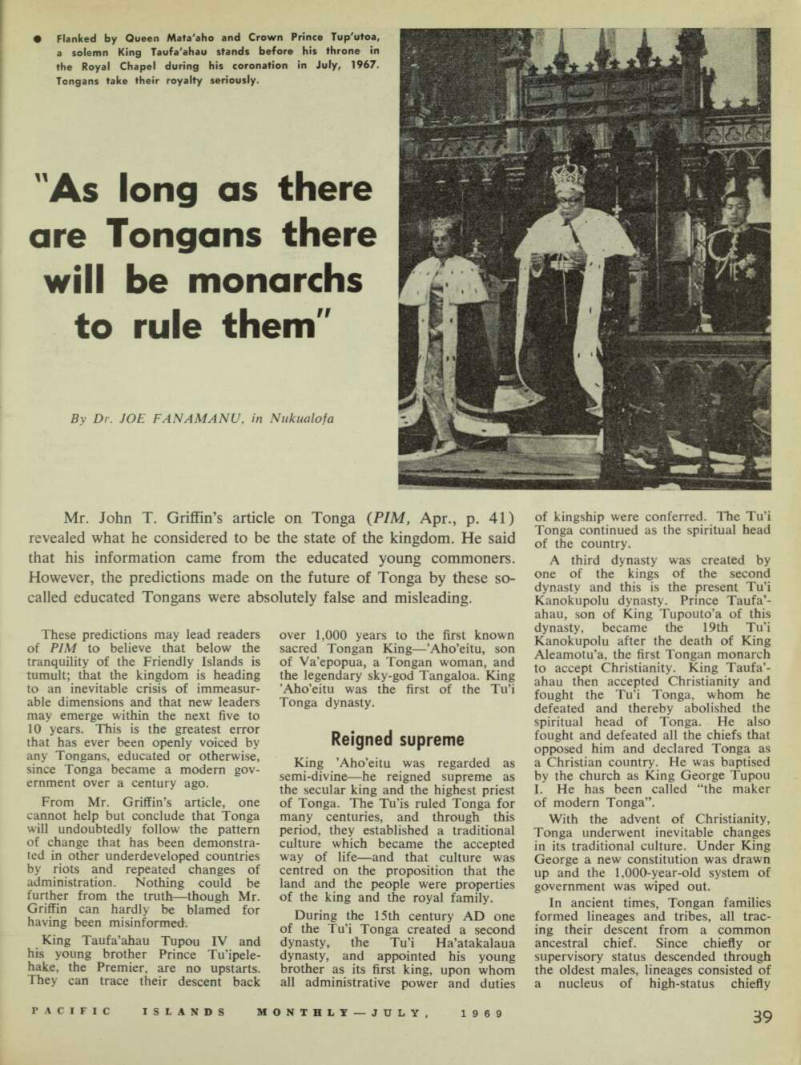
Flanked by Queen Mata'aho and Crown Prince Tup'utoa, a solemn King Taufa'ahau stands before his throne in the Royal Chapel during his coronation in July, 1967.
Tongans take their royalty seriously.
families, and a large number of commoner families ranked according to their distance from the main line of descent.
King George, realising the long years of effective leaderships of the chiefs and their forefathers before them, set out to turn Tonga into a unified and modern nation by using the chiefs whom he had recently fought against as his representatives in their respective districts—to the dismay of some of his brave warriors who had fought these same chiefs.
But the king knew that there could be no lasting peace and unity under his rule if the different tribes which comprised the population of the country, were not under the leader ship of their respective chiefs. After all the people are related to their chiefs. Not only did King George give these chiefs an important part to play in the new scheme of things, he also created them nobles with hereditary titles. These nobles re ceived large pieces of land to control and to distribute to their people.
Since 1845, when a modem form of government was established in Tonga under the British plan, the nobility have contributed immensely to its growth. Through the years, Tonga has learned to survive the hard way. Its remoteness from the world’s civilised centres, and its lack of economical resources made things very hard. However, with the guid ance of the nobility, the people were always united in a common front to face hardship for a better tomorrow.
There is, it is worth mentioning here, a great distinction between a noble and a commoner in Tonga.
For example, a noble, if involved in an argument, is usually quiet and diplomatic and shows a high degree of patience and tolerance. On the other hand a commoner will argue at the top of his voice, jump ing from point to point and finally, as the saying goes, jumping “from the frying pan into the fire”.
The land
The area of land owned by the nobles has dwindled over the years because the government is distribut ing land to all males of 16 years and above. In light of this it seems very unfair that commoners should accuse the nobles of hanging on to their land.
After all, the nobles do have very large families and they conduct ceremonies in their grounds. Besides this, they have to feed all the riff raff in the community.
At the same time as the com moners were given land grants (under King George Tupou I) they were also accorded free education and medical attention. Through the years they were not troubled with the burden of running their government, but were left to attend their religions and plantations, and government business was handled by some of the social leaders and commoners.
This practice became so well in grained in the minds of the people
that they considered government as a property of the royalty and the nobility, and the people themselves as a separate entity.
Today the so-called educated dissident makes much of this, suggest ing that the people are victims of an unfair system. The government is trying hard to have the people realise that it is their government, and it doesn’t have to employ all the educated commoners in order to prove it, since government business requires only a certain number of trained people.
Discontent
When discontent and resentment were voiced indiscriminately by some of the educated commoners, as reported by Mr. Griffin, one wonders what they are thinking of.
I am quite certain also that there are no facts whatsoever to justify their discontent with the royalty and the nobility.
Scientists have found that a popu lation which clamours for drastic change is a population of misfits. The dissident group in Tonga is out, one gathers from their expressed opinion, to free the Tongans from their “bondage”, hoping that afterwards the people out of their gratitude will elect them as their national leaders.
This at least was suggested by Mr.
Griffin’s article.
This reminds me of a monkey and a fish caught up in a great flood.
The monkey, who was agile, ex-
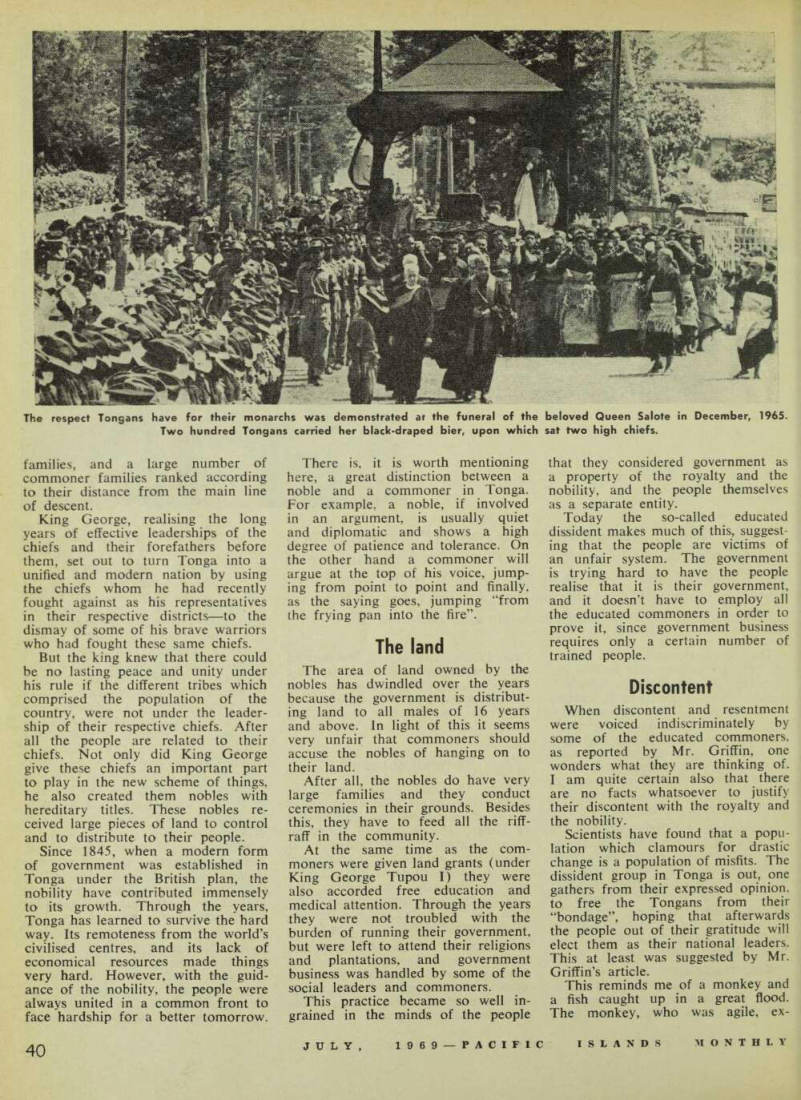
The respect Tongans have for their monarchs was demonstrated at the funeral of the beloved Queen Salote in December, 1965.
Two hundred Tongans carried her black-draped bier, upon which sat two high chiefs.
Great concern for people's welfare
perienced and who considered himself very smart, had the good fortune to scramble up a tree to safety. As he looked down into the raging water, he saw a fish struggling against the swift current. Filled with a humanitarian desire to help his less fortunate fellow, he reached down and scooped the fish from the water.
To the monkey’s great surprise the fish was not grateful for this help.
Sensitive
King Taufa’ahau is most sensitive to all problems confronting Tonga and its people. This is also true of the Premier, the nobility and the Ministers of the Crown. With few exceptions, most of the commoners are only sensitive about personal profit.
The King and his ministers tackle all problems according to priorities, in order that the greatest benefits can be accorded to the greatest number in the shortest time possible.
Recently, the great concern of government for the welfare of the people was revealed when an expert on local government from the United Kingdom’s Ministry for Overseas Development arrived in Tonga and toured the country, discussing the role of local government with the nobles and the people in their villages. It is at the local govern ment level that land and other problems of local importance will have to be studied and solutions sought by the people and their leaders.
Population increase
The problem of population in crease, in which unemployment is an integral part, is being dealt with by family planning, the use of the best agricultural methods, the en couragement of foreign investment and the development of light in dustries Young Tongans, after their secondary education, are in the practice of hanging around Nukua lofa, saying that they are looking for a job, while lands owned by their families are lying idle. From a recent survey made by the Agri cultural Department of the Tongatapu district it was found that only about one-third of the total land area is being farmed properly. The same
goes for the Ha’apai islands, and in the Vavau islands even less land is being farmed.
In Polynesia, the Tongas are un surpassed in their love of monarchy.
There is no room in Tonga for violence or for support for revolu tionary ideas. Well-educated people should recognise that whatever a person may need his need must not let him overthrow the principles by which he must live. A person who does not recognise this cannot fairly be called educated.
Royalty "for ever"
From my personal observations, I can say without reservation that Tongan royalty will last as long as there is even one single Tonga subject still alive to be ruled.
Readers may ask: who is this person who thinks he knows so much about the common people of Tonga?
I can easily answer that. I am a commoner and I have for years worked together with the nobles and the people, and I know very well the thinking, the feelings and the attitudes of my peers.
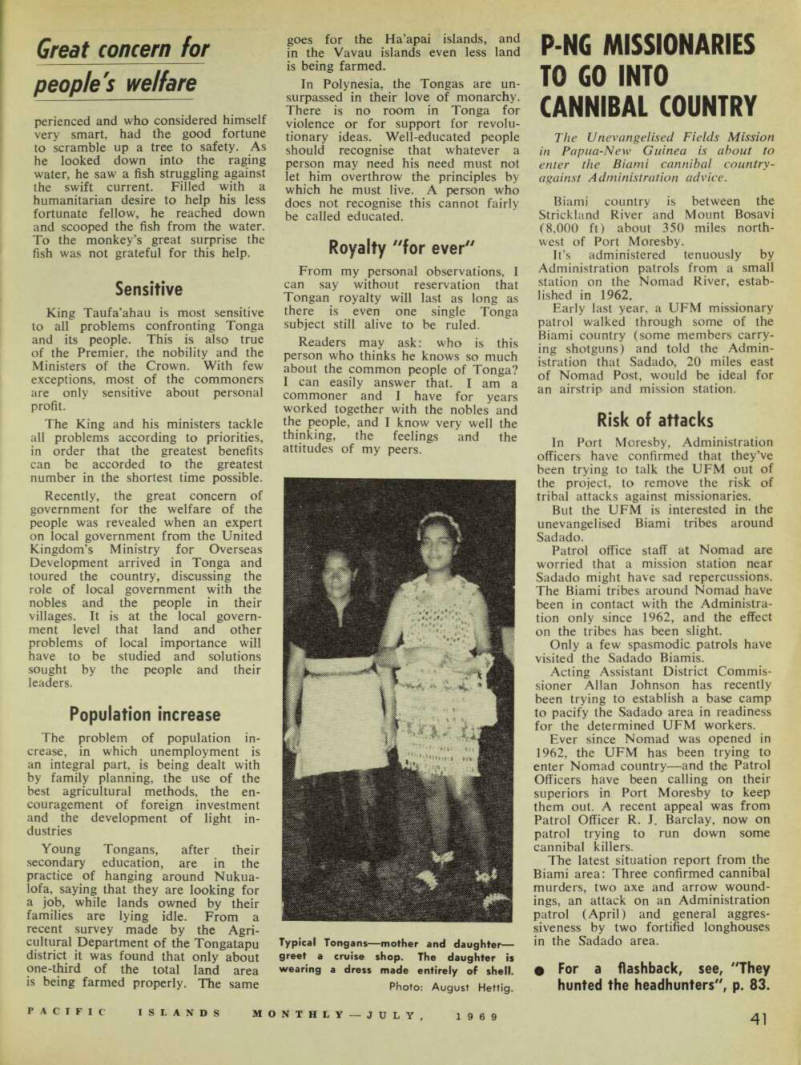
Typical Tongans—mother and daughter— greet a cruise shop. The daughter is wearing a dress made entirely of shell.
Photo; August Hettig.