To the Point
pp. 38-40 · Read in the full issue
They're not natives, they're just low purchasing power consumers
The Third Waigani Seminar, held at the University of Papua and New Guinea and sponsored by the university and four other bodies interested in New Guinea affairs, is over. Its two sections, one on land tenure and the other on indigenous enterprise, ran simultaneously for a week, in contrast to the earlier seminars which were weekend affairs.
People who were interested, as I was, in both sections were unlucky.
Or were we? There were 21 papers on land tenure and 32 papers plus eight panel discussions on indigenous enterprise. I chose land tenure.
I have attended all three Waigani Seminars, and I am still puzzled about the rationale, not merely of Waigani Seminars, but of seminars in general. For that matter I am still far from clear about the dif ference between a conference, a consultation, a seminar and a work shop.
Conferences, of course, are pretty old-fashioned, and if you go to one it’s just as well to wear a tie. There’s no firm rule about consultations, but I recommend a tie carried in the pocket as a precaution. For seminars and workshops you can go in a Hawaiian shirt and scuffs, and you may still look a square.
What's a seminar?
When I was asked to write a paper for the first Waigani Seminar, I had only a very vague idea of what a seminar was. The New Guinea Research Unit’s genial chief, Ron Crocombe, who roped me in, ex plained that I had to read a paper which would then be discussed.
“Write a paper that will take half an-hour to read, no more,” he com manded. Innocent that I was, I wrote a paper that woud take half-an-hour to read. It would be an exaggeration to say that I was the only contributor who did, but I was certainly one of a very select minority. The majority wrote papers which would have taken anything from an hour upward to xead in full.
Now I can understand people ■writing long papers when they are asked to write short ones. They may be intending to use them afterwards for some other purpose. Or they may think that this is a good way of getting them published. Or they may
To the Point with Percy Chatterton
just be the kind of people who can’t be brief.
But what beats me is that in most cases it doesn’t seem to occur to them until they actually stand up to speak with that thick wad of fool scap in their hands that they haven’t a hope of getting through it in the time available.
One would expect that they would realise this beforehand and would have either prepared a summary of it or at least marked those para graphs which they intended to read.
But not a bit of it!
After reading the first few pages in full, they look at their watches in a surprised way, and, realising that they haven’t a hope of getting through it, begin to flounder around making an impromptu and haphazard selection of passages to read. At least, that’s what it looks like from the receiving end.
Then there are those who, not content with having already written too much, break off from their read ing at intervals to insert comments or after-thoughts. These finish up in an even worse mess.
Come to that, why read the papers at all, if they have been cyclo styled and circulated in advance as they usually have?
If people are interested enough to come to the seminar, one would ex
pect that they would be interested enough to read the papers before hand. In this case all that would be necessary would be a brief summary of the contents of the paper fol lowed by a more thorough discussion than is possible under the present system.
Under this system, those of us who go along hoping to learn some thing from the give-and-take of debate between our local experts and their overseas counterparts, get fobbed off with a 50-minute reading from a text already in our hands, followed by a truncated discussion.
Niuginians talked less
However, I must admit that if the plan I have suggested above had been followed at the recent Waigani Seminar the participants would have had to sit up far into the night to digest the next day’s papers. The long-distance winner was a 50 pager, but there were several that ran it pretty closely, and some slimmer ones that cheated by using single spacing.
It is interesting to note that, with a few highly-to-be-praised exceptions, it was the Europeans who produced the long-winded dissertations. The Niuginians and the nationals of other Pacific countries who contributed papers were, in the main, commend ably succinct. Perhaps the reason
was that they sat down to write a paper for this seminar.
I think that it is high time that the organisers of the Waigani Seminars made up their minds what they are trying to do.
Are they trying to provide an umbrella under which the writers of academic theses can shelter/ is the tag “Read at the Xth Waigani Seminar” destined to take its place alongside “Purveyors to the Royal Family” and “Gold Medal 1887 International Trade Fair”? Or are they trying to provide a forum where experts and non-experts who are interested in the past and present of Melanesia, and concerned for its future, can toss around ideas? To my mind, this is what they should be doing.
Suggestions for future
I venture to offer some suggestions to the organisers of the Fourth Waigani Seminar. First, one subject —not two. Second, not more than four papers per day. Third, contri butors to be strongly encouraged to write papers that can be read in half an-hour. Fourth, contributors who want to write longer papers be allowed to do so, and to have them cyclo styled and distributed, but be re quired to prepare beforehand a sum mary, synopsis or conspectus (“over view” is the current in-phrase, I believe) of their paper, which can be read in half-an-hour.
Alternatively, papers should be distributed about a month before the seminar begins, so that we can digest them at our leisure and be prepared to discuss them intelligently.
At the moment I have on my desk a five-inch thick pile of papers which I fully intend to work my way through, bit by bit. They will, I am sure, do me a lot of good, and when I have finished I shall be in a position to enter into intelligent dis cussion with their authors. But, except in the case of local authors, it will be too late.
Whither Waigani? (And by the way, may I say once more that it should be Vaigana?) ONE of the conclusions which emerged very clearly from the Third Waigani Seminar was that our Niugini laws are too closely based on Australian precedents and do not sufficiently reflect Niuginian customs and Niuginian ways of thought.
Niuginians can frequently be heard referring to the territory’s legal
system as “the white man’s laws”, and while, no doubt, they feel that many of them are fair and reasonabble, there are others which their own ways of thought reject.
One very relevant example of this at present relates to “improvements” on land. In the part of Papua with which I am most familiar, trees belong to the man who planted them, not to the owner of the land on which they are growing. I have sometimes had Papuans claiming the right to collect coconuts from trees growing on mission land (and freehold land at that) on the ground that their grandfathers planted them.
Legally I suppose that I could have stopped them doing this, but I accepted the validity for them of their own tradition.
A law which said that buildings belonged to the man who built them and trees to the man who planted them, however eccentric it might seem to western lawyers, would be regarded as a reasonable one by most Niuginians.
In the field of business enterprise I belive that much good could be achieved by encouraging groups of Niuginians to register their com munally-owned land under the Land Registration (Communally Owned Land) Ordinance, and making it possible, if indeed it is not already possible, for them to register as a land development company and utilise their communal title to obtain bank loans.
I believe that this is a form of land development which would be
Land problems aren't simple
much more acceptable to many Niuginians than the procedure pro vided by the Land Registration (Tenure Conversion) Ordinance, which requires that a majority of the communal owners shall surrender their rights in order to allow a selected small number of them to receive individual titles to portions of the total area.
It would certainly be more ac ceptable to them than selling the land to the Administration for leasing to persons unknown and perhaps un loved.
The method of registering com munal ownership has the advantage of preserving an interest in the land to the descendants of the native owners, and this is a matter on which Niuginians often feel very strongly.
The suspicion with which native members of the Legislative Council viewed the introduction of the Tenure Conversion Ordinance in 1963 was, I believe, well founded; it was certainly representative of Niu ginian feeling.
Newspaper secret
At one of the sessions of the Waigani Seminar, having done my homework the previous evening by reading the paper which was currently being presented, I was guilty of the schoolboy practice of reading under the desk. My reading matter was the South Pacific Post, and, scanning it, I came on some thing which struck me as very comic.
It was not, I hardly need say, in the “comic” strips, nor was it in the news. It was in the advertisement columns.
For years I have been intrigued by the lengths to which we have been invited to go to avoid using a simple little six-letter word the word “native”. At one time, 1 believe, the Administration issued a directive to public servants instruct ing them that “native” might be used as an adjective, as in “native people” or “native customs”, but never, never, as a noun.
Then came a time when we ceased to be Europeans and natives and became expatriates and indigenes.
Some whiteskins who had been born in Niugini objected to this, but they were overruled.
Then, in the Public Service, we began to talk about overseas officers and local officers, and in the private sector, overseas personnel and local personnel. And giving jobs to Niu ginians instead of to Australians became known as “localisation”.
What a word!
I have the impression that we expatriates have tended to be more sensitive about this than the indigenes themeselves. Many Niuginians don’t seem to mind being called natives, and 1 have sometimes tried to en courage this attitude by describing myself as a native of Lancashire.
True, the younger generation of Niuginians, and particularly the ter tiary students, sometimes apply this word to themselves, I suspect, with a tinge of irony, rather like that of their usage of a current catch phrase “Yes sir masta”, as symbolic of an attitude of mind they resent.
There are, however, two usages which I thoroughly detest.
One of these is “the native”.
There is no such creature as “the native”, any more than there is such a creature as “the Australian”.
The statement that “the native is lazy” is neither more nor less true than the statement that “the Aus tralian drinks a lot of beer”. There are some Niuginians who are lazy and some who are very industrious,
just as there are some Australians who put away a lot of beer and others who never touch the stuff.
Whenever I read a book or an article by an Old Territorian which starts talking about “the native”, I im mediately toss it away.
My other pet aversion is “foreign native”, an expression often used to describe Niuginians who, though they may be “local officers”, are not in fact locals (what traps we set for ourselves), but hail from some other part of Niugini.
Detested phrase
I remember an occasion on which I was speaking at a panel discussion on low cost urban housing. I went to extraordinary lengths to avoid the detested phrase.
I spoke about “Papuans and New Guineans who have come from other parts of our country to live and work in Port Moresby”; and as my speech proceeded I tried to ring changes on this ponderous phrase to avoid monotony.
The next speaker was a well known Papuan of radical views who, though he has lived in Moresby for many years, is not a local. “Mr.
Chairman,” he began, “I have a few things 1 would like to say about houses for foreign natives”.
A couple of years or so ago some “Papuans and New Guineans who have come from other parts of our country to live and work in Port Moresby” formed a committee to watch over their interests. They called it “The Foreign Natives Com mittee”. Later they changed the name to “The Port Moresby Residents Representative Committee”; but I suspect that this change was suggested to them and was not spontaneous.
But to get back to my under-the desk discovery. It was nothing less than a brand new, shiny, advertising agent’s euphemism. “The May edition”, it proclaimed, “will be read by well over 3,000 high purchasing power consumers”.
This is surely the euphemism to end all euphemisms. So let us banish forthwith “European” and “native”, “expatriate” and “indigene”, “overseas officer” and “local officer”, and settle once and for all for “high purchasing power consumer” and “low purchasing power consumer”.
And as we still have quite a few shanty settlements around the town, perhaps it’s time the Papua and New Guinea Society organised another panel discussion on “Houses for Low Purchasing Power Consumers”.
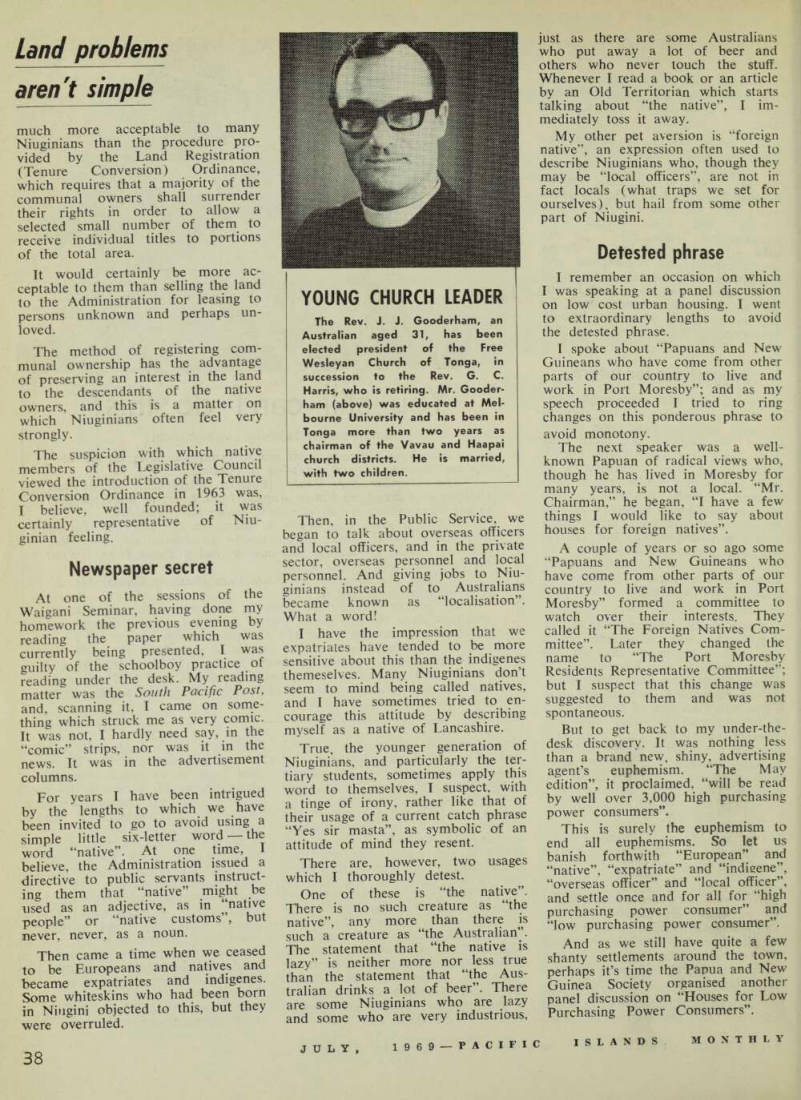
Young Church Leader
The Rev. J. J. Gooderham, an Australian aged 31, has been elected president of the Free Wesleyan Church of Tonga, in succession to the Rev. G. C.
Harris, who is retiring. Mr. Gooder ham (above) was educated at Mel bourne University and has been in Tonga more than two years as chairman of the Vavau and Haapai church districts. He is married, with two children.