Tropica I ities
pp. 36-37 · Read in the full issue
Suddenly , The
Fishing Isn't
So Good
Tropica I ities
Output at American Samoa’s and Star Kist, is running well catches in nearby waters are few Some say the Asian fishermen, who supply Van Camp and Star Kist, have fished out huge areas of the Pacific around the Samoas and Fiji; others maintain that the fish have just moved out of the area tem porarily.
Whatever the answer, the fact is the fish are rare.
The drop in production is starting to hurt. All retailers in Pago Pago have noted big falls in turnover; Samoans are out of jobs; South Korean fisherman are not spending as much as usual; and one major importer of small Japanese cars in Pago Pago has 20 new cars on his hands he cannot sell.
No one’s screaming “recession” yet, but the canneries dominate Samoa’s economy and if the fish shortage continues serious thought will have to be given to the can neries’ future.
In seeking good catches, the fishing boats are moving over 3,000 miles away from their Pago Pago base.
Popular fishing grounds are areas around the three isolated groups of French Polynesia the Marquesas, Tuamotus and Gambiers.
There is apprehension in French Polynesia’s thriving capital of Papeete about these fishing activities. A number of French Polynesians are suggesting that their territory should have a hand in these operations, especially so since the Asians might decimate French Polynesia’s fish population as they seem to have done around the Samoas.
Interest in the uninvited Asians
two fish canneries, Van Camp
below capacity because good
and far between. was growing in June in Papeete when a PIM staff writer spent two weeks there.
He heard it suggested that part of France’s atomic testing navy fleet, lying idle in Papeete Harbour, be used “more sensibly” to make sure Asians didn’t come in too close to remote islands (Papeete is still smarting over the raid by an Asian fishing vessel on supplies from a remote Tuamotu village).
There’s also the thought that a cannery with French share-holding be set up on Maketea Island. Make tea, a worked out phosphate mine, is close to Papeete and it has much used phosphate facilities equipment which could possibly be used for cannery operations.
With only about 30 residents, there are three big overseas-ships’ buoys on Makatea, good roads, a moving bridge, a loader, and many installations.
That was the
month that was
In other ways in American Samoa in June, things were bursting out all over.
Mr. O. Lewis, a deputy assistant secretary for the US Department of the Interior, was in Pago Pago in early June, telling practically every one (except the embarrassed Owen Aspinall) that a new governor was shortly to be appointed. {PIM, June, P- 31.) Washington apparently hopes that
a new Governor—probably Mr. J.
M. Haydon, president of the Seattle Port Commission—will take over sometime in August, with a new team and new policies.
The Governorship of American Samoa—worth $U536,000 a year— is a political plum, but Samoans are currently angry that Washington should so openly show this in its present tactics.
Later in June the contract with the National Association of Educational Broadcasters to run the Samoan education system ended and Governor Aspinall, after approval from the local legislature, proposed a new contract with the University of Southern Cali fornia. But the USC contract was not approved in Washington.
That wasn’t the only education upset. A Californian, Mrs. Dorothy Hansen, created a furore when she threatened to sue the Government of American Samoa for breach of con tract after she was sacked from her job as a television teacher. And Mrs.
Hansen made things worse by alleg ing widespread discrimination against Samoans in the education system.
June just wasn’t American Samoa’s month.
Chilly in the
football pool
And nor was June the month for the Nauru football pools scheme. In Nauru, many employees of Pacific Sporting Pools had to be put off, and in one week only 200 coupons were received at PSP headquarters on the island.
One of the reasons for the poor response was that many Australians
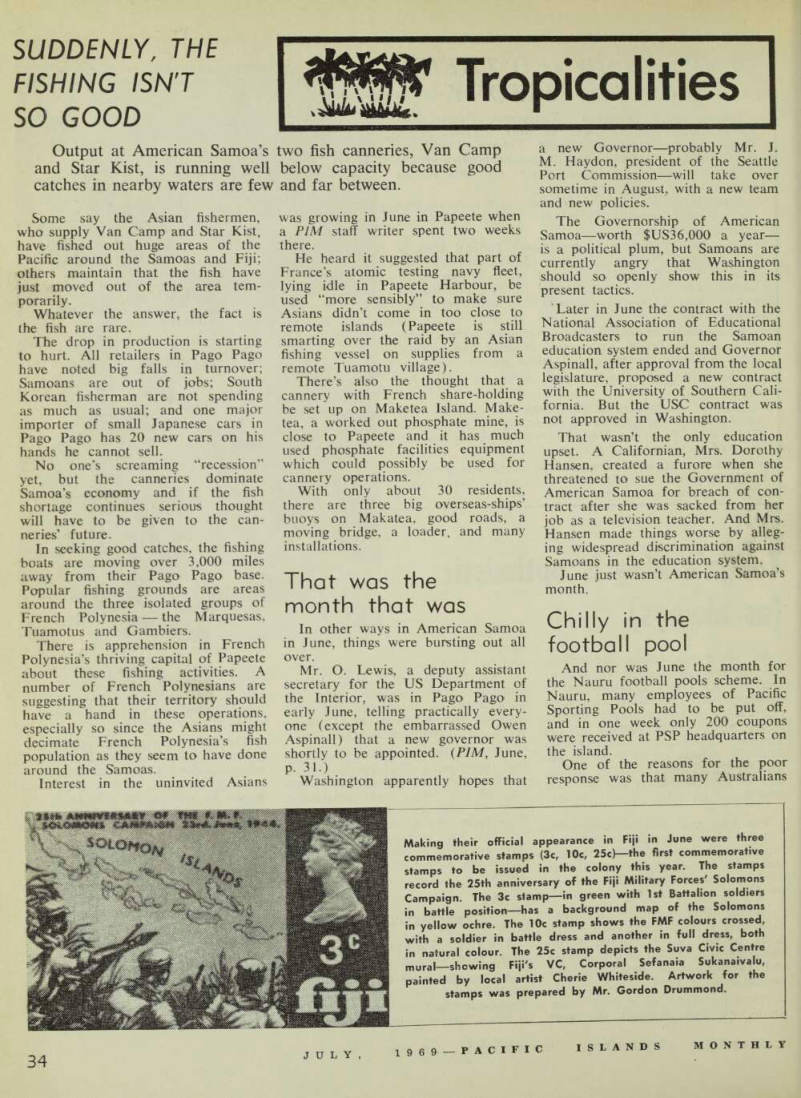
Making their official appearance in Fiji in June were three commemorative stamps (3c, 10c, 25c)— the first commemorative stamps to be issued in the colony this year. The stamps record the 25th anniversary of the Fiji Military Forces' Solomons Campaign. The 3c stamp—in green with Ist Battalion soldiers in battle position—has a background map of the Solomons in yellow ochre. The 10c stamp shows the FMF colours crossed, with a soldier in battle dress and another in full dress, both in natural colour. The 25c stamp depicts the Suva Civic Centre
mural—showing Fiji's VC, Corporal Sefanaia Sukanaivalu,
painted by local artist Cherie Whiteside. Artwork for the stamps was prepared by Mr. Gordon Drummond.
sent their entries seamail, instead of airmail, and they arrived too late.
Things got better later, but not nearly as well as the promoters hoped. It was all very chilly in the pool.
Apparently, after three weeks of operation there have been winners, but not even Mr. George Pearce, director of PSP, was able to tell us how much had been won.
He could only say that people with a total of 20i points won $105.50 for each 10 cents they invested on the first pools day, and people with a total of 22 points on the second pools day won $108.85 for every 10 cents invested.
A bit of flag
waving by SPC
South Pacific Islanders and neigh bours have been invited to help design a flag for the South Pacific Com mission.
The idea of having an SPC flag to flutter at international gatherings was first voiced at last October’s South Pacific Conference in Noumea.
A couple of rather subdued designs were passed around the gathering, but Islanders were unanimous that the best motif for an SPC flag would be the huge colourful shirt worn by the Commissioner from Western Samoa—Afoafouvale Misimoa.
Upon this suggestion, Misimoa came to the next assembly with his shirt neatly packaged and solemnly presented it, to the great merriment of everyone present.
The next conference, in Noumea in October, will judge designs sub mitted for the flag competition, with two prizes of $lOO and $3O to be awarded. Entries of about 10 in. x 6 in. should include the words “Commission du Pacifique Sud— South Pacific Commission” and bear the CPS-SPC sign. The dominant colour should be turquoise blue.
The flag designs should reach the SPC, BP No. 9, Noumea, by Septem ber 15.
100 years old and
still going strong
Fiji’s only daily newspaper, The Fiji Times, is making preparations to celebrate its centenary in Septem ber. The Fiji Times was established in Levuka, the then capital of Fiji, on September 4, 1869, by George Littleton Griffiths, a man of remark able character and ability, who owned and edited the newspaper for 40 years.
Fiji was then a no-man’s-land, but
became a British Crown Colony in 1874. The newspaper was moved to the new capital, Suva, about 70 years ago.
After the death of Mr. Griffiths, The Fijji Times had a somewhat chequered career, but maintained continuous publication.
It eventually was taken over by Mr. Alport Barker (subsequently Sir Alport Barker) who merged with it his own Western Pacific Herald. The newspaper was then called Fiji Times & Herald.
In 1946, a year before he died.
Sir Alport Barker sold Fiji Times & Herald Ltd. to Mr. R. W. Robson, founder of PIM and head of Pacific Publications Pty. Ltd.
Mr. Robson changed the news paper’s name back to The Fiji Times, made it a morning daily (previously it had been an evening daily), brought in Mr. Len Usher (who had been the Fiji Government’s Public Relations Officer) as Executive Director and Editor, modernised the plant, erected a very large and well equipped newspaper office in the centre of the city and, in March last, introduced a new four-unit Com munity Goss (offset) press.
Fiji Times & Herald Ltd., as part of a deliberate policy, has trained local technicians. There now are over 200 people on the payroll, and fewer than 20 of them are Europeans.
The Fiji Times has a present circulation of around 11,000, and the new plant also produces two weekly newspapers which it owns (one in Fijian and one in Hindi) and a very large amount of commercial print ing, including newspapers for other people.
The centenary celebrations, now being planned, will include several public functions, and the establish ment of a scholarship fund, etc.
Hard talking saves
the council
One Chinese, three Europeans and 34 Tolai tribesmen at Rabaul have been elected to the Gazelle Local Government Council after one of the New Guinea Administration’s toughest campaigns for several years.
The fate of local government at Rabaul was literally at stake.
The Gazelle Council, covering 60,000 village people, has just be come multi - racial but several hundred, including at least one native member of Parliament, did not like the idea.
At the end of May, 8,000 Tolai men, women and children marched to the District Commissioner, protest ing that Europeans and Chinese would take over the council if it became multi-racial.
In June during the voting, the Administration turned all its local government experts out into the cam paign to break down the opposition.
Dozens of native candidates (there were 108 candidates of all races) threatened to withdraw their nomina tions, but were talked out of it.
A native Parliamentarian can vassed ahead of the polling teams, urging voters to abstain. In one village, a distant sing-sing was ar ranged to make sure that nobody was there when the polling team arrived.
Eventually, the government men won the battle. It was a tough fight —one very senior local government officer returning to Port Moresby hoarse from a dozen speeches to talk the Tolais out of boycotting their own local government.
In some of the 38 council wards, the polling was still very low—the former president of the Gazelle Council, Mr. Vin Tobaining, was re portedly re-elected in his ward, with only 11 votes.
New president of the Gazelle multi racial council is the Tolai school teacher. Mr. Stanley Tomarita.