They're selecting their
pp. 28-136 · Read in the full issue
best for the Games
Throughout the South Pacific in June, territories were getting down to the serious business of selecting their final teams for the Third South Pacific Games, to be held in Port Moresby, August 13-23. Here is the latest round-up of territory developments.
Following some very encouraging performances at the national swim ming championships on June 5, 6 and 7, the Amateur Swimming As sociation of Fiji announced the names of 12 swimmers for the final selection squad. From these, 10 will be selected for Port Moresby.
Squad members are: Men—Sailosi Baleisolomome, Gary Dale, Robert Hough, David Lane, Harvey Probert, Mosese Veremalua and Phil Wilkins.
Women—Lorraine Emberson, Julie Murphy, Olive Pickering (who has been in Australia since 1967), Lyndal Probert and Margaret Smith.
The association had contacted New South Wales swimming autho rities regarding the possibility of Olive Pickering being available to swim for Fiji, but by mid-June, Olive had not submitted any qualifying times to the association. It seemed unlikely that she would swim for Fiji.
By early June, nine swimmers in the training squad had beaten the qualifying times set by the selectors— and these, with two exceptions, were faster than the winning times at the first Games in Suva. They correspond with fourth-place times at the second Games at Noumea.
He broke four records
The final selection trials were to be swum between July 2-5 and the team for the Games was due to be an nounced on July 7.
Following the Fiji swimming championships, the Victor Ludorum and Victrix Ludorum trophies for the best all-round individual per formances went to Phil Wilkins and Lorraine Emberson.
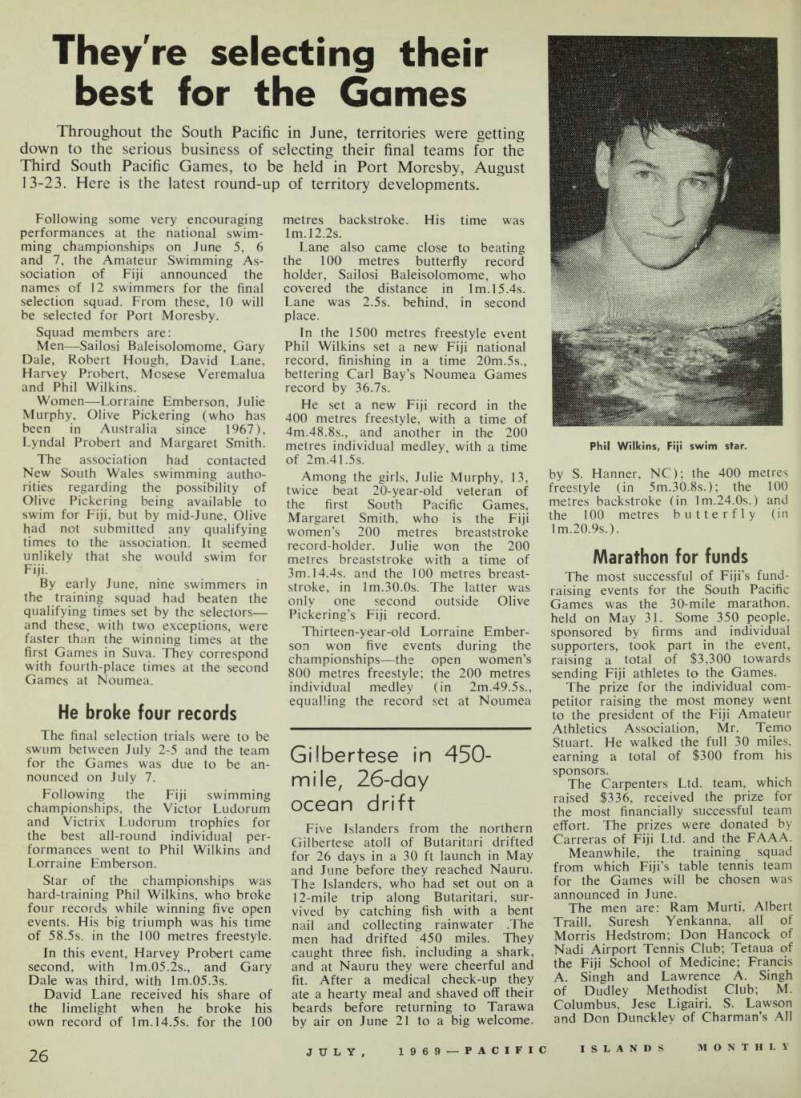
Star of the championships was hard-training Phil Wilkins, who broke four records while winning five open events. His big triumph was his time of 58.55. in the 100 metres freestyle.
In this event, Harvey Probert came second, with 1m.05.25., and Gary Dale was third, with 1m.05.35.
David Lane received his share of the limelight when he broke his own record of Im. 14.55. for the 100
metres backstroke. His time was 1m.12.25.
Lane also came close to beating the 100 metres butterfly record holder, Sailosi Baleisolomome, who covered the distance in Im. 15.45.
Lane was 2.55. behind, in second place.
In the 1500 metres freestyle event Phil Wilkins set a new Fiji national record, finishing in a time 20m.55., bettering Carl Bay’s Noumea Games record by 36.75.
He set a new Fiji record in the 400 metres freestyle, with a time of 4m.48.85., and another in the 200 metres individual medley, with a time of 2m.41.55.
Among the girls, Julie Murphy, 13, twice beat 20-year-old veteran of the first South Pacific Games, Margaret Smith, who is the Fiji women’s 200 metres breaststroke record-holder. Julie won the 200 metres breaststroke with a time of 3m. 14.45. and the 100 metres breast stroke, in 1m.30.05. The latter was only one second outside Olive Pickering’s Fiji record.
Thirteen-year-old Lorraine Ember son won five events during the championships—the open women’s 800 metres freestyle; the 200 metres individual medley (in 2m.49.55., equalling the record set at Noumea
by S. Hanner, NC); the 400 metres freestyle (in 5m.30.85.); the 100 metres backstroke (in 1m.24.05.) and the 100 metres butterfly (in 1m.20.95.).
Marathon for funds
The most successful of Fiji’s fund raising events for the South Pacific Games was the 30-mile marathon, held on May 31. Some 350 people, sponsored by firms and individual supporters, took part in the event, raising a total of $3,300 towards sending Fiji athletes to the Games.
The prize for the individual com petitor raising the most money went to the president of the Fiji Amateur Athletics Association, Mr. Temo Stuart. He walked the full 30 miles, earning a total of $3OO from his sponsors.
The Carpenters Ltd. team, which raised $336, received the prize for the most financially successful team effort. The prizes were donated by Carreras of Fiji Ltd. and the FAAA.
Meanwhile, the training squad from which Fiji’s table tennis team for the Games will be chosen was announced in June.
The men are: Ram Murti, Albert Traill, Suresh Yenkanna, all of Morris Hedstrom; Don Hancock of Nadi Airport Tennis Club; Tetaua of the Fiji School of Medicine; Francis A. Singh and Lawrence A. Singh of Dudley Methodist Club; M.
Columbus, Jese Ligairi, S. Lawson and Don Dunckley of Charman’s All
Phil Wilkins, Fiji swim star.
Nations Club; and Viliame Lea of the Suva City Council.
The women are: Akisi Naivaluvou of MGM High School; Litiana and Tere Taaram of the Fiji School of Medicine; Dr. N. Laisa of Dudley Methodist Club; and Jiko Yasa of Nadi Airport Club.
From New Caledonia
France is supplying New Caledonia South Pacific Games team with six coaches who will accompany the team to Port Moresby.
In addition five Caledonian sports men will return from training in France to join the Games team.
Expected back in July are Arnojlt Beer (discus, shot put thrower who has just reached 900 lbs in weight lifting), Petelo Wakalina (Wallisian javelin thrower), Thierry Ruyer (swimmer) and Charles (Melanesian soccer player).
Second soccer star Marc Kanyan is now disqualified from the Games as he has turned professional for the Bastia team in Corsica.
Meanwhile the young Melanesian tennis champion Wanaro N’Godrella is competing in Europe in the French team and does not expect to reach the Pacific until early August.
The Caledonian delegation of 220 at Port Moresby will be the second largest after the host team. The delegation is composed of 184 com petitors; the others include officials, a doctor, and a cook to prepare special French dishes for the athletes, as was done at the first Games in Suva.
(Maybe the Anglo-Saxons will take their own tea-and-toast makers next time they visit a French territory.) Mr. Patrice Wright will be in charge of the men’s camp, and chaperone for the girls will be Mrs.
Carrie Gaveau, a Maori from North Auckland, who has been in Noumea a year since her marriage to a Cale donian basketball enthusiast.
The cost of sending the Caledonian delegation is approx. SABO,OOO, which is being raised in France and locally.
The second Games lottery was drawn in June, with winning prize of SA 10,000 going to a Melanesian grocery worker.
Meanwhile the athletes are being spurred on to defend the French flag.
Defeated
A Caledonian soccer team which flew to Sydney in May suffered defeats in all matches: 6-0 against the NSW selection, 5-2 against Hakoah and 4-1 against the NSW South Coast.
The volley-ball teams led by Canadian Father Paul Brousseau managed better scores, with the men recording six victories and one defeat, the girls scoring five victories and two defeats. They were matched against teams from four Australian States, in Sydney.
The Caledonian girl basketballers conceded defeat in all three matches against the Fijian selection at Suva in May, scores being 21-28, 28-37 and 34-40. The girls’ only consola-
tion was that the Fijians had also already soundly beaten the Tahitian women basketballers. The men’s basketball team expects to visit Aus tralia to try its strength, possibly early August.
Caledonian boxers, after their Tahiti trip in April, have recently matched themselves against New Zealand opponents.
In Noumea at the end of May, Mitra Kaloi and Noel Kaoutch were victors, with Phelon Phadom and Pouhiou defeated by the New Zealanders. In the star encounter of the evening, New Zealander Billy Opetaia defeated Ravulu Kalaviti, of Fiji, when the referee stopped the fight in the 6th round.
Success in NZ
At a return evening in Auckland on June 9, the Caledonians won the Rothmans trophy with three victories out of five bouts against the New Zealanders. Victors were Menango, Mitra Kaloi and Phelon Phadom, with Maurice Kaloi and Noel Kaoutch suffering defeats. (A second evening was planned for June 14).
Caledonian judo contestants also benefited in June from encounters with visiting New Zealanders. Out of the 10 initial contests, the visitors (second team in NZ) won six and drew four with Caledonian M. Sutter winning the open tournament.
Finally, among the swimmers, the first of the Caledonian team members have been named. The girls are Simone Hanner, Marie-Jose Kersaudy, Christian Legras and Claire Hemonot. The boys include Jean-Pierre and Jean-Yves Mamelin, Jehan Morault, Philippe Maillot and
(Continued on p. 132)
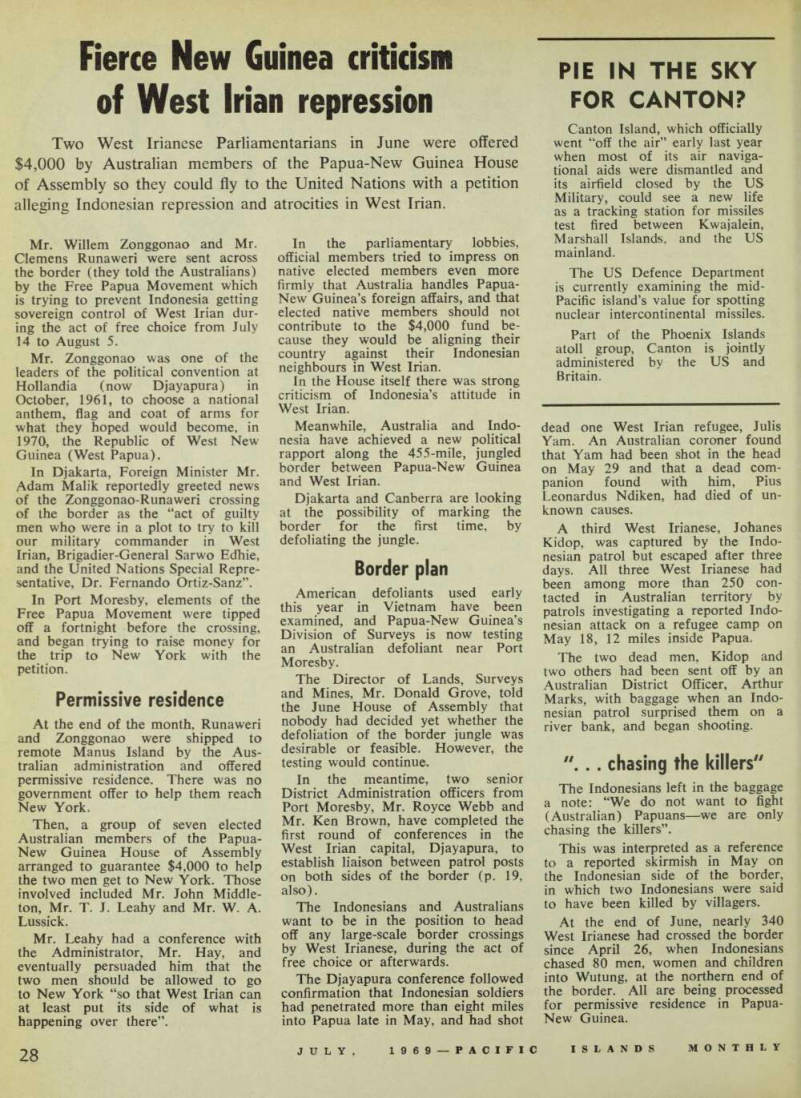
In Apia in June, former Olympian Peter Snell explains the techniques of middle distance running to young enthusiasts at the Church College of Western Samoa. He was one of four NZ experts who visited Western Samoa to advise on the Games.
Photo: Glen Wright.
Thierry Ruyer (returning from France).
Four Tahitian swimmers are reported to be going shortly to Noumea to train, but their hopes are turned rather to 1972.
As for the Wallisians, those of their team not presently living in Noumea were expected to arrive in June to train in New Caledonia.
When August comes, there will be a veritable air-lift from Noumea with a Qantas Boeing and four UTA
Caravelle flights transporting the 470 French participants (from all terri tories) to Port Moresby.
Western Samoans coached
Western Samoan athletes enjoyed a windfall of good fortune recently, which could help them at the Games.
Four expert New Zealand coaches, headed by world-famous Olympic runner Peter Snell, conducted three week’s coaching out of Apia, sponsored by the NZ Rothman’s Sports Foundation.
Features of the programme were a penthathlon for school athletes.
boxing, a marathon race, a hockey match (Fiji-Samoa), and the national athletics championships. (The latter two were part of the week-long National Independence Day cere monies that started June 2).
The other coaches were Bryan Wilson, sprinter and Rugby specialist; Ron Grimmer, boxer, and Don Clarke, footballer, and head of the New Zealand Rugby Association.
After meeting Prime Minister Fiame Mataafa, the four coaches began coaching. An inter-school pentathlon was underway quickly and boxing soon followed.
The men exuded enthusiasm which was contagious. Amateur athletes flocked to the sessions on both Upolu and Savaii, eager to learn.
A squad of the most likely can didates for the Games was given special training.
All told, the coaches put in 14 long days, Sundays excepted, from May 19 to June 6, instructing athletics, Rugby, boxing, hockey, weighlifting, pentathlon and marathon.
Also, they lectured at school as semblies, officiated at games and matches and were honoured guests at the Independence celebration.
American Samoa
American Samoa hopes to send a 70-man team, consisting of 60 athletes and 10 managers and trainers, to Port Moresby next month.
The Samoans are expected to do well in boxing and basketball events.
About $25,000 had been raised ($15,000 by local contributions, SIO,OOO from the government) by mid-June towards sending the team to Moresby. Another $15,000 was needed.
Organising secretary-treasurer of funds, politician and lawyer, Ivi Pele, told PIM he was confident the $15,000 would be raised in time.
American Samoans have been entered in basketball, volleyball, weight lifting, boxing, softball and tennis events at the Games.
Boxing hopefuls include three Samoans who won their events at the last Games, at Noumea in 1966. They are Ve’a, 23, a heavyweight, To’o, 20, Ve’a’s half-brother, a light heavy weight, and Pii Nomaea, 20, a middleweight.
Another middleweight, Sive, 20, is expected to do well.
The 60 athletes, most of whom have been training for a year, include 15 girls. Should insufficient funds be raised, non-athletes of the team will be dropped first.