"Chief President Moses": Man with
pp. 25-27 · Read in the full issue
a message for 10,000 Hebrideans
• Robert Langdon, executive officer of the Pacific Manuscripts Bureau at the Australian National Univer sity in Canberra, recently spent four weeks in the New Hebrides seeking out and microfilming documents of interest to historians, linguists, anthropologists and others. While there, he also heard a lot of talk about . . .
By Robert Lamgdon
If someone in the New Hebrides were to conduct a poll to discover the most talked about man in the condominium in the past 12 months or so, my guess is that the vote would go overwhelmingly to a barely literate man called Jimmy Stephens.
Stephens, who is looked on as a prophet by many New Hebrideans, is also known as Chief President Moses and Jimmy Tupou Patuntun Stephens Moses.
He is the leader of Nagriamel, the first political movement to develop in the New Hebrides on a national scale since those islands came under the joint administration of Britain and France in 1906.
The aim of Nagriamel is to restore to native ownership all European owned land that has never been developed agriculturally. However, Nagriamel leaders say that the move ment is not anti-European.
The land they seek is called in their parlance “dark bush land” and was generally acquired in the lawless days before the condominium when European speculators, such as the well-known John Higginson, of New Caledonia, acquired paper titles to huge areas in exchange for a few axes, bolts of calico or bottles of gin.
More than 10,000 members
The name Nagriamel is derived from native words for two plants — nagria, a croton, and mel, the cycas palm—which figured pro minently in the life and ceremonies of the northern New Hebrides in former days. Bunches of nagria leaves of varying sizes were used to indicate rank in the old pig-killing ceremonies, while fronds of mel were used as tabu signs on graves, plots of ground, etc.
The Nagriamel movement is estimated to have a membership of more than 10,000 throughout the New Hebrides, but particularly in the northern islands. This says a great deal for the leadership and
persuasiveness of Jimmy Stephens, considering that the movement has been in existence for barely three years, that communications between most islands are poor, and that the total population of the condominium children, Europeans and all —is less than 80,000.
Stephens is a man of 45 or there
abouts, with a greying, patriarchal beard and a way with New Hebrideans that has not been seen before. He has worked at various times as a bulldozer driver, care taker of a church, and skipper of an inter-island trading vessel.
Although he speaks English, he is more at home in Pidgin, the lingua-
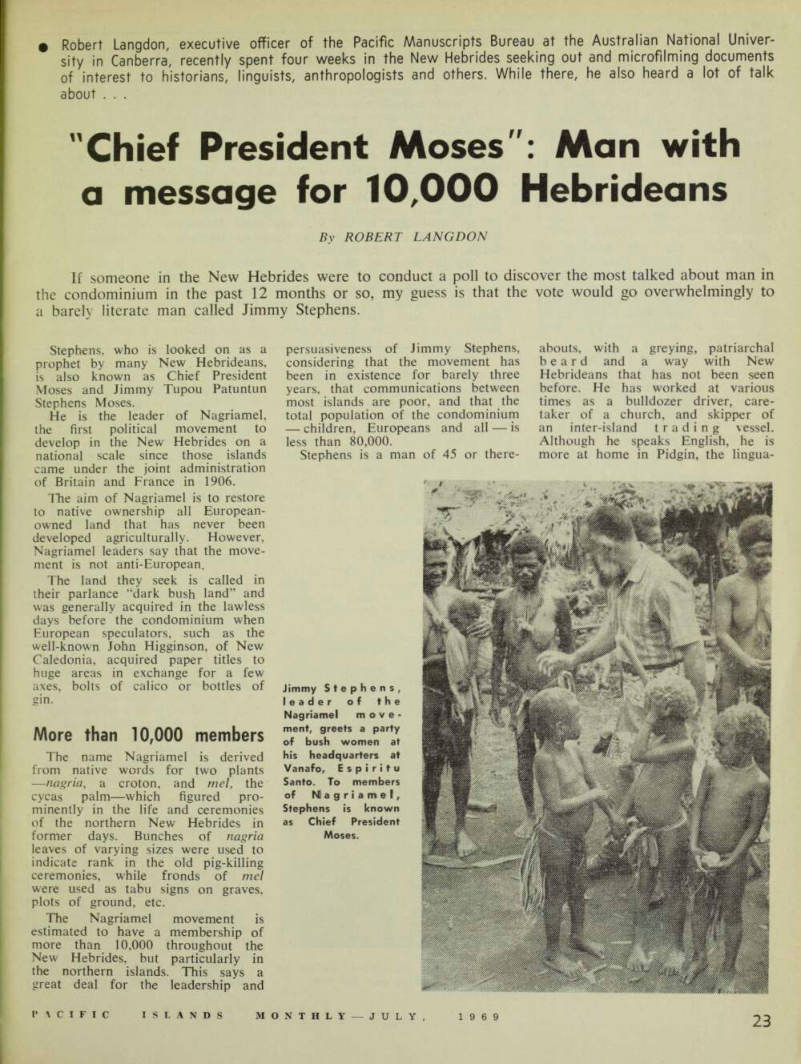
Jimmy Stephens, leader of the Nagriamel move ment, greets a party of bush women at his headquarters at Vanafo, Espiritu Santo. To members of Nagriamel, Stephens is known as Chief President Moses.
franca of the Babel-tongued New Hebrides.
Part-English, part-Tongan and part-New Hebridean, Stephens is a grandson of an English seaman who arrived in the New Hebrides in the 1890’s and settled on Tanna, then on Aoba, and finally at Nogugu, Espiritu Santo. See panel at right.
Jimmy Stephens was a youth in Santo during the war years when tens of thousands of American servicemen invaded the place and brought the locals an era of plenty that they had never known before.
Although the war spoiled his chances of getting much formal education, contact with the Ameri cans did a lot to sharpen young Stephens’ wits, and it left him with a stock of savoir faire far in excess of that of the average New Hebridean.
After the war, so “old hands” in Santo say, Stephens did very well for himself by digging up caches of equipment that the Americans had buried and left behind. Later, when these sources of income dried up, he became a bulldozer driver, care taker of a Catholic church, and skipper of a Burns Philp trading ship. Whatever job he had, it is said, he always looked very much the part—just as he does today with his greying, patriarchal beard in his role of chief president, prophet and leader of Nagriamel.
Bought rifles
Whether Stephens had a hand in the foundation of Nagriamel or whether he joined it shortly after its foundation, I could not find out.
However, the movement appears to date back to January, 1966, when Chief Buluk, a headman of the Big Bay area of Espiritu Santo and a friend of Stephens from the war years, called a meeting of 20-odd Espiritu Santo chiefs. These chiefs, mainly bushmen, met to discuss the invasion by Europeans of what they considered was their land.
Shortly after this, Stephens entered into an arrangement with the bush men to buy them some rifles, ap parently to ward off or intimidate encroaching Europeans. However, after collecting a goodly sum of money from the bushmen, Stephens failed to deliver the goods, and the bushmen complained to the govern ment. The result was that Stephens was gaoled.
Then Stephens, through his friend Buluk, apparently persuaded the bushmen that his intentions had been honorable, and before long
they were pleading with the govern ment to let him out again.
Following his release, Stephens, Buluk and a number of other New Hebrideans went to live on some land called Vanafo, near the upper reaches of the Sarakata River, some 15 miles north of the town of Santo.
This land is on the vast, fertile, largely undeveloped plateau that extends all the way up the eastern side of Espiritu Santo to Big Bay.
Expedient
According to a judgment of the Joint Court in Vila, the land belongs to the big French company, Societe Francais des Nouvelles
Hebrides, which, around the turn of the century, acquired all the assets of a company owned by the New Caledonian speculator John Higgin son.
As with much of the land it owns, SFNH has never done any thing to develop Vanafo; and it seems that when Stephens, Buluk and Co. moved in on it, the company made no effort to try to drive them off. Instead, under the influence of the French Administration, it decided it would be politically expedient to let them be.
Stephens and his companions worked hard and built up Vanafo into an attractive settlement with neat houses and gardens. News of their doings soon spread among the New Hebrideans and brought them many visitors. Stephens lectured these visitors on how SFNH had gobbled up their land, and so began to spread the Nagriamel philosophy that all “dark bush land” owned by Europeans, but never planted with coconuts, coffee or cocoa, should revert to the natives.
As time passed, Stephens allocated plots of Vanafo land to people from other islands so that anyone who wished to live and work there for a spell could do so. Quite a number of New Hebrideans did this, for to work at Vanafo was to work for the Nagriamel cause.
Meanwhile, Stephens sent agents to other parts of Espiritu Santo and to other islands in the group to preach the gospel of Nagriamel, to enrol new members in the move ment, and to collect subscriptions from them.
In the early days, the subscription gathering techniques of these agents
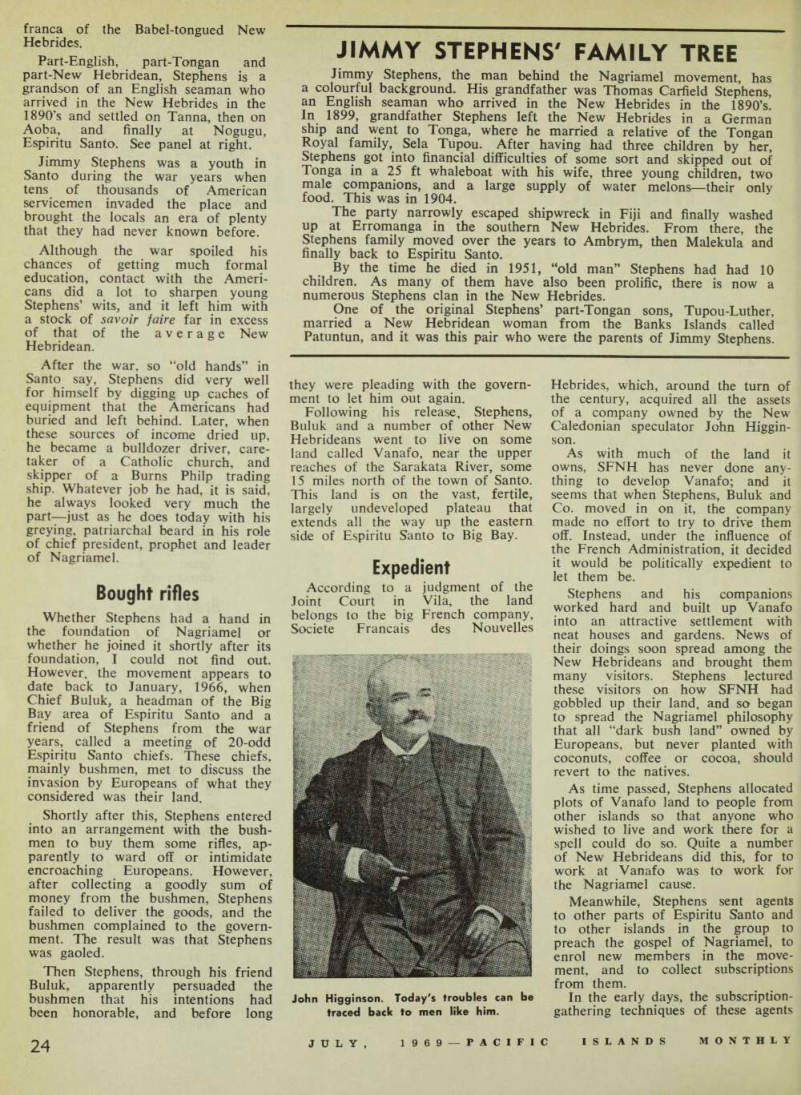
John Higginson. Today's troubles can be traced back to men like him.
were simple and unsophisticated, but nowadays they carry tape-recorded messages from their leader. What ever these messages say, they are apparently persuasive, for (uncon firmable) report has it that $50,000 has been paid into Nagriamel funds.
In search of "advice"
Stephens has spent part of the Nagriamel money in building Vanafo into an agricultural centre producing peanuts, among other things, and with big ideas for the future. Other amounts have been spent in travel ling to Australia, New Caledonia and Fiji in search of what he calls “advice”. Yet other sums again have gone in fees to an Indian lawyer from Fiji, Mr. K. C. Ramrakha, who is also a leading Fiji politician.
Mr, Ramrakha was engaged last year to appear for Stephens, Buluk and others in a court appeal after they had been sentenced to various terms of imprisonment for illegal entry on European—but not SFNH —land.
As a result of Mr, Ramrakha’s intervention, all sentences were con siderably reduced. However, they were still long enough—so some Europeans say—for Stephens and Buluk to become martyrs for their cause in the eyes of the New Hebrideans.
The sentences, at any rate, do not seem to have deterred Nagriamel members from their campaign for land reform. All along the road from Santo to Hog Harbour, and even in less frequented parts of Espiritu Santo, one repeatedly comes across signs erected on European owned land which read: “Nagriamel private property please keep off,” or words to that effect.
Meanwhile, Vanafo continues to grow. Whereas at the census in May, 1967, it had a population of only 27, its residents on a more or less permanent basis now number more than 200. A smart blue mini-bus, proudly labelled “Nagriamel Trans ports,” recently inaugurated a shuttle service between Vanafo and Santo.
Last October, an important cere mony was held at Vanafo. A newly-created flag, featuring the nagria and the mel, was hauled to the top of a lofty white flagpole that Stephens had acquired from some where. It was at about this time that Stephens was given the title of Chief President Moses apparently because he is leading members of Nagriamel in the wilderness.
Europeans who braved the formid able road to Vanafo to witness the flag-raising ceremoney, and others who have been since, have been
particularly impressed by the orderly appearance of the place, the almost military discipline, the sentry boxes, the neat sign - posted plots of land for New Hebrideans from other islands, the reception centre for visitors with its genteel visitors’ book, above all, the polite, quaintly worded notices to be seen at every hand. One sign, for example, says: Please Nagriamel Visitor Camp your cars here.
Another sign gives visitors and members arriving in the village instructions about shaking hands and signing the visitors’ book, and goes on to state that “at 3 o’clock the bell will sound for men’s swimming; at 5 o’clock the bell will sound for women and children swimming”.
A third notice, which is the basic manifesto of the Nagriamel move ment, says: Nagriamel Committee Claim Please, sir, our cry come to you.
Help us natives to get our land back under Nagriamel. Please, the European or New Hebridean who wants to work in the natives' reserve after cocoanut, cocoa, coffee plantation, please, they should pay rant go to Nagriamel.
Although the tenor of, and standard of English in, the Nagriamel notices might suggest that the move ment is not a difficult one to deal with administratively, it is clear that neither the British nor French Administrations is taking it lightly.
People on both Santo and Aoba told me that the French Administra tion had offered to establish a school at Vanafo and the British a medical clinic—both with the idea of getting “a leg in” to try to direct Nagriamel along “reasonable lines”. However, both offers were refused. On the other hand, the Nagriamel leaders have allowed a church to be established at Vanafo by the Churches of Christ mission, which has long had a reputation in the New Hebrides for being somewhat “agin the government”.
All in all, therefore, neither the British nor the French (who have considerably more to lose) are terribly happy about Nagriamel. But
both seem to be living in the hope that, by saying as little as possible about it, it will eventually go away.
Until now, so I understand, not a single word has appeared about Nagriamel in either the French or the British newsletters, which are published regularly by the two residencies. Nor has anything ever been said about it over jointly sponsored Radio Vila, which is sup posed to broadcast the local news.
However, the British and French Resident Commissioners did permit themselves to mention its name just once when they made a joint speech to open the 16th session of the New Hebrides Advisory Councils last December. They then said: “We must not omit to mention a resettlement operation now being carried out by some New Hebrideans in the Vanafo area of Santo. While in some respects—e.g. their desire to develop the land for agriculture and cattle with the help of modern equipment these people are for ward-looking, in others they seem to be preoccupied with the past, inasmuch as they talk a great deal about custom law.
“Although it was necessary earlier this year to punish some of the people involved in the Nagriamel movement for illegal entry on to land, we are watching its activities with interest and shall not oppose any desirable project which will not disturb good relations between the various communities.”
Brave and cautious
These, of course, are both brave and cautious words in a territory where: • The native population is in creasing at such a rate that it is likely to double itself within 30 years. • Native pressure on undeveloped land is growing correspondingly. • Europeans number less than 2,000. • Most of the choicest un developed land is owned by Euro peans, particularly the French com pany, SFNH, which is partly-owned by the French Government.
In these circumstances, it looks very much as if something or some one will have to give, and the chances are that it won’t be Nagriamel.
What happens in the future will undoubtedly depend to a large extent on Jimmy Stephens, alias Chief President Moses, who, in late May, was in New Caledonia seeking “advice” from a big Noumea busi nessman on the development of a cattle and timber industry in and around Vanafo.