Than Peanuts
pp. 124-127 · Read in the full issue

Fiji Gets More
From Australia
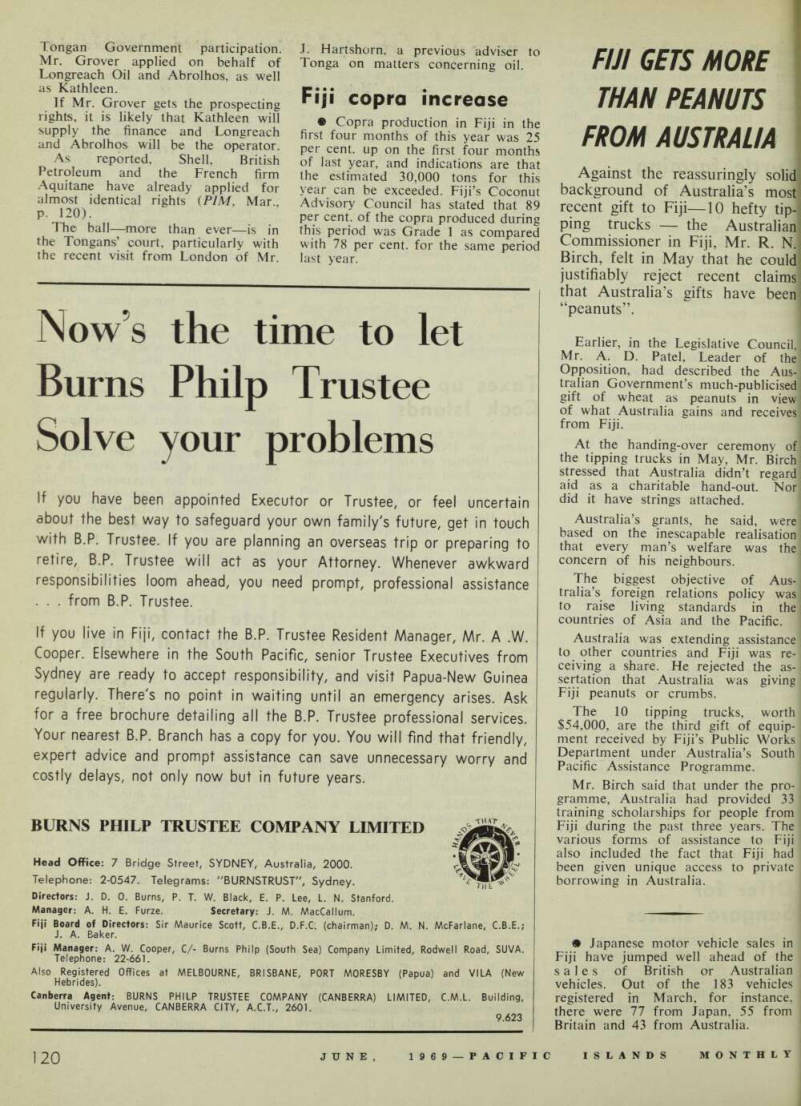
Against the reassuringly solid
background of Australia’s most
recent gift to Fiji—lo hefty tip
ping trucks the Australian Commissioner in Fiji, Mr. R. N.
Birch, felt in May that he could
justifiably reject recent claims
that Australia’s gifts have been
“peanuts”.
Earlier, in the Legislative Council,!
Mr. A. D. Patel, Leader of the Opposition, had described the Aus tralian Government’s much-publicised gift of wheat as peanuts in view of what Australia gains and receives from Fiji.
At the handing-over ceremony of the tipping trucks in May, Mr. Birch stressed that Australia didn’t regard aid as a charitable hand-out. Nor did it have strings attached.
Australia’s grants, he said, were based on the inescapable realisation that every man’s welfare was the concern of his neighbours.
The biggest objective of Aus tralia’s foreign relations policy was to raise living standards in the countries of Asia and the Pacific.
Australia was extending assistance to other countries and Fiji was re ceiving a share. He rejected the as sertation that Australia was giving Fiji peanuts or crumbs.
The 10 tipping trucks, worth $54,000, are the third gift of equip ment received by Fiji’s Public Works Department under Australia’s South Pacific Assistance Programme.
Mr. Birch said that under the pro gramme, Australia had provided 33 training scholarships for people from Fiji during the past three years. The various forms of assistance to Fiji also included the fact that Fiji had been given unique access to private borrowing in Australia. • Japanese motor vehicle sales in Fiji have jumped well ahead of the sales of British or Australian vehicles. Out of the 183 vehicles registered in March, for instance, there were 77 from Japan, 55 from Britain and 43 from Australia.
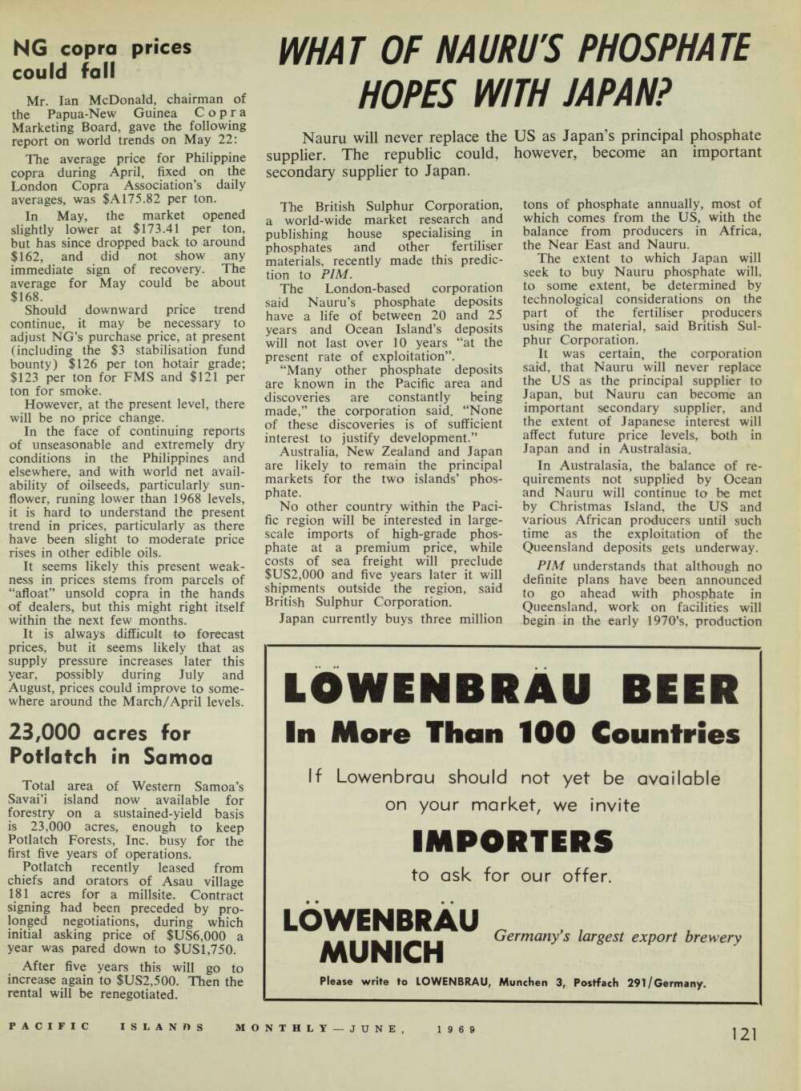
NG copra prices
could fall
Mr. lan McDonald, chairman of the Papua-New Guinea Copra Marketing Board, gave the following report on world trends on May 22: The average price for Philippine copra during April, fixed on the London Copra Association’s daily averages, was $A175.82 per ton.
In May, the market opened slightly lower at $173.41 per ton, but has since dropped back to around $162, and did not show any immediate sign of recovery. The average for May could be about $l6B.
Should downward price trend continue, it may be necessary to adjust NG’s purchase price, at present (including the $3 stabilisation fund bounty) $126 per ton hotair grade; $123 per ton for FMS and $l2l per ton for smoke.
However, at the present level, there will be no price change.
In the face of continuing reports of unseasonable and extremely dry conditions in the Philippines and elsewhere, and with world net avail ability of oilseeds, particularly sun flower, runing lower than 1968 levels, it is hard to understand the present trend in prices, particularly as there have been slight to moderate price rises in other edible oils.
It seems likely this present weak ness in prices stems from parcels of “afloat” unsold copra in the hands of dealers, but this might right itself within the next few months.
It is always difficult to forecast prices, but it seems likely that as supply pressure increases later this year, possibly during July and August, prices could improve to some where around the March/April levels.
23,000 acres for
Potlatch in Samoa
Total area of Western Samoa’s Savai’i island now available for forestry on a sustained-yield basis is 23,000 acres, enough to keep Potlatch Forests, Inc. busy for the first five years of operations.
Potlatch recently leased from chiefs and orators of Asau village 181 acres for a millsite. Contract signing had been preceded by pro longed negotiations, during which initial asking price of SUS6,OOO a year was pared down to $U51,750.
After five years this will go to increase again to $U52,500. Then the rental will be renegotiated.