Vila—The
pp. 99-100 · Read in the full issue
Town That
Just Grew
By Roger Thompson
A notable aspect of European penetration in the South Pacific s that in four of the principal island groups, the present-day capitals ire not the sites that Europeans chose for their first settlements.
Papeete became Tahiti’s capital )ecause Matavai Bay did not afford ill-the-year-round protection for ship ping. Levuka, the old capital of Fiji m Ovalau Island, was supplanted by >uva because Ovalau did not offer :onvenient room for Levuka’s ex pansion. Tulagi made way for Honiara as the capital of the Jolomons both for space reasons and pecause World War II wiped it out.
The reasons for change in these hree cases were clear-cut. The same :annot be said about the fourth case, he New Hebrides capital of Vila, 'or this gained supremacy over Savannah Harbour, the first major ettlement, in a scarcely perceptible vay.
Other than sandalwood traders, vho moved on as supplies of sandal vood ran out, and Presbyterian nissionaries, Europeans did not ittempt to settle in the New Hebrides mtil the late 1860’s. Then, enticed )y a boom in world cotton prices esulting from the American Civil Var, they began arriving in the group o start cotton plantations. The slands of Tanna and Efate were their farting points.
On Tanna they never effectively ;stablished themselves because the lative inhabitants, who did not like ntruders, forcibly expressed their lispleasure.
The most popular place on Efate vas Havannah Harbour on the north vestem side of the island, less than
20 miles from Vila. The harbour was named in 1849 by Captain John Erskine after his ship, HMS Havannah.
Natives more peaceable
Here the natives were much more peaceable than those on Tanna. In 1872, Captain John Moresby, RN, visited the place and wrote: “Partial clearings have been made, and wooden buildings spring up round the anchorage at the head of the harbour. . . . Doubtless in a few years a flourishing town will have arisen where the rude open houses of the settlers now stand”.
However the next year saw the peak of Havannah Harbour’s develop ment, although it continued to be an important settlement for nearly 20 years.
It is on record that 31 adult Europeans lived there in 1873; all but three were British. They grew cotton on a number of plantations.
A Sydney firm, Scott, Henderson and Company, had set up steam driven machinery for ginning the cotton. This firm also ran a large store which supplied settlers and passing ships.
The collapse of European settle ment at Havannah Harbour was started by a sharp fall in world cotton prices in the early 1870’s.
In 1874 the European population
had been reduced to 19, and the planters had given up growing cotton in favour of maize. The following year Scott, Henderson and Company considered their enterprise at the harbour an unprofitable one and pulled out, leaving their machinery to rust.
Fierce hurricane
Drought, hurricanes and malaria completed the destruction of the European settlement at Havannah Harbour. During 1877 and 1878 there was a long drought which ruined many of the crops which the settlers attempted to grow. In January, 1878, one of the fierce hurri canes that visited the New Hebrides with unusual frequency in the late 1870’s, wrecked many of the houses that remained.
On nearby Nguna Island, Mrs.
Milne, a missionary’s wife, wrote that after it had passed “there was not a green leaf or blade of grass left from the shore up to the top of the hills. The trees and bushes were all stripped bare”.
There seems to have been an in creased amount of malaria in the 1870’s. “None who live ashore here escape this malady”, wrote Charles Rudd, a Fiji labour vessel’s Govern ment Agent, who visited the harbour in 1876.
From that year until the end of the decade at least nine settlers there
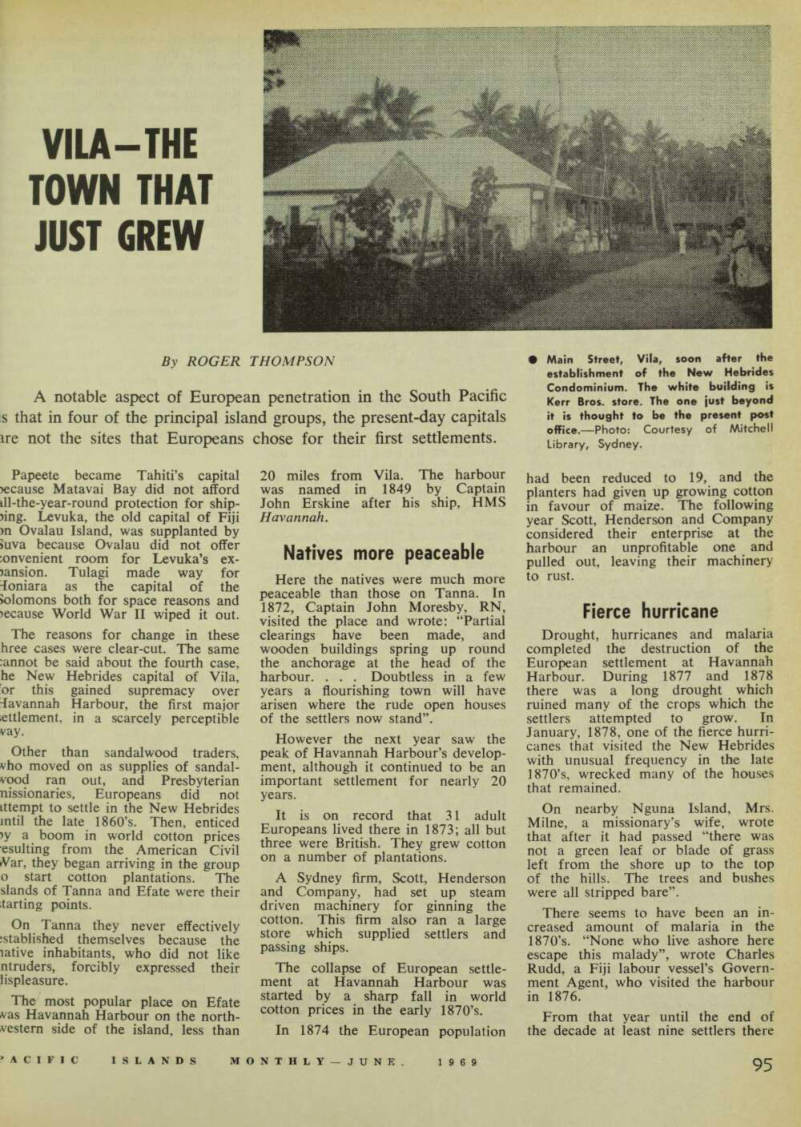
• Main Street, Vila, soon after the establishment of the New Hebrides Condominium. The white building is Kerr Bros, store. The one just beyond it is thought to be the present post office.— Photo: Courtesy of Mitchell
Library, Sydney.
No settlers left
died or were forced to leave because of ill-health.
By 1880 there were practically no settlers left at Havannah Harbour.
Walter Coote, who visited it in that year, wrote in Wanderings South and East that the main features of Euro pean habitation were two broken down stores, which chiefly stocked cheap liquor and rusty old rifles.
A few new British settlers arrived at Havannah Harbour in the early 1880’s, but they were bought out in 1882 by the Compagnie Caledonienne des Nouvelles-Hebrides, which was started in New Caledonia by John Higginson, a naturalised Frenchman.
Higginson’s company continued to run a store at the harbour, and Douglas Rannie, a Government Agent in the labour trade, who saw it in 1884, wrote that it was “a low wooden building with verandahs all round, and was well stocked with commodities of all kinds, from soft goods and groceries to hardware and harder grog, and some of that of the very worst sort”.
A place to avoid
That grog, said Rannie, had made Havannah Harbour a place that respectable ship masters avoided. It was the fuel on which many a fight had flared between crew members of labour ships, which used the harbour for victualling. Results could be seen in the local cemetery.
Ships engaged in the labour trade frequently visited the New Hebrides, and they helped provide a trade that was lucrative enough for Donald Macleod, the manager of the Com pagnie Caledonienne in the group, to establish his own store at Havannah Harbour to compete with the French one in 1885. Julian Thomas, a reporter for the Mel bourne Age, said in 1887 that Macleod lived in a “two-storied verandahed brick homestead” that was the finest house he had seen in the Pacific. It is still there today.
In 1886 the Governor of New Caledonia thought that the harbour was one of the most strategically important places in the New Hebrides, and he sent there over 100 troops in an unsuccessful attempt to persuade the French Government to annex the group. The troops stayed for nearly two years, but they did little more than suffer from malaria.
Troops were also sent to Port Sand wich on Malekula.
In 1889 Hugh Romilly established
himself at Havannah as British Consul in the New Hebrides, though he had a choice of only three Euro pean houses in which to live. He chose Macleod’s, but he was glad to leave at the end of the year, saying, “I do not know if there are any more unpleasant places in the world”.
Romilly should have gone to Vila if he wished to reside at the most important centre in the New Hebrides. A few Europeans had settled there in the 1870’s and by Romilly’s time it was going ahead.
The earliest settler was probably “Jack” Rodin, a Swede, who arrived in 1874 and lived there for many years. A few Frenchmen went there in the early 1880’s. The most notable of these was Ferdinand Chevillard, who built up a fine plantation, and who was for a long time the leader of the French community at Vila.
"Franceville"
In 1886 the Compagnie Cale donienne established seven French families on its land round Vila Bay, which increased the European popula tion there to more than twice the number at Havannah Harbour. The company probably chose Vila be cause it was able to buy more land there than at Havannah Harbour, where much of the best land was owned by Macleod, the Presbyterian Mission and absentee Australians.
The settlers lacked experience and capital and had a hard time at first.
But in 1889 the French residents at Vila thought their little settlement was important enough to be called a municipality, and they called it Franceville, by which name it was known by Frenchmen for some years.
In 1890 the newly formed Aus tralasian New Hebrides Company recognised Vila as the most impor tant centre in the New Hebrides by deciding to establish its islands headquarters there. The same year Donald Macleod sold his store at Havannah Harbour and opened a new one at Vila. In 1892 the famous author Louis Becke unsuccessfully applied for a job in Macleod’s store.
A census taken by the Rev. F.
R. M. Wilson for the Federal
Council of Australasia showed that in 1891 there were 27 adult Euro peans at Vila, compared with only six at Havannah Harbour. Vila by this date was easily the largest Euro pean settlement in the New Hebrides.
During the 1890’s the town con tinued to grow. In 1898 a Melbourne Argus correspondent wrote that, when entering Vila’s harbour, he saw “three or four pretentious-looking buildings straight ahead” and “some half-dozen or so smaller houses” dotted round the coast-line. He said that it was “a half-French, half- English settlement; each English building has its French counterpart, and the notices of the shops are in both languages”.
There were stores belonging to the Australasian New Hebrides Company and a French rival. For the thirsty traveller there were two hotels, one of which was “a long wooden build ing, having plenty of bottles on the bar shelves”, and looking like a typical Australian country pub. There were also a few private houses scattered along the main street, which was little more than “a jungle path”.
Predominantly French
In 1905, when Beatrice Grimshaw visited the New Hebrides for the Sydney Morning Herald, she wrote: “Vila ... is principally remarkable for what is not there. ... Its main street can be distinguished from the surrounding bush with care, and a pioneering axe, since it has something like a dozen different buildings distributed over the course of a mile or so. The other streets consist of crazy lettered boards, planted about uninhabited wilds, and declaring, in the teeth of probability, that this particular section of . . . scrub is the Rue de Something, or the Avenue de Somebody Else. That is Vila”.
She noted that it was becoming a predominantly French settlement and that she heard little English spoken in the streets, though Burns Philp, which had taken over the Aus tralasian New Hebrides Company, maintained an office and a ware house.
The following year, when the condominium was established, Vila became the official capital of the New Hebrides. Soon public build ings were erected for institutions such as the post office and the Joint Court.
Since then it has grown greatly in size, and it is today a thriving port with a population of over 3,000. At the 1967 census there were 778 Europeans, 1,459 New Hebrideans and 835 part-Europeans, Vietnamese and others.