Magazine Section
pp. 89-97 · Read in the full issue
How Britain Raised The Flag
In The Marquesas Islands
By Robert Langdon
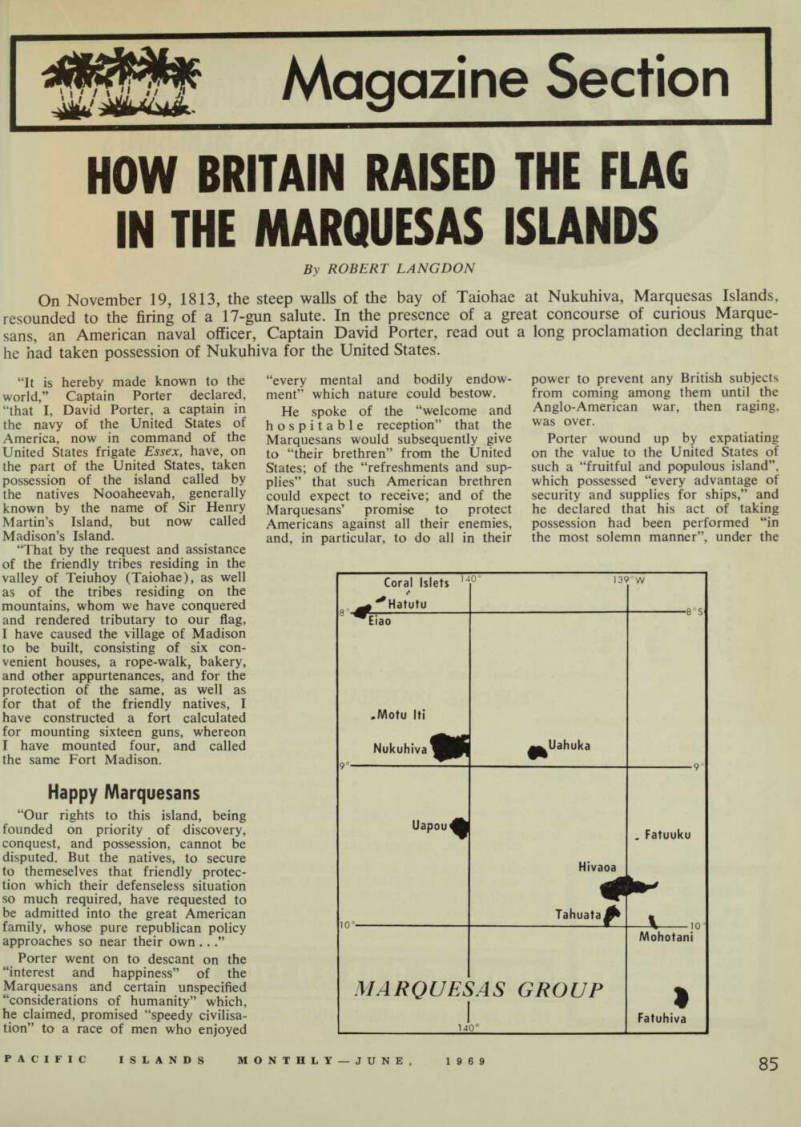
On November 19, 1813, the steep walls of the bay of Taiohae at Nukuhiva, Marquesas Islands, resounded to the firing of a 17-gun salute. In the presence of a great concourse of curious Marque sans, an American naval officer, Captain David Porter, read out a long proclamation declaring that he had taken possession of Nukuhiva for the United States.
“It is hereby made known to the world,” Captain Porter declared, “that I, David Porter, a captain in the navy of the United States of America, now in command of the United States frigate Essex, have, on the part of the United States, taken possession of the island called by the natives Nooaheevah, generally known by the name of Sir Henry Martin’s Island, but now called Madison’s Island.
“That by the request and assistance of the friendly tribes residing in the valley of Teiuhoy (Taiohae), as well as of the tribes residing on the mountains, whom we have conquered and rendered tributary to our flag, I have caused the village of Madison to be built, consisting of six con venient houses, a rope-walk, bakery, and other appurtenances, and for the protection of the same, as well as for that of the friendly natives, I have constructed a fort calculated for mounting sixteen guns, whereon I have mounted four, and called the same Fort Madison.
Happy Marquesans
“Our rights to this island, being founded on priority of discovery, conquest, and possession, cannot be disputed. But the natives, to secure to themeselves that friendly protec tion which their defenseless situation so much required, have requested to be admitted into the great American family, whose pure republican policy approaches so near their own..
Porter went on to descant on the “interest and happiness” of the Marquesans and certain unspecified “considerations of humanity” which, he claimed, promised “speedy civilisa tion” to a race of men who enjoyed
“every mental and bodily endow ment” which nature could bestow.
He spoke of the “welcome and hospitable reception” that the Marquesans would subsequently give to “their brethren” from the United States; of the “refreshments and sup plies” that such American brethren could expect to receive; and of the Marquesans’ promise to protect Americans against all their enemies, and, in particular, to do all in their
power to prevent any British subjects from coming among them until the Anglo-American war, then raging, was over.
Porter wound up by expatiating on the value to the United States of such a “fruitful and populous island”, which possessed “every advantage of security and supplies for ships,” and he declared that his act of taking possession had been performed “in the most solemn manner”, under the
American flag, and in the presence of numerous witnesses.
Having said all that, Captain Porter had a copy of his proclama tion sealed in a bottle and buried according to the imperialist customs of the day—and so, for the first time, an island in the South Pacific was claimed as an American colony.
Captured 15 ships
The annexation of Nukuhiva was the climax to an extraordinary drama which had begun in the United States 13 months earlier when Cap tain Porter was ordered to prepare his frigate Essex for a long cruise.
The purpose of the cruise was to harass and capture British shipping,
following the outbreak of war between Britain and the United States.
The cruise was a highly successful one, for Porter captured no less than 15 ships in the Atlantic and Pacific before two British warships out manoeuvred and outgunned him out side Valparaiso in March, 1814, and forced him to surrender.
Porter’s usual technique in cap turing an enemy ship was to display the British colours and signals as he closed in, and to act in all respects like a Britisher until the enemy cap tain had either come aboard his ship for a social call or had otherwise fallen hopelessly into his trap.
His first victim fell to him near the Brazilian island of Fernando de
Noronha on December 12, 1812.
This was the Nocton, a British packet of 10 guns and 31 men, which had on board cash to the value of about $55,000 No more ships were then taken until Porter entered the Pacific via the Horn. They then came thick and fast, almost all of them being whalers.
Three were captured off the coast of Chile and Peru, and four off the Galapagos Islands in a matter of a few weeks. As each one was cap tured, Porter transferred her crew to his own ship and placed the prize under an officer and crew of his own.
Eventually, he had so many mouths to feed that he sailed to Tumbez, Peru, gave his prisoners three boats in which to row them selves ashore, and left them to their own devices after exacting a promise from them that they would not serve against the United States until “regularly exchanged” as prisoners of war.
While Porter was at Tumbez.
Downes, his first-lieutenant, who had been left in the Galapagos with a prize-ship fitted out as a raider, turned up with three more captured vessels. Porter promptly sent him to Valparaiso to dispose of these as best he could, and then headed back to the Galapagos in the Essex in search of further victims.
Useful and inoffensive
Four more British whalers, the Charlton, Seringapatam, New Zea lander and Sir Andrew Hammond, were captured before Lieutenant Downes returned from his mission to Valparaiso. Porter then decided to sail for the Marquesas Islands to clean his ship’s bottom, overhaul the rigging and smoke out and kill the numerous rats which infested her Porter reached Taiohae, Nukuhiva, on October 27, 1813. Among the many handsome Marquesans who visited his fleet was an Englishman called Wilson, who had lived in the Marquesas for several years, and was tattooed, like the natives, from head to foot. Although Porter did not take kindly to Wilson at first, he soon found him a useful and in offensive interpreter, whose only failing was a liking for rum.
With Wilson’s help, Porter quickly made friends with the people of Taiohae, established a camp on shore, and set about revictualling his fleet. On learning that the local people were troubled by the warlike Hapaa tribe of a neighbouring valley, and finding that the Hapaas derided
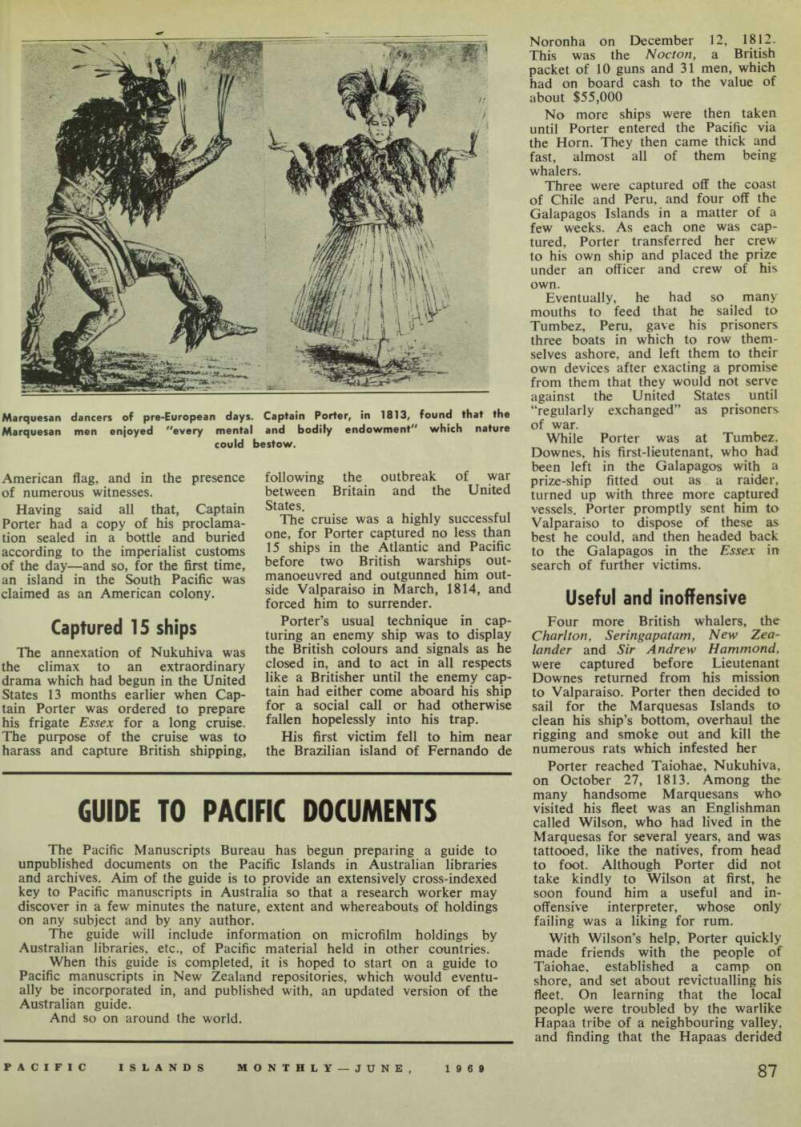
Marquesan dancers of pre-European days. Captain Porter, in 1813, found that the Marquesan men enjoyed "every mental and bodily endowment" which nature could bestow.
New light on the Porter affair
his threats to “chastise” them, Porter landed a six-pound gun and employed a body of local natives to drag it to the top of a mountain overlooking Hapaa territory. With the gun, Porter sent Downes, his first-lieuten ant, and a party of forty men armed with muskets, together with a number of Taiohaes with ammunition for the cannon.
In a battle which ensued between the Haapas and the Americans, the Haapas more than held their own at first. Fighting with spears and stones as they retreated to a mountain fortress, they killed five of their invaders without losing a single man themselves. From their fortress, they jeered at Porter’s men and con temptuously exposed their posteriors to them.
This was too much. Before long, the Americans stormed their aerie with augmented forces and took their fort, killing many of the Hapaas and committing many other depreda tions. The scene of massacre, plunder and destruction, Porter wrote after wards, was “shocking to see,” but as a result, he got a large supply of pigs which he badly needed to feed his men. Porter was equally ruthless in subduing other tribes, and extracing tribute from them the warlike Taipis (the Typees of Herman Mel ville) being the most difficult to conquer.
Continued his war
Having brought the Marquesans, as he thought, under control, and having taken possession of Nukuhiva on behalf of the United States Gov ernment, Porter sailed again to con tinue his war on British shipping.
Three of his prizes were left behind at Taiohae in the charge of three officers and twenty men, with six prisoners of war. Their orders were to remain at Nukuhiva for five months and then go to Chile if no word came from him.
Soon after Porter had gone, the Marquesans again began to show a spirit of resistance, but were again subdued by the Americans. Mean while, the English prisoners-of-war plotted among themselves to seize the American officers, and eventually persuaded all but eight of the Ame rican seamen to join them. Lieutenant Gamble, the senior officer, and four loyal seamen were cast adrift in a small boat, while the mutineers put to sea in one of the prize vessels, the SerinoaDotam, and sailed for Sydney.
Although Gamble and his com
panions managed to reach one of the other prize vessels in the bay, they and three others were lucky to escape being massacred by the Marquesans.
Finally, Gamble and seven others, all suffering from wounds or illness, put to sea in the prize vessel; and after extraordinary hardship, they sailed her to Hawaii.
Meanwhile, Captain Porter had sailed the Essex to Valparaiso, and it was there that two British warships, HMS Cherub and HMS Phoebe found him on February 7, 1814, The Cherub and Phoebe had been expres sly sent to the Pacific to try to drive the Essex from the seas.
Up to this point, and for the sub sequent battle between the Essex and the two British warships, the only information hitherto available has been that contained in Captain Porter’s Journal of a Cruize made to the Pacific Ocean, first published in Philadelphia in 1815. Now, how ever, the Pacific Manuscripts Bureau has uncovered a sheaf of documents in the Public Record Office, London, which throw new light on the Porter affair. These documents reveal among other things—and this fact has never previously been published —that soon after Lieutenant Gamble had left Taiohae, a British naval officer arrived on the scene, dug up Captain Porter’s document of an nexation, and took possession of Nukuhiva on behalf of Great Britain.
The first of the PRO documents is a letter dated April 6, 1814, from Vice-Admiral Manley Dixon, com mander-in-chief of the Royal Navy’s South American station at Rio de Janeiro which then had charge of all British naval vessels operating in the Pacific. In this letter, Admiral Dixon informed the Admiralty that he had just heard that the Phoebe
and Cherub had reached Valparaiso, and had there found both the Essex and a consort in harbour. “Captain Hillyer (of the Phoebe) proposed a meeting outside immediately,”
Dixon’s letter went on, but Captain Porter declined “and the four ships remained at anchor when the last letters came away.”
Surrendered
Other letters reveal how Admiral Dixon had taken two British naval vessels —the Briton (Captain Sir Thomas Staines) and the Tagus (Captain Pipon)—under his orders when they happened to turn up in Rio and had sent them off to the Pacific to “give confidence to the southern whale fishery”.
No account has yet been found in the PRO of the battle which took place on March 28, 1814, between the Essex, the Phoebe and the Cherub when the Essex lost two thirds of her men and Porter sur rendered.
However, on August 23, 1814, Admiral Dixon reported to the Admiralty that the Essex had arrived in Rio, and had been commissioned there as a British ship on 4th of the month.
Meanwhile, the Cherub had been sent from Valparaiso to Hawaii to look for some American ships that were thought to be there, and the Briton and Tagus were scouring the seas in other directions. On October 15, 1814, Captain Staines of the Briton sent the following report on his activities to Vice-Admiral Dixon in Rio:— “After parting Company with the Phoebe off Juan Fernandez in the early part of June last, I proceeded with the Briton and Tagus to Lima where we got various supplies, though not abundant; thence I cruised Coast wise touching at Payta, Tumbez, Sta.
Elena Island, La Plata and Salango,
Typee Valley on the island of Nukuhiva.
The island was claimed by Captain David Porter for the US in 1813.
Prize ships gone
but gain’d no information of either American or British whalers. . . .
From Salango, I made a direct Course to the Gallipagos Islands, and visited Anchoring (anchorages) at Charles’s, Chatham, James’s & Narborough Islands, but innumer able Turtle and Turpin were the only fruits of this visit, not a Vessel of any description was to be seen, and as there appear’d nothing here requiring our protection, I the less hesitated to proceed to the Marquesas Islands. ... I arriv’d together with the Tagus at Nooa heevah on the 20th of August, but found of the three prize ships to Essex, and left there on her departure, viz. Seringapatam, Sir Andrew Hammond and Greenwich, the former was ran away with by some of the Americans who mutinied and join’d the British prisoners in retaking the Ship, and I suspect is gone to Port Jackson, the Sir Andrew Hammond proceeded to the Sand wich Islands with the American Lieutenant of Marine . . , the Green wich was burnt by themselves, not having men to navigate her. . . .
Three cheers
“After digging for the space of five days we at length discovered the Bottle containing the American document declaring the Island to be taken possession of in full right for the United States of America. This I counteracted by a public meeting of the King Keatanooe, the Natives of the Island, Captain Pipon and myself, together with the Officers, Seamen and Marines of both Ships, on the Mount on which was the American Battery and Flag Staff, and where the Bottle was found, and, by a Public declaration of our taking possession, not only as a right from a Nation at war with us, but also by the particular request of the Venerable old King Keatanooe who desired to be under the protection of King George and Solicited that I wou’d take possession in full Right and Sovereignty for Great Britain, this was immediately done, the British Flag planted where the Ame rican was before waving, three Cheers, given by both Crews and Natives together, a Salute of 17 guns fir’d by Briton and the Band playing God save the King. The British Colours were then given in charge to the Natives and were flying dis played by them when we departed thence the 30th of August.”
Three days after writing his ac-
Band played "God save the King "
count of his visit to the Marquesas, etc., Sir Thomas Staines sent Admiral Dixon another letter, the contents of which have been frequently republished since Sir John Barrow, the Admiralty Under-Secretary, revealed them for the first time in his review of Porter’s Cruise in the Pacific Ocean in the Quarterly Review for 1815.
“I have the honor to inform you,”
Staines wrote on October 18, 1814, “that on my passage from the Marquesas Islands to this port (of Valparaiso) I fell in with an Island where none is laid down in the Admiralty or other Charts, according to the several Chronometers of the Briton and Tagus. I therefore hove to until day-light and then closed to ascertain whether it was inhabited which I soon discovered it to be, and to my great astonishment found that ;very individual on the Island (40 in Number) spoke very good English.
They proved to be the descendants of the deluded crew of the Bounty, which, from Otaheite, proceeded to the above-mentioned Island where the ship was burnt. ... A venerable old man named John Adams is the only surviving Englishman of those who last quitted Otaheite in her . . .”
It appears that Sir Thomas Staines’ report of his rediscovery of the Bounty settlement on Pitcairn Island caused so much excitement in England that the other aspect of the Briton’s cruise to the Pacific was overlooked. So it was that no ac count of Staines’ annexation of Nukuhiva was ever published—and never either ratified or disavowed.
The rediscovery of this long forgotten aspect of Britain’s imperial history is interesting in itself. But even more interesting, perhaps, is the likelihood that numerous other forgotten documents of value to Pacific historians will now be brought
to light in the Public Record Office —in a file where one would scarcely have expected to find such things, the file of the Royal Navy’s com mander-in-chief on the South Ame rica station at Rio de Janeiro, and elsewhere.
From inquiries, it seems that the commander-in-chief in Rio was in charge of British naval operations in the Pacific—first in the Pacific as a whole, and later in only the eastern portion—from 1807 to 1837.
Thus, further search at the Public Record Office should reveal letters, logbooks and journals relating to perhaps three or four dozen naval vessels that were in the Pacific during the period of the Rio commander’s suzerainty. A few such ships whose names immediately come to mind are HMS Dauntless (1822), Satellite (1829), Seringapatam (1830), Comet (1831), Actaeon (1835) and Zebra (1836), plus all those associated with the cruise of Porter’s Essex and with the early days of French inter vention in Tahiti.