dreading
pp. 71-73 · Read in the full issue
In Suva, they're dreading of a new city
An off-shore residential-resort complex incorporating beaches, four hotels, a golf-course, model village and nightclub ... a splendid waterfront with shops and hotels ... a Miami style keys area . . . super-contemporary pedestrian malls and shaded walkways . . . this is the New Suva. Or Suva as it might be, if a group of imaginative young local architects have their way.
The Suva envisaged by the Fiji Association of Architects is a model city. A convenient, aesthetically pleasing, visionary metropolis with little of its present air of South Seas indolence and haphazard growth. An idealist’s city, really—but a highly desirable one.
Their suggestions for the possible development of Suva —before it be comes an impossibly crowded city of some 250,000 people, probably by 1986 —was seen at a town planning exhibition of photographs, sketches and models at the new Town Hall earlier this year. It was prepared by a committee of five architects— Colin Bennett, Rob Truscott, Greg West, Dennis Biggs and Robin Retchford—and hailed by all who saw it as very adventurous indeed.
The architects themselves admit that implementation of their pro posals would require many millions of dollars—hardly likely to be forth coming from government. But as one committee member has re marked: “All we need are a few large developers like L. J. Hooker, and we’re well on our way”.
Another says, a touch cynically: “I bet if I took a picture of Suva as it is today, and another in 20
.. , ~... .. years time, there d be little evidence of properly planned development. We can only hope our exhibition will stir the public imagination and make people realise what could be done.
People should realise that it there isn’t constructive balanced develop heart of Suva will rot and
die .
Reclamation
Massive reclamation of Suva’s foreshore is an integral part of the committee’s vision of the future.
Where there is now sea, mud and swampland, around the shoreline from The Town Hall and Government House to the Pacific Theological College, they see a new dimension for the city—including vast, attrac tively-designed housing tracts, apart ment blocks, a marina, yacht club, an d recreation area resembling the Miami keys.
Priority was given to the wharf area which they say should be a prestige gateway to Suva—instead of a confused muddle of pedestrians, cars, trucks, buses, ramshackle ware houses and disorganised tourist traffic.
To facilitate the movement of
ships’ passengers, they propose a first floor level pedestrian-link, direct from the gangways across the traffic and right 6 into the marke ts and the heart a pedestr j an mall Cargo would be ha £ dled at groU nd' level and there would be a tourist reception area with 0 toilets and res t-rooms.
Tbe j ast sug g es tion has received the fu u suppor t 0 f Suva tourist interests, who’ve been plugging for it for years.
Following the principle that free pedestrian movement is the lifeblood rf a city’s commercial centre, the committee proposes a magnificent pedestrian mall, designed to remove the noise, fumes, danger and tension £at makes shopping an ordealrather all familiar tr> anv ™ e r “SS nour 1 e e a
"Hibiscus Mall"
The architects envisage a “Hibiscus Mall”, based on plans drawn up by town planner, Mr. David John, and recently adopted in principle by the Suva City Council, Creation of the Mall would involve t h e c i os ing off to traffic of Margaret Street, Thomson Street and the teeming duty-free thoroughfare known as Cumming Street, achieving
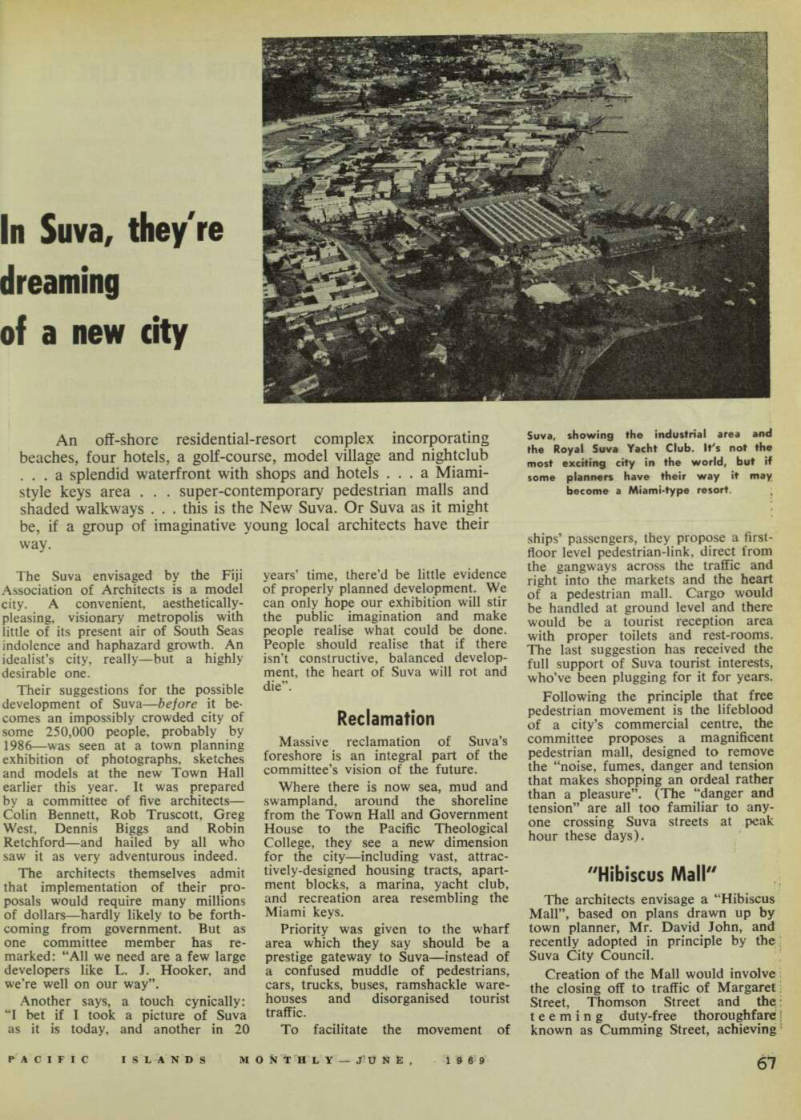
Suva, showing the industrial area and the Royal Suva Yacht Club. It's not the most exciting city in the world, but if some planners have their way it may become a Miami-type resort.
A model villag
an attractive, safe, shady oasis for shoppers.
One of the most novel proposals has come from young New Zealander, 3reg West, who suggests transformi ng a quarter-mile area of reef into a luxurious recreation-resort, with aotels, beaches, nightclub, model milage, golf green and residential buildings.
It would be about a quarter of i mile off the foreshore past Govern ment House, toward Suva Point. \ccording to Greg West, reclamation vould not be outrageously costly— ‘at high tide the reef is only a foot >r so below the surface and it would nake a very solid foundation”—and :ould be easily achieved by a large cale land development company.
Transforming a "sewer"
“It could be leased from the gov mment on a long-term basis,” he uggests. “When one realises that hince Rainer, for instance, is filling a something like 80 fathoms near Monaco, my idea seems relatively imple.”
Another commendable proposal is the transformation of centrally situated Nubukalou Creek which the architects rightly describe as re sembling a “sewer”—into a little piece of Venice.
The suggested scheme shows it as a logical extension of the shopping centre, with a series of internal pedestrian-courts linked to a multi level car park to the east of the creek. This would be overlooked by a series of five-storey blocks of flats.
People will argue that such radical changes would rob Suva of its present character and atmosphere—and not even the architects themselves imagine that all or even many of their suggestions will be seized and acted upon.
Their ideas do have great merit however. If nothing else, they show that although Suva is one of the fatest-growing cities in the South Pacific, there is still time to turn it into a showpiece of town planning.
It would take a great deal of courage and foresight, of course, and a great deal of money.
But if the proper authorities decided it was worth the effort, Suva could become as progressive a city as any in the world.