Tourists Are Welcome With Open
pp. 65-67 · Read in the full issue

Arms-But Not On Sundays
From GLEN WRIGHT, in Apia Tourism is important to Western Samoa’s economy, says Prime Minister Fiame Mata’afa, but the country can do without the traveller if he arrives on Sunday.
In other words, cruise ships cannot dock here on Sundays.
That this policy of the Immigra tion Department is not just talk was proved in late April when Morris Hedstrom, agent for the cruise ship Kuala Lumpur, was refused per mission for the vessel to stay in port on Sundays in June and October.
As a result, the liner will call at Apia on Friday, June 6, and depart on Sunday, June 8, at 6 a.m. And in October its visit will be shortened one day so as to conform with the regulation.
A circular letter to shipping agents late last year had laid down the dictum that application for Sunday cruise ship visits world have to be made to the Immigration Office.
The Prime Minister, Fiame Mata’afa, says that he considers the arrival of a vessel on Sunday as “potentially disadvantageous” to the people and in conflct with a Sunday observance law that he has in mind (but which never gets past the dis cussion stage in the national assembly).
Nonplussed Chamber of Com merce members, when they heard that cruise ships would not be allowed to dock in Apia on Sundays, were incredulous. A member pointed out that Sunday dockings had never created any problems before; that when the Queen Fredrika docked here on a Sunday, many of the passengers attended church services and were very decorous about it.
A concession
The Prime Minister, Mata’afa, did make a concession, however. He declared that he would consider each case of a Sunday landing on its own merits. For example, a ship in distress will be permitted to tie up at the wharf on Sunday, but passengers will not be allowed to leave it. On the other hand, if tour companies ignore his mandate, their ships will not be permitted to dock at all on Sundays —regardless of the circumstances.
Mata’afa has provided ample evidence of his power m recent months. He told legislators when they were considering the application of Potlatch Forests Inc. for a franchise to engage in lumbering on Savaii Island that if they did not respect his wishes and grant it, he would dissolve Parliament (PIM, Jan., 1968) - , J , „ Later he ordered a young Canadian would-be writer out of the country.
The youth had singlehandedly sailed here in a small yacht and had obtained a job in Apia. He had planned to stay long enough to write a novel. ii,, tt milc :~oi More recently, Hollywood musical composer and conductor Russ Garcia and his wife were sent packing after nine days in Apia harbour. The
Prime Minister refused, without ex planation, Garcia’s written request for extension of his twelve-day permit so he could fly to New Zealand for some concert appearances. His wife was to have stayed in Apia at a hotel. The Garcias were on a round the-world trip aboard their trimaran, Dawnbreaker.
“It was the unkindest experience of my life,” said Garcia later in Pago Pago.
He added that he had lost thousands of dollars in fees because of his inability to fulfil contracts.
Deportation order
Meanwhile, in American Samoa, Judge Goss of the High Court has ordered that 35-year-old Niuean, Sione Toa, be deported back to his own island for engaging in a single act of sexual intercourse, which he admitted. Sione had been a resident of the territory for 21 years.
The woman involved, a Samoan,
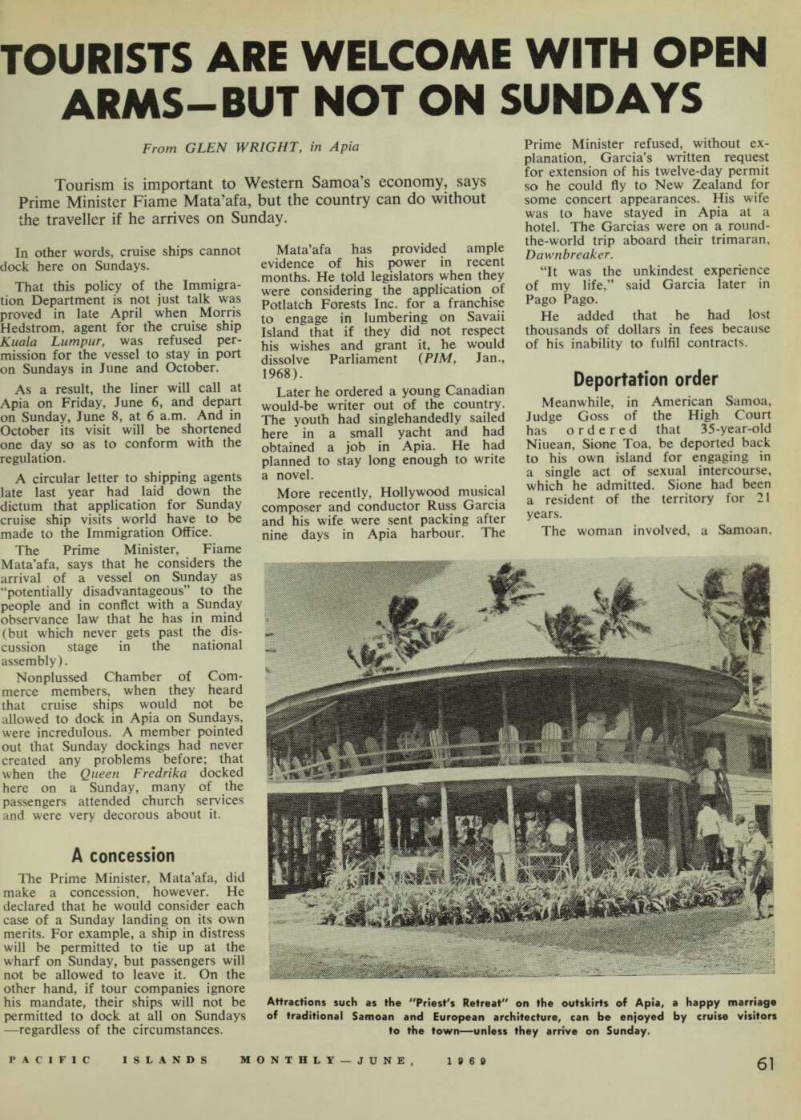
Attractions such as the "Priest's Retreat" on the outskirts of Apia, a happy marriage of traditional Samoan and European architecture, can be enjoyed by cruise visitors to the town —unless they arrive on Sunday.
also admitted the act, testifying that she requested it.
Such a single act of copulation was described by Judge Goss as being, in the words of the Deporta tion statute, “general conduct which renders an individual undesirable to remain in the territory”. He based his decision on an old Samoan custom that forbids single acts of fornication between men and women of disparate social standards.
In what respect the Niuean and the Samoan were disparate was not made clear. At any rate, Sione’s counsel George Wray, has moved for a new trial.
And then there is the latest official pronouncement about the liquor busi ness in Western Samoa. Liquor dispensers, if “Incorporated Societies”, are not required by law to buy busi ness licences or to pay income tax on profits. Commissioner of Inland Revenue R. E. Meredith has ruled.
To be such a “club”, the establish ment must sell only to its members, and be non-profit.
The markup on sale of liquor is not considered profit so long as it is used only for the operation costs of the club, such as rent, improvements, salaries of staff and other approved expenses.
“Incorporated Societies” do not need business licences because they are not considered as engaging in business. Nor are they prosecuted for selling liquor to non-members or otherwise breaking the terms of their “Incorporation”. In such in stances the Department of Inland Revenue merely collects taxation from the profits. • Permanent terminal landing rights for Fiji Airways on Nauru are likely to follow Nauru’s pur chase, in June, of $20,000 worth of shares in Fiji Airways Ltd.
After thinking about it for a year, the republic came to the party in May and bought itself a seat on the rapidly-growing regional operator, thereby joining six other territories indirectly or directly on the board.
The territories are Fiji, Western Samoa, Tonga, the Gilbert and Ellice Islands, the Solomons and the New Hebrides.
Currently, Fiji Airways’ prop-jet 748’s fly weekly return flights to Nauru (begun May 9), via Funafuti and Tarawa, both in the GEIC. In the past, Nauru would not grant permanent landing rights, because she was interested in services pro posed by Air Micronesia and a new operator, Central Pacific Airways.