involvement in the South Seas
p. 59 · Read in the full issue
He'd like to see more student involvement in the South Seas
“The biggest problem facing students at the University of the South Pacific? I’d say their own shyness . .
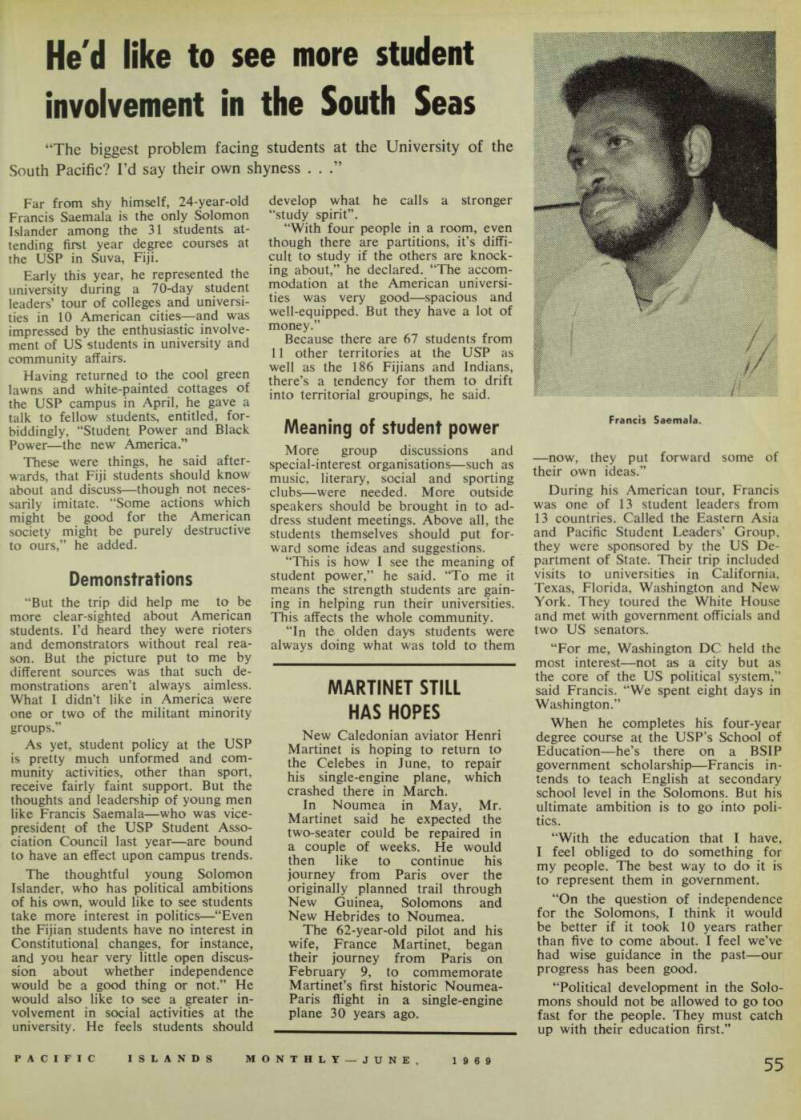
Far from shy himself, 24-year-old Francis Saemala is the only Solomon Islander among the 31 students at tending first year degree courses at the USP in Suva, Fiji.
Early this year, he represented the university during a 70-day student leaders’ tour of colleges and universi ties in 10 American cities—and was impressed by the enthusiastic involve ment of US students in university and community affairs.
Having returned to the cool green lawns and white-painted cottages of the USP campus in April, he gave a talk to fellow students, entitled, for biddingly, “Student Power and Black Power —the new America.”
These were things, he said after wards, that Fiji students should know about and discuss—though not neces sarily imitate. “Some actions which might be good for the American society might be purely destructive to ours,” he added.
Demonstrations
“But the trip did help me to be more clear-sighted about American students. I’d heard they were rioters and demonstrators without real rea son. But the picture put to me by different sources was that such de monstrations aren’t always aimless.
What I didn’t like in America were one or two of the militant minority groups.”
As yet, student policy at the USP is pretty much unformed and com munity activities, other than sport, receive fairly faint support. But the thoughts and leadership of young men like Francis Saemala—who was vice president of the USP Student Asso ciation Council last year—are bound to have an effect upon campus trends.
The thoughtful young Solomon Islander, who has political ambitions of his own, would like to see students take more interest in politics—“ Even the Fijian students have no interest in Constitutional changes, for instance, and you hear very little open discus sion about whether independence would be a good thing or not.” He would also like to see a greater in volvement in social activities at the university. He feels students should
develop what he calls a stronger “study spirit”.
“With four people in a room, even though there are partitions, it’s diffi cult to study if the others are knock ing about,” he declared, “The accom modation at the American universi ties was very good—spacious and well-equipped. But they have a lot of money.”
Because there are 67 students from 11 other territories at the USP as well as the 186 Fijians and Indians, there’s a tendency for them to drift into territorial groupings, he said.
Meaning of student power
More group discussions and special-interest organisations—such as music, literary, social and sporting clubs—were needed. More outside speakers should be brought in to ad dress student meetings. Above all, the students themselves should put for ward some ideas and suggestions.
“This is how I see the meaning of student power,” he said. “To me it means the strength students are gain ing in helping run their universities.
This affects the whole community.
“In the olden days students were always doing what was told to them
—now, they put forward some of their own ideas.”
During his American tour, Francis was one of 13 student leaders from 13 countries. Called the Eastern Asia and Pacific Student Leaders’ Group, they were sponsored by the US De partment of State. Their trip included visits to universities in California, Texas, Florida, Washington and New York. They toured the White House and met with government officials and two US senators.
“For me, Washington DC held the most interest—not as a city but as the core of the US political system,” said Francis. “We spent eight days in Washington.”
When he completes his four-year degree course at the USP’s School of Education—he’s there on a BSIP government scholarship—Francis in tends to teach English at secondary school level in the Solomons. But his ultimate ambition is to go into poli tics.
“With the education that I have, I feel obliged to do something for my people. The best way to do it is to represent them in government.
“On the question of independence for the Solomons, I think it would be better if it took 10 years rather than five to come about. I feel we’ve had wise guidance in the past—our progress has been good.
“Political development in the Solo mons should not be allowed to go too fast for the people. They must catch up with their education first.”
Francis Saemala.