Zero Wasn't
pp. 46-47 · Read in the full issue
That
Exactly
A Bargain!
By Thomas King
With so many people seemingly interested in the fate of the “Kavieng Zero”, it’s about time the real story was told. And since I’m “lucky” enough to own the plane, I'd like to do the telling.
The story began early in 1967 when 1 decided to swap a CAC Wirraway I owned for the Zero which was then being held at Kavieng by the Papua-New Guinea War Memorial Trust. I had made the decision to swap after a friend of mine in the territory had inspected the Zero and sent me some pictures of it. As I knew that the cost of shipping the Zero from Kavieng to Melbourne would be considerable, I thought it best not to add to that cost by going on a round trip to Kavieng to see the Zero for myself.
Extras not included
I approached a shipping company and was told that the rate for ship ping the Zero non-stop to Melbourne would be $1,208. This was a fixed rate —extras were not included. I agreed to that rate, and began sav ing money to pay for the transporta tion.
At the same time I’d met in Mel bourne a very decent chap from the Treasury Department in Kavieng, and he agreed to prepare the Zero for loading when he got back to the territory.
When, after two years, I’d saved enough money to pay the shipping company, I found that the direct service from Kavieng to Melbourne
had been discontinued. The shipping company, however, told me that they would try to arrange a special direct trip for me.
Meanwhile, the Zero, lying un guarded in Kavieng, had been at the mercy of every Tom, Dick and Harry, who either wanted a souvenir or to relive World War II by seeing another “Nip Zero” bite the dust.
The next thing I heard from the shipping company was that the Zero was on its way to Melbourne, but not direct. It had been shipped from Kavieng to Rabaul on the Crestbank, and from Rabaul was heading for Melbourne on the Braeside. Because of the trans-shipment involved I was charged another S5B0 —which I had to pay before the shipping company would give me the Customs clearance papers.
When the Braeside finally berthed in Melbourne, I went down to the wharf, expecting the Zero to be off-
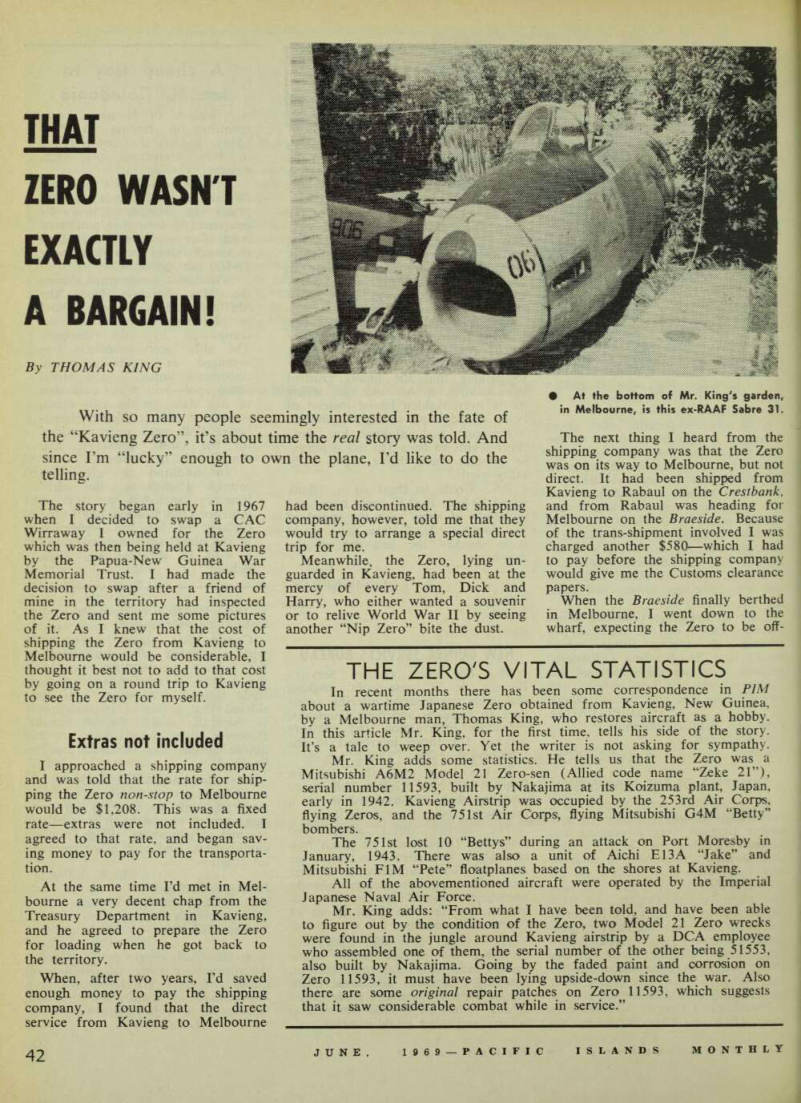
• At the bottom of Mr. King's garden, in Melbourne, is this ex-RAAF Sabre 31.
ca by trans-shipment
loaded in good time. But nothing went right.
The Zero was in a forward hold.
When I saw it I got quite a surprise.
Stacked high on top of the starboard beam were dozens of sacks of some type of bean, each of which weighed 150 lb—or more.
As the shipping people couldn’t remove the Zero until every last bean sack had been removed, the Zero had to be left where it was for a few days.
Two days later I returned to the Braeside and I saw that the wooden plank which had been supporting the bean sacks above the wing of the Zero had collapsed under the weight, sending the sacks crashing down on top of the wing.
There were also several holes in the cockpit area of the fuselage which hadn’t been there two days earlier.
Apparently some wharfie thought the Zero would look better with some artificial bullet holes through it.
There was also other damage that had been caused by trans-shipment handling. I’d sent dismantling and handling instructions for the Zero to Kavieng—but not to Rabaul (after all, I didn’t know it was going to be off-loaded there). As a result it copped considerable damage. For instance, the wing leading-edges had been bashed in, the foldable wing tips were mangled, the tail cone had been squashed flat and the rope that had been slung round the wings and forward fuselage section (built as one unit), had sliced through the trailing and leading-edges of the port wing root as soon as strain was put on it.
Empty beer bottles!
(Zero aircraft are pretty easy to damage because they were lightly built. The duralumin skinning is no thicker than 24 gauge; there is no steel-tube fuselage skeleton; there are no armour plates, bullet proof wind screens, or self-sealing fuel tanks; and the so-called firewall is only 20 gauge dural. The weight of a com plete Zero airframe [model 21], minus engine, is no more than 2,500 lb.
The engine weighs 1,200 lb.) In addition to the abovementioned damage, I also found several empty beer bottles in the rear fuselage
section. It wasn’t Japanese beer.
The big day—the day when the Zero was to be unloaded—was a Friday. At about 8.30 that Friday evening the Zero was lifted out of the ship’s hold and loaded onto a truck to be taken to my home in Preston, some six miles away. It received a few scars during the operation.
The trucking company had quoted $4O as the price for clearing the Zero through Customs and carting it from the wharf to Preston. But things weren’t to be that easy.
As council laws did not allow the movement of such a load at night, the Zero had to be stored in the trucking company’s yard over the weekend. All this added to the cost, and in the end I had to pay $ll5 for having the Zero trucked from the wharf to Preston. As well as this, I had to pay the company for Customs clearance, duty, wharf handling, etc. The total amount I had to pay was $248!
After that weekend, things went smoothly enough. Then came the reckoning.
The total cost I had to pay to get the Zero from Kavieng to Preston was approximately $2,200 —nearly twice as much as I had expected to pay after adding up all the quotes I had been given, in writing, by the various companies.
And what had I paid for? Not very much, I fear.
It is very unlikely that the aircraft will ever be rebuilt —this I concluded after close inspection of the Zero and consultation with aircraft overhaul and repair firms. The firms estimate that it would cost $4,000 to put the aircraft together again.
I am sorry that the Kavieng people feel that they have lost a Zero, be cause I don’t feel I have gained one.
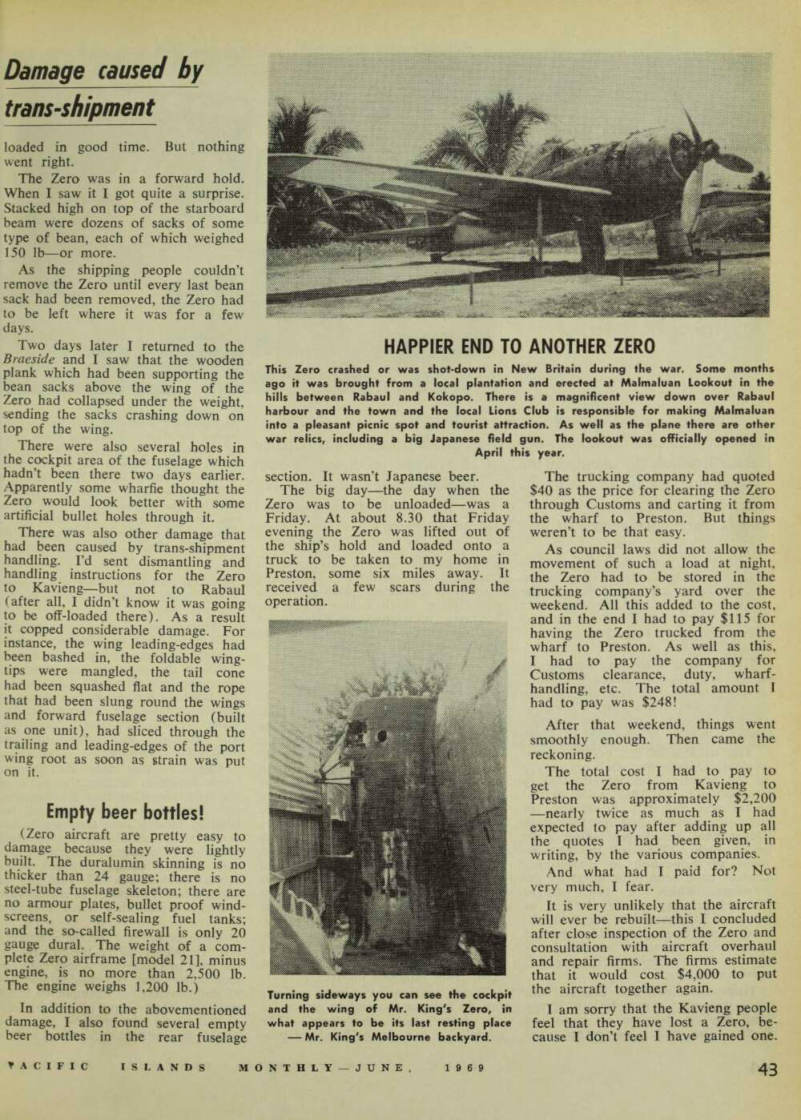
Happier End To Another Zero
This Zero crashed or was shot-down in New Britain during the war. Some months ago it was brought from a local plantation and erected at Malmaluan Lookout in the hills between Rabaul and Kokopo. There is a magnificent view down over Rabaul harbour and the town and the local Lions Club is responsible for making Malmaluan into a pleasant picnic spot and tourist attraction. As well as the plane there are other war relics, including a big Japanese field gun. The lookout was officially opened in April this year.
Turning sideways you can see the cockpit and the wing of Mr. King's Zero, in what appears to be its last resting place -Mr. King's Melbourne backyard.