Tropicalities
pp. 40-42 · Read in the full issue
“Manu Tupou is flying in to do one of Raymond Burr’s “Iron side” shows, you know. They’re due in Suva today ... or maybe tomorrow.” As often happens in Fiji, much-touted rumours preceded an event which didn’t eventuate. Another non-happening had happened, as it were.
It seemed that Manu Tupou, the Fijian actor who had a role in “Hawaii” and a bigger one in “A Man Called Horse”, had just been cast in another picture in New York and couldn’t make the sentimental journey home to star in a segment of the “Ironside” television series.
But Raymond Burr, a Fiji Per sonality these days, what with owning Naitauba Island and all, got on with the job anyway. In Fiji in May, with his right-hand-man-secretary Bob Benevedes, his cameraman Howard Morehead, and his two assistant sleuths in the show, Don Galloway and Don Mitchell, he filmed hun dreds of scenes for an hour-long “Ironside” segment.
Since buying his island several years ago, burly, broad-shouldered Burr has gained popularity with the locals, though few would have seen him in the long-running “Perry Mason” series or as the wheelchair propelled star of the newer “Ironside” show, which goes into its third year in June.
During his recent sojourn though, he and the “two Dons” (Mitchell and Galloway) provided the locals with much entertainment.
Weather cost them $20,000
With Burr safely ensconced in a stand-in wheelchair, they were to be seen whizzing up and down the sea wall at Suva Travelodge whenever the sun came out. They did the same in busy Renwick Road, causing some surprise among shoppers when Burr arose from his wheelchair and strode abo’it between “takes”.
We found them in the Travelodge cocktail bar one afternoon, not too much depressed by the fact that in clement weather had already cost them $20,000 in lost filming time.
They’d shot scenes at Travelodee and the Botanical Gardens, but still had the Tradewinds, the ketch Maroro, the canal-side esplanade at Morris Hedstroms, several Fijian villages, The Fiiian at Yanuca and Nadi Air port to go.
Raymond Burr explained that some of the scenes—and others previously shot at Naitauba, which is in the Lau Group—would be used in the documentary he’s making on Fiji. It would be released in “two, three or four years” time.
The script for the Fiji segment of “Ironside”, which is currently being screened in Australia, New Zealand, the US and England (where it enjoys peak Saturday night viewing), hadn’t been written yet. But the outline was there.
The other members of the group were obviously enjoying their stay in Fiji—though Don Galloway, who plays Sergeant Brown in the series, was momentarily preoccupied with a hole in the sole of his left shoe . . .
“It’s probably the worst thing that has happened to me in my entire life.”
Drinking was his profession, acting was his second job, he said. Never-
theless he’s been with the “Ironside” series since it began.
He professed a desire to go to Australia, but thought he probably wouldn’t. “I’d only have time to stay in the cities—and I’d much rather see the bush. I like wide open spaces.”
The necessary touch of showbiz ec centricity was provided by tall, tousled, hippie-beaded Duffy—he had no other name, he said—who de scribed himself variously as “stunt man, Don Galloway’s stand-in, camp follower and Prince of Clowns.”
"Prince of clowns"
One gathered that he’d “been in these islands in the war”, had worked as a barman, chef, actor and motor mechanic and found most things to be either wild, groovy, up-tight or screwed-up. He’d known Raymond Burr for eight years—and spoken only 500 words to him. He admired him tremendously. Specially the good things he was doing for the 167 Fijians and Indians working on Naitauba, Up until now, Raymond Burr has been spending two out of every 12 months in Fiji. A couple of years from now, he told us, he intends to take a year off and spend it at Naitauba, where he has various agri cultural projects underway.
His two Fiji-registered companies— Ventures of Fiji and Raymond Burr International—have very wide char ters. “They cover anything from banking and real estate export imnort and film-making. We’ll prob ably do all of those, except banking,” he said.
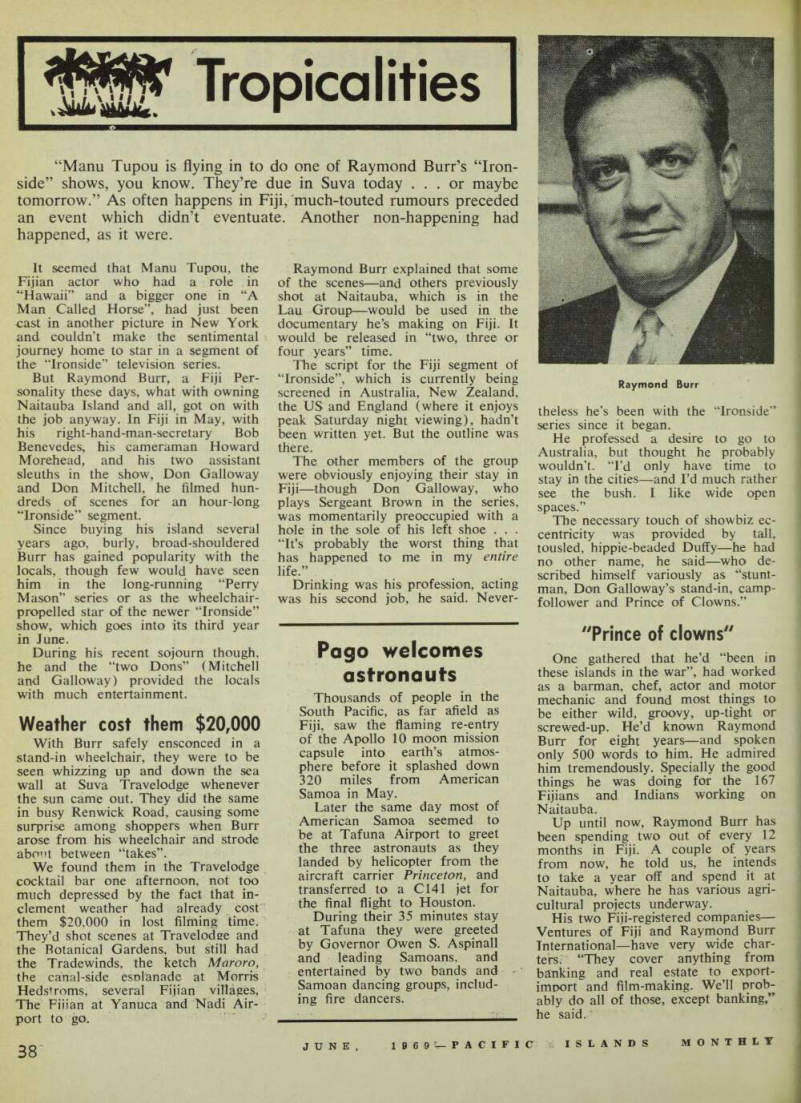
Raymond Burr
"Wantok" will tell
the news in Pidgin
Papua-New Guinea will soon have another newspaper —a Pidgin English fortnighly published at Wewak and aimed at the national market.
A New Zealander, Mr. Ray Goodey, will be editor but the man behind the scenes is one of the territory’s undisputed experts in Pidgin English, Father F. M.
Mihalic, 52, an American with the Roman Catholic Mission at Wewak.
Father Mihalic’s Wantok will probably come off the Mission press at Wewak in August or September.
It’s going to be another example of the increasing ecumenical spirit in P-NG, with the Lutheran Mission at Madang printing additional copies from Mihalic plates supplied from Wewak.
Editor Goodney says it will sell for 10 cents, with airmail subscrip tions offering a saving for native readers. The new newspaper will be an offset production, with plenty of pictures—and newsprint the villagers can smoke once they-re up-to-date on world events!
Wantok aims to give its readers a complete territory and world news cover, and the publishers have already signed a contract with the newly established New Guinea News Service.
Father Mihalic adds: “My genuine plan is to make this a strictly non secular newspaper”.
Racism among the
multi-racials
Politics, racism and gross mis understanding have been making elections of anew local government council at Rabaul, New Britain, the most crucial for many years.
Nearly two years ago the Gazelle Council decided to become multi racial, allowing the council to tax everybody in its area.
The shift from native local govern ment to multi-racial meant that a person of any race has been able to stand for any of the 38 council seats.
But 60,000 of the Gazelle Council voters are Tolais, and only 1,000 are European and Chinese.
On May 16, four days before polling began, more than 8,000 Tolais, some with anti-European placards, marched through Rabaul protesting against the multi-racial plan.
The nine non-native candidates among the 116 seeking Gazelle Council seats followed the protesters to the District Office, where govern ment men, including District Com missioner Harry West, tried to ex
plain, once again, the theory of multi-racial local government.
The protesters said that Rabaul had been run efficiently since 1952 by a purely native council, and they didn’t want Europeans taking over the council now. They weren’t im pressed by the fact that even if all non-native candidates were elected, they would represent only 24 per cent, of the council membership.
Out of the meeting came some extraordinary misinterpretations: some believed the multi-racial council would enable Europeans to take Tolai land; others, that a multi-racial council would legislate permission for Europeans to marry Tolai women; and a fear that the Euro peans, somehow, would contrive the poll.
The Member of the House of Assembly for Kokopo (near Rabaul), Mr. Oscar Tammur, emerged as the main leader of the campaign against multi-racialism in local government.
He held more than a dozen night meetings before polling began, and urged Tolai voters to keep away from the polls in protest.
Pressure against multi-racialism was so great on May 16 that the out going councillors were obliged to reverse their earlier decision, and come out against making the Gazelle Council multi-racial.
P-NG Administrator Hay explained that he had already proclaimed elections for a multi-racial council, and could not change it, constitution ally. He asked the Member for
Gazelle, Mr. Matthias To Liman, to issue a statement making it clear that if the Tolai voters did not want a multi-racial council, they could simply (by weight of numbers) vote in an all-native council.
The poll will be declared early in June, when the answer will be known.
Papua-New Guinea has 142 coun cils, and 124 are multi-racial. The Tolai protests at Rabaul came as a severe jolt to the government plan ners who believed that multi-racial local government would come smoothly to the sophisticated Tolais.
In a way, a
lucky break
Lucky or unlucky? A Honiara man is wondering after buying over 40 imperfect stamps at the local post office. He’s undecided because it will be a while before he knows how valuable the stamps are; and maybe he’s unluckv because he posted 25 of the stamps before he recognised the imperfection.
The man, who wants to remain anonymous, bought a sheet of more than 40 two-cent Solomons stamps which showed two canoeists kite fishing. On the imperfect stamps the paddle held by one of the men is completely detached from its stem.
About two years ago, two imperfect stamps cost the purchaser $1.40 at the Honiara PO and were later sold in America for £Stg. 1,000.
Some new New
Guineans are found
Romantics who fear that there are no more lost tribes in New Guinea can take heart.
An Administration patrol into the August River Census Division of the West Sepik District has contacted three new groups of people on the south-east of Green River Patrol Post in the West Range area.
Mr. A. Plummer, Assistant District Officer who led the patrol, said the groups spoke the same language and lived at villages named Nigyama, Umurita, and Kobaru, each more than a day’s walk apart.
The people had heard of the Administration, and were quite will ing to meet the patrol, he said. They lived in scattered garden houses around the ranges and each family tended its garden. They seldom met as groups, and had little contact with outsiders.
Mr. Plummer didn’t see any European clothes, but in each village he found axes and bush knives.
Families lived in high fortress style houses, with one family to each house, although the buildings were large enough to house two of three families.
Village men wore gourds, lawyer cane waist bands, and pig tusks as ear decorations. The women wore grass skirts, and the people had pierced noses usually threaded with bamboo.