Madang Is
pp. 38-39 · Read in the full issue
Right Now
In The
Doldrums
By Judy Tudor
Unlike most of the towns in Papua-New Guinea, which are showing mushroom growth, Madang is going through a period of stagnation.
About three years ago Madang had a surge of growth, but since then growth has stopped, and in some cases the town appears to have retrogressed.
One reason for this was the intro duction of jet air services from Sydney to the territory- These terminate at Port Moresby and feeder services go out from there instead of, as previously, from Lae. Towns further out, such as Madang, tend to suffer.
But the big factor in the fear that Madang could wither on the New Guinea vine is the Lae-Highlands road. The increasing use of this road and the change-over to road transport from air transport has had a very direct effect on the prosperity of Madang which once was the chosen air terminal for freighting into the Highlands. From Madang to Mt.
Hagen was 30 minutes by DC3, in comparison with the Lae-Mt. Hagen flight time of 60 minutes.
Madang, in those days, was the busiest airport in the territory, and one of the busiest in Australia. These days it must be the least busy of all the main centres.
Still giving trouble
Increased use of the Lae-Highlands road began with the completion of the reconstruction of the Kassam Pass section in 1965, Reconstruction has now proceeded as far as Goroka and although the road is still giving trouble, especially in the lowland, Markham Valley section, hundreds
of lorries are now travelling the whole length of it to Mt. Hagen every week.
Most freighting in and out of the Highlands, with its increasing pro duction of coffee and tea, is along the 373 miles of road between Lae and Mt. Hagen. As Lae and the Highlands prosper, Madang residents sink into deeper despair, made all the more acute by the knowledge that if they had a road to the Highlands it would be a good 100 miles shorter than the Lae route.
The Madang-Mt. Hagen road is still on the Administration agenda.
It’s still “planned”, but when those plans are likely to come to something nobody is saying.
Over a year ago Madang hopes were raised when a road was built from the town 25 miles or so out
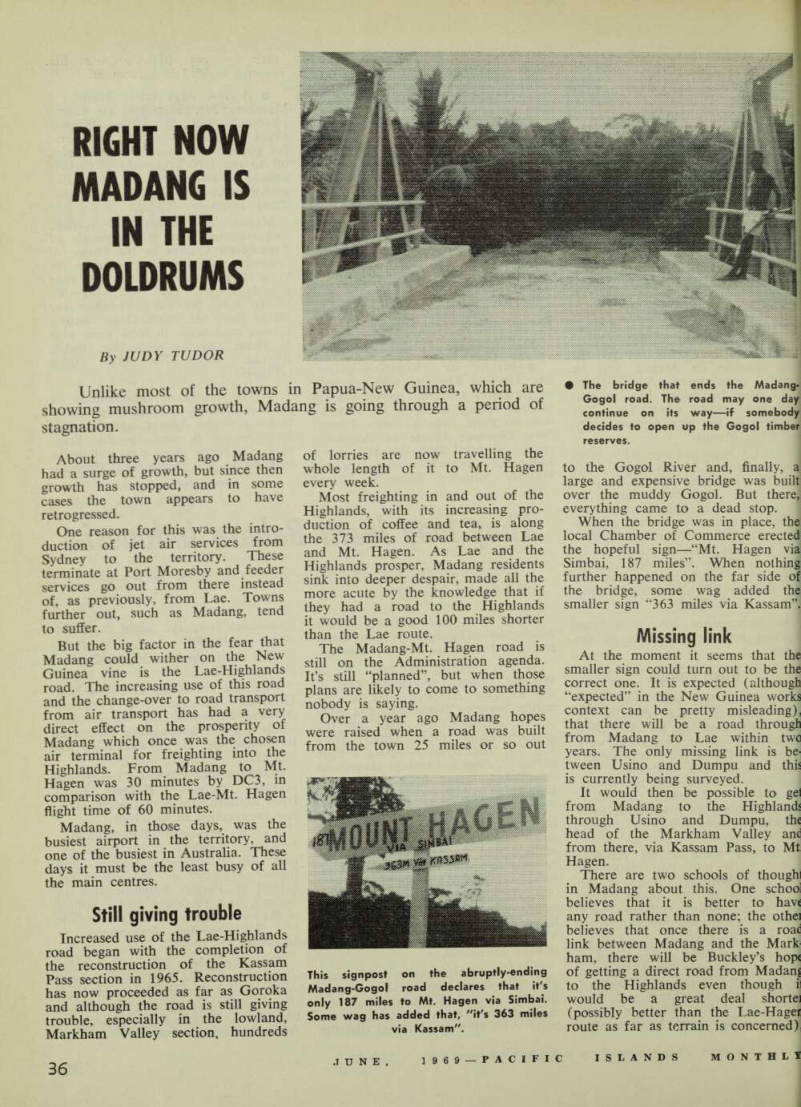
to the Gogol River and, finally, a large and expensive bridge was built: over the muddy Gogol. But there,] everything came to a dead stop.
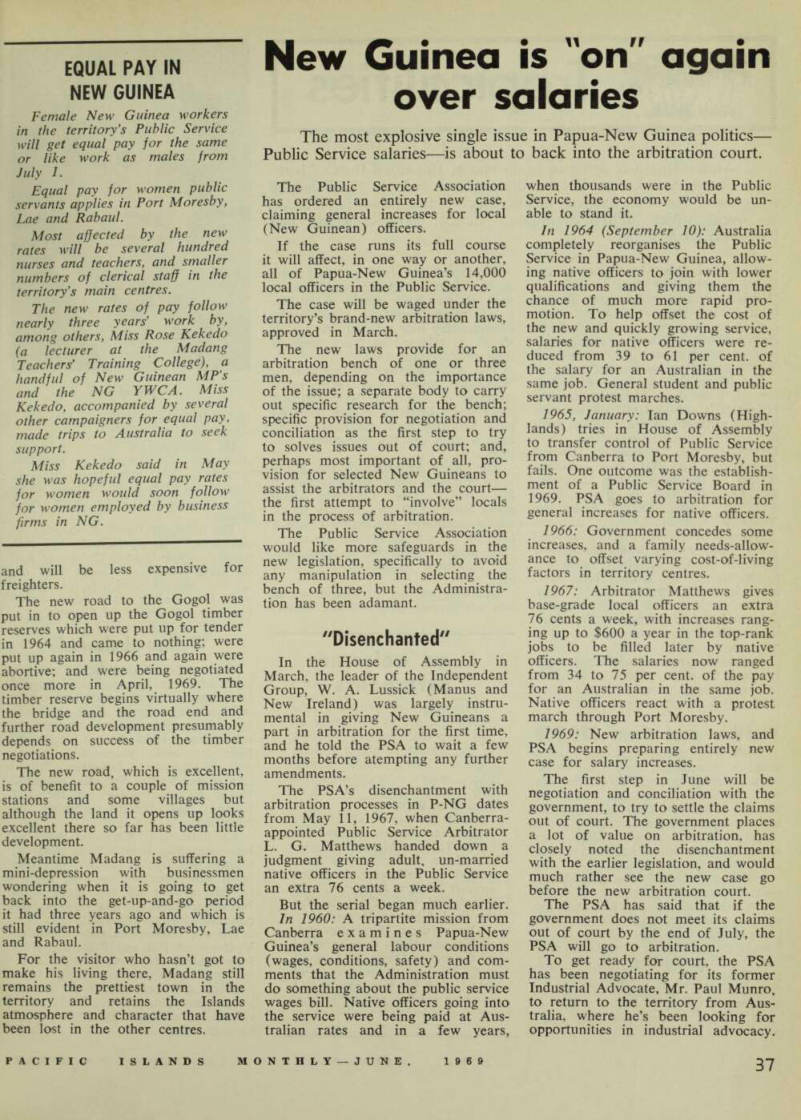
When the bridge was in place, the local Chamber of Commerce erected] the hopeful sign—“Mt. Hagen via Simbai, 187 miles”. When nothing! further happened on the far side of the bridge, some wag added the smaller sign “363 miles via KassanT’J
Missing link
At the moment it seems that the smaller sign could turn out to be the correct one. It is expected (although “expected” in the New Guinea works context can be pretty misleading), that there will be a road through from Madang to Lae within two years. The only missing link is be tween Usino and Dumpu and this is currently being surveyed.
It would then be possible to gel from Madang to the Highlands through Usino and Dumpu, the head of the Markham Valley and from there, via Kassam Pass, to Mt.
Hagen.
There are two schools of thought in Madang about this. One school believes that it is better to have any road rather than none; the other believes that once there is a road link between Madang and the Mark ham, there will be Buckley’s hope of getting a direct road from Madang to the Highlands even though il would be a great deal shortei (possibly better than the Lae-Hagec route as far as terrain is concerned),
• The bridge that ends the Madang.
Gogol road. The road may one day continue on its way —if somebody decides to open up the Gogol timber reserves.
This signpost on the abruptly-ending Madang-Gogol road declares that it's only 187 miles to Mt, Hagen via Simbai.
Some wag has added that, “it's 363 miles via Kassam".
and will be less expensive for freighters.
The new road to the Gogol was put in to open up the Gogol timber reserves which were put up for tender in 1964 and came to nothing; were put up again in 1966 and again were abortive; and were being negotiated once more in April, 1969. The timber reserve begins virtually where the bridge and the road end and further road development presumably depends on success of the timber negotiations.
The new road, which is excellent, is of benefit to a couple of mission stations and some villages but although the land it opens up looks excellent there so far has been little development.
Meantime Madang is suffering a mini-depression with businessmen wondering when it is going to get back into the get-up-and-go period it had three years ago and which is still evident in Port Moresby, Lae and Rabaul, For the visitor who hasn’t got to make his living there, Madang still remains the prettiest town in the territory and retains the Islands atmosphere and character that have been lost in the other centres.