Ng's Border
pp. 36-141 · Read in the full issue
War
Hots Up
Only one month to go until the beginning of the “act of free choice” in Indonesian West Irian.
The “act” begins in June and President Suharto wants the results cabled to him in Djakarta by August 15.
He’ll announce the result on August 17 during his speech marking the 24th anniversary of that August day in 1945 when Sukarno and Hatta declared the independence of the United States of Indonesia.
There’s a good reason why Presi dent Suharto wants the result of the “act of free choice” to reach him on August 15—it takes two days for a cable from West Irian to reach Java, despite the relatively short distance (2,300 miles) and the upgrading recently of West Irian’s communica tions with the arrival of United Nations and telecommunications equipment.
That’s the story of West Irian’s “act of free choice” ... all going like clockwork, according to Djakarta’s schedule.
The eight Regional Councils in West Irian have come out in favour of the Indonesian plan for the “act” . . . the traditional system of Musjurawah (consultation) used in the other 16 provinces.
Turned down
As a senior Indonesian in West Irian argued recently with a UN official, why let West Irian’s adult population have the luxury of a one man, one-vote general election until 1972?
Instead, the Indonesians plan to select 1,000 “leading” Papuans (the word “Papuan” is taboo in West Irian: everyone is an Indonesian citizen) to take part in the consulta tion to decide the future of the ter ritory’s 800,000 Papuans.
The Indonesians see as eminently reasonable this plan for one vote for every 800 of West Irian’s Papuans.
They turned down flat the sug gestion by U Thant’s Special Repre sentative, Ortiz-Sanz, for the one man, one-vote system for the more sophisticated of West Irian’s coastal people, particularly at Merauke, Kokonao, Fakfak, Sorong, Mano kwari, Noemfoor, Biak, Nabire and Sukarnapura (now renamed Djaya pura —“happy town”).
However, the Indonesians accepted the UN proposal that all eight Regional Councils in West Irian should be consulted, to see if they agreed with Djakarta on the method of conducting the “act of free choice” by the traditional method of con sultation, instead of by a vote.
"Treason"
Now that the eight councils have agreed to the method of the “act”, all that remains is for consultation to begin, and the first round is scheduled before the middle of June.
President Suharto, whom Sukarno had named in 1961 as head of the “West Irian Liberation Command”, has now twice said that any “vote” (or act) against Indonesia during the consultation, will be regarded as an act of treason.
On September 21, 1961, when Australia, the United States and the 87 other UN Nations were voting in favour of the transfer of Dutch New Guinea to Indonesia, only one dubious voice was raised: Minister L. Zollner of the African Republic of Dahomey.
“This”, he said, “will be the first time in UN history that an act of self-determination will be supervised and carried out by the nation to
whom the result will be most favour able”.
Zollner was worried about 1969 but the other 88 signatories to th< transfer agreement spoke confidently of Indonesia’s “spirit under th< charter of the United Nations” to d( the right thing when the time came Indonesia is now doing just that doing (in her view, and according her traditions) the right thing by thi 800,000 Papuans of West Irian.
At Manokwari, Brigadier-Genera Sarwo Edhie’s 6,000 marines am crack infantrymen have broken th back of the Arfak tribal rebelliot and the only important leader sti] loose is Frits Awom.
Awom took over from Lodewij Mandatjan, who came out of th Arfak Mountains in January to b whisked off to Djakarta, given crisp new Army uniform, shown t the foreign Press, and billed as misguided Papuan “who now (a( cording to Antara News Service realises he was wrong to fight again Indonesia”.
In Papua-New Guinea, a hard coi of “freedom fighters” (Operasic Papua Merdeka) determined to mal Indonesia give West Irian a genuir act of free choice, has been ste] ping up its propaganda activities, i They are the more political aware of the 220 men, women ar children officially allowed across tl border to settle in Australian Ne Guinea since Indonesia took over tl territory on May 1, 1963.
The Papua-New Guinea “freedo: fighters” are financed from Hollar and New York, and they run j highly efficient, clandestine ms
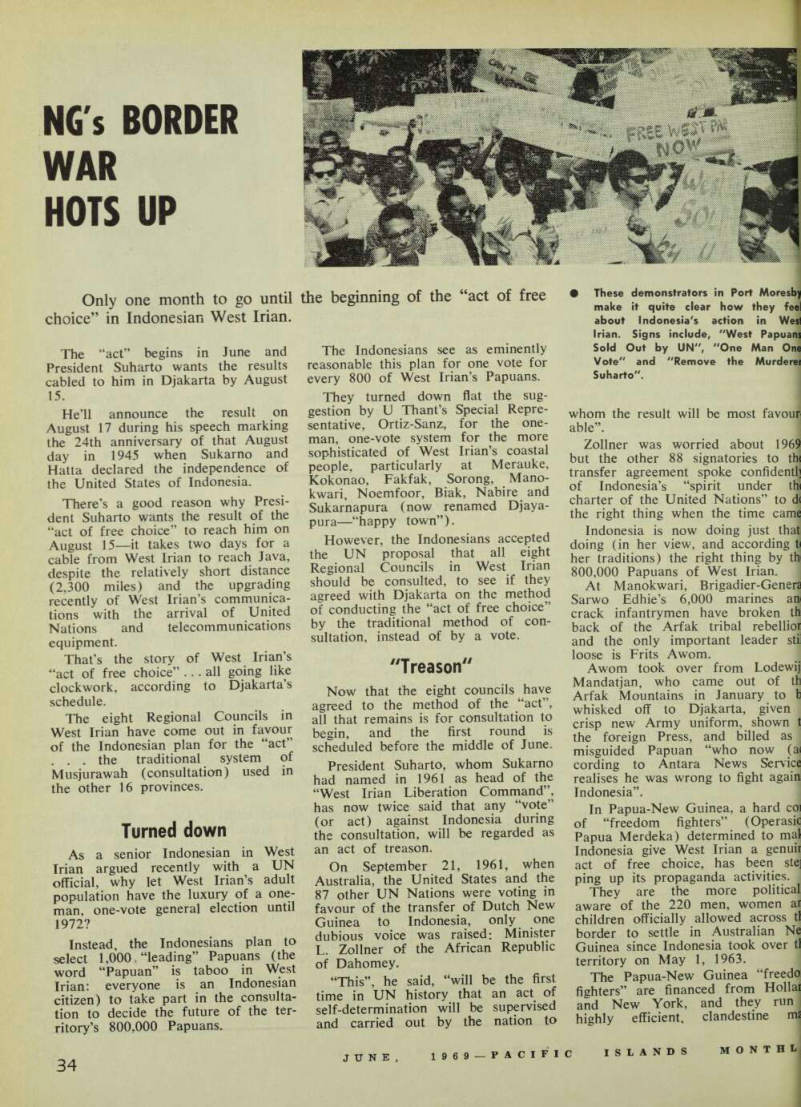
These demonstrators in Port Moresby make it quite clear how they feel about Indonesia's action in West Irian. Signs include, "West Papuans Sold Out by UN", "One Man One Vote" and "Remove the Murderer Suharto".
vice between Indonesian and Aus lian New Guinea.
K Dutchman at Vanimo in the st Sepik District of Australian w Guinea, Adrian Visser, 35, is “go-between” and “mailbox” for West Irianese in Australian ter ry.
Tsser has been particularly active :e the Australians late last year nded up 50 of the West Irianese i, women and children refugees dumped them on remote Manus nd, where they can be more ly watched by the Australian jrity Intelligence Organisation the Papua-New Guinea Special nch. . former leading member of the rasion Papua Merdeka fighting in West Irian, Nicholas Nere, become the spokesman for the it Irianese on Manus, and he ntly embarrassed Administrator O. Hay by asking him to post destine mail, when Mr. Hay back to the New Guinea main from Manus, icholas Nere and one other West lese man on Manus recently be e the first (and at time of pub ion, the only) two refugees to up Indonesia’s guarantee of safe luct to return for the act of free ce. The Port Moresby Austra ; handling Nere’s application to rn to West Irian next month ; tried to talk him out of the because of his violently anti ►nesian activities. le Indonesians have also been ming up” on their side of the er.
Bush camps
iroughout last year, 160 West defectors lived illegally in h bush camps on the Australian of the border, but these were en down and the bush-dwellers red back into Indonesian ter y. This was done last November, before Indonesia’s Brigadier jral Edhie paid a lightning (and unexplained) visit to Papua- Guinea.
March, some of the refugees ked back into Australian ter y near Wutung Village at the iern end of the border. They once again ordered back >s the un-marked border. the end of March, a patrol of nesian and West Irianese native e from Skosai Patrol Post on Fami River seven miles west of mg, arrived unexpectedly at mg Patrol Post. Early in April, Indonesian patrol boat crossed
the Australian border into Papua- New Guinea waters, cruised off Wutung for some time, and then headed back towards the Tami River Stic! Dijivsnurß a • i t
Foreign affairs battle
There s likely to be a full scale battle m the Papua-New Guinea Assembly in June to decide who speaks for the territory in foreign affairs—Canberra or Port Moresby?
The “foreign affair” sparking oft the battle? West Irian After virtually ignoring West Irian and Indonesia’s colonial activities for six years, Papua-New Guinea late in May was drawn right into the foreign affairs front line.
The sequence: a A/TT-T a f rr • n • • MHA for Kompiam-Baiyer, Mr. Traimya Kambipi, told newsmen in Canberra that the Indonesian act of free choice to begin on July 10 was no more than a farce. Papua- New Guinea’s House of Assembly should demand that the UN make Indonesia consult West Irian’s 800,000 Villagers honestly. Eight
other territory MHA’s with Mr.
Traimya nodded in agreement. . . , , ... . * few days later, Ministerial .Members Mr. To Liniciri (Rabaul) and Mr. Toua Kapena (Port Moresby) reached Canberra for government briefing before going off to the UN Trusteeship Council’s annual examination of Australia’s performance in the New Guinea Trust Territory, T * T • , T , To JHf?" “ ld Ka P ena £ that lf £°P le °f Papua-New Guinea or the House of ° n t0 T 1H i “ sue , T at tb s y T irnan InH ol 19 a*’ 7° M;w n for • j ay ’ f J 9 hn bad . a private conference in New York with U Thant and the negro. Dr, Ralph Bunche, about the West Irian refugees). • The Canberra departments of External Affairs and External Terri tories saw the danger, and immedi atel V issued a note to the Press tbat Canberra was constitutionally responsible for Papua-New Guinea’s
(Continued on p. 134)
foreign affairs, not Port Moresby or the House of Assembly. • Simultaneously in Port Moresby, the University Politics Club was listening to the Member for Moresby, the Rev. Percy Chatterton, describing West Irian’s forthcoming act of free choice as a shameful business, both for Indonesia and the UN. • The Politics Club arranged for a protest march through Port
Moresby, with a petition for Prime Minister Gorton, and Ministers Freeth (External Affairs), Barnes (External Territories) and U Thant.
More than 600 signatures were scrawled on the petition, which tells the Gorton Government that if it is not prepared to tell Indonesia to do an honest job in West Irian, then it should say nothing at all. To condone Indonesia’s plans, the petition says, is shameful. • Within 24 hours of the Politics Club seminar on West Irian, ABC and South Pacific Post correspondent
at Wewak, Albert Crichton, “broke” the story that a wounded West Irianese had just been carried across the border from West Irian’s capital.
He is Leo Jamby, 26, an official; member of the banned Free Papua Movement (Operasi Papua Merdeka) headed in Ddft, Holland, by self exiled Marcus Kaisiepo. Jamby had bullet wounds in ah arm.
He is the very first West Irianese to cross the border carrying tangible proof that the Indonesians have been shooting in West Irian. Jamby originally came across the border on April 26 with 80 other West Irianese men, women and children— under a hail of Indonesian bullets.
He went tb the government quarantine camp at Yako, nine miles from the border but early in May, slipped back into West Irian with a native friend.
Wounded
On May 20 he was back— wounded. Four West Irianese friends had smuggled him to Wutung Patrol Post aboard a canoe and when gov erment man Tony Try, 28, assured them Jamby would be taken to hospital, they sneaked back towards Djayapura. • Newsman Albert Crichton then nosed out another wounded West Irianese. He had bullet wounds in a shoulder, and the Australians were keeping him at Vanimo Hospital.
The man told interrogating officers that he had been lined up with five other men near Djayapura a few days earlier and an Indonesian firing team had opened up. The other five were felled and, he presumed, were dead.
He escaped, and slogged his way 18 miles to the border.
In Port Moresby, the government men very reluctantly confirmed the second man’s arrival. • In his government house at Hohola, the self-exiled West Irianese secretary of the Free Papua Move ment (Pacific Area) Elias Marjen sent urgent petitions to U Thant’s Special Representative in West Irian, Dr. Fernando Ortiz-Sanz, appealing for a UN peacekeeping force for the territory, and UN-controlled radio programmes broadcast from Djaya pura, Merauke, Sorong, Biak and Manokwari telling the villagers the facts about the act of free choice from July 10 to August 5. • On May 24, more than 600 people marched through Port Moresby with banners slating Aus tralia’s performance in the West
rian affair. The organiser, university tudent and part-time tutor Geoffrey Jray, stayed well behind the scenes.
The front man, president of the Diversity Politics Club, Leo Hannett from Bougainville) delivered the etition to Administrator D. O. Hay, nd told reporters he was thinking f a telegram to Messrs. To Liman nd Kapena in New York, to make □re they raised the West Irian act f free choice.
But District Commissioner D. J.
'lancy (Mendi) was with them in Jew York—with instructions to play own the West Irian issue as best e could. • At Yako Quarantine Camp line miles from the border, 111 West rianese men, women and children /ho crossed the border amid bullets n April 26, were still being pro essed to see how many had justifiable laims for permissive (political) esidence in Australian territory.
And all over Papua-New Guinea, tfHA’s were trying to decide just ow deeply the House of Assembly hould involve itself in West Irian ffairs, during the meeting beginning une 17.
They gave a hostile reception to suggestion by the Department of external Affairs that the House should not debate” the West Irian uestion, as international relations /ere a Commonwealth matter.
And from the West Irian border i Western Papua, reports from two Vest Irianese men are that Indo lesians have been shooting again, "he two walked three days to Weam •atrol Post and said that 15 uni ormed Indonesians had come to the illage site known as Old Kwari (on
the Suki Lagoon track) to open fire on 200 West Irianese men, women and children living there for weeks without Port Moresby’s knowledge.
Old Kwari is 12 miles into Aus tralian territory. The danger of really serious shooting incidents on—and across —the border is mounting.
If Mr. Barnes is unworried about the furious Indonesian activity along the border and the persistent cros sings by refugees, then his Patrol Officers and other field staff are worried . . . they’re worried that the regular crossings since 1963 (at least 1,600 so far) will increase rapidly as the “act of free choice” draws nearer.
Geic Census Result
Last December’s census in the Gilbert and Ellice Islands Colony shows a population of 55,185.
According to Dr. Hans Zwart, demo grapher at the South Pacific Com mission, this figure is about 1,000 less than projections, but final figures and details are being processed in Hawaii.
Conducting the census on the widely-scattered 40-odd islands of the GEIC had its problems. Forms from the isolated Line Islands (2,000 miles from the GEIC’s capital, Tarawa) were shipped to Panama to be re turned to Tarawa!