When Is A Fijian
pp. 35-165 · Read in the full issue
A Fijian?
The question of whether all residents of Fiji should be given a tional name, and whether that name should be “Fijian”, is again the spotlight.
In a seemingly casual remark in ided in his address to the Ba luncheon in May, the Chief nister and leader of the Alliance rty, Ratu Sir Kamisese Mara, dared himself in favour of the m “Fijian”. \ single name, he said, would ed a feeling of nationalism—and term “Fijian” seemed to be the t for identifying all people of Fiji, stressed however, that this was own personal opinion. The name 1 certainly not been the subject any Alliance Party resolution.
When elaborating on his suggestion the Legislative Council a few days it, Ratu Sir Kamisese explained t he “had never fallen in love h the name Fijian”, t wasn’t an indigenous word and 1 been coined by Captain Cook. :er visiting Vatoa, one of the small ithem Lau islands, during his /els, he called at Tonga where was told that Vatoa belonged to “Feeshee” group. This was trans :d by Cook as “Fiji” and written ord made of it. fhe Chief Minister added that if 'one could produce a national ne better than Fijian, he would glad to hear it.
jposition's congratulations
lome people claim the Chief lister’s suggestion stems from the >e that such an action would win re Indian support for the Alliance. )thers believe it is purely because his sincere belief in the need to ate a national identity for Fiji, n the campaign to build a “one ntry, one people” image—vitally )ortant in view of the pending istitutional Conference in London •oth Government and Opposition the need to create some iblance of racial unity.
Jpposition member Mr. K. C. nrakha, said the Chief Minister chosen the right psychological ment to make the pronouncement, position leader Mr. A. D. Patel > congratulated Ratu Sir Kamisese, ugh he pointed out that he had Je the same suggestion himself the House in 1967.
However, opinion in Fiji is by no means overwhelmingly in favour of “Fijian” as the national name. In some quarters, opinion is over whelmingly against it. The national secretary of the Fijian Association, Ratu David Toganivalu, commented: “While this was a personal comment made by the Chief Minister, the view was an interesting one, which will be widely discussed in more detail in due course”.
“Whatever they call them, Indians and Fijians will never be the same.
Why should they be allowed to call themselves Fijians when they travel overseas for instance?—people will
get the wrong idea of what we’re really like,” said one Fijian. Not a particularly logical opinion perhaps —but a fairly common one. (Continued on p. 159)
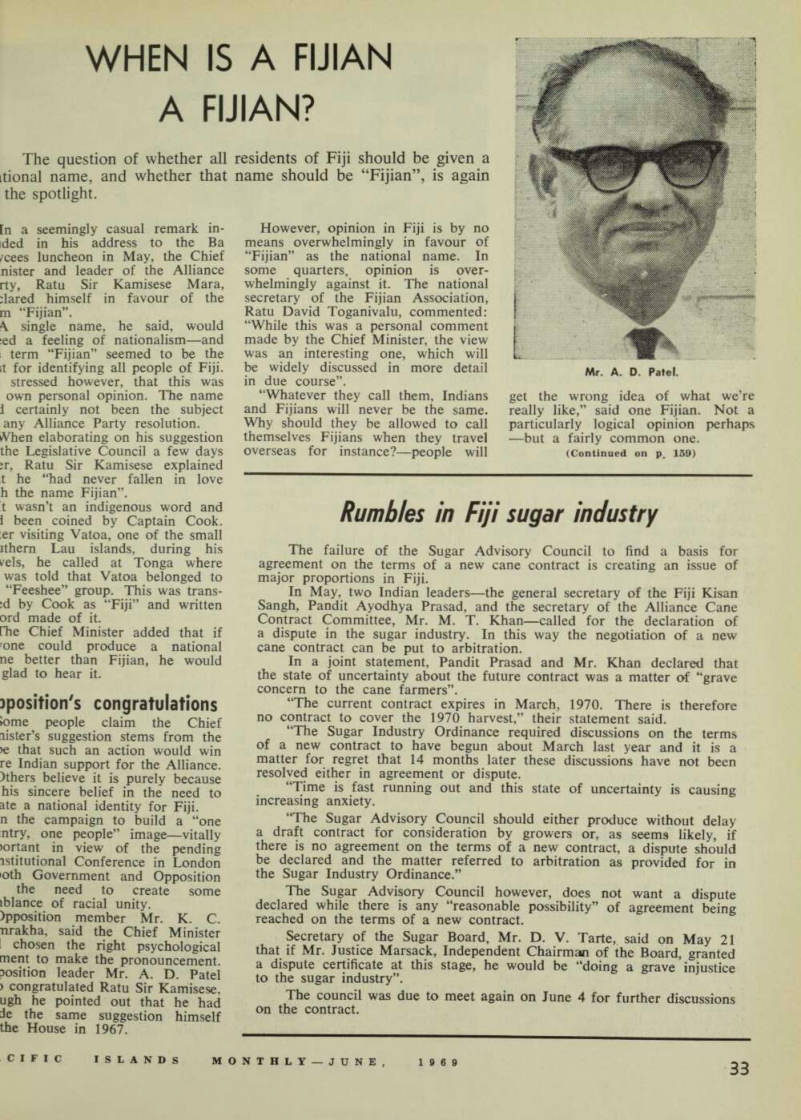
Mr. A. D. Patel.
Others of the young Fijian political elite were less guarded. \nd many quite apolitical Fijians pannot conceive why all races in Fiji should be lumped together as ‘Fijian”.
“Whatever they call them, Indians ind Fijians will never be the same.
Why should they be allowed to call hemselves Fijians when they travel overseas for instance? —people will >et the wrong idea of what we’re eally like,” said one Fijian. Note a particularly logical opinion perhaps —but a fairly common one.
Some Fijian leaders believe the ong-term solution is to “Fijianise” ill people in Fiji. And this of course nvolves “de-Indianising” the largest lection of the country’s population, n terms of culture, custom and political belief. This, they say, can ind must be done if Fiji is to be ‘ree of violence and racial jealousies.
One thing is certain. If “Fijian” pecomes the national name, the ndigenous people will require a ipecial name of their own—perhaps Taukei” or “Kai Viti”. For they lave reached the stage where they ire going to demand special con :essions in commerce, education and :mployment. They do not intend o be known as the “have nots” in heir own community.
Meanwhile, Fiji has seen the emergence of a well-written, well ;dited monthly journal —The Fiji Nation Newsmagazine —published on pehalf of the Alliance Party.
Although undeniably a part of the jovernment’s increasingly efficient propaganda machine, the magazine las proved so far to be refreshingly controversial and “hard” in its views.
By throwing new light on some of he behind-the-scenes thinking in "ijian circles, it’s a valuable addition o the local newspaper scene.
In its second issue in May. the nagazine used “Fijian Power—What Will It Mean?” as its theme.
Assuming that the magazine’s philosophy does in fact mirror that )f Fijian leaders, the “Fijian Power” nessage gave some pretty significant pointers to the way things could
happen in Fiji.
It predicted an era in which the indigenous Fijian would receive every possible concession in commerce, education and employment. An era in which discrimination would be for the Fijian.
This “power” would mean a high percentage of jobs reserved for Fijians; a high percentage of new business licences given to Fijians; a high percentage (almost 100 per cent.) of government overseas scholarships awarded to Fijians.
Such “power” would not mean reducing the European or Indian to the status of second-class citizen.
It would mean preventing the Fijians from remaining a second-class citizen.
It would be hard for the non- Fijian student to see a scholarship awarded to another whose grades might not be so high; for the non- Fijian technician and civil servant to see a less-qualified man elevated to a higher position; for the non-Fijian businessman to see the Fijian beginner given the advantage.
But it would happen.
Not unexpectedly, this hard-hitting new journal doesn’t evoke much sympathy from the more outspoken members of Fiji’s National Federa tion Party.
And the Liberal Party leader, Dr.
W. L. Verrier, went so far as to call it the “most mischievous, the most unscrupulous, the most evil piece of journalistic irresponsibility which has for many, many years been laid before the public of Fiji”.