Hostile official reception
p. 33 · Read in the full issue
to Nauruan pools
Long white envelopes, postmarked Nauru, went out to 300,000 ostly-surprised people in Australia and Fiji in May, as a Nauru ised football pool went into operation. But before the results of ie first matches were due, the scheme was already meeting with rious political troubles.
The troubles weren’t on Nauru — e Republic of Nauru condones e operation and stands to gain a rcentage of profits without having put any money at all into the heme. The troubles were in Aus alia, where various State govern ents were beginning to organise lited opposition to the pools.
Their objections mainly centred ound the fact that the pools could ke money that might otherwise be ent on State-controlled lotteries, le States apparently weren’t in rested in an offer by the promoters, 'dney men George Pearce and Bill ayberry, for them to receive a ircentage of Australian takings.
The promoters thus had a serious st-minute fight on their hands.
Football pools pay out money on e results of football matches, innings depend on the number who ck the right results, and the auruan pools have not made any omises about prize money.
The first two P-Days were to be ay 31 and June 1 when 51 different otball games were to be played on ounds from Perth to Brisbane, itrants —and between 150,000 and r O,OOO were anticipated by the Pro cters—had to have their entry rms in the hands of Pacific Sport g Pools at Nauru by those dates.
Of the 300,000 coupons sent out, >5,000 had gone to Australians and >,OOO had been posted to residents Fiji, according to promoters.
To handle the deluge of mail— ore letters than the Republic )rmally gets in a year—9o Aus alian and English contract em oyees stood by at company head larters on Nauru, supported by over )0 Nauruan “sorters and checkers”.
Since its formation on Nauru last :ptember ( PIM, Nov., 1968, p. 32), icific Sporting Pools’ ambitious an to start the pools, build a hotel, >erate a new Australia-Nauru air rvice and set up several other minor orations, has received widespread iblicity.
In May, the 15th floor Sydney iite of Messrs. Mayberry and Pearce oked cramped with themselves, two tractive receptionists and two assis
tants. Papers, files, telegrams and job applications covered desks, while phones ran hot with inquiries from pools entrants, journalists after stories, and staff.
Mr. Pearce said in late May, before the “political” upsets, that operations were moving fast. Over $500,000 had been subscribed by Australian share holders, Nauru’s hotel was partly built to accommodate 100 people and an agreement had been made with a Swiss charter firm for hire of a DC6B aircraft later this year for operation of a Brisbane-Nauru weekly flight to carry the football entries and coupons back and forth. (By no mere coincidence Fiji Airways started weekly air services to Nauru only three weeks before P-Day.)
Tax-free salaries
Five pools executives on Nauru had been appointed, under a general manager, Mr. K. M. Robson. Others were Messrs. D. G. Stephens, D. S.
Irons, D. Shapiro and A. Russell.
Messrs. Robson, Stephens and Irons all have experience with the big English football pools operators, Littlewoods, Vernons and Zetters and Mr. Russell was formerly manager, mailing services, with the New South Wales Government.
The 90-odd Australian male and female employees on Nauru have signed 18-month working contracts
and the executives, four year con tracts. All are receiving tax-free salaries and subsidised accommoda tion.
PSP’s two-man board had doubled (previously Messrs. Pearce and May berry were the company’s directors).
One new member is Mr. Raymond Lord, a Port Moresby-based accoun tant with interests in about six NG beer taverns and a hand in the town’s proposed new brewery which will operate with Japanese help.
The other member is Mr. Alan Newbury, a Sydney-based investor with real estate interests.
Mr. Pearce said all football coupons and copies of its Nauru paper The Central Pacific Post had been printed in Brisbane. Entry money in cash, money order or cheques would be handled through the Bank of New South Wales’ new branch on Nauru. To process entries and determine winners, Nauruan sorters —instead of costly computers —would be used.
Under Australian law, he said PSP was unable to advertise its pools publicly but it had “overcome this” by obtaining a mailing list of 300,000 “interested” people. He wouldn’t say how the names had been acquired.
Mr. Pearce said shareholdings in Pacific Sporting Pools had been restricted to Australians, none of whom had a controlling interest. Mr.
L. J. Hooker, former head of his Australia-wide Hooker Corporation, had a shareholding through sub sidiary companies of the corporation.
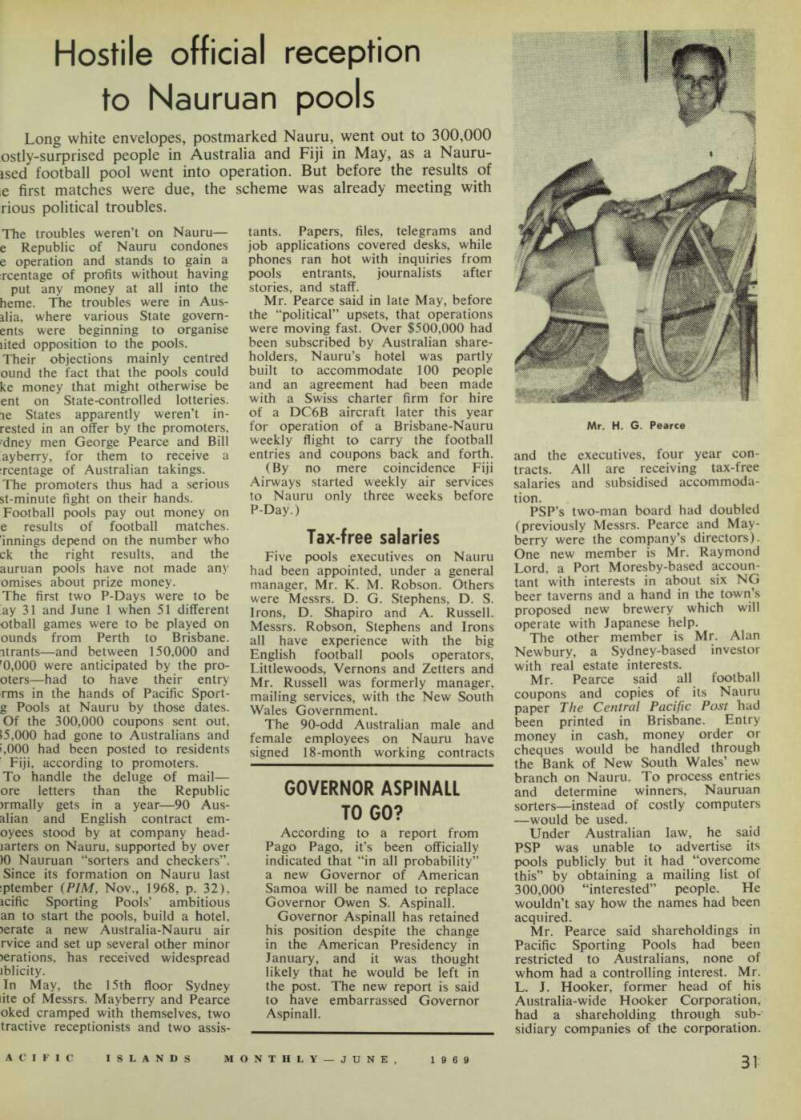
Mr. H. G. Pearce