by Carnival de Gaulle
pp. 29-166 · Read in the full issue
New Caledonia bewildered by Carnival de Gaulle
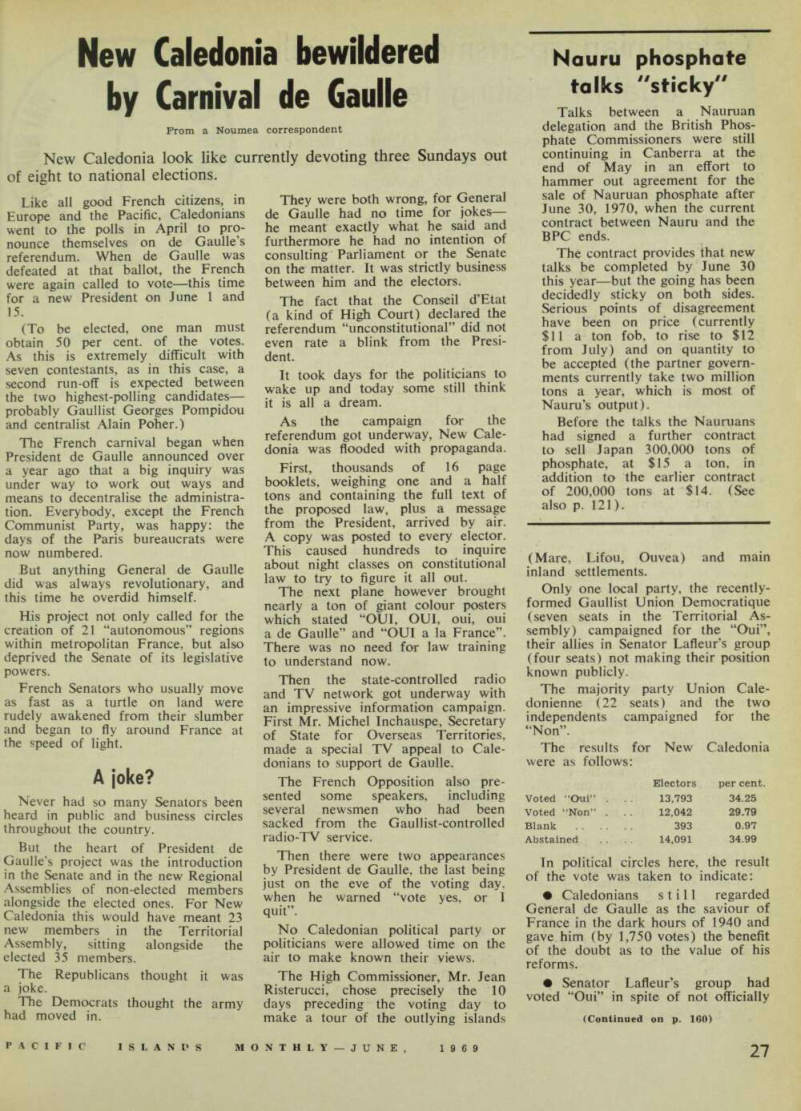
From a Noumea correspondent New Caledonia look like currently devoting three Sundays out of eight to national elections.
Like all good French citizens, in Europe and the Pacific, Caledonians went to the polls in April to pro nounce themselves on de Gaulle’s referendum. When de Gaulle was defeated at that ballot, the French were again called to vote —this time for a new President on June 1 and 15. (To be elected, one man must obtain 50 per cent, of the votes.
As this is extremely difficult with seven contestants, as in this case, a second run-off is expected between the two highest-polling candidates — probably Gaullist Georges Pompidou and centralist Alain Poher.) The French carnival began when President de Gaulle announced over a year ago that a big inquiry was under way to work out ways and means to decentralise the administra tion. Everybody, except the French Communist Party, was happy: the days of the Paris bureaucrats were now numbered.
But anything General de Gaulle did was always revolutionary, and this time he overdid himself.
His project not only called for the creation of 21 “autonomous” regions within metropolitan France, but also deprived the Senate of its legislative powers.
French Senators who usually move as fast as a turtle on land were rudely awakened from their slumber and began to fly around France at the speed of light.
A joke?
Never had so many Senators been heard in public and business circles throughout the country.
But the heart of President de Gaulle’s project was the introduction in the Senate and in the new Regional Assemblies of non-elected members alongside the elected ones. For New Caledonia this would have meant 23 new members in the Territorial Assembly, sitting alongside the elected 35 members.
The Republicans thought it was a joke.
The Democrats thought the army had moved in.
They were both wrong, for General de Gaulle had no time for jokes— he meant exactly what he said and furthermore he had no intention of consulting Parliament or the Senate on the matter. It was strictly business between him and the electors.
The fact that the Conseil d’Etat (a kind of High Court) declared the referendum “unconstitutional” did not even rate a blink from the Presi dent.
It took days for the politicians to wake up and today some still think it is all a dream.
As the campaign for the referendum got underway, New Cale donia was flooded with propaganda.
First, thousands of 16 page booklets, weighing one and a half tons and containing the full text of the proposed law, plus a message from the President, arrived by air.
A copy was posted to every elector.
This caused hundreds to inquire about night classes on constitutional law to try to figure it all out.
The next plane however brought nearly a ton of giant colour posters which stated “OUI, OUI, oui, oui a de Gaulle” and “OUI a la France”.
There was no need for law training to understand now.
Then the state-controlled radio and TV network got underway with an impressive information campaign.
First Mr. Michel Inchauspe, Secretary of State for Overseas Territories, made a special TV appeal to Cale donians to support de Gaulle.
The French Opposition also pre sented some speakers, including several newsmen who had been sacked from the Gaullist-controlled radio-TV service.
Then there were two appearances by President de Gaulle, the last being just on the eve of the voting day. when he warned “vote yes, or I quit”.
No Caledonian political party or politicians were allowed time on the air to make known their views.
The High Commissioner, Mr. Jean Risterucci, chose precisely the 10 days preceding the voting day to make a tour of the outlying islands
(Mare, Lifou, Ouvea) and main inland settlements.
Only one local party, the recently formed Gaullist Union Democratique (seven seats in the Territorial As sembly) campaigned for the “Oui”, their allies in Senator Lafleur’s group (four seats) not making their position known publicly.
The majority party Union Cale donienne (22 seats) and the two independents campaigned for the “Non”.
The results for New Caledonia were as follows: Electors per cent.
Voted “Oui” . . . 13,793 34.25 Voted “Non” . . . 12,042 29.79 Blank 393 0.97 Abstained . . . . 14,091 34.99 In political circles here, the result of the vote was taken to indicate: • Caledonians still regarded General de Gaulle as the saviour of France in the dark hours of 1940 and gave him (by 1,750 votes) the benefit of the doubt as to the value of his reforms. • Senator Lafleur’s group had voted “Oui” in spite of not officially
(Continued on p. 160)
campaigning for the “Oui” (Senator Lafleur was in Paris during the referendum). • There could be a trend away from Union Caledonienne, but towards abstaining rather than towards any other party.
The forthcoming presidential elec tion will show how the two main parties of New Caledonia really stand.
In Paris in May, Senator Lafleur called upon Gaullist candidate Georges Pompidou. Union Cale donienne President of the Territorial Assembly, Armand Ohlen, then flew off to Paris and with Francis Sanford of French Polynesia called on chief Gaullist rival, Alain Poher, acting President and former President of the Senate.
Mr. Poher is reported in the Cale donian Press as having told the visitors from Noumea and Tahiti that “the government had given instruc tions that the overseas territories and metropolitan France should be assured of objectivity in radio broad casts and the free running of the elections”.
• One of the South Pacific’s best known academics (and occasionally the most controversial), New Zealand born Dr. R. J. Crocombe, has been appointed Professor in the School of Social Development at the University of the South Pacific, Fiji. He is expected to arrive there about August.
Currently Dr. Crocombe is executive officer of the New Guinea Research Unit, based in Port Moresby.