Up Front
pp. 5-6 · Read in the full issue
with the Editor
Don’t look for a or even for topicality in anything I lieht happen to write in this column of bits and bias. I know I 3ve said that before, but it’s approoriate to say it again before noting at you a long oassage from Will Mariner’s An Account of e Natives of the Toma Islands , published first in 1817.
This passage happens to be my vourite from any Pacific book, ich is its fascination for me that :casionaly I will pull out the volume om my library shelf and read that ige to visitors.
Will Mariner’s own story is well lown these days. He was the ship’s >y in the British privateer Port au •ince, which was plundered by those Id Tongans in 1806, and who sur ged under the patronage of the chief nau, to finally return to England, me and fortune. His account of his >ngan experiences over four years as written with the help of Dr. hn Martin.
This favourite passage of mine re les a conversation that young ariner had heard around the kava "wl in Haanai, one of the Tonean oup, probably about 1807. A chief lated how a ship had recently rived at Tongatapu from Botany ly, bringing home after two years Sydney a Tonean chief called iloo Mata Moigna and his wife, tafehi. The pair were now sorry -Y were back on Tonga, and pre- Ted the infant settlement of Botany y.
Mariner goes on with his narrative: “The account they gave of the lelish customs at this place, and the atment they at first met with, it ly be worth while to mention. The >t thine that he and his wife had do, when they arrived at the gover ns house, where they went to ;ide, was to sweep out a laree court rd. and clean down a ereat pair of ts: in vain thev endeavoured to slain, that in their own country ;y were chiefs, and, being accus ned to be waited on, were quite used to such employments: their sostulations were taken no notice and work thev must. ‘At first their life was so uncom lable, that they wished to die; no
one seemed to protect them; all the houses were shut against them; if they saw anybody eating, they were not invited to partake: nothing was to be got without money, of which they could not comprehend the value, nor how this same money was to be obtained in any quantity; if they asked for it, nobody would give them any, unless they worked for it, and then it was so small in quantity, that they could not get one-tenth part of what they wanted with it.
Kicked him out
“One day, whilst sauntering about, the chief fixed his eyes upon a cook’s shop, and, seeing several people enter, and others, again, coming out with victuals, he made sure they were sharing out food, according to the old Tonga fashion, and in he went, glad enough of the occasion, expecting to get some pork; after waiting some time, with anxiety to be helped to his share, the master of the shop asked him what he wanted, and, being answered in an unknown language, straightaway kicked him out, taking him for a thief, that only wanted an opportunity to steal. Thus, he said, even being a chief did not
Our Cover
Two hoys indulge in some horseplay at Raro tonga in the Cook Islands.
Horse racing along the sands is a popular pastime in the Cooks. And when the racing is over, there’s always the surf for cooling.
This picture was taken for us by Sheree Lip ton.
prevent him being used ill, for, when he told them he was a chief, they gave him to understand, that money made a man a chief.
“After a time, however, he acknow ledged that he got better used, in pro portion as he became acquainted with the customs and language. He ex pressed his astonishment at the perse verence with which the white people worked from morning till night, to get money: he could not conceive how they were able to endure so much labour.
“After having heard this account, Finow asked several questions re specting the nature of money: what is it made of?—is it like iron? can it be fashioned like iron into various useful instruments? if not, why can not people procure what they want in the way of barter? —but where is money to be got?—if it be made, then every man ought to spend his time making money; that when he has got plenty, he may be able after wards to obtain whatever else he wants.
Monopoly with chiefs
“In answer to the last observation, Mr. Mariner replied that the material of which money was made was very scarce and difficult to be got, and that only chiefs and great men could pro cure readily a large quantity of it; and this either by being inheritors of plantations or houses, which they allowed others to have, for paying them so much tribute in money every year; or by their public services; or by paying small sums of money for things when they were in plenty, and afterwards letting others
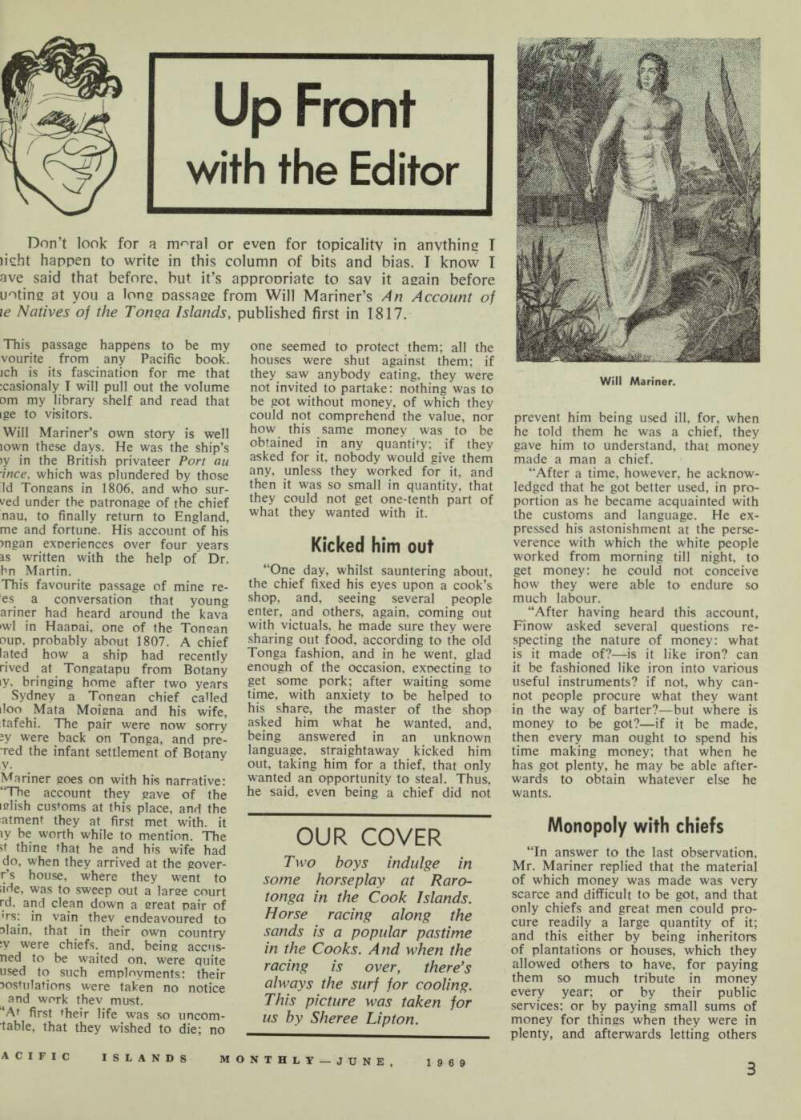
Will Mariner.
have them for larger sums, when they were scarce: and as to the lower classes of people, they worked hard, and got paid by their employers in small quantities of money, as the re ward of their labour: &c.
“That the king was the only person that was allowed to make (to coin) money, and that he put his mark upon all that he made, that it might be known to be true; that no person could readily procure the material of which it was made, without paying money for it; and if contrary to the taboo of the king, he turned this material into money he would scarcely have made as much as he had given for it.
“Mr. Mariner was then going on to shew the convenience of money as a medium of exchange, when Fili moeatoo interrupted him, saying to Finow, I understand how it is;— money is less cumbersome than goods, and it is very convenient for a man to exchange away his goods for money; which, at any other time, he can exchange again for the same or any other goods that he may want; whereas the goods themselves may perhaps spoil by keeping (particularly
if provisions), but the money he supposed would not spoil; and al though it was of no true value itself, yet being scarce and difficult to be got without giving something useful and really valuable for it, it was imagined to be of value; and if every body considered it so, and would readily give their goods for it, he did not see but what it was of a sort of real value to all who possessed it, as long as their neighbours chose to take it in the same way.
Money for fools
“Mr, Mariner found he could not give a better explanation, he there fore told Filimoeatoo that his notion of the nature of money was a just one.
“After a pause of some length, Finow replied that the explanation did not satisfy him: he still thought it a foolish thing that people could place a value on money, when they either could not or would not apply it to any useful (physical) purpose: ‘if he said, ‘it were made of iron, and could be converted into knives, axes, and chisels, there would be some sense in placing a value on it;
but as it is, I see none: if a man,’ I he added, ‘has more yams than he wants, let him exchange some of them away for pork, or gnatoo; cer tainly money is much handier, and ' more convenient, but then as it will not spoil by being kept, people will store it up, instead of sharing it out, as a chief ought to do, and thus become selfish; whereas, if provision were the principal property of a man, j and it ought to be, as being both the most useful and the most necessary, he could not store it up, for it would I spoil, and so he would be obliged either to exchange it away for some-1 thing else useful, or share it out to his neighbours, and inferior chiefs and dependants, for nothing.’ He concluded by saying, ‘I understand now very well what it is that makes the Papalangis so selfish; —it is this money!’ ”
As I said, look for neither a moral nor topicality in that discussion that took place around a kava bowl in Tonga more than 160 years ago.
It doesn’t mean to say there isn’t any.
Mariner’s Tonga is not an easy volume to get, and I just thought I’d like to share it with you.
Stuart Inder