Edible protein from grass
pp. 145-147 · Read in the full issue

A process for producing edible protein from grass and crop waste has been developed by scientists at the University of New South Wales, Sydney. It has been hailed as a significant step towards the solution of the world’s food problems.
Similar processes have been developed in other parts of the world, including Britain and the USSR. It is claimed that the Australian process is proving three times as efficient as any other.
Scientists at the University of NSW aim further to perfect the process so that it can be used by families, or by co-operatives in villages by 1969.
Wnrlfinn Ini* cjv upstc
VVOrKing Tor SIX years
Professor G. H. Roper, associate professor of biological engineering at the University of NSW, says that the process “could lead to man being able to adequately feed himself in the future without the danger of protein shortage”.
Professor Roper has been working for six years on this project with Professor F. J. Moss, associate professor of biological technology at
the university. Professor Moss is a former physician who became so in terested in the protein deficiency problem that he set up a pnvate laboratory to work on it 20 years ago.
So far the Australian research team has been able to produce pro tein suitable for human consumption from such sources as grass, sawdust, sugar cane fibres, crop stubble and coconut flesh. With the new pro cess, 35 lb of edible protein can be produced from 100 lb of grass.
A process employed in British ex periments at the Rothamstead Agri cultural Research Centre is able to produce only 12 lb of edible protein from 100 lb of grass, Professor Roper says that as far as he knows, the Russians have not progressed as far as Australians in respect of protein production for human consumption. However, they have said they will be producing 1.3
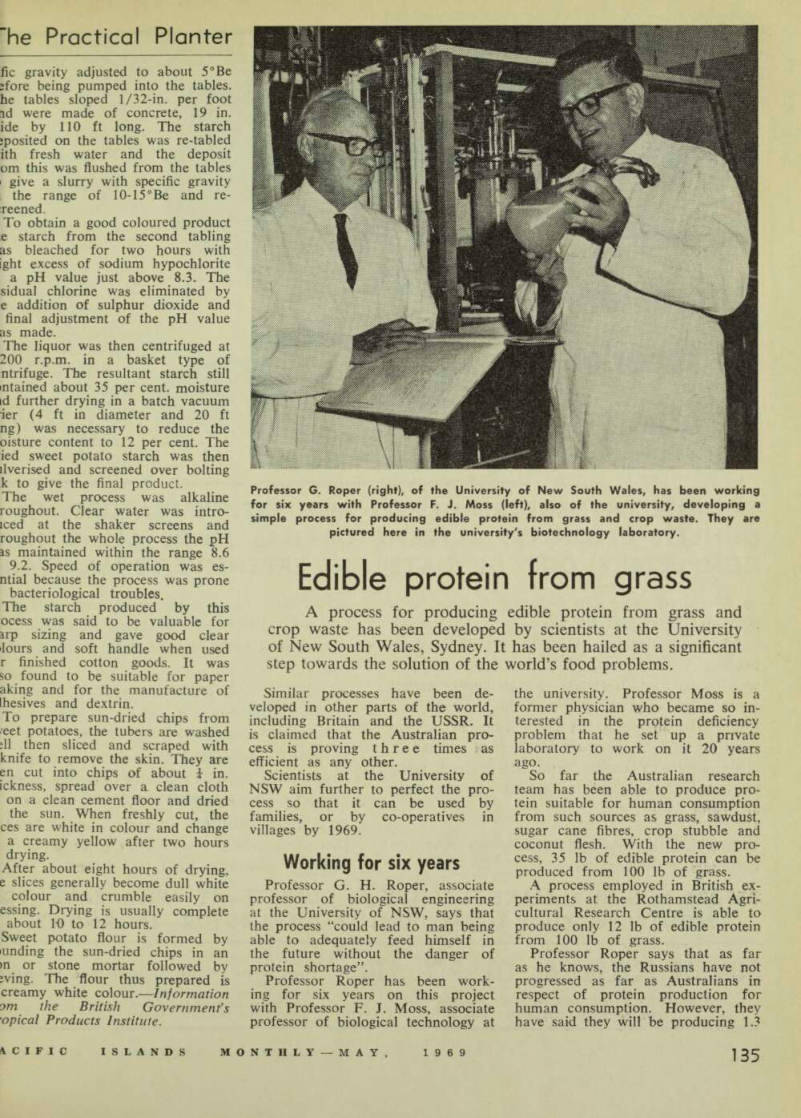
Professor G. Roper (right), of the University of New South Wales, has been working for six years with Professor F. J. Moss (left), also of the university, developing a simple process for producing edible protein from grass and crop waste. They are pictured here in the university's biotechnology laboratory.
lillion tons of protein, synthesised ■om waste, for use as stock feed i 1970.
The artificial protein produced at le University of NSW is powdery, rotein produced from sugar cane as a sweet taste like molasses, /hen lucerne is used, the product as a pleasant salty flavour. The rotein produced by this Australian lethod is of extremely high quality, enerally of comparable value to £g.
Of special significance is the dative simplicity of the Australian lethod, which can be used anywhere, articularly in underdeveloped areas.
"Breakthrough"
Professor J. R. A. McMillan, ational president of the Australian reedom from Hunger Campaign, as hailed the work of Professors loss and Roper as the beginning of i phenomenal breakthrough in meet ig the world’s protein shortage”.
Almost any plant can be used, yen the plant debris left behind fter a crop has been harvested.
Explaining the Australian process, rofessor Roper said: “The protein produced in several stages. Using rass, the plant material is crushed nd the plant juices extracted.
“This juice is set aside and the lant fibres are then treated with ilphuric acid. The sugary solution i the fibre residue is added to the lant juices, together with selected acteria or yeasts to feed on the igars present and produce protein i their own bodies.
“We have found that we can use bout 20 different micro-organisms 5 do the job of producing protein,” e said.
The protein produced is analysed 3r its animo acid content, the vital onstituent of proteins, and if neces ary the raw protein is supplemented dth animo acids to improve its uality. To obtain the protein, the olution is spun off in a centrifuge. • Proposals are now being con idered for transport projects in luding new and improved roads, Iridges, wharves and airstrips for lie 1969/70 Papua-New Guinea tural Development Programme. The irogramme provides funds to each *-NG district for expenditure on pproved projects. Priorities are put orward by the District Co-ordinating Committees in consultation with the .ocal Government Councils, District Advisory Councils and other com nunity representatives.