Business and Development
pp. 125-130 · Read in the full issue
Suddenly, New Guinea
Is Copper-Studded!
America’s Freeport Sulphur prospecting company has begun photogeology in West Irian to check the extent of its discovery of high-grade copper on the territory’s highest mountain.
Freeport Sulphur found copper on Mount Carstensz (16,503 ft) in 1961, and re-negotiated its option when the Indonesians arrived in May, 1963, and re-named the mountain, Sukarno. (IPs since been re-named again, Djayatop).
The extent of the copper is un known, but the average grade is 2.5 per cent, (compared to 0.47 on Bougainville’s Panguna site, being developed by Conzinc Riotinto of Australia). Freeport’s find is of far richer grade than Bougainville’s, and in addition there are gold, silver and iron ore in this West Irian bonanza. One estimate puts the gold alone as being worth SA3O million.
However, West Irian’s copper is in mountains nearly four times higher than Bougainville’s and more than twice the distance from the coast.
There are 33 million tons of mineralised ore at the Freeport site, estimated by the company to be worth a staggering SAI billion at current world prices.
Estimates are so far based on “indicated assays,” but studies last year showed there were “no metal lurgical obstacles” to separating the four metals from the ore.
The iron is of an average grade of 40.6 per cent.
To get it out will mean working in sub-freezing temperatures in the high mountains, and in tropical con ditions as the coast is approached.
It is 60 miles to the coast.
The present feasibility survey is costing $2 million. Operations are being directed from Darwin.
At the Carstensz find at present are Freeport’s director of overseas operations, Mr. Forbes Wilson, a team of company scientists and about 50 West Irianese laborers. As in
Bougainville’s early days, supplies are being brought in by helicopter.
In April the site was inspected from the air by three of Freeport’s directors, travelling in a special jet from Darwin.
The directors are Godfrey S.
Rockefeller, Langbourne M. Williams (chairman) and Admiral Arleigh Burke. They had nothing to say for publication.
Technical and political implications have yet to be carefully weighed, but undoubtedly a rich find would mean a bonanza for Indonesian New Guinea.
Meanwhile, 300 miles further east, in Western Papua, the Canadian based prospecting company, Kenne cott Explorations, has also found promising copper in the upper Ok Tedi (Alice) River, north of Kiunga {PIM, Mar., p. 120). This is in Aus tralian territory.
Kennecott geologists are now opera ting two diamond drills in the area, Kennecott has also made a new ap plication to enter West Irian, to see if the Ok Tedi copper extends across the border and into the remainder of the un-mapped Star Mountains.
Bougainville lease granted
On April 11, the Administrator of Papua-New Guinea, Mr. D. O.
Hay, announced in Port Moresby that a special mining lease of about 10,000 acres of land at Panguna had been granted to Bougainville Copper Pty. Ltd., which is the operating company for Conzinc Riotinto of Australia.
The announcement meant the end of the prospecting phase for CRA on Bougainville. The company now becomes liable for a total expenditure of at least $3O million to mine and concentrate ore within five years.
Total expenditure in getting the whole operation working town, port and mining facilities will in fact be about $250 million, but only about three years will be required.
CRA has made no official an nouncement that it will go ahead with the full scheme because other negotiations are continuing. But it needed the special lease so it could go ahead with preparations in the belief that it will eventually be com mitted for the full expenditure.
It has still to announce details of who will buy the copper (Japan is taking some, but negotiations have also been proceeding elsewhere), and who will finance the huge develop ment.
Some of the finances will come from share issues in CRA and an operating partner, New Broken Hill.
The company had until December 31, 1971, before it needed to apply for the special mining lease in place of the prospecting authority it has been working under. (See full report PIM, Dec., 1968, p. 125).
Under the terms of an agreement, the P-NG Administration has the option to purchase at par 20 per cent, of the shares of Bougainville Copper Pty. Ltd., and the Administration will also get royalties of U per cent., five per cent, of which would be paid to the Bougainville landholders direct
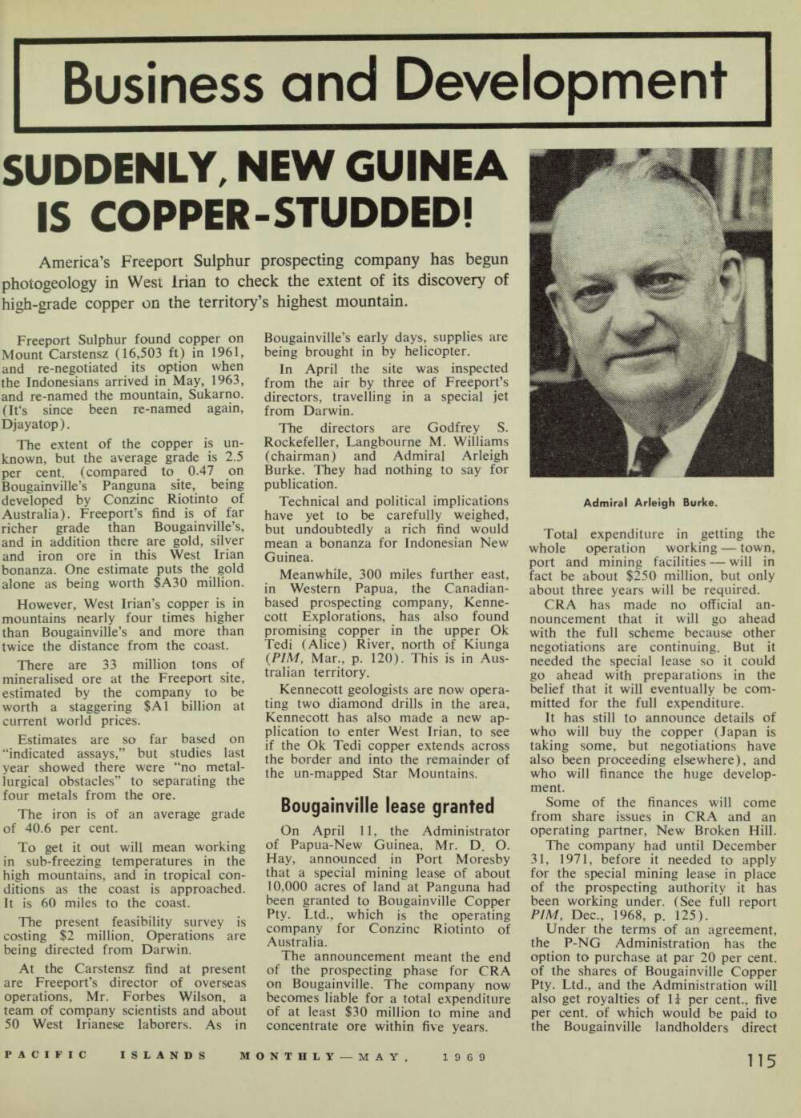
Admiral Arleigh Burke.
and the remainder into territory revenue.
Since 1963, CRA has spent more than $17,000,000 diamond-drilling the Panguna ore-body, driving two long tunnels, putting in a pilot pro cessing plant, surveying for a town and port site, and building up its staff to more than 700 Europeans and New Guineans.
The prospecting indicates an ore body of at least 760 million tons of the higher grade material containing copper worth, at today’s prices, at least $2,000 million. The ore also contains gold worth many additional millions.
The company will need 57,000 acres of Bougainville land for the total operation—lo,ooo acres for open-cut and the surrounds; 40 acres for a concentrator; 100 acres for a pit-side town for key staff; several thousand acres for tailings and volcanic over-burden; thousands of additional acres for a 25-mile high way from Panguna to a major town and port to be built north of Kieta.
The open-cut will be one of the largest in the southern hemisphere— -8.000 feet long, 5,500 feet wide.
Native landowners are still divided in their attitude to the furous pro specting activity in the Kawerong Valley, where Panguna lies, and about 200 will have to be resettled, probably on the Roman Catholic Mission’s Mabili Plantation, a few miles north of Kieta, which was recently purchased by the Administra tion.
Three villages lie within the boundaries of the 10,000-acre special mining lease—Moronei Village, only 2.000 ft from the edge of the pro posed pit, and Dapera and Pirurari villages, considerably further away.
The boundary just misses one of the most troublesome villages— Guava. Other landowning groups with rigid attitudes towards pro specting—Pakia, Onovi and Kokorei —are also outside the special mining lease, which occupies about five per cent, of the entire Kawerong Valley.
West Irian timber
contract to NZ
A New Zealand firm has won the first major logging and sawmilling contract in West Irian since the de parture of the Dutch in 1963. The contract is worth $700,000.
J. C. Groome Ltd. (Wellington) will begin moving into West Irian in mid-June with 15 men. The company will install sawmilling and logging equipment, and operate in 25,000 acres of light to medium forest be tween the capital of West Irian,
Djayapura, and the border with Papua-New Guinea, 20 miles to the east.
The contract, for three years, was awarded by the UN Food and Agri cultural Organisation on instructions from the Fund of the United Nations For the Development of West Irian.
FUNDWI, has received $30,000,000 from Holland to be used in an at tempt to restore West Irian’s economy.
Aimed at boosting West Irian’s ex port income, the contract was an nounced in Port Moresby by FUNDWFs Executive Secretary, American Thomas F. Power, Jr. The contract is also aimed at teaching the West Irians how to log and mill their own forests.
J. C. Groome Limited will estab lish its main sawmill near Djayapura.
The NZ experts will concentrate on peelers, veneers, plywood and general building timber, and ship logs to Japan and the US.
Development' bonk
planned for W. Irian
West Irian will soon have its own version of the highly-successful Papua-New Guinea Development Bank.
It will be called the Joint Develop ment Commission and is being organ ised by Djakarta and the UN’s FUNDWI. The commission will get its operating capital from Djakarta.
The UN has earmarked $4,000,000 for the first 10 years of operations in forestry, fishing, agriculture and small businesses. The UN consult ants early this year visited P-NG to check the operations of the terri tory’s Development Bank, and to find
a way of reducing the anticipated high rate of bad debts.
The executive secretary of FUNDWI, Thomas F, Power, Jr., will go to West Irian in July to get the Joint Developent Commission off the ground.
PNG Motors'
interim report
Turnover is up, profit is “margin ally down”—according to the first interim report issued by PNG Motors.
But by how much either way was not disclosed by New Guinea’s motor vehicle seller, petrol vendor and taxi operator whose 50 cent shares were listed on the Sydney Stock Exchange last December ( PIM, Dec., 1968, p. 127).
Directors said that providing cur rent trading conditions continued, they were “confident” a final dividend of 12i per cent, would be paid in September.
They gave high costs on expansion programmes undertaken by the com pany earlier in 1968 and lower revenue from taxis as the reasons for lower profits.
New branches were opened at Madang and Mt. Hagen, and demand for Rover, Jaguar and British Motor Corporation vehicles was good, they said.
Conspicuous for its absence from the interim report was any news of the company’s much-publicised plans to introduce two small vehicle assembly plants in Moresby and in either Lae or Madang.
Sir Donald Cleland, former Ad ministrator of P-NG and now chair man of the company, had said that he hoped production at the plants would start by the end of this year.
A fellow director, Mr. A. A.
Morris, added last November ( PIM, Dec., 1968, p. 127) that the company was “considering” building a small passenger vehicle in NG. It would cost “about $900” and be a “fibre glass Mini-moke without the trim mings”.
Not interested in
Forari reopening
Consolidated Goldfields of Aus tralia will not buy into or reopen the New Hebrides Forari manganese mines on Efate.
Owners of the mines (closed last December), Messrs. Leconte and Mas, of New Caledonia, and Vila dentist Dr. van Nerum, offered Con solidated the mines, but the huge diversified Australian miner rejected
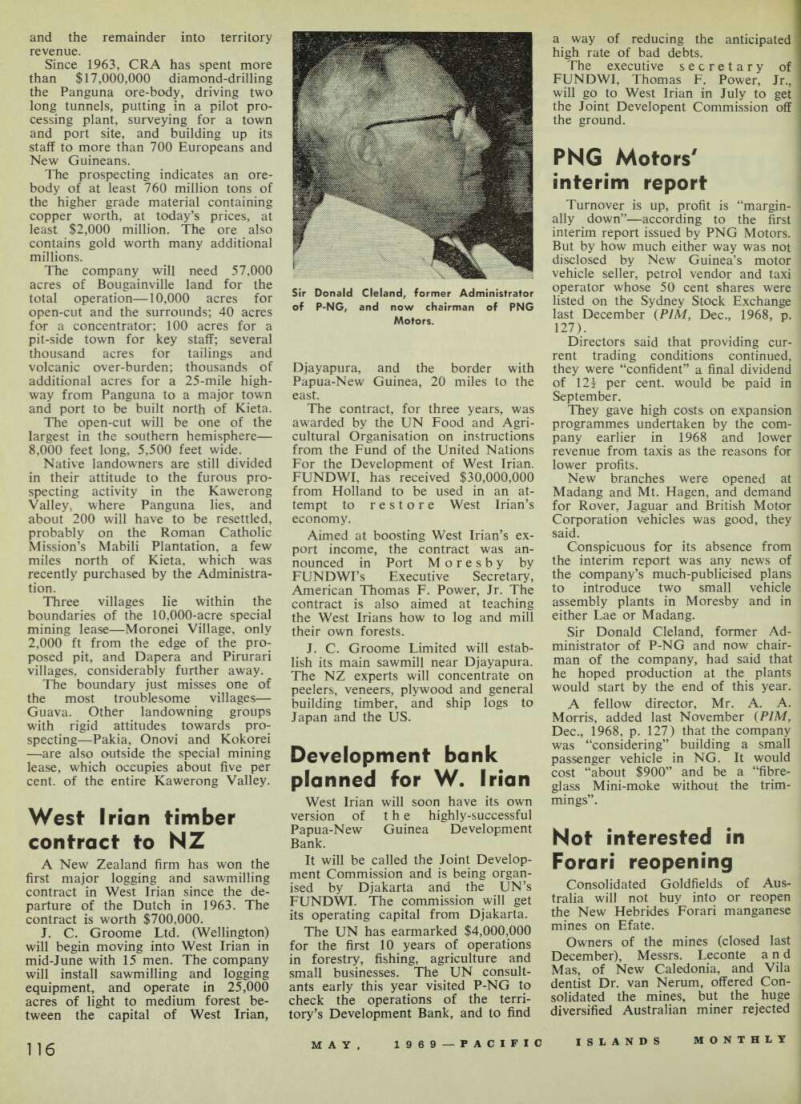
Sir Donald Cleland, former Administrator of P-NG, and now chairman of PNG Motors.
proposals in April after it found nanganese ore reserves were limited.
Consolidated, which sent two ;eams to check on the mines in March and April, decided that while he manganese was of a high grade, •eserves were not big enough to nerit reopening of the mines or stari ng a big mining project.
NG's Big Three
nove ahead
Steamships Trading Co. Ltd.’s Toup net profit and turnover for the lalf-year ended December 31, 1968, bowed a “satisfactory increase” over he corresponding period of 1967, lirectors reported recently.
An unchanged dividend of five per ent. payable on May 30 will be paid :> shareholders registered on May 5.
Steamies, New Guinea’s third iggest trader after Burns Philp and Carpenter, saw its 50 cent shares ouble their par value in April, the rst time the company had regained :s $1 mark in nearly two years.
Just how well NG’s big three are oing individually is hard to tell, mports to the territory are booming nd exports are doing almost as well, ioth Steamies and BP’s have small ngers in Papua’s long-depressed übber industry, which is on the edge f a comeback, but real results of lis won’t show until 1969-70 results re known, late in 1970.
Carpenters is concentrating on big evelopmental projects such as tea nd desiccated coconut, and BP’s nd Steamies are increasing the num er of their retail outlets in the terri- Dry.
All three, of course, would like a najor hand in the $250 million lougainville copper development— specially in developing supermarket ites, homes and associated industries.
Incidentally, PIM described teamies as “probably the best buy if Islands companies shares” last ear (PIM, Feb., 1968, p. 122). teamies price was then 56 cents.
Dil decision
>oon in Tonga
Tongans should know soon just yho will seek out the oil that may ir may not lie hidden in their king lorn.
At the end of April a Swiss firm if oil consultants was expected to end a man to Tonga with a com peted draft proposal for oil explora
tion in the kingdom. Feeling in the kingdom in April was that one company, rather than a group of companics, will be selected to undertake oil exploration.
Naturally, the three companies— Shell. British Petroleum and Aquitaine—who had earlier won Tongan approval to check out the oil seepages were awaiting the arrival of the man from Switzerland with some anxiety Would they all be able to share in a possible Tongan oil bonanza?
Or would only one of them be able 9 J L o', o t.- , The Swiss firm, which was retained
by the Tongan Government for £12,000, will be making a recom mendation in April. Final decision rests with the King and his Ministers, of course.
Meanwhile, the Minister of Lands, Laufilitonga Tuita, said in April: “If oil is found in marketable quantities it is a comforting thought to know that we will be in a position to re the economy and greatly im prove our standard of living”. , He added , a w , a ™. n 8 note -. ‘ ho “? h ’ * h he \^ e t cl ? re i « ls a disturbing thought that in the event of gaming so much money we may lose our way of life”. (Over)
Off* New Guinea
plantation merger
Tllo • f . XT lew? ? 8 t f- of two Gui l ?ea l^LF\*T lon < x B /T PS ’ Pla^ n ltd i * nff td and Makurapau Estates „ w.r lerS W ?, S a S fi”’ b.tious attempt by a big shareholder of Plantation to exercise control over both copra-cocoa producing groups « 8 B p tr/M, Apr., p. liy;.
However, when the boards of both companies met in April to consider Plantation’s offer of six of its 50 cent shares for five of Makurapau’s 50 cent shares, directors of the companies didn’t “gell” and it was obvious the groups couldn’t proceed as one under one management.
Makurapau indicated it was interested if Plantation offered 72 cents cash a share for its capital but Plantation didn’t accept this price.
$2 million mineral
L
survey tor Fiji
In March, the Canadian company, Barringer Research Ltd., of Ontario. signed an agreement with the Fiji Government to conduct a mineral hunt which will be the colony’s biggest yet.
The 12-month survey, for which
specialised aerial and ground techniques will be used, will cost about S 2 million. The Fiji Government contribute $37,000 for the charter of an aircraft and will provide office space.
During the search for mineral deposits, all of Viti Levu and Vanua Levu—except those areas already covered b P existi mining tene ' monto „ -n Jj ents Wlll be closed to prospectors.
However, manganese, bauxite, phos phate and certain other minerals are £ xcluded from the closUre . . » the survey—due to start in two ? r tbree months time reveals mm in § potential in certain areas, the company will have the right to apply * or bcences t 0 prospect.
Providing the government is satisfied that prospecting work is serious and at adequate levels of expenditure, it will provide Barringer with initial three-year licences.
bolomons copra prices
dron bv $lO
. Co P ra P nc “ ,P“ d „ loca P™’ ducers m the British Solomon Islands Protectorate took a drop of $lO a ton for all B rades from April 1.
Manager-secretary of the Copra Board, Mr. Doug Corner, said the
decision had been forced on the board by recent drops in world copra prices.
The prices paid to local producers before April 1 had been in force for just over a year and at the time of their introduction represented a $2O increase per ton on the prices which had held for 18 months before
that .
The new ] oca i pr i ces are; First Grade, $l3O per ton; Second Grade, 1126 a ton; Third Grade, $ll6 a ton Mio ton -
UeClllie CXpCCTCD
Cod To Dti Ccs
r Mr. lan McDonald, chairman of the Papua-New Guinea Copra Marketing Board, gave the following report on world copra market trends on April 22: There has been a general recovery in world market supplies of lauric acid oils over the past six months or *>, andl this trend is expected to con for the rest of the year, “Market prices have more or less followed the supply position very closely, as can be seen by move ments in 1967 when world supplies were down around 18 per cent., and
i the latter half of 1968, when world xports began to move upwards.
“A large part of the increase in turics is coming from copra and oconut oil, from the Philippines and ■om Indonesia and Malaysia. Papua few Guinea exports of copra and oconut oil also rose during 1968 y almost 18 per cent, compared with 967, and the level this year could e somewhere around that for 1968.
“Currently, prices continue to give ray slightly, and at an average of round Si 76 this month are running little more than 3 per cent, below ic November/March average. It is ot expected that there will be any ;covery in prices while the supply tuation remains at present levels— i fact, it is my opinion that a further ecline in prices will occur during le course of the year.”
Cinjibi loses on
>lontotion sale
Kinjibi Holdings Ltd., New Guinea lighlands coffee producer, has sold me of its two plantations at a small apital loss to Goroka-based Bena Coffee Lands Ltd.
The plantation, Norikori, near Cainantu, was sold for $BO,OOO.
Although Kinjibi lost about $4,000 m Norikori, which it bought 10 ears ago, the $BO,OOO was a better irice than a similar offer received ast year of $50,000.
Norikori has two 99-year leases— me, of 99 acres, is good until 2060 md the other, of 209 acres, is good mtil 2052. About half of its area s planted with coffee.
Bena Coffee, with two plantations ilready in the Highlands, has four European directors, three of whom ire based in Goroka and one lives n Perth, Australia.
According to Kinjibi, in the year mding December 31, 1967, Norikori earned a net profit of $7,717, after 3roviding for income tax of $956. It produced 37 tons of coffee in 1965, 28 tons in 1966 and 36 tons in 1967.
Kinjibi had advertised that Norikori was for sale for over a year (P/M, luly, 1968, p. 120).
For the year ended December 31, Kinjibi earned a profit of $20,159, derived mostly from its Norikori and Kinjibi coffee plantations, near Banz.
With a paid-up capital of just over $280,000 no dividend was paid to shareholders, who numbered about 520 and came mostly from NSW.
PlM’s finance man understands that mainly because of irregular rains in 1968, the company will show a reversal in its results for 1968 and produce a loss.
One question is what will Kinjibi do with its $80,000?
It had already received $5,000 and $20,000 more will come when the NG Administrator, Mr. D. O.
Hay, gives his consent to the sale.
It could be because of Kinjibi’s poor returns over the last 10 years, the Australian shareholders will argue that funds be invested in Australia instead of being ploughed back into NG.
Certainly the recent handling by the NG Administration of the Bougainville Arawa Plantation case has made Kinjibi directors, along with many other expatriate owners of NG land, apprehensive about future investment in local properties.
Canada buVS bIQ
pjjj timber firm
* Ope of Fijis latest timber con cessions, the Navutulevu Timber Company, is to be sold for a reported $750,000 to Vancouver timber dealers, Arnott Smith Export Com pany.
The papers were signed in Suva in April, but the actual takeover was expected to be sometime in May.
The timber mill, owned by Nabou tini businessman Mr. Raja Ram and his three sons, is in about 137,000 acres of Fijian-owned land in the
Naboutini highlands, about 50 miles from Suva.
The Canadian company’s plans are believed to include importing thousands of dollars worth of timber processing equipment and redesigning the existing mill. It plans to double the mill’s production by the end of this year.
There are also plans for a sub sidiary company to occupy about 50 acres of land in the mill area and pro duce prefabricated houses for export to Tahiti and Hawaii.
No watch plant
for A. Samoa now
Plans between the US Sheffield Watch Company of New York and the American Samoan Government to set up a SUSIOO,OOO watch as sembly plant in American Samoa have been scrubbed.
Both parties have disagreed on arrangements for the plant—which was to have employed up to 50 Samoans—and in the recent words of Governor Owen S. Aspinall, “the contract is cancelled”.
The plant was mooted last year (PIM, Oct., 1968, p. 125) and pro duction was to have begun in Feb ruary this year.
That rubber
is still bouncing
Four Papuan rubber producers an nounced dismal profit results for 1968 in April, but PI M’s commerce reporter stands by his prediction last month that these producers, plus the two other producers, are all set for a comeback this year (PIM, Apr., p. 118).
Kerema, Rubberlands and Sogeri all showed declining profits for 1968.
Sogeri’s result to June 30, 1968, was $20,548, a fall of 52 per cent.
For 1968-69 directors noted that earnings further declined in the first six months, due to a fall in produc tion, but they predicted better things for the last six months of this financial year.
Kerema’s profit for 1968 slumped from $18,896 to $8,763 after the firm obtained a “average realisation price” of 17.75 cents per pound for rubber.
Rubberlands’ profit dropped from $13,170 in 1967 to $7,380 last year after its average price for rubber was even 10wer—17.49 cents per pound.
Mariboi was the only producer to so far show improved results. Its December, 1968, half-year result compares well with 1967-68’s result of $19,000 profit.
All these producers’ performances
were based on average rubber prices of about 17 cents. As PIM pointed out last month, prices are now over 24 cents and the overall future looks bright.
The biggest rubber buyers, North America and Europe, have their economies running at a high rate. A new British law on increased tyre thickness for vehicles will help, as will a recent decision by the US General Services Administration to buy extra for its massive rubber stockpile.
Russia and China, heavy rubber buyers over the past 12 months, have eased off lately in world markets because of the near-25 pence Sterl ing world price, which the Com munists consider too high. Demand there is unpredictable, but rubber brokers believe if the price falls a couple of pence, these countries will buy big again.
Pearl shell diving
in the Cook Islands
On May 1, pearl shell diving will be resumed at Manihiki, in the Cook Islands, until 100 tons of MOP have been taken. A maximum of six div ing licences will be issued.
Last year the Minister of Agri culture and Fisheries, Mr, A. Short, proposed that the lagoon be re opened for pearl shell, but the Mani hiki Council rejected the proposal as the Manihiki Islanders were con centrating on the production of copra which was then fetching high prices.
s2m firm to develop
Fiji registered
The much-discussed Fijian Invest ments and Development Corporation, in which only Fijians can become directors, was registered in Suva in April.
Its nominal share capital was declared to be $2 million in SI shares, of which shares amounting to $2,454 had been taken up at the time of registration.
The corporation was sponsored by the Fijian Chiefs of the major pro vinces, headed by the Vunivalu of Bau, Ratu George Cakobau, the Chief Minister, Ratu Sir Kamisese Mara, Ratu Edward Cakobau and Ratu Penaia Ganilau. The wife of the Chief Minister, Adi Lady Lala Mara, is a director.
The corporation will operate as a holding company, establishing sub sidiaries in profitable fields of activity either as a fully-owned subsidiary or in collaboration with Fijian enter prises having local and foreign investors.
The minimum share subscription is placed at 10 shares.
Dylup made
hay in '6B
Dylup Plantations Ltd., Madang copra and cocoa producer, made hay in ’6B. It reported a 75 per cent, increase in profit and has announced a five per cent, bonus dividend, making a total payout to share holders of 17i per cent.
The progressibe Dylup, not con tent with upping cocoa and copra production for 1968, has continued to manufacture coir fibre and shell carbon from coconuts, increasing output six-fold. But it was the record-high prices for cocoa of over $BOO a ton in 1968 (average New Guinea costs for a ton are less than $300) and an increase of 431 tons of copra production which made the real money.
For the year ended January 31, 1969, Dylup earned $135,054 —an earning rate of 26.6 per cent, on the company’s paid capital of $506,746.
Directors gave no indication of prospects this year but with overall territory agricultural production set for a boost according to Moresby’s statistics men, there’s little reason why Dylup shouldn’t do well again.
In a detailed look at the prospects of Islands firms a year ago, PIM re commended buying Dylup whose price then for its 50 cent shares on Australian stock exchanges was 56 cents (PIM, Feb., 1968, p, 122) The latest price? $1.12.
Ratu Sir Kamisese Mara, one of the sponsors of the Fiji Investments and
Development Corporation.