Papua's 'Outside Man'
pp. 105-109 · Read in the full issue
A new book helps R. W. Robson recall the
Adventures Of Jack Hides,
In some degree, Jack Hides of Papua is a legendary figure.
In a greater degree, he is forgotten —his name means nothing to the thousands of public servants, mostly overpaid and over-privileged, who run Papua-New Guinea today. It is 30 years since he died, miserably, in Sydney, at the tragically early age of 32.
Into his short lifetime, Jack Hides packed a remarkably colourful career.
He had many faults—and they ruined and virtually killed him—but also he was endowed with outstanding qualities of courage, enterprise and personal charm. I think that he did more than any other man —except the redoubtable Hubert Murray him self—to stir Australia’s knowledge and imagination in relation to its almost unknown New Guinea terri tory. For three or four years, in the middle Thirties, Jack Hides was Papua’s “Wonder Boy”.
Mr, J. P. Sinclair, now a Deputy District Commissioner in Papua-New Guinea, deserves more than thanks for his extraordinarily good work in saving the Jack Hides story from oblivion. In his new book, The Out side Man, Jim Sinclair not only brings out the acute drama of Hides’ ex traordinary career, but he also puts into effective and reliable shape much of the truly remarkable history of Papua in the decade prior to World War 11, after which Papua became merged with the Trust Territory of New Guinea, and lost its identity.
Not "Explorer" Type
I can write of this with some authority, because I was, both person ally and as publisher of Pacific Islands Monthly, involved in some of the outstanding incidents of Jack Hides’ career.
Hides was born in Port Moresby, member of a well-known Papuan family; and Sinclair’s account of his early life there, of how he learned the Motu and Koiari languages, of how he was a school-fellow with the Champion boys, of how he got a patchwork education in Queensland and New South Wales, of how he
became a champion swimmer and a leader of mad escapades, and of how Sir Hubert Murray, in 1925, took him back to Papua (aged 19) as a public service clerk—all make a fascinating chapter.
A year later, when he was only 20, Hides became a cadet patrol officer, and went out into the bush he loved, and into work for which he had always yearned. He spoke the native languages, he knew the natives, his bush-craft was superb and he immediately commanded the goodwill and loyalty of the tribes men.
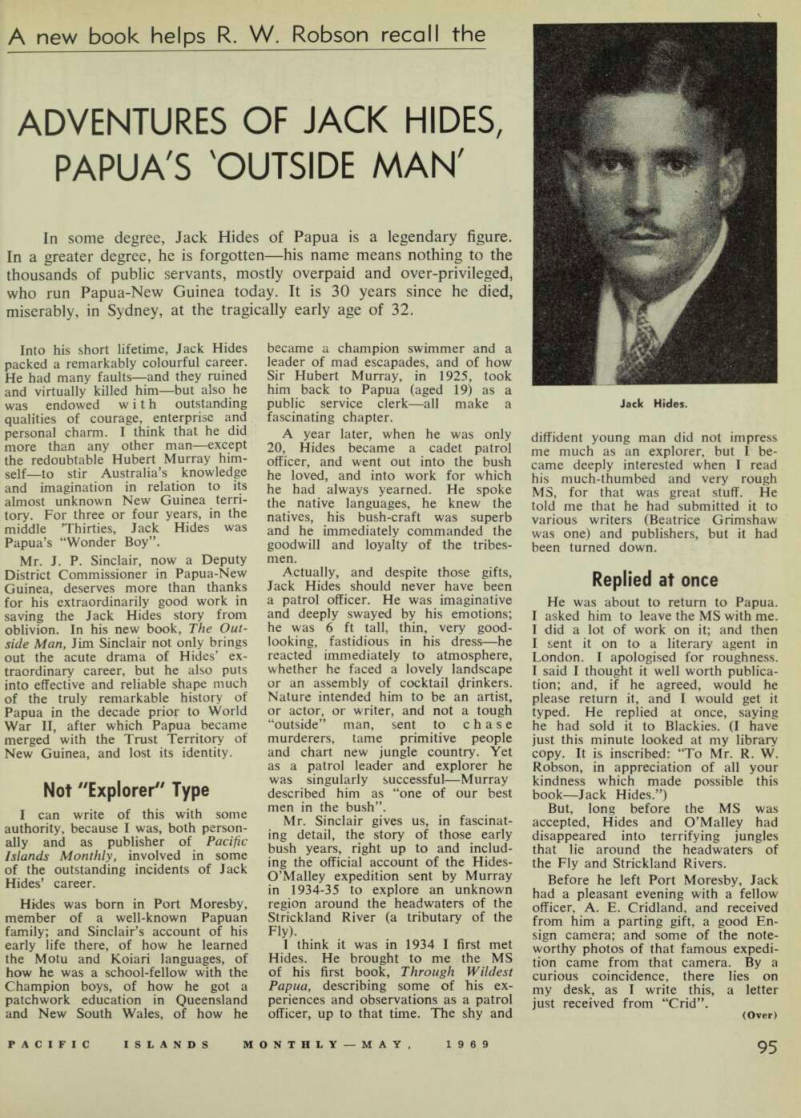
Actually, and despite those gifts, Jack Hides should never have been a patrol officer. He was imaginative and deeply swayed by his emotions; he was 6 ft tall, thin, very good looking, fastidious in his dress—he reacted immediately to atmosphere, whether he faced a lovely landscape or an assembly of cocktail drinkers.
Nature intended him to be an artist, or actor, or writer, and not a tough “outside” man, sent to chase murderers, tame primitive people and chart new jungle country. Yet as a patrol leader and explorer he was singularly successful—Murray described him as “one of our best men in the bush”.
Mr. Sinclair gives us, in fascinat ing detail, the story of those early bush years, right up to and includ ing the official account of the Hides- O’Malley expedition sent by Murray in 1934-35 to explore an unknown region around the headwaters of the Strickland River (a tributary of the Fly).
I think it was in 1934 I first met Hides. He brought to me the MS of his first book, Through Wildest Papua, describing some of his ex periences and observations as a patrol officer, up to that time. The shy and
diffident young man did not impress me much as an explorer, but I be came deeply interested when I read his much-thumbed and very rough MS, for that was great stuff. He told me that he had submitted it to various writers (Beatrice Grimshaw was one) and publishers, but it had been turned down.
Replied at once He was about to return to Papua.
I asked him to leave the MS with me.
I did a lot of work on it; and then I sent it on to a literary agent in London. I apologised for roughness.
I said I thought it well worth publica tion; and, if he agreed, would he please return it, and I would get it typed. He replied at once, saying he had sold it to Blackies. (I have just this minute looked at my library copy. It is inscribed: “To Mr. R. W.
Robson, in appreciation of all your kindness which made possible this book—Jack Hides.”) But, long before the MS was accepted, Hides and O’Malley had disappeared into terrifying jungles that lie around the headwaters of the Fly and Strickland Rivers.
Before he left Port Moresby, Jack had a pleasant evening with a fellow officer, A. E. Cridland, and received from him a parting gift, a good En sign camera; and some of the note worthy photos of that famous expedi tion came from that camera. By a curious coincidence, there lies on my desk, as I write this, a letter just received from “Grid”. (Over)
Jack Hides.
Nearly all the people connected ith those incidents of 30 years ago re dead now, but “Grid” is still a ell and hearty resident of Papua— roprietor of a notable tourist resort t Wanigela, on the northeast coast.
Hides and O’Malley suffered great rivations on that expedition. They at through the incredible limestone arrier (called “broken bottles” by ack’s police), had a quick look at ic famous Tarifuroro region, fought ieir way out of repeated ambushes y the hostile wig-men, and got back ) the Papuan coast, more dead than live, half a year later, via the urari and Kikori gorges.
Lionised
Waiting for Jack in Port Moresby ere warm praise from Governor furray for “a very difficult expedi on carried out with complete suc jss”; advice that he was the father fa verv new baby daughter; and copy of his book, which I had had le pleasure of sending him—he did ot even know the MS had been :cepted.
The two young explorers were given three months’ leave in Aus tralia, in late 1935, and were lionised in a way that was really extra ordinary.
As Sinclair says: “The Strickland- Purari Patrol captured the imagina tion of the world to an extraordinary degree.”
Looking back on my own memories, I am inclined to think that those events were the beginning of the end for young Jack Hides. They did not exactly turn his head—in fact, he behaved very modestly, in the cir cumstances —but he did get his values out of focus.
There had been other very suc cessful explorers deep inside Papua and New Guinea around that time —I am thinking especially of Ivan Champion and Karius, and Mick and Danny Leahy and J. L. Taylor—and their accomplishments and adventures had been just as noteworthy as those of Hides; and it soon was clear that the enormous publicity given Hides and O’Malley aroused some jealousy and considerable bitterness. It is all described very effectively in Sinclair’s excellent book.
Through Wildest Papua ran into more editions, and Blackies, naturally, clamoured for another. Jack wrote it in quick time. It was called Papuan Wonderland, and was pub lished in 1936. I had nothing to do with it: but in my library is a copy fulsomely inscribed “To the King of the Pacific Islands, with remembrance and affection—Jack Hides, Brisbane, 2/8/36.”
From drama to drama
During the Thirties, the thoughts of folk in Papua were filled by thoughts of gold. The fantastically rich goldfields of Morobe had given the Mandated Territory of New Guinea (as it then was) a tremendous economic lift, and Papua believed that there was just as much gold awaiting discovery on the southern side of the Owen Stanley ranges.
Jack Hides was obsessed with the idea. Always, on patrol, in remote creeks and isolated valleys, he used a prospecting dish. And on that Strickland patrol, whenever he prospected, he usually found what he regarded as good colours. This led on to the next drama in his career.
He went from exploring to writing; from writing to disastrous gold-seek ing.
The success of his literary activ ities aroused criticism in high official circles in Port Moresby and Can berra when Jack contracted to sell a special story to the Sydney Morning Herald. Melbourne Herald protested
strongly to Canberra: “We consider Mr. Hides’ official report and photo graphs should be made available to all the Press before he is permitted to write any private article for one paper exclusively.”
Port Moresby accepted this view point, and such practices were sternly forbidden by anew regulation, issued early in 1937.
Meanwhile, there had been a lot of criticism of Hides’ leports on his expedition.. It was claimed that his descriptions were over-coloured, his maps awry and his estimates of popu lation exaggerated.
He resigned
This plunged the temperamental Jack into black depression; and when the Government’s new law against the private use by officers of offici ally-gathered data was publicised, he decided that he was the victim of jealous persecution, and resigned.
Always a free and frequently up roarious drinker, he now drank more than ever.
But his writings and his lectures had brought him into contact with some of Sydney’s leading business and professional men They were impressed by his conviction that, somewhere in the virtually unknown interior, there were rich lodes which fed those persistent golden colours into the tributaries md creeks of the upper Fly River; and so they quickly formed a very liberally cap italised company, Investors Limited, to finance Hides in another, and pri vate expedition into the Strickland River. He went, in a few days, from deep depression to triumph.
Told in great detail by Sinclair, after 30 years, the account of this development reads like romance. But I can vouch for its complete accuracy, for I was in it.
Provided lavishly with funds and almost carte blanche, Jack took heart again. He chose David Lyall as com panion; assembled a large force of carriers and a platoon of ex-police boys at Daru; packed some 25 tons of stores and equipment into a couple of good power-boats; and set off up the Fly, and on into the raw Strick land area.
Old hands sneered
Some very experienced men had been in there before Hides, seeking gold, and had given it away. I par ticularly remember a search made by a party comprising Joe Bourke (still alive, in Queensland), Bill Kom (murdered later by the Japs), and W. A. Kienzle (now a successful planter in the Yodda Valley)—there
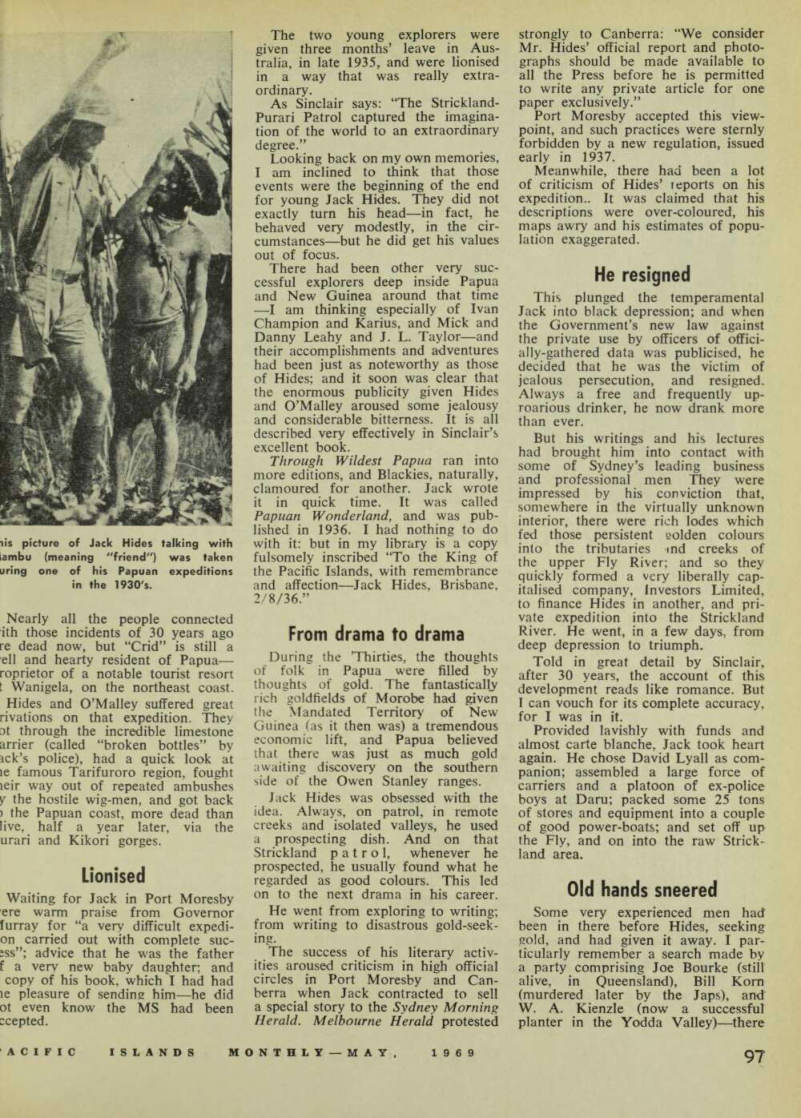
[?]is picture of Jack Hides talking with ambu (meaning "friend") was taken wring one of his Papuan expeditions in the 1930's.
,vere no better bushmen and jrospectors than they. They found ill the colours, but no sign of pay ible gold. Their feat of exploration, •ight across to the Sepik River, was jutstanding; but it got no official recognition.
It was not surprising that the really knowledgeable ones sneered in public as the richly-equipped Hides- Lyall expedition set off to locate Hides’ fabulous goldfield.
The rest is history, well told in this book. Hides reported his dis :overy of rich alluvial gold on the Upper Strickland, and demanded a legal mining title over the area. In vestors Ltd. engaged me to go to Port Moresby, and hire a seaplane and bring them out; secure title over a defined area; and send them back again. All of which I did.
My meeting on the Port Moresby waterfront with those beer-hungry young men, and my subsequent efforts in the “Lower Pub” to induce them to stay quiet long enough to get title to the lease, and then to persuade them to fly back to the Strickland, was an experience I shall never for get.
The story is here in this book, but without the purple patches. As Sinclair reports, I myself had little faith in Hides’ goldfield, and I em phatically warned the company against undue optimism.
Disaster
Hides and Lyall went on beyond the areas covered by the first lease, over the limestone barrier, into Man dated New Guinea. They were still in good shape.
Then Lyall became gravely ill.
They lost much valuable equipment in a series of accidents. Lyall had to be carried from here on. They turned back, towards the Papuan coast, hundreds of miles away.
Hides displayed superb bushcraft and leadership. They got out of the mountains by floating down the roaring Strickland on a couple of rafts. They suffered grievously from beriberi. They got into the Fly, and were overwhelmed by a vast tidal bore. Hides and two native servants, carrying Lyall, finally crawled up to an isolated homestead. The remnants of the expedition—a few starving, exhausted carriers — drifted down soon afterwards. Lyall died, and was buried at Dam. The expedition had ended.
Experts sent up to examine the Strickland leases pronounced them valueless. Hides returned to Australia, completely broken in health and in spirit, for the death of Lyall affected
him deeply. He completed two more books, Beyond the Kubea (the story of this disastrous expedition) and Savages In Serge (a tribute to the Papuan police who always stood by him loyally, no matter how great his troubles). He died in Sydney on June 18, 1938.
This is at once a book of adventure, written with rare skill; a close study of a remarkable young man; and, as a result of much careful research, valu able background to the history of the last decade of Papua as a sep arate Australian territory. (THE OUTSIDE MAN. Published by Lansdowne. Price $5.95.)