Reflections After Ten Years
pp. 45-49 · Read in the full issue
Of Island Hopping
New Zealand reader NAN DALY pays personal tribute to the South Pacific as she knows it.
As our DCS thundered along the runway at Faaa, Tahiti, and I settled back for the si-hour flight to New Zealand and home, my thoughts turned from 1968 to 1959, and to a very different departure, from a very different Tahiti.
In 1959 my husband and I had boarded the Solent flying-boat Aranui, piloted by “Captain Joe”
Shephard, and skimmed from the lagoon on a journey which would encompass 18 hours’ flying time, three different planes, and two over night stops, before reaching NZ.
“Captain Joe” is now flying a VIP desk in Montreal, but he will never be forgotten in the Pacific.
In 1959, Papeete, Tahiti’s capital, was host to some 40 tourists and yacht boys during our stay, and we were a very varied group—from America, Australia, NZ and Hawaii — and we were accompanied by some of the most beautiful vahines on the island.
It was a happy cast, augmented by “Captain Joe” and his crew at intervals, and the play never ended.
We met each morning at the old Vaihiria, which is now the Vaima, to start the fun again. We usually visited both Quinn’s and the Bar Lea and we always ended up at Lafayette. There were four hotels to choose from in those days—the Grand on the waterfront, the Royal Fahitien, Les Tropiques and la Grana.
Hilarious results
My husband and I fell in love with Tahiti from that first visit in 1959. English was not then as freely spoken as now, and it was fun to try our school-day French, often with hilarious results.
Papeete was a bustling, friendly town and every day we made new Friends —Therese, a charming young Chinese girl; a French lady who had taught school in our home town in NZ; a taxi driver who had fought with the Anzacs.
The Royal Tahitien, where we stayed, was a delightful hotel, with its inimitable restaurant. After leaving the Royal Tahitien we went to Hotel Aimeo on Moorea—and then, all too soon, we had to leave Fahiti. We realised the truth of the
saying—“A week is too long, and a lifetime not long enough to be in Tahiti”.
Fascinating
The journey back to NZ in the flying-boat must have been one of the most fascinating flights in the world. We flew over the deep blue of the Pacific, with legendary islands such as Palmerston and Tin Can, lying like jewels of green, separated from the ocean by their white foam ing reefs and incredible blue-green lagoons. At the tiny island of Akiami, in the Cooks, we landed for a swim and refreshment under the coconut palms, then on to Western Samoa,
where we were given a wonderful welcome at “Aggie’s” in Apia.
We stayed in Apia overnight and during the evening I took a stroll along the rain-fresh waterfront, looking into lighted churches filled with Polynesian voices raised in song.
Next morning, after a few hours’ flight, we were in Suva—so very British after the “laissez faire” of Tahiti. We lunched at the friendly Club Hotel, explored the teeming streets, bright with saris, and tempt ing with bargains, and then took a short flight in an eight seater “Heron” to Nadi.
After another over-night stop at the charming Nadi Hotel, we had some hours’ wait for our connecting plane.
What a maelstrom that old Nadi airport building was! All the world seemed to be coming and going vociferously. The first jet-prop Electra flew in on its delivery flight to New Zealand while we were there —and how sophisticated it seemed!
We finally boarded our DC6 with
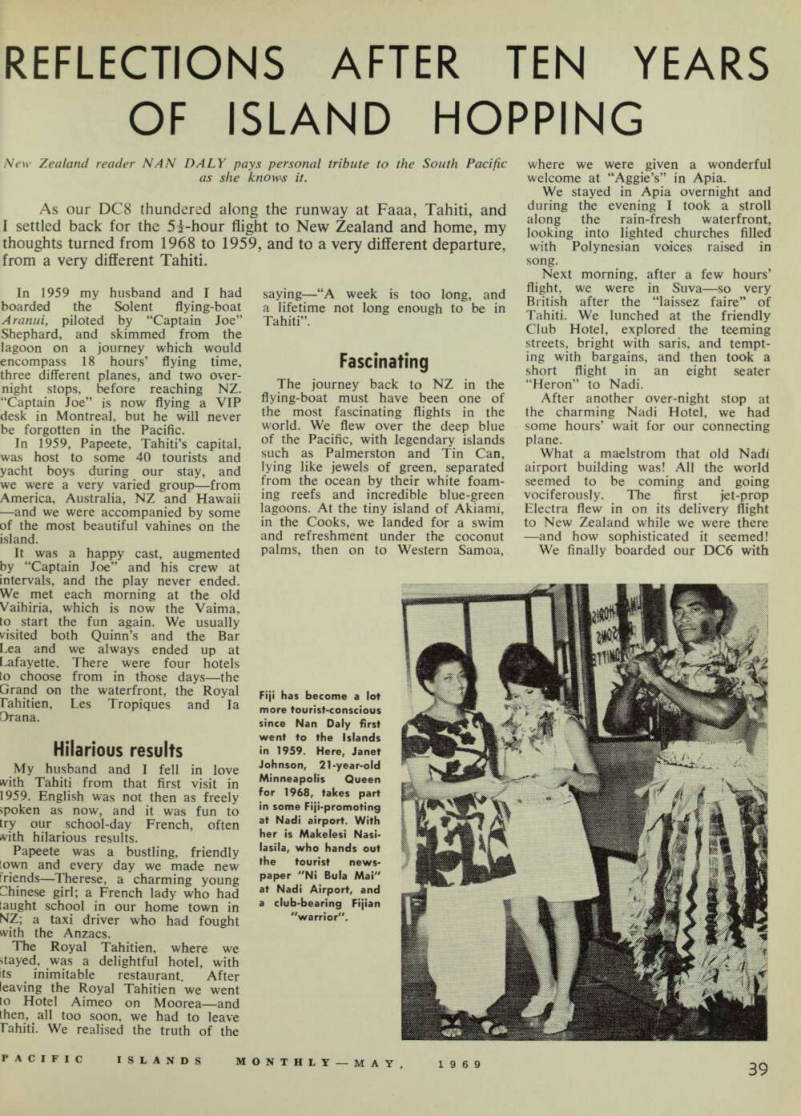
Fiji has become a lot more tourist-conscious since Nan Daly first went to the Islands in 1959. Here, Janet Johnson, 21-year-old Minneapolis Queen for 1968, takes part in some Fiji-promoting at Nadi airport. With her is Makelesi Nasi lasila, who hands out the tourist news paper "Ni Bula Mai" at Nadi Airport, and a club-bearing Fijian "warrior".
its cabin temperature at 97, and it had cooled only slightly when we reached Auckland just over five hours later.
A changed place
When we returned in 1964, Papeete was a changed place. The new air strip at F’aaa was disgorging thousands of tourists a year and hotels had mushroomed. The joint was jumping.
The Foreign Legion had moved in, together with the myriad officials and personnel necessary for “the bomb”. The Grand Hotel had become military premises. Le s Tropiques had burned down, and la Orana was an Officers’ Club.
Our old favourite, the Royal Tahitian, was unchanged but was so heavily booked that we had to rent a house nearby, behind which the coconut trees were being mas sacred and a site cleared for more military buildings.
Now the action was more diver sified. There were shows at the hotels nightly. The Bar Lea, with its wonderful spontaneous tamures had faded, and the Zizou and the Whisky-a-Go-Go were the night spots.
Quinn's clients changed
Quinn’s was still booming, but the clientele had changed. No longer did we see sedate family parties with freshly-laundered children the emphasis was on youth and noise.
There were uniforms everywhere and no longer a supply of friendly vahines. Now they all had regular amis, who spoke French and were there indefinitely. Now they had graduated from scooters to cars. Now all the world had brought his wife.
The Tahitian men were working long hours, driving trucks and build ing hotels, shops, restaurants, wharves. There was a muted anti pathy between the Tahitians and the new French arrivals, and a feeling af disruption.
But the indescribable charm of Fahiti was unchanged, and most our 3ld friends were still there.
During this visit, we had time to 1y m a DC4 to Bora Bora, that .abulous island which is the true ?outh Seas—-with only a handful of :ars, two villages and two hotels, it has almost forgotten the presence 3f thousands of American forces luring World War 11. The only eminders are the decaying military nstallations— and the young people
of appropriate age, who combine the finest attributes of two different peoples.
Our hosts, the Reynolds, father and son, at the Hotel Noa Noa, produced many pleasures for us; a picnic on the motu, speed-boating, sightseeing, marvellous meals and music.
Flights get shorter
In 1964 the journey from Tahiti to Nadi was only four and a half hours. When we landed there on our return to NZ we found Nadi airport a new place with its labyrinth of corridors and stairs.
Nearby was the new Mocambo Hotel with pool and patio, glamour and bustle. We began to feel the fascina tion of Fiji—the sugar cane burning in the dusk, the feeling in Nadi of
being at the cross-roads of a busy sky.
We moved to Suva and stayed a while at the stately Grand Pacific Hotel. Then back to Nadi. After three and a half hours in a jet-prop Electra, we were in NZ again.
In 1965, DCB’s were old friends and the flight to Nadi from NZ was shorter than ever. We enjoyed the new Tanoa Hotel near the airport, with its intimate atmosphere and lovely views.
We flew to Suva in a DC3 and stayed at the Club Hotel.
After Fiji we went to New Cale donia—a three-hour transition from English to French atmosphere. How ever, in New Caledonia the pre dominating influence was Ffiench rather than Polynesian, as in Tahiti, and the mixed island population of Melanesians, Tonkinese and outer
islanders did not mix with tourists as the Tahitians did.
We settled happily in the Hotel Noumea with its charming dining room, and perfect view of the Baie des Citrons. Here there was gaiety and always new interest. We met Lee Graham, the lone yachtsman, and a Frenchman whose grandfather and my husband’s grandfather had left Ireland about the same time, one family finally settling in New Zealand, and the other in New Caledonia. He, too, is named Daly.
We rode in the handy mini-buses, swam and sunbathed, visited new restaurants, and departed regretfully, in a Comet which sped us home in three and half hours.
In 1966 we found Nadi airport as busy as ever, although DCB’s were flying direct to Honolulu. New hotels were still springing up near Nadi, and Suva was expanding its tourist accommodation. Castaway Island was a friendly new resort, and every where there was the feeling of progress. In New Caledonia the new Nouvata was completed, and the Chateau Royale had opened.
Missed Fiji
In 1967 a direct flight from NZ to Tahiti was time-saving but we missed the stop-over in Fiji, and wondered if Nadi airport was still as busy. In Tahiti, we felt a further change in atmosphere. The bomb tests were over for the while, but Papeete was still alive with officials and military personnel, now in mufti when on leave, and there was a subtle change in the French-Tahitian relationship.
The French seemed to have suc cumbed to the charm of their tem porary home. Tourists were still pouring in, and there were more shops, restaurants and hotels.
To our delight, we found that we were surrounded by old friends— though the coconut grove behind our 1964 holiday house was now a com plex of military establishments, with a four-lane highway through it.
In 1968 we were in Honolulu after a direct flight of eight hours, and five hours later, we were in San Francisco. The hospitality of our American friends, whom we first met in the South Seas, was truly wonder ful, and it was with mixed feelings that we left on our eight hour flight to Tahiti.
The Pacific Islands have given us valued friends and many happy memories. Aeroplanes will become swifter, progress and politics will effect changes, but the lure of the Islands will never change, and our hope is that some day we will once more be winging over the Pacific.