Tonga says it will open its doors
pp. 25-26 · Read in the full issue
to overseas investment
The kingdom of Tonga, where all land is State-owned and where commercial development has traditionally been regarded as the prerogative of the Crown, in April invited overseas capital to establish and operate a wide range of businesses and industries. The kingdom asked people and firms to start new ventures as varied as the assembly of television sets and the exploitation of seaweed.
Announcement of the new “open door” on investment, which is a sig nificant policy change for Tonga, was made by Tonga’s able Finance Minister, Mahe U. Tupouniua. Full text of his statement was: “Tonga is now entering the final >tage of its first five-year development Dlan. Its introduction has stimulated ;he economy by concentrating on *eally urgent economic needs.
“Private enterprise has not as yet made any substantial contribution to he country’s economic growth, other han in the field of wholesale and etail distribution. The main private ;ector activity is agricultural produc ion on family land holdings. There s very little manufacturing, and imple scope exists for the establish nent of labour-intensive, export jriented, import-substitute, producer ;oods and service industries, as well is for those related to the develop nent of the resources of the sea. fonga’s expanding tourist industry ilso creates a demand for more imenities and hotel accommodation.
Suitable ventures
“There are no private financial nstitutions, and the Treasury acts ocally as banker.
“In the past, the government has mdertaken several projects which in nany other countries would have >een done by private enterprise; "onga’s sole hotel, the International )ateline, for example, was financed /holly from development funds and 3 being operated as a quasi ovemment concern.
“Government has now decided that - should no longer utilise its de elopment funds for projects of a ommercial nature and welcomes out ide investment. Those, which, in the pinion of the government, are suit ble ventures for the kingdom, will e given earnest consideration. More over, the government has expressed a esire to financially participate in ertain approved projects.
“All enquiries should be addressed
to the Minister of Finance, PO Box 87, Nukualofa.”
Separate sources said that the Tongan Government was now investi gating revision of various laws and other factors which it felt were neces sary to encourage overseas develop ment.
It was investigating, or was pre paring to investigate, banking pro cedures; taxation including tax in centives, tax holidays and special de preciation; concessions and exemp tions on Customs duty, electricity and water; changes in land and building laws and in immigration laws.
No details were available as to just what the kingdom was prepared to do. Nor was it clear what the “cer tain projects” were that Tonga had expressed a desire to participate in.
Mahe’s announcement came at the same time as a petition signed by 180 Tongan public servants on Tongatapu asking for salary in creases, and pointing out that it was more than 10 years since the last salary revision. Living standards had gone up, and so had the cost of living, the public servants said.
Pressures such as this faced by the Tongan Government, which also has a swiftly-growing and better-educated population, are the reasons why it has finally put out a call for overseas investment. Tonga is on the threshold of complete independence from Britain, and the economy must be strengthened.
Stabilised wages
In Sydney, the “open door” an nouncement was welcomed by Burns Philp and W. R. Carpenters, who are among the few outside companies to have business operations in Tonga.
They said Tonga could be a base for export industries — Tonga’s small population (about 80,000) would generally preclude worthwhile secon dary industries that could not also have access to overseas markets.
But the attitude in both companies was that Tonga would need stabilised wages if it was to attract overseas capital.
Here is the list of investment opportunities suggested by the Finance Minister:
• Labour-Incentive: Cloth
ing industries, assembly of watches and transistors, and “other plans
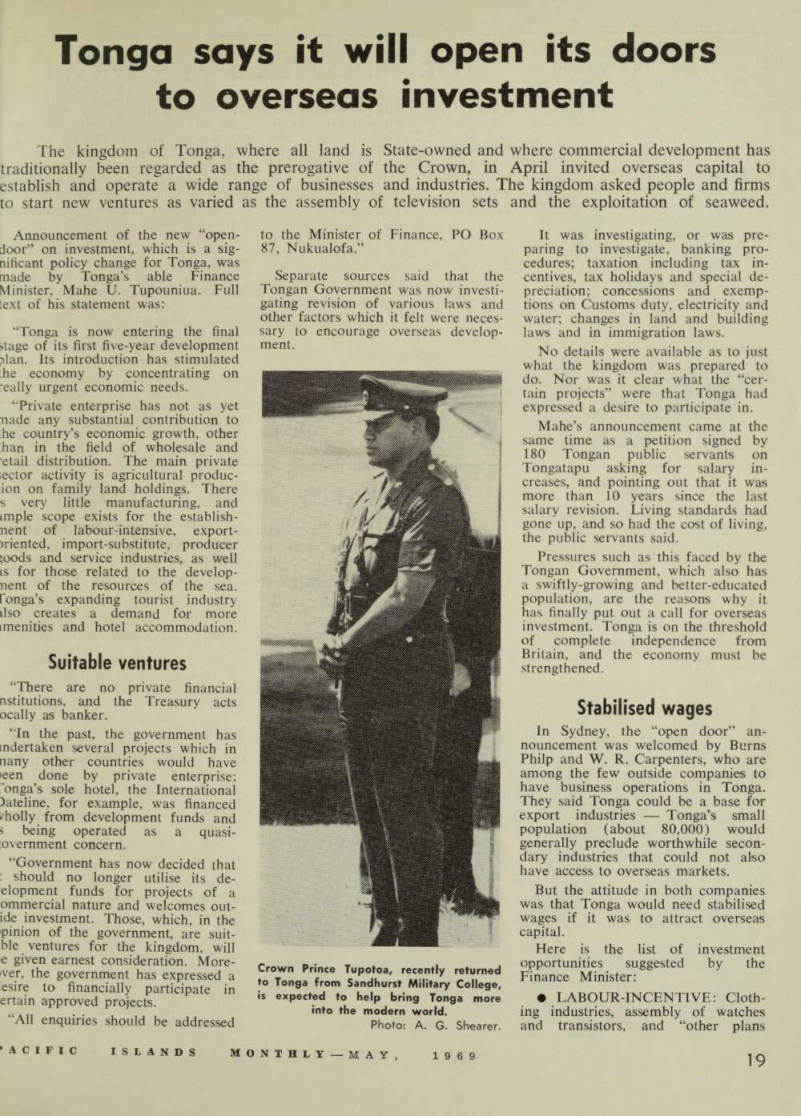
Crown Prince Tupotoa, recently returned to Tonga from Sandhurst Military College, is expected to help bring Tonga more into the modern world.
Photo: A. G. Shearer.
which no doubt will be suggested by applicants”. © EXPORT: Soaps, perfumes, ear rings, handbags, toys, handicrafts, coir, matting, rope, assembly of port able television sets, fruit and vege table canning.
© Import-Substitute: Soaps,
mineral waters, confectionery, pos sibly a brewery, and margarine. • SERVICE: Hotels, restaurants, motor garage, boot and shoemaker repairers, dry-cleaning, tailors and electrical repairers. • TOURISM; Mass production of handicrafts, aquatic sports, local tours and sports facilities (including golf).
• Resources Of The Sea:
Animal feed and fertiliser, fish canning, seaweeds, crayfish, boat building and repairing, slipways. • FREEZING WORKS: Abattoir, fresh fish, dairy products, meat and fish canning.
• Producer Goods: Manu
facture of agricultural implements, assembly of light tractors, manufac ture of roofing iron, nails, furniture and timber. • PUBLIC SECTOR: Airfields (joint ventures presumably with Tonga), a pharmacy, electricity and water.
After its first 10 weeks on offer, Tonga’s first-ever internal govern ment loan of 5T300.000 has been three-quarters filled. The loan is in the form of a bond issue for five years, with 4 per cent, interest.