Business and Development
pp. 123-126 · Read in the full issue
Things aren't what they used to be with the Big Two
By Ken Mcgregor
W. R. Carpenter Holdings Ltd. has sold its entire share holdings in Bums Philp and Co. Ltd. Carpenters had maintained its strategic stake in BP’s for many years and the huge sale has surprised businessmen and stockbrokers.
The sale —handled quietly at top board level of both companies— went unnoticed late last year. How ever, it closely followed some heavy buying of BP shares last year by several big firms until the BP-Mauri Brothers link-up (P/M, Dec., 1968, p. 129).
Carpenters sold its 300,000 $1 BP shares at an average price of $5.30 in a deal worth over $H million.
I understand Queensland Insurance Company Ltd. (in which BP’s have a 49 per cent, holding) bought the Carpenter BP holding, along with several thousand shares sold at a later date in BP’s by the massive English “takeover group”, Slater Walker Securities.
Queensland Ins’ce held 60,000 shares in BP’s on September 11 last year. It now holds 281,250 BP shares.
An executive for Slater Walker told me his company bought 150,000 BP shares for about $4 each last year. Shortly after the BP-Mauri Bros, exchange share deal, widely seen as a move to head off a take over of BP’s, Slater Walker sold its BP shares at about $6.
Also, in the last seven months, Carpenter’s chairman, Mr. C. H.
Carpenter, has reduced his personal shareholding in BP’s from 33,000 shares to 8,000.
It’s not too hard to see what was going on. BP’s have long been re garded as a leading Australian com pany with undervalued assets (many believe they still are, even with their current one-for-five share bonus).
Last year Slater Walker, with a lead ing Australian financier and several other firms, bought BP’s in a big way when the company’s $1 shares sold for many months below their then-asset backing per share of 54.30.
The Carpenter sellout of BP is significant and indicative of growing evidence that things “aren’t what they used to be” between the two boards of the big Islands traders and in vestors.
When Carpenters recently an nounced a $500,000-plus hotel-motel deal with an Australian motel group, the company’s deputy chairman, Mr.
W. R, Carpenter, made a couple of public comments which no Carpenter board member would have been heard making a few years ago.
He was asked at a news conference if the hotel deal was merely follow ing the BP-Travelodge tie-up mooted last year.
“We don’t follow in Burns Philp’s footsteps,” he replied. And added: “We might have been approached before Burns Philp on that Trav elodge deal”.
BP’s and Travelodge wouldn’t comment on this hint that Travelodge knocked on Carpenter’s door before it visited BP’s Bridge Street head-
quarters, but Mr. Carpenter’s message seems to be “we’ll go our own way these days”.
Differences in business operations are already evident. HP’s says hotels make money in the Islands, Car penters say they don’t; Carpenters have put millions into NG tea and desiccated coconut and BP’s not a cent., and in Fiji Carpenters take a more pessimistic view of the colony’s future than BP.
In Mr. W. R. Carpenter’s words recently: “We want to be far more Australian-orientated”.
BP’s, incidently, last year still had a healthy stake in Carpenters 248,000 50 cent, shares worth at current values (without Carpenter’s one-for-five bonus) $850,000.
New bank opens
in Noumea
The Banque Nationale de Paris was officially opened in Noumea in March, thus joining the Banque de ITndochine as the second bank in New Caledonia.
The new bank ranks first in France and the Common Market, sixth in the world and already has four branches in Australia.
Noumea Director, Mr. Robert Combaut, stated his bank’s move here was prompted by the “promis ing future” of the territory. (Over)
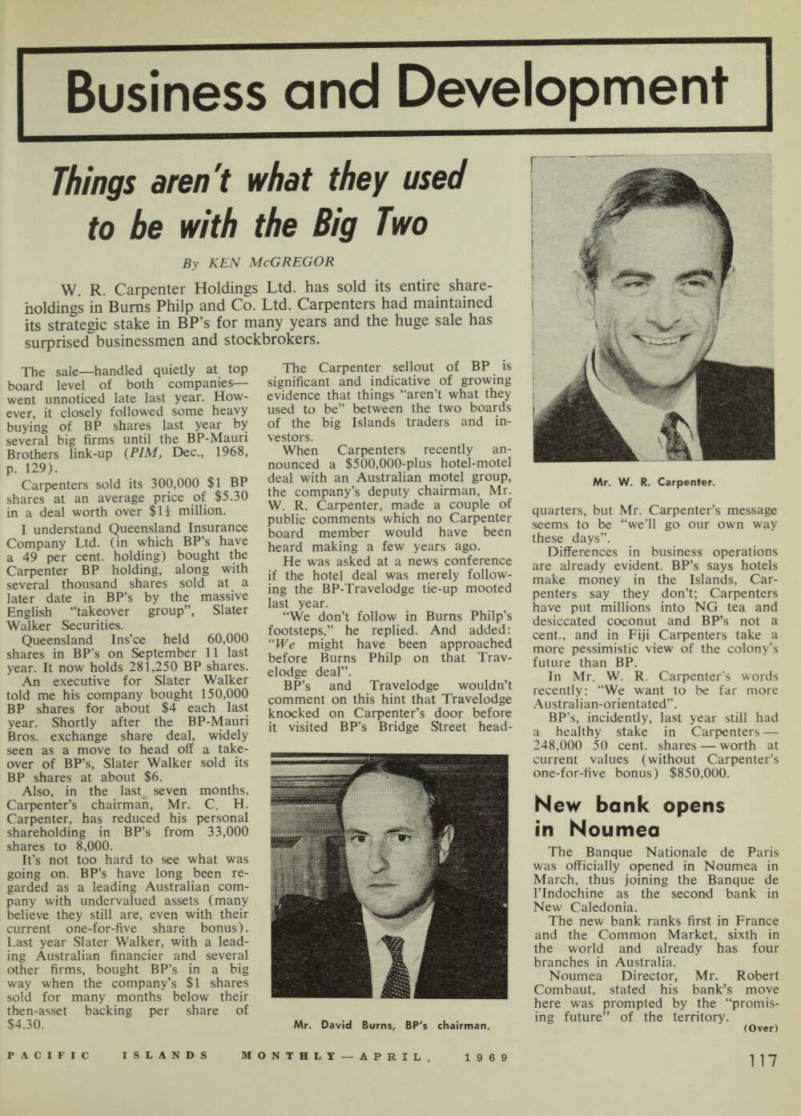
Mr. David Burns, BP's chairman.
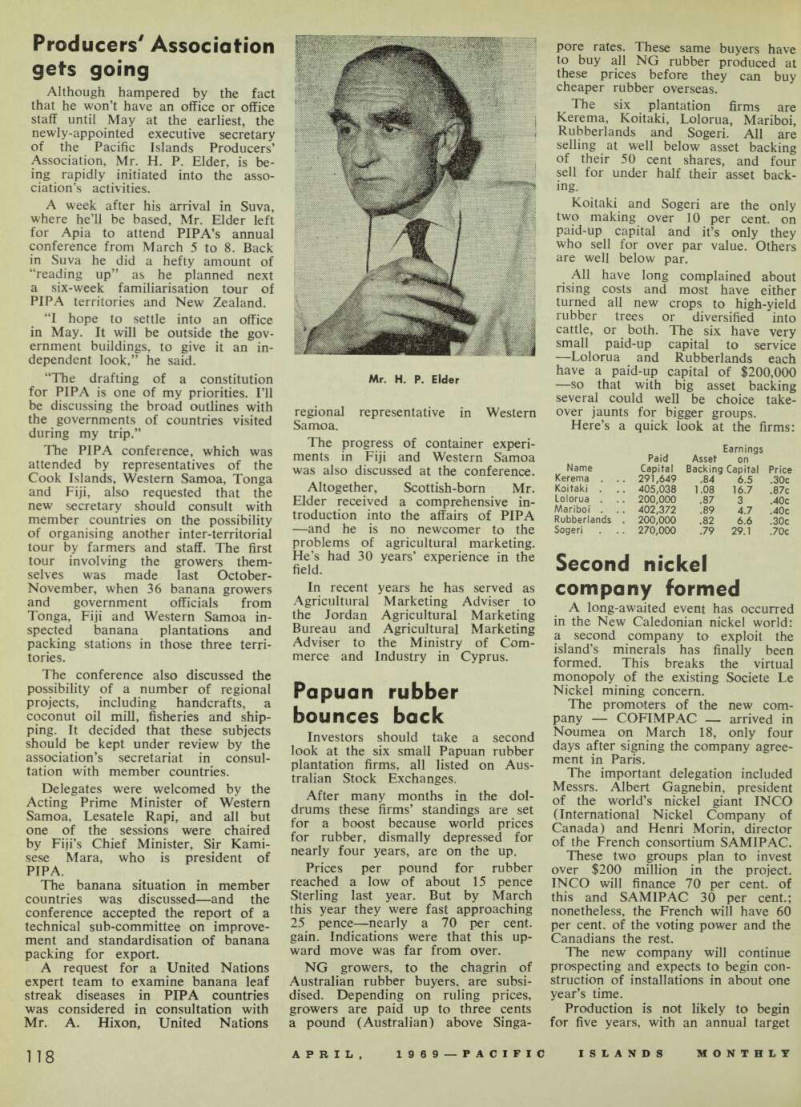
Mr. W. R. Carpenter.
Producers' Association
gets going
Although hampered by the fact that he won’t have an office or office staff until May at the earliest, the newly-appointed executive secretary of the Pacific Islands Producers’
Association, Mr. H. P. Elder, is be ing rapidly initiated into the asso ciation’s activities.
A week after his arrival in Suva, where he’ll be based, Mr. Elder left for Apia to attend PIPA’s annual conference from March 5 to 8. Back in Suva he did a hefty amount of “reading up” as he planned next a six-week familiarisation tour of PIPA territories and New Zealand.
“I hope to settle into an office in May. It will be outside the gov ernment buildings, to give it an in dependent look,” he said.
“The drafting of a constitution for PIPA is one of my priorities. I’ll be discussing the broad outlines with the governments of countries visited during my trip.”
The PIPA conference, which was attended by representatives of the Cook Islands, Western Samoa, Tonga and Fiji, also requested that the new secretary should consult with member countries on the possibility of organising another inter-territorial tour by farmers and staff. The first tour involving the growers them selves was made last October- November, when 36 banana growers and government officials from Tonga, Fiji and Western Samoa in spected banana plantations and packing stations in those three terri tories.
The conference also discussed the possibility of a number of regional projects, including handcrafts, a coconut oil mill, fisheries and ship ping. It decided that these subjects should be kept under review by the association’s secretariat in consul tation with member countries.
Delegates were welcomed by the Acting Prime Minister of Western Samoa, Lesatele Rapi, and all but one of the sessions were chaired by Fiji’s Chief Minister, Sir Kami sese Mara, who is president of
Pipa.
The banana situation in member countries was discussed—and the conference accepted the report of a technical sub-committee on improve ment and standardisation of banana packing for export.
A request for a United Nations expert team to examine banana leaf streak diseases in PIPA countries was considered in consultation with Mr. A. Hixon, United Nations
regional representative in Western Samoa.
The progress of container experi ments in Fiji and Western Samoa was also discussed at the conference.
Altogether, Scottish-born Mr.
Elder received a comprehensive in troduction into the affairs of PIPA —and he is no newcomer to the problems of agricultural marketing.
He’s had 30 years’ experience in the field.
In recent years he has served as Agricultural Marketing Adviser to the Jordan Agricultural Marketing Bureau and Agricultural Marketing Adviser to the Ministry of Com merce and Industry in Cyprus.
Papuan rubber
bounces back
Investors should take a second look at the six small Papuan rubber plantation firms, all listed on Aus tralian Stock Exchanges.
After many months in the dol drums these firms’ standings are set for a boost because world prices for rubber, dismally depressed for nearly four years, are on the up.
Prices per pound for rubber reached a low of about 15 pence Sterling last year. But by March this year they were fast approaching 25 pence—nearly a 70 per cent, gain. Indications were that this up ward move was far from over.
NG growers, to the chagrin of Australian rubber buyers, are subsi dised. Depending on ruling prices, growers are paid up to three cents a pound (Australian) above Singa
pore rates. These same buyers have to buy all NG rubber produced at these prices before they can buy cheaper rubber overseas.
The six plantation firms are Kerema, Koitaki, Lolorua, Mariboi, Rubberlands and Sogeri. All are selling at well below asset backing of their 50 cent shares, and four sell for under half their asset back ing.
Koitaki and Sogeri are the only two making over 10 per cent, on paid-up capital and it’s only they who sell for over par value. Others are well below par.
All have long complained about rising costs and most have either turned all new crops to high-yield rubber trees or diversified into cattle, or both. The six have very small paid-up capital to service —Lolorua and Rubberlands each have a paid-up capital of $200,000 —so that with big asset backing several could well be choice take over jaunts for bigger groups.
Here’s a quick look at the firms:
Second nickel
company formed
A long-awaited event has occurred in the New Caledonian nickel world: a second company to exploit the island’s minerals has finally been formed. This breaks the virtual monopoly of the existing Societe Le Nickel mining concern.
The promoters of the new com pany COFIMPAC arrived in Noumea on March 18, only four days after signing the company agree ment in Paris.
The important delegation included Messrs. Albert Gagnebin, president of the world’s nickel giant INCO (International Nickel Company of Canada) and Henri Morin, director of the French consortium SAMIPAC.
These two groups plan to invest over $2OO million in the project.
INCO will finance 70 per cent, of this and SAMIPAC 30 per cent.; nonetheless, the French will have 60 per cent, of the voting power and the Canadians the rest.
The new company will continue prospecting and expects to begin con struction of installations in about one year’s time.
Production is not likely to begin for five years, with an annual target
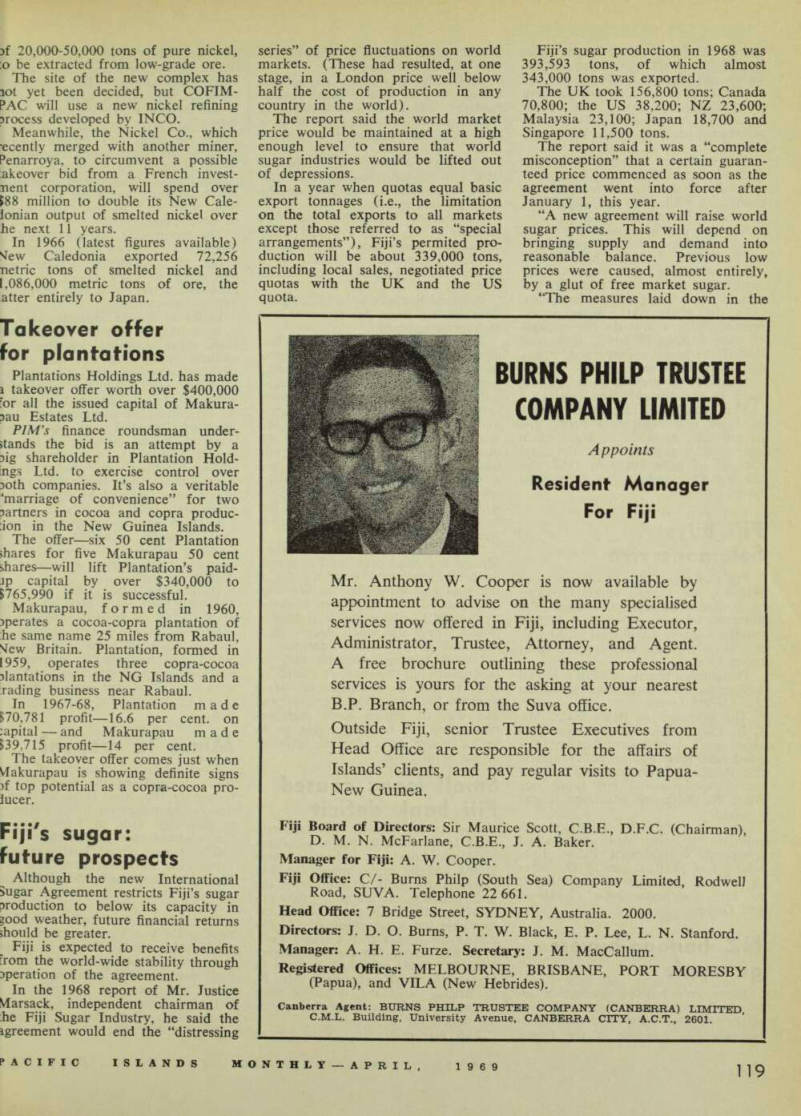
Mr. H. P. Elder
Earnings Paid Asset on Name Capital Backing Capital Price Kerema . 291,649 .84 6.5 .30c Koitaki . 405,038 1.08 16.7 .87c Lolorua . 200,000 .87 3 .40c Mariboi . 402,372 .89 4.7 .40c Rubberlands . 200,000 .82 6.6 .30c Sogeri 270,000 .79 29.1 .70c
Df 20,000-50,000 tons of pure nickel, ;o be extracted from low-grade ore.
The site of the new complex has lot yet been decided, but COFIM PAC will use a new nickel refining process developed by INCO.
Meanwhile, the Nickel Co., which •ecently merged with another miner, Penarroya, to circumvent a possible akeover bid from a French invest nent corporation, will spend over 588 million to double its New Cale ionian output of smelted nickel over he next 11 years.
In 1966 (latest figures available) Vew Caledonia exported 72,256 netric tons of smelted nickel and 1,086,000 metric tons of ore, the atter entirely to Japan.
Takeover offer
for plantations
Plantations Holdings Ltd. has made i takeover offer worth over $400,000 for all the issued capital of Makura pau Estates Ltd.
PlM’s finance roundsman under stands the bid is an attempt by a Dig shareholder in Plantation Hold ings Ltd. to exercise control over Doth companies. It’s also a veritable ‘marriage of convenience” for two Dartners in cocoa and copra produc :ion in the New Guinea Islands.
The offer—six 50 cent Plantation shares for five Makurapau 50 cent shares —will lift Plantation’s paid ap capital by over $340,000 to 5765,990 if it is successful.
Makurapau, formed in 1960, Dperates a cocoa-copra plantation of he same name 25 miles from Rabaul, Slew Britain. Plantation, formed in 1959, operates three copra-cocoa Dlantations in the NG Islands and a rading business near Rabaul.
In 1967-68, Plantation made 570,781 profit—l 6.6 per cent, on :apital and Makurapau made
539,715 profit—l 4 per cent.
The takeover offer comes just when Vlakurapau is showing definite signs >f top potential as a copra-cocoa pro lucer.
Fiji's sugar:
future prospects
Although the new International Sugar Agreement restricts Fiji’s sugar production to below its capacity in ?ood weather, future financial returns should be greater.
Fiji is expected to receive benefits trom the world-wide stability through Dperation of the agreement.
In the 1968 report of Mr. Justice Marsack, independent chairman of he Fiji Sugar Industry, he said the igreement would end the “distressing
series” of price fluctuations on world markets. (These had resulted, at one stage, in a London price well below half the cost of production in any country in the world).
The report said the world market price would be maintained at a high enough level to ensure that world sugar industries would be lifted out of depressions.
In a year when quotas equal basic export tonnages (i.e., the limitation on the total exports to all markets except those referred to as “special arrangements”), Fiji’s permited production will be about 339,000 tons, including local sales, negotiated price quotas with the UK and the US quota,
Fiji’s sugar production in 1968 was 393,593 tons, of which almost 343,000 tons was exported, The UK took 156,800 tons; Canada 70,800; the US 38,200; NZ 23,600; Malaysia 23,100; Japan 18,700 and Singapore 11,500 tons, The report said it was a “complete misconception” that a certain guaran teed price commenced as soon as the agreement went into force after January 1, this year, “A new agreement will raise world sugar prices. This will depend on bringing supply and demand into reasonable balance. Previous low prices were caused, almost entirely, by a glut of free market sugar, “The measures laid down in the
agreement for keeping sugar sales on the open market as far as possible within an agreed price range are mostly directed towards readjustment of quotas, and export and import wants, when prices fall below the minimum or rise above the maxi mum.”
For example, one provision was that all imports of sugar from non members of the agreement would be prohibited while the prevailing price was below the minimum.
Another provision was that if the price rose above certain levels then stocks, which must be held by all exporters under the terms of the agreement, would be released and offered for prompt sale to importers.
In the report, Mr. Marsack ex pressed concern over the big increase of cane burning in 1968. It warned that if the practice continued, strong action would be taken.
Measures to prevent cane burning were in the current cane contract.
The report said the high quality of Fiji’s raw sugar was partly due to crushing methods of fresh clean cane and it regretted that the total tonnage of cane burnt in 1968 was the highest recorded since the present contract began.
Fiji buys
Solomons rice
Fiji’s Rewa Rice Company, of Nausori, has bought about 120 tons of brown long-grain rice from the Solomon Islands—a big boost to that country’s newly-established rice-grow ing industry, and its biggest export order to date.
Previously, nearly all Fiji’s brown long-grain rice imports came from the United States.
The manager of Rewa Rice, Mr.
I. L. Lloyd, described the new pur chase as a useful contribution to a good neighbour trading policy among the Pacific Islands—and added that the company would buy more rice from the Solomons whenever it was available.
The rice from the Solomons was supplied by the Australian-backed company, Guadalcanal Plains Ltd., which has planted over 4,000 acres of rice in the hope of exporting it to Fiji, Indonesia, New Caledonia and Guam.
NZ banana-buyers
go apple
Large-scale banana production in stead of patch-work village enterprise might be the only way in which bananas can compete in the future
against other varieties of fruit on the New Zealand market.
This, anyway, seems to be the opinion of Mr. Ross Walker, general manager of Fruit Distributors of New Zealand, who recently made a tour of Islands banana-growing terri tories.
He predicted that other, cheaper fruit will provide Island bananas with some pretty stiff competition on the New Zealand market.
Housewives there had to buy bananas at 15 cents a pound while apples and pears were only nine to 11 cents a pound, he said. As a result, fewer bananas were being sold.
If Island bananas were to compete, their quality must be improved and their price reduced.
Merging individual plantations into blocks might enable economical pro duction of cheaper, high-quality bananas on a large scale, he thought.
New Zealanders are perennial complainers about Islands’ bananas, and not without cause. If Mr.
Walker’s campaign is to raise the quality of the fruit few people would quarrel with the idea but if it’s just a matter of price, it’s hard to see why people who want to eat bananas will be fobbed off with pears just because they are four cents a lb cheaper.
New Zealand has a constant foreign exchange problem but people inside the country live off the fat of the land and there must be few who can’t afford 15 cents for bananas.
In Australia, where the fruit is also grown, they are much dearer than that and, on the whole, inferior.
Islands banana industries may be inefficient; but we haven’t heard of any banana millionaires. Most growers live at subsistence level and one way of getting some improve ments into the industry might be to get a better price for the product at the selling end.
Small loans caused
Fiji bank deficit
The large number of relatively small loans made by the now-defunct Fiji Agricultural and Industrial Loans Board and its replacement, the Fiji Development Bank, in support of the government’s agricultural develop ment programme were primarily re sponsible for a net deficit of $23,754 during the bank’s first working year.
In his report for the year ended June 30, 1968, published in Suva in March, the bank’s chairman, Mr. H.
P. Ritchie, said the directors were concerned at the extent of the operat ing deficit for the year.
This was primarily attributable to
the agricultural loans, which neces sitated an extensive and highly super vised credit service. The associatec expenses were substantially in exces; of the interest which the bank couk expect to derive from such loans.
The situation was further aggra vated by the inability of many newly settled farmers to meet more thar a portion of the interest payment: which became due while their pro jects were still in the early stage: of development.
The report said that the operating deficit which arose from loans re lating to agricultural developmen was offset to some extent by mor< profitable activities in support of in dustrial development.
Loans to finance industry were a a considerably higher average leve than those required by the agri cultural community and the associ ated costs of administration were con siderably lower. While ensuring tha adequate funds remained availabh for agricultural development, the banl therefore pursued all favourable opportunities of investing in the in dustrial sector.
The liabilities and assets of the Agricultural and Industrial Loan Board were assumed by the Fiji De velopment Bank in July 1, 1967 Legislation was drawn up to give the bank virtually unlimited powers ii assisting promotion of natural re sources, transportation and other in dustries in Fiji.
During the year ended June 30 1968, the bank made loans to a tota of $510,758 to finance a variety o enterprises in the industrial field. / further $230,218 went in loans fo agricultural development. Several pro posals relating to the tourist industr were considered, but were either de dined or deferred for later considera tion.
Mines to reopen?
Consolidated Goldfields of Aus tralia is studying the feasibility o reopening the New Hebrides Forar manganese mines on Efate followinj a three-day visit to Efate by sL Consolidated men in March.
The mines closed last year afte Japan, the only buyer of the Nev Hebrides manganese, offered low un economical prices for the ore (PIM Oct., 1968, p. 123).
Consolidated had talks with Vil; dentist, Dr. van Verum, a part owne of the mines, in late March in Sydne: but no negotiations to buy the mine; had begun. The company doesn’ mine manganese at present and i looked at Forari as part of a genera examination of all mineral prospect: in the South Pacific.