Pacific Shipping
pp. 103-113 · Read in the full issue
Is MILI now on the move?
Heading for the Gilbertsand Nauru?
After seven months running small ships out of the US and Japan to the US Trust Territory, Micronesian Interocean Line Inc. (or MILI) is moving further afield—to the Gilbert and Elhce Islands and possibly Nauru. And MILI has other plans for expansion, aimed at making itself into a significant Central and South Pacific regional shipping force.
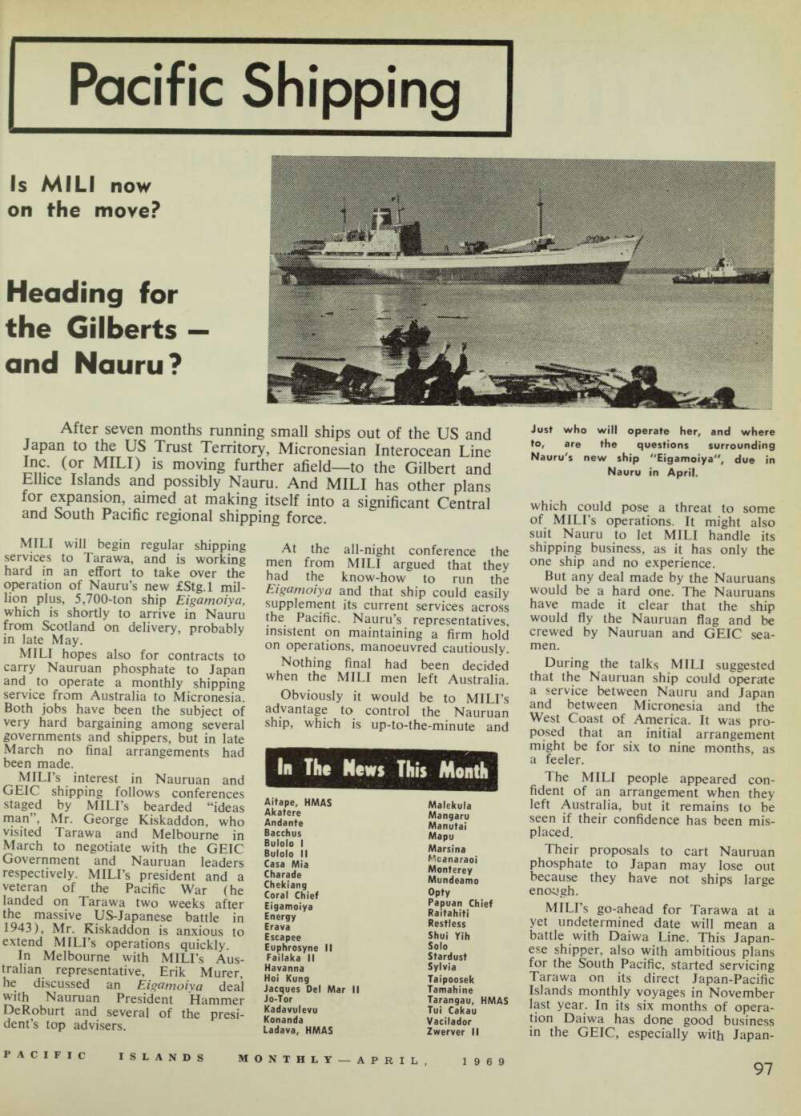
MILI will begin regular shipping services to Tarawa, and is working hard in an effort to take over the operation of Nauru’s new £Stg.l mil lion plus, 5,700-ton ship Eigamoiya, which is shortly to arrive in Nauru from Scotland on delivery, probably in late May.
MILI hopes also for contracts to carry Nauruan phosphate to Japan and to operate a monthly shipping service from Australia to Micronesia.
Both jobs have been the subject of very hard bargaining among several governments and shippers, but in late March no final arrangements had been made.
MILLs interest in Nauruan and GEIC shipping follows conferences staged by MILLs bearded “ideas man”, Mr. George Kiskaddon, who visited Tarawa and Melbourne in March to negotiate with the GEIC Government and Nauruan leaders respectively. MILLs president and a veteran of the Pacific War (he landed on Tarawa two weeks after the massive US-Japanese battle in 1943), Mr. Kiskaddon is anxious to extend MILLs operations quickly.
In Melbourne with MILLs Aus tralian representative, Erik Murer, he discussed an Eigamoiya deal with Nauruan President Hammer Deßoburt and several of the presi dent’s top advisers.
At the all-night conference the men from MILI argued that they had the know-how to run the Eigamoiya and that ship could easily supplement its current services across the Pacific. Nauru’s representatives, insistent on maintaining a firm hold on operations, manoeuvred cautiously.
Nothing final had been decided when the MILI men left Australia.
Obviously it would be to MILLs advantage to control the Nauruan ship, which is up-to-the-minute and
which could pose a threat to some of MILI’s operations. It might also suit Nauru to let MILI handle its shipping business, as it has only the one ship and no experience.
But any deal made by the Nauruans would be a hard one. The Nauruans have made it clear that the ship would fly the Nauruan flag and be crewed by Nauruan and GEIC sea men.
During the talks MILI suggested that the Nauruan ship could operate a service between Nauru and Japan and between Micronesia and the West Coast of America. It was pro posed that an initial arrangement might be for six to nine months, as a feeler.
The MILI people appeared con fident of an arrangement when they left Australia, but it remains to be seen if their confidence has been mis placed.
Their proposals to cart Nauruan phosphate to Japan may lose out because they have not ships large enough.
MILLs go-ahead for Tarawa at a yet undetermined date will mean a battle with Daiwa Line. This Japan ese shipper, also with ambitious plans for the South Pacific, started servicing Tarawa on its direct Japan-Pacific Islands monthly voyages in November last year. In its six months of opera tion Daiwa has done good business in the GEIC, especially with Japan
Just who will operate her, and where to, are the questions surrounding Nauru's new ship "Eigamoiya", due in Nauru in April.
ese cement and manufactured goods.
With the GEIC’s Wholesale Society as agents, MILI will ship to Tarawa with its seven-year-old 4,454-ton trader Hoi Kung out of Japan. The ship can take up to 450 deck pas sengers, and MILI says it will carry Japanese general cargo, cars, motor cycles, cement and foodstuffs.
MILI will also service Tarawa out of the US West Coast. Taipoosek, sister ship to the Hoi Kung, will bring American foodstuffs, building materials and soft drinks. Both ships will be on a round-Micronesia run and will call at Tarawa after Majuro, Marshalls.
The US service will be monthly and the Japanese service three weekly.
Both will start later this year.
Obviously Tarawa isn’t as yet a big enough market for both MILI and Daiwa. One shipper will have to step aside.
MILI may have an advantage over Daiwa for two reasons. One, it has told the GEIC Government it will use GEIC-trained seamen on MILI ships, and, two, it can call the tune somewhat because the Wholesale Society trader Moanaraoi has sperated (so far unofficially) to Majuro, which, under MILTs agree ment with the US Government should be exclusively a MILI trading area.
It’s likely that closer shipping links between MILI and the GEIC Government will follow present agreements. Possibilities include the bartering of Moanaraoi to MILI and he extension of its runs in the Marshalls, crew exchanges between he two territories and cruises of he GEIC’s expensive training ship Teraka throughout the US Trust territory.
MILI is pushing in almost every lirection, including Sydney where icgotiations have already been held vith unnamed parties to start a Jydney-Micronesia monthly shipping ;ervice. At present shipping links )etween Micronesia and Sydney are ilmost non-existent.
To top its route expansion plans dILI in March announced that it rill form a ferro-cement boatbuild ng centre on Truk, Caroline Islands, t chose Truk because of the island’s entral position in the US Trust Ter itory and the good supply of local abour available.
Mr. Henry DuPont, an American naster builder, will head the centre, riiich will build ferro-cement boats ip to 45 ft long and ferro-cement •arges capable of carrying 150 tons, •ituated on Mon Islet, production is xpected by the middle of the year nd the craft will be used for trans porting cargoes from MILTs seven
ships to the ports of Micronesia which do not have adequate berthing facilities.
Cement will come from Japan or Taiwan but MILI people in Sydney have expressed interest in examining the GEIC’s white lagoon mud which has been used successfully to build strong airstrips on Abemama and North Tabiteuea.
Over 20 locals will be employed at the boat building centre and more will get work on adjoining slipways and a marina.
MILI currently has one other plan —to train Micronesians as ships’ officers. This plan could well be realised in coming months if Mr.
Kiskaddon has his way.
Meantime, within Micronesia, main interest in MILI is whether the new company can develop efficient local services quickly, with outside expansion or not.
Everybody Wants
Papuan Prawns
Rights to search for prawns in New Guinea waters, particularly in the Gulf of Papua, have touched off a political and commercial storm in Australia.
Pressure from strong Australian prawning interests to give them, or New Guineans, instead of overseas companies, “first go” at the ter ritory’s supposed untapped prawn wealth sparked off pointed questions in Australia’s House of Representa tives in March.
The fuss follows almost overnight and certainly unexpected enthusiasm for NG’s offshore prawn potential by three companies, backed by multi million dollar overseas groups.
The companies are: • Gulf Fisheries (NG) Pty. Ltd.,
financed by investors from Kuwait and Australian investors operating through Equinox Investments Pty.
Ltd. of Port Moresby ( PIM, Feb., p. 110). Gulf was due to complete an extensive scientific prawn survey of the gulf and other parts of NG in late March. • Territory Fisheries Pty. Ltd., backed by Canadian (Placer Development Limited) and Norwe gian capital, whose two prawn searchers, Bulolo I and Bulolo 11, arrived in Moresby in mid-March from the US and got going im mediately on a three to six-month survey of prawn resources in the gulf. • Torres Strait Fishing Company, with Japanese and Australian back ing, based out of Thursday Island with rights to look for fish and prawns in the Orangeri Bay area of the Gulf.
The Gulf Fisheries and Territory Fisheries companies both have stated aims to employ as many New Guineans as possible, to start a prawn-processing works in NG and export prawns to Japan and the US.
It is obviously politically expedient that any territory fishing enterprise should involve local labour—the Department of External Territories has insisted all along that such must be the case.
On March 5, in the House of Representatives, Mr. K. M. K. Cairns, a Liberal Member from Queensland, put on the notice paper several •questions to Mr. Barnes, the Minister for External Territories.
First was, when did the Kuwait Fishing Company (Gulf Fisheries) win its license to survey the Gulf of Papua for fishing and prawning prospects?
His other questions were: • Were Australian or New
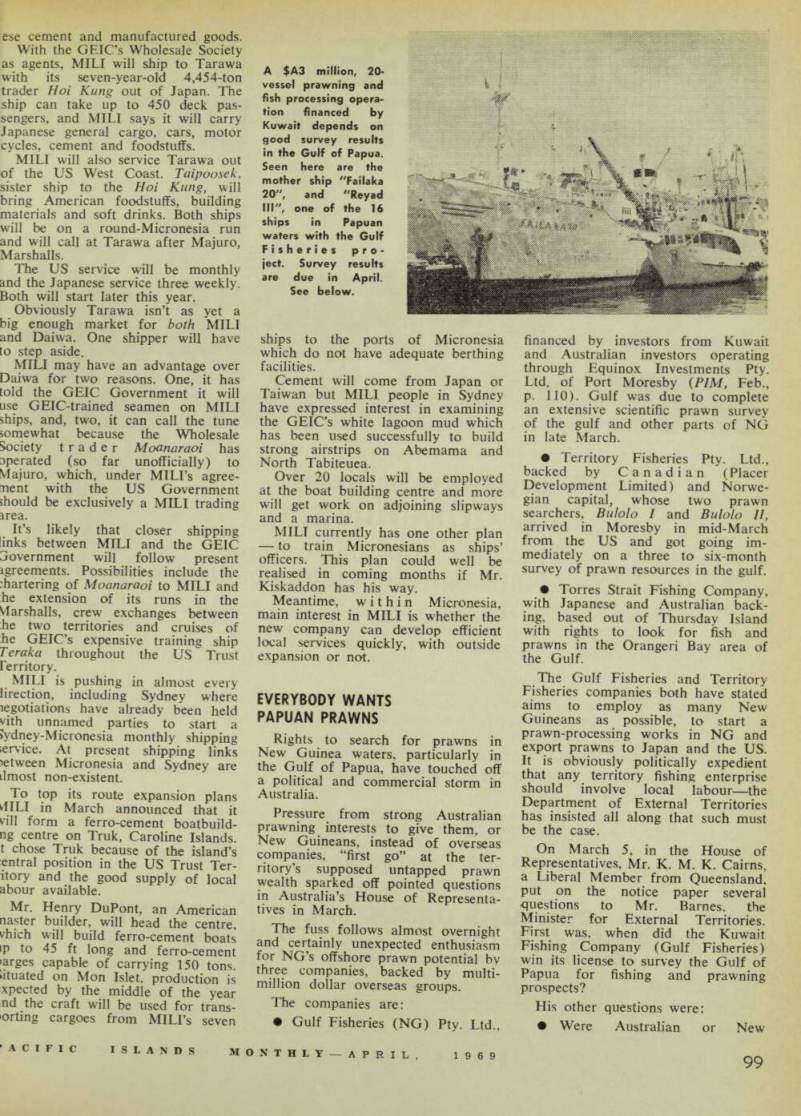
A $A3 million, 20vessel prawning and fish processing opera tion financed by Kuwait depends on good survey results in the Gulf of Papua.
Seen here are the mother ship "Failaka 20", and "Reyad III", one of the 16 ships in Papuan waters with the Gulf Fisheries pro ject. Survey results are due in April.
See below.
Guinean fishing interests consulted before Kuwait won its rights? If not, why not? • What benefits would Australians or New Guineans get because Kuwait had won its prospects? • Did Torres Strait Fishing Com pany have exclusive fishing rights at Orangeri Bay? If yes, when and why did it get them? • Were these rights awarded after competition with Australian and New Guineans? What other fishing interests were consulted? • If other Australian interests weren’t consulted, why not?
In a reply to the Kuwait questions, Mr. Barnes said Gulf Fisheries was granted a permit to survey the “fish ing resources” of the Gulf of Papua on December 23, 1968. The rights were not exclusive and the survey was being carried out “inside and outside” territory waters of NG. Other ques tions hadn’t been answered when PIM went to press.
It certainly looked as if some people in Australia weren’t happy with the way prawning rights have been handled, even at a stage when NG commercial prawning grounds aren’t yet known. Someone, obviously, must think NG has plenty of prawns.
Which hasn’t exactly been proved.
And there are some people, ap parently, who think that New Guinea prawns should be kept for Australian prawners—and are prepared to fight all the way. The questions in parliament were obviously inspired.
Prawning has become very big business south of Papua, in Aus tralia’s Gulf of Carpentaria, over the last 24 months, and several big Australian firms particularly Craig Mostyn and Co. Pty. Ltd., of Sydney have invested hundreds of thousands of dollars in ships and processing works.
Prawning today apparently involves more than dropping a net over the side of a boat!
Cray Business
Is Booming In Papua
Crayfishing is booming at Yule Island, north of Port Moresby, in the Gulf of Papua. A major shipment of $20,000 of crays left Moresby in March for the US and hopes are other similar shipments will follow.
A joint company—called Yule Lobster Enterprises has been formed by two groups, Morr Pty.
Ltd. and Kairuku Fishing Society Ltd., to catch, process and export.
Morr is a family comoany in which local businessman Mr. Ron Slaughter has big interests. Kairuku is a New Guinean-owned co-operative with about 600 members.
Things started with a NG Admin
istration loan to build freezers and facilities and now both parties have pooled an initial capital of $50,000.
Recently a $25,000 trawler was bought from Australia and now plans are to have a fleet of 12 30-ft trawlers. Crayfishing will be the main business but in the off-season the freezers will handle fish for local markets.
New Charters, New Names,
New Services
Burns Philp and Co. Ltd. have chartered the freighter Papuan Chief from her owners, John Swire and
Sons of London. From late April BP’s will operate the ship, which has flown in recent months under the China Navigation Company flag (an associate company of the Swire Group), on a three-weekly round service from Australia to New Guinea.
BP’s will rename her Marsina— the name of a former BP vessel— and run her from Sydney to Brisbane, Rabaul, Kavieng and Sydney. On alternate trips she will call at Honiara, Solomons, instead of Kavieng.
The company already operates a six-weekly service from Australia to
Honiara with the Tulagi, via Norfolk Island and the New Hebrides.
A BP spokesman said the operation of the Marsina would be a trial for assessing side-port loading vessels.
He said her charter time was “indefinite”.
China Navigation, which says its two vessels Island Chief and Papuan Chief have recently been “chocka block” with NG cargoes, will im mediately replace the Papuan Chief on its regular Sydney-Brisbane-Port Moresby run.
Chekiang, to be renamed Coral Chief, will step in and offer more refrigeration and general cargo space.
A side-port loader, Chekiang is already known in the Islands on other China Navigation runs.
The BP charter closely follows the sale of its fifth freighter Malekula to Noumea’s Captain Emile Savoie ( PIM, Mar., p. 91). Malekula com pleted her first successful Sydney- Lord Howe-Norfolk Is.-New Cale donia run in March, returning direct to Sydney.
PlM’s Noumea correspondent said Caledonians were pleased to welcome the ship, which has been renamed Jacques Del Mar 11. He added: “With its 300-ton refrigerated space, she is expecially appreciated by Noumea housewives, who depend on imported fruit, vegetables and other perish ables”. The ship has a limited number of first-class passenger cabins. Sydney agents are F. H.
Stephens.
In another NG shipping develop ment, Queensland Papua Line, which has operated the freighter Jo-Tor from Brisbane to NG ports in recent months, took this ship out of service in March following a breakdown of charter arrangements.
The line hopes to charter another vessel.
Plenty Of Activity
In The New Hebrides
Co-operative activities, good trad ing conditions, missionary work and a general step-up in overall develop ment (particularly building) are the major reasons for the great numbers of small ships of all shapes and sizes operating through the 80-odd islands of the New Hebrides these days.
The condominium is to get an international-standard overseas wharf at Vila {PIM, Mar., p. 99) and another—much smaller—wharf is to go up on Malekula.
Santo’s American-built wharf has long been able to handle overseas vessels of the Jacques Del Mar and Tulagi class.
A recent list of vessels operating in the New Hebrides included: Aquitane, Manutai (Burns Philp),
Mangaru, Lopevi, Hip Chow , Tui Cakau, Havanna, Konanda (Burns Philp), Neptune, St. Joseph, Southern Cross, Navaka, Pacifique, Silae, Narciss Cugola, Rocinante, Pankumu, Alize, Ruphtodyne and Euphrosyne II (British touring vessel).
It’s quite a fleet!
S.P.I.F.D.A. Man
Arrives
With all the rain that fell in New Caledonia upon his arrival, the director of the new South Pacific Islands Fisheries Development Agency could almost have started a fresh water hatchery.
Mr. Alan Tubb reached Noumea in March and is settling in at the South Pacific Commission, which will be his headquarters for operating the joint UNDP-SPC project (PIM, Jan., p. 123).
A budget of $870,000 has been allocated for workings over the next three years. About half of this amount will actually come in the form of facilities and equipment made avail able by governments and territories in the area.
Mr. Tubb is an Australian fisheries officer, who has spent 13 years in Bangkok, where he worked for the FAO. Among his special interests in the Pacific are prospects for Islanders in the trading of turtles and beche de-mer.
Ill-Fated "Energy"
Tries Again
The 48 ft motor fishing vessel Energy left Rarotonga on February 15 on her third attempt to reach New Zealand from the Cooks.
She left Avatiu harbour in com pany with the freighter Akatere, the idea being that should she break down again Akatere would take her in tow to NZ.
Aboard Energy were Captain John Moorhouse, Barry L. Hall and Cook Islander George Tearii, engineers;
and Colin H. Kennedy and another Cook Islander, Tuakare Mahutariki, deck hands.
Mr. Hall had flown up from NZ with spare parts for the engine on an RNZAF Hercules flight. Energy departed Rarotonga for Wellington on December 11, but broke down when only 190 miles away and had to be towed back to Rarotonga by MV Tagua. On January 11 she left again for NZ, but again had engine trouble. This time she managed to reach Avatiu harbour under her own steam.
Energy is on a delivery voyage from Gibraltar to her new owners in Wellington.
Last November Energy was re ported missing when her engine failed on the voyage from Panama to Tahiti. The vessel took 65 days to reach Bora Bora. The next leg of the voyage took her to Rarotonga
which she reached under sail. The engine had failed again, and she had to be towed into harbour ( PIM, Jan., p. 103).
BOTTLE DRIFT . . . CANOE DRIFT Meki, an islander of Port Resolu tion, on the east coast of Tanna, New Hebrides, recently found a bottle washed up on a beach near his village with a note inside from Mr, Reuben Doom, of Papeete, Tahiti.
Mr. Doom had dropped the bottle off the Matson liner Monterey on a trans-Pacific crossing last September.
On a map the distance between Rob Roy Island, south of Choiseul, Solomons, and Kolombangara, in the Solomons New Georgia district, doesn’t look much.
It’s a trip of a bit over 40-odd miles across a strip of the Pacific known as New Georgia Sound.
But a Solomon Islander who re cently made the trip in his 15-foot motorised launch found, it can be “quite a way”.
Shortly after leaving Rob Roy, his engine broke down and for six days he paddled before he reached Kukudu, Kolombangara. Exhausted, he had had little food or water.
Furthest Up
The Sepik
Two Australian Navy patrol boats —HMAS Aitape and HMAS Ladava —recently completed the furthest penetration, by ships of the Royal Australian Navy, of NG’s largest river, the Sepik. The boats reached the government station at Ambunti, 232 miles from the mouth of the
river, after a three-day passage.
Aitape was commanded by Lieutenant Commander S. Bateman and Ladava by Lieutenant P. Blenkin sopp.
The previous best voyage up the winding Sepik by an Australian vessel was made in 1914 when the torpedo boat destroyers Warrego and Parramatta steamed 193 miles up stream in an unsuccessful search for a reported German raider.
For his trip. Lt.-Cmdr. Bateman used a 1919 German chart and a 1964 Australian River Survey chart.
Depth readings to 130 ft were made and the shallowest part encountered showed a reading of 10 ft of the keel.
The patrol found that actual changes had occurred in the course of the river since the 1964 survey.
At times both boats went at minimum speed to avoid huge forest logs and floating “islands” of vegetation. They made Angoram on the first night and Mindibit the second night.
Wharf For Port Sandwich
The New Hebrides Condominium Government has called tenders for construction of a much-needed wharf at Port Sandwich, on south-east Malekula. Tenders were to be in by March 21.
40 In One Canoe
Overcrowding of canoes operating in the Port Moresby-M arsh a 11 Lagoon-Kairuku area of the Gulf of Papua recently came under scrutiny at a meeting of Papua’s Central Dis trict Advisory Council in Moresby.
One councillor, Mr. N. I. Uroe, cited a recent case of 40 people travelling around on a 45 ft canoe.
Some of these people were “hanging on by their eyelashes”, he said.
Naval Disturbance
Seven New Guinean sailors have been sacked following “disturbances” over alleged pay discrimination at the Royal Australian HMAS Taran gau Manus Island Navy base in December.
About 25 of the 200 island recruits on Manus staged a demonstration after a new system of pay for Aus tralian Navy recruits had been introduced.
Navy officials said the dissatisfacwas caused by “a misconcep tion”. No one was injured and the seven sailors discharged had since left Manus.
Schooner Lost On
Tuamotu Reef
The 41ft trading schooner Rai tahiti was wrecked on the reef at Kaukura Atoll, Tuamotus, in the early hours of February 21. Six men who were aboard at the time were saved.
The Raitahiti had traded between Kaukura and Papeete since May, 1960, carrying copra, fish and food stuffs.
The schooner was built at Kaukura in 1958-59. She belonged to Mr. Peni Richmond, a member of Kaukura’s Richmond clan.
South Pacific
Shipping Briefs
• A reproduction of an etching of ' Euphrasyne, a touring vessel for the British Resident Commissioner to the New Hebrides, has been pre sented by Britain for display in Vila’s Cultural Centre.
Euphrosyne operated in the New Hebrides and New Caledonia from 1911 to 1928, when she was wrecked at Noumea by a cyclone.
Meanwhile, the current British Resident Commissioner’s vessel, Euphrosyne 11, has recently had a change of master. Captain Arthur Kalchichi, of Fila, has replaced
Captain Leith Nasak, of Tanna.
Captain Nasak was due to start in struction courses for Certificates of Competency in March. • Captain Jack Dalby, formerly representative of the Australian Stevedoring Authority for the Queensland ports of Townsville and Bowen, has taken up his new job as traffic manager for the Fiji Marine Department. His Fiji job in cludes keeping ship movements in and out of all Fiji ports as smooth as possible. • Commander F. Hunt, marine superintendent and principal licensing officer for the New Hebrides British Residency in Vila for the past two years, recently completed his working contract in the condominium. He’s expected back in Vila in July to set up a private business as a land surveyor. • The New Zealand company, Steel Products Ltd., is building a 35 ft prototype sports fishing boat which it hopes to sell in Fiji, the New Hebrides and Australia. It is described as extremely difficult to sink because of special material built into the hull. The craft will have two diesel engines and a cruising speed of 20 knots. It will cost be tween $24,000 and $30,000. • Suva’s Pacific Transport Com pany is currently proposing to operate a daily passenger ferry service between Fiji’s two biggest islands, Viti Levu and Vanua Levu. Sea conditions in the Koro Sea, which have been tabbed one of the roughest strips of Pacific Ocean, could be a drawback. • Refrigerated Express Lines (A/asia) Pty. Ltd., a newly-formed Australian shipping charter group, could be making regular calls at Port Moresby later this year en route from Western Australia to New York.
Plans are to ship frozen foodstuffs, such as prawns, crayfish and barramundi, on Japanese-chartered freighters. Hopes are to pick up NG prawns or crayfish in Moresby and also possibly collect the same out of Fiji or Tonga by a call at Suva. • American Samoa’s hunt for two 55 ft steel-hulled utility boats ( PIM, Mar., p. 105) is over—the territory has bought them for SNZBO,OOO from NZ’s Whangerei Engineering and Construction Company Ltd.
Captain John Calver, manager of Samoa’s Water Transportation Division, is hopeful they’ll be delivered in September.
• A Tongan-inspired move to have the Pacific Islands Producers’
Association operate its own banana carrying ship was discussed at the early March meeting of the associa tion in Apia. A decision, however, was deferred until further investiga tions into costs, etc., can be made. • Money is still coming to the Kadavulevu Dependants’ Fund, Fiji, for widows and orphans of nearly 100 people who died when the trader Kadavulevu sank in 1964. Latest donation is part of a salvage pay
ment Mobil Oil Australia Ltd. received for help given by one of its tankers Pacific Carrier, in Fiji waters last year. The amount: 5F35.50. • A 5U575,000 cable ferry to operate between the islands of Koror and Babelthaup in the Palau Group of the Caroline Islands was expected to arrive in April. The ferry will replace an old military boat, which in recent months has had much engine trouble—a problem which has created heat among locals.