How Would An Oil Boom Affect Sacred
pp. 43-53 · Read in the full issue
Tonga, A Kingdom In Transition?
By John T. Griffin
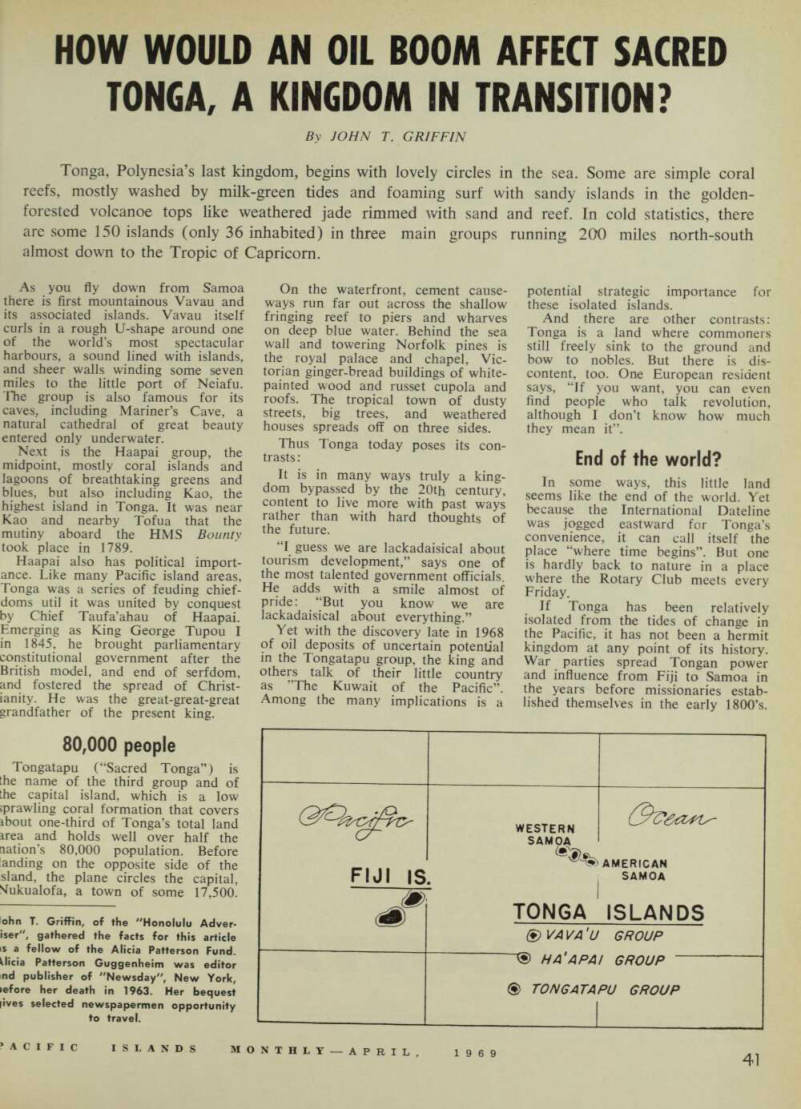
Tonga, Polynesia’s last kingdom, begins with lovely circles in the sea. Some are simple coral reefs, mostly washed by milk-green tides and foaming surf with sandy islands in the golden forested volcanoe tops like weathered jade rimmed with sand and reef. In cold statistics, there are some 150 islands (only 36 inhabited) in three main groups running 200 miles north-south almost down to the Tropic of Capricorn.
As you fly down from Samoa there is first mountainous Vavau and its associated islands. Vavau itself curls in a rough U-shape around one of the world’s most spectacular harbours, a sound lined with islands, and sheer walls winding some seven miles to the little port of Neiafu.
The group is also famous for its caves, including Mariner’s Cave, a natural cathedral of great beauty entered only underwater.
Next is the Haapai group, the midpoint, mostly coral islands and lagoons of breathtaking greens and blues, but also including Kao, the highest island in Tonga. It was near Kao and nearby Tofua that the mutiny aboard the HMS Bounty took place in 1789.
Haapai also has political import ance. Like many Pacific island areas, Tonga was a series of feuding chief doms util it was united by conquest by Chief Taufa’ahau of Haapai.
Emerging as King George Tupou I in 1845, he brought parliamentary constitutional government after the British model, and end of serfdom, and fostered the spread of Christ ianity. He was the great-great-great grandfather of the present king.
80,000 people
Tongatapu (“Sacred Tonga”) is the name of the third group and of the capital island, which is a low sprawling coral formation that covers ibout one-third of Tonga’s total land area and holds well over half the nation’s 80,000 population. Before landing on the opposite side of the sland, the plane circles the capital, Nukualofa, a town of some 17,500.
On the waterfront, cement cause ways run far out across the shallow fringing reef to piers and wharves on deep blue water. Behind the sea wall and towering Norfolk pines is the royal palace and chapel, Vic torian ginger-bread buildings of white painted wood and russet cupola and roofs. The tropical town of dusty streets, big trees, and weathered houses spreads off on three sides.
Thus Tonga today poses its con trasts : It is in many ways truly a king dom bypassed by the 20th century, content to live more with past ways rather than with hard thoughts of the future.
“I guess we are lackadaisical about tourism development,” says one of the most talented government officials.
He adds with a smile almost of pride: “But you know we are lackadaisical about everything.”
Yet with the discovery late in 1968 of oil deposits of uncertain potential in the Tongatapu group, the king and others talk of their little country as ’’The Kuwait of the Pacific”.
Among the many implications is a
potential strategic importance for these isolated islands.
And there are other contrasts: Tonga is a land where commoners still freely sink to the ground and bow to nobles. But there is dis content, too. One European resident says, “If you want, you can even find people who talk revolution, although I don’t know how much they mean it”.
End of the world?
In some ways, this little land seems like the end of the world. Yet because the International Dateline was jogged eastward for Tonga’s convenience, it can call itself the place “where time begins”. But one is hardly back to nature in a place where the Rotary Club meets every Friday.
If Tonga has been relatively isolated from the tides of change in the Pacific, it has not been a hermit kingdom at any point of its history.
War parties spread Tongan power and influence from Fiji to Samoa in the years before missionaries estab lished themselves in the early 1800’s.
John T. Griffin, of the "Honolulu Adver [?]iser", gathered the facts for this article is a fellow of the Alicia Patterson Fund.
Alicia Patterson Guggenheim was editor and publisher of "Newsday", New York, before her death in 1963. Her bequest gives selected newspapermen opportunity to travel.
Monarchs have brought attention
(Today the Wesleyan Methodist Church is the state church of Tonga).
Nor was Tonga immune from the manoeuvrings of the big powers in the Pacific last century. But fortu nately because of its isolation, its relative lack of resources, and the general turn-of-the-century political settlements, Tonga escaped outright colonization and preserved much of its independence. Under a treaty with Great Britain in 1900, it emerged as a protected state, autonomous, but with British advisers playing key and sometimes forceful advisory roles in government and England handling foreign affairs. Last year the old treaty of friendship was revised to lessen British influence. Soon Tonga will join the British Commonwealth and the United Nations as well as post its own ambassadors in some foreign countries.
Tonga’s monarchs have brought the nation a measure of international attention in recent years, Salote Tupou 11, the smiling, statuesque queen who ruled for 47 years before her death in 1965, was a benevolent, protective figure.
Prince is Sandhurst man
Her son, crowned in 1967 as King Taufa’ahau Tupou IV, travelled widely in the years he was premier.
In December he went to England for his son’s graduation from the Royal Military Academy at Sand hurst. No mere constitutional monarch, the king today remains the most important figure in the nation.
Tonga’s king presides over a political-cultural system that is a mixture of feudal holdover and British parliamentary practice. Unlike in Samoa where the matai or chiefs are elected by family members, noble titles (and the land that goes with them) are hereditary in Tonga. It is, in short, less democratic.
Here, also, the extended family is the most important cultural unit in the average man’s life. Villages are not as attractively neat, clean, and parklike as those in Samoa where matai exercise control, but they re main culturally important.
At the same time, there is a meaningful shift from the old ways.
There is said to be a trend towards westernised ideas of the smaller, close-knit family. But, as in the West, there is also a breakdown of the old discipline that families provided.
One result is more urban crime.
A well-educated Tongan official said of such social change: “I would
say acculturation is faster here than in most Other island areas”.
That may or may not be SO in some social matters, but change is far less fluid in the political arena.
It is progress that officers who used to be appointed by the premier are now elected by the people. Still real power centres around the king, the nobility, and the cabinet headed by the premier, Prince Tu’ipelehake, brother of the king.
Parliament consists of seven nobles elected from among the thirty three hereditary titles, seven commoners elected by adult franchise, the cabinet, and the appointed governors of Haapai and Vavau. There is one house and no parties. Most important ideas come from the Privy Council (king, cabinet, and governors) which also legislates between the annual two-three month sessions of parliament. Says one respected Tongan of this situation: it s like England a couple hundred years ago. The commoners have some
ri B hts a nd representation. In parlia ment they tend to join together. But the initiative and power is still with the elite. It may be getting outdated, but because the system is over ninety Y ears old there is resistance to change.”
On the other side of the scale, there is growing resentment over the power and privilege of the nobility in some quarters, notably from some educated young commoners.
Obviously not too many feel as strongly as the concerned young man who sought me out and said, among
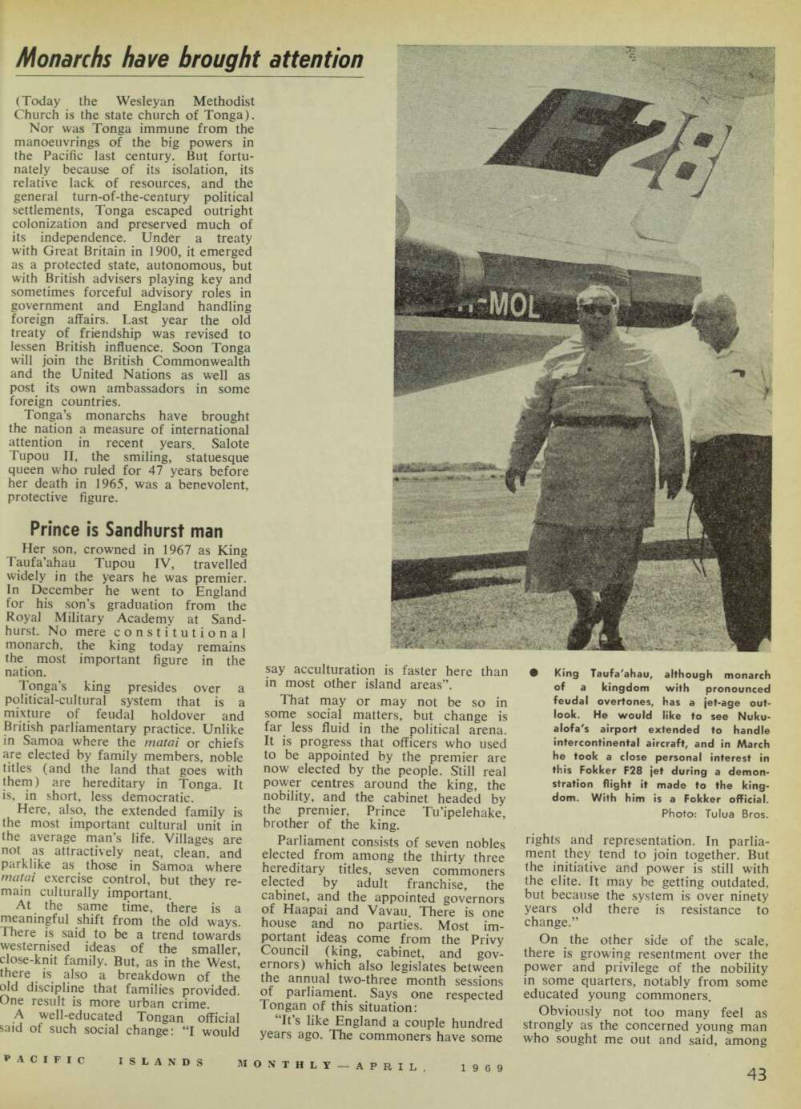
• King Taufa'ahau, although monarch of a kingdom with pronounced feudal overtones, has a jet-age out look. He would like to see Nuku alofa's airport extended to handle intercontinental aircraft, and in March he took a close personal interest in this Fokker F28 jet during a demon stration flight it made to the king dom. With him is a Fokker official.
Photo: Tulua Bros.
Nobles: key question
other things. “The nobles and royalty treat us like dogs sometimes. . . .
There has to be change. If there isn’t, I am afraid there will be trouble in five or ten years”.
Most Tongans, especially in rural regions, retain deep respect for the hereditary elite. Some of the most talented commoners recognise the stabilising value of tradition in periods of change. But indications are a growing number feel adjust ments in the system must be made in the face of changing political at titudes and growing economic pres sures.
Whether the nobility can respond to such a need is one of the key questions in Tonga today. And it is not as simple as waiting for a group of old men to be replaced by their enlightened sons. Says one informed political observer: “The average age of the nobles is 38 to 40. Some are not educated, and there are very few respected elders. Early change is not automatic”.
The king’s importance can be measured several ways. One is in the words of a commoner active in politics: “The king has more power than it might seem because he is both educated and experienced as the former premier. That’s why he has so much control. He’s too clever”.
On another level there is this point from a European: “The king is in a special position. The nobles need him because he is head of the estab lished system; so he can make them move. On the other hand, while many commoners may distrust or dislike the nobles, they respect the king and accept the concept of a royal sovereign”.
King as a bridge
As a result, a common point made about Tonga today is that this king must be the architect of new adjust ments between nobility and com moners. If he fails, the thinking goes, there is nobody in sight to prevent turmoil.
I saw the king on three occasions during my visit to Tonga—at a long private interview at the palace, at an elaborate state ceremony that lasted several days, and on a dawn scientific trip that turned into some thing of a feast.
Before the interview, I was ferried to the palace grounds in an old London taxi of 1930ish vintage that was once the official car of Queen Salote. The king now has a Cadillac and other modern vehicles, but such was the love for the late queen that older Tongans still sometimes turn
King reads proofs of kingdom's newspaper
and bow to the little black taxi, It is that kind of a country.
The palace itself is not expensively elaborate by the standards say, of various Asian potentates and presidents. But it has an atmosphere.
Behind the white clapboard and roccoco trimmings of the 1860’s are cool quiet rooms with Polynesianfun!it 11 re* rich ‘ om “ e furniture, oiled wood, and fine Tongan mats for rugs. Norfolk pines shade lawn and garden and frame the view On sea to far-off atolls.
On the sunny day I visited a group ot laughing women worked on one lawn dyeing a brown pattern into a piece of tapa cloth the size of a mrge room.
Ihe king is a huge man 6 feet 2 inches and perhaps 350 lb. The sheer size of the man is impressive as he comes quickly into the recepf "soft Ta„Ton n B 8 a n W v a . t rd I r kS J ik » xr i • Tp ngan version of a Nehru shirt with matching lava lava, and around his waist an especially old, frayed, and valued ta’ovala, the finely woven pandanus leaf mat that serves as part of most Tongan costumes. If the royal appearance tends to be awesome as he fills much
of a large couch, the visitor is both relaxed and engaged. There is quiet. serious talk broken at times by rich laughter when the king jokes about such things as his catching the errors editors have missed when he proofreads the weekly editions of Tonga’s only paper.
The 50-vear old kino has u PPn called a ‘Siss^ce some writers, and there is no doubt he has pursued a variety of interests from scuba divin and surfin in younger days to agriculture, economics, and history. Parts of our talk for example, ranged from copra nroduction to how the king instructed US Peace Corps volunteers in the use of the abacus for teaching maths Tongan schools. n i;*- i rOIITICai TUtUre But we a,so talked about politics.
T » , T ?? ga now > he said, is seeking to combine the best of hereditary stability and continuity with an ejected system to take advantage of all People with ability and leaderqualities”.
I asked about reports of resentment
over the nobility by some commoners but got the impression the king did not consider it a priority problem in itself. At one point he said: “The succession of titles isn’t divisive, and in any case we have a substratum of officials and they do the hard work”.
The king’s response leads one to reflect back on the view of several persons. They say that although the king has informants, there is some question of his sensitivity concerning dissident commoner feelings.
On the other hand, one might also question whether a sophisticated national leader of any kind would want to share his innermost con cerns on the first meeting with a visiting newsman. The answer is in conclusive but important.
I saw the king next as he took part in programs commemorating the 100th anniversary of secondary education which marked the fact that Tonga was the first of the South Pacific islands to establish it. Tupou College, Tonga’s first secondary school, was founded in the late 1860’s by King George Tupou I and the Wesleyan Mission.
The celebration underscored the role of religion in Tongan life. One of its high points was a rendition of Handel’s “Messiah” in the Free Wesleyan Church cathedral, which
Still a land of traditional feasts
was decorated as if for Christmas with red stars, green paper, and fragrant vines. While the king sat elevated and alone in the royal pews, hundreds of his white-clad people took turns singing in groups or solo.
The queen, a dignified, strong looking woman, played the organ and sang one solo. The royal brass band played portions of the score.
For the climax, choirs from various parts of the islands some 2,000 voices sounding like a great organ in the tropical night—joined in a thunderous Hallelujah Chorus.
The king also presided over a great feast as part of the celebration.
Incredible amounts of food were spread out under thatched dining pavilions. There were dozens of woven eight-foot trays, each over flowing with several tiny suckling pigs (golden roasted and smiling), lobsters, chickens, corned beef, giant yams, taro pieces as big as thighs, coconut pudding, bananas, water melon, and salad.
Beforehand, guests had tea and cakes in fine British tradition and watched a two-hour program of often wild Tongan dancing. Hundreds from villages around Tongatapu took part in the panorama of colourful costume, violent drumming, and spirited shouting. It was a scene of ferocious grace.
Frilly British dresses
While the king’s matapule, or talking chiefs, sat on the ground shouting instructions and encourage ment to the dancers for him, the monarch himself sat behind on a shaded platform decorated with fine mats and rich tapa. There, with charm and sophistication, almost as if in another world, he chatted with the European men in dark suits and their ladies in frilly British dresses and hats who were his guests.
Another view of the king in public was offered at dawn on my last day in Tonga. It was the first day of winter in the Southern hemisphere, and several of us travelled to a far corner of Tongatapu to watch the king verify one of his scientific historical findings. There by a quiet village and coconut grove is a sort of South Sea Stonehenge called the “Ha’amonga”. This 20-foot high trilithon of three huge coral slabs was erected over 700 years ago. It had served as a ceremonial arch, but in 1967 the king had deciphered the pattern of lines etched on the top of the central slab. He theorised that ancient Tongans had used it to
determine when the sun rose at the beginning of various seasons.
We waited in the pre-dawn dark ness for the king who arrived in a black station wagon with a motor cycle escort. As the time of sunrise approached, the king, wearing sport shirt, lava lava, and brown boots, marched vigorously to the arch, climbed a wooden stairway con structed for the occasion and peered into the transit set by the royal surveyor along the sight line through the trees to the ocean horizon.
Unfortunately, the sun rose un seen behind clouds. So we all waited, swatting mosquitos in the dim light and talking to the king when he spoke down to us. Finally after 15 minutes the orange sun shot a ray through a hole in the clouds. There was ap plause for the sun as the king made his sighting.
Tonga's Stonehenge
“Does this confirm your theory then, Sir?” I asked up to the king.
“Certainly. There was never any doubt,” he answered with some majesty. When he descended, the king added with pride; “While this is simpler, it is only here and at Stonehenge that we have such a structure.”
The king then moved across the road to a tapa cloth pavilion con structed in a school yard to receive villagers. They came bearing two huge woven baskets of food much like those used for servings at the royal feast in Nukualofa. The half dozen of us European guests were about to leave when a messenger brought word th~t, “The king would
like you to share one basket of his food”.
Just what major oil deposits would mean to this Tongan scene is un certain; the potential commercial value of the findings of September and October is still to be determined.
Economically (as well as politic ally) Tonga needs something. A traditional South Pacific copra banana economy has served well enough in the past. Tongans still have enough to eat, and there is hardly an air of crisis in the king dom. Yet concerned officials and economic experts point to a com bination of population explosion, unemployment problem, and land situation that poses real danger signals.
In islands with limited land area and (any oil aside) limited economic potential, Tonga’s population has been increasing at a reported 3.8 per cent, a year to some 80,000 today. That means more than 300 Tongans per square mile, a very high figure by Pacific Islands’ standards.
For Tongatapu the figure is more than 480 persons per square mile.
Some 60 per cent, of Tonga’s population is under 21. The average age is 17, which means a high per centage of youths coming into the job market. There are only govern ment and private industry jobs for a fraction of those coming out of school every year. “We don’t have good figures,” said one official, “but unemployment is bad and under employment is terrific”.
Tonga’s land situation is both unique and complicated. All land is the property of the crown. Large
Britain still has a consul in Tonga, Mr.
A. C. Reid, here seen in his Nukualofa garden with one of the guns from the British privateer, "Port au Prince", which was taken when the ship was captured by the Tongans in 1806.
Tonga presented the guns to Britain on the 50th anniversary of the UK - Tongan Treaty of Friendship in 1950.
Doubts on tourism
tracts are assigned to the hereditary nobles. But last century, King George instituted a system where every man at age 16 is entitled to a rural farm allotment of acres and a house site in town. Much of this land comes from the estate of the nobles.
Today only one third of the eligible males have their allotted land. A variety of sometimes con flicting reasons are given why the system has not worked: Much of the still available land is in remote regions, including the far-off islands of the Haapai and Vavau groups.
Most men understandably want their land on populous, crowded Tongatapu or near the towns. Nobles have some times been slow and selfish, control ling and using the system to their advantage. Men are sometimes lazy, often not using the land they have.
A number turn down plots, waiting to take over land their fathers have developed.
Whatever the facts, there is a political importance in the land situation. A top government official put it this way; “It is not just land but the fact that it is tied up with all sorts of expectations and rights.
To know you are entitled to some thing and not to get it means frustration. It is a handy tag, and people bent on unrest are using it”.
Land reform needed
There are also questions whether this system of large but dwindling noble estates and small plots lends itself to Tonga’s economic develop ment needs.
There are people talking about economic development, of course.
Tonga is in the midst of what seems a solidly modest five-year develop ment plan.
But, at least in the pre-oil days in 1968, the king and everyone else were looking toward tourism as the major economic development hope.
Tonga, by its own wishes, has been pretty much out of the Pacific tourism boom.
It has a good government-owned hotel, The Dateline, on the Nukualofa waterfront with 50 rooms. In 1967, even with the flood of people for the king’s coronation, there were only
2,000 overnight-or-longer visitors for
an occupancy rate of about seven per cent. Visiting cruise ships brought some 8,500 more tourists for stops of several hours.
In 1968 the hotel occupancy was expected to hit at least 25 per cent., hardly a crush but gaining fast!
Additionally, the number of cruise
ships more than doubled, bringing the total to 14.
Moreover, Tongan officials were making plans. The king was talking about the need to move quickly on turning the present 5,000-foot grass airstrip into a 10,000-foot paved runway capable of receiving intercom tinental jets from Hawaii and Australia.
Vavau alrnnrt VdVdU dirporr Plans were approved to add 30 rooms and a new beach to The Datefin®.’ . with more rooms to follow.
Officials talk of hotel sites on rural Tongatapu and other island groups.
Unfortunately, plans for a promiemg resort on Vavau were set back because wind currents make the recently completed airstrip built high on a plateau between two cliffs unusable. A British adviser picked the site, but with characteristic good humor Tongans seemed to shrug off the problem to accept the idea of at least a year s delay while a new str iP 18 built.
Ihis planning is not being done with unthinking acceptance of tourism.
But there are those with strong doubts about the impact of tourism.
An extreme view came from a commoner member of the legislature: If much tourism comes here, we will become like Hawaii, where there are no more Hawaiians. There will be no m( j re i.^ ongans ‘ * keen t( ? Hawaii and have seen how it is spoiled”.
A top official put it in more moderate perspective: “Tourism is something we have to do economically. Yet we are always apprehensive about it. We hope it can be developed
in a way and at a pace Tonga dictates. The only way we think this can be done is through the rate we introduce hotels”, How oil fits in the equation of Tonga’s future is, again, the big question. A major new income would ease the financial strain on the gov eminent. Wisely used, it could help bridge some of the growing social tensions. For even if happiness can’t be bought, money can open some roads in that direction.
On the other side, easy money from oil can raise problems. If, for example, it were used to perpetuate the inequities in the nobility-com moner situation, the potential time table for trouble in Tonga would be advanced.
Even with the best of intentions there is the fact that Tonga is already in social and early-political transi tion. Any new economic development —oil, tourism, etc.—plus education and the certainty of increasing con tacts in the Pacific world—all will hasten general change.
So the idea that the king is a key figure comes up again. It may well be an oversimplification, for there may be others who will emerge as more important in the next five or ten years.
Right now, this massive man with the background, education, and respect he holds, is very much in the middle of a delicate situation He could like his forebear, King George, set his islands on a new and needed direction. Or, sadly he could be the last king of Polynesia
Nukualofa's excellent government-owned Dateline Hofei is drawing more and more visitors. Tonga soon hopes to extend it.