croc hatcheries
pp. 30-31 · Read in the full issue
A plea for croc hatcheries in New Guinea
As long as there have been men on the vast Fly and Sepik River systems of Papua-New Guinea, there have also been crocodiles. Until recently, no one thought the supply of the reptiles would ever run out but due to civilised man and woman and their desire for genuine croco dile shoes, bags and other articles, this appears likely to happen.
In the last decade crocodile shoot ing in the big rivers of P-NG has become a major industry, with native and non-native shooters en gaged in the work. The export of crocodile skins is the biggest industry of the Sepik District of New Guinea and the Western District of Papua.
In the last couple of months, since January, the Sepik people have been smarting under the effects of a Crocodile Protection Ordinance which, in the House of Assembly in March, was amended so that it does not now affect the Sepik. Here, Martin Kerr reports the controversy from the Sepik’s point of view.
The introduction of crocodile trade regulations in Papua and New Guinea in January was received with mixed feelings on the Sepik River.
While the need for some form of control to stop the wholesale slaughter of crocodiles has been recognised for the last five years, the manner in which the legislation was formulated left much to be desired.
Its major provision is that protec tion is to be given not only to baby crocodiles but also to all others over 20 belly inches.
In 1967, Dr. Robert Bustard, a Queen Elizabeth Fellow research ing in Canberra, visited the Sepik and Western Districts of P-NG where he interviewed shooters and crocodile skin-traders.
His opinion was that the solution to the dwindling crocodile popula tion was to set up hatcheries in the villages, under the guidance of the P-NG Department of Agriculture, Stock and Fisheries. It was planned that the eggs be collected from the breeding areas and placed in wire pens to protect them and later, the baby crocodiles, from the ravages of man, pig and cassowary.
Native shooters mostly agreed that hatcheries seemed a good idea, es pecially as the crocodiles would be released after a year and left to fend for themselves.
Hatcheries are quite feasible and
highly practical. As a bonus to con servation, both natives and agricul tural authorities would also get to know more of the habits of croco diles. Under the new regulations, the restrictions and licensing laws were difficult and expensive to police, cost money to the European and native entrepreneur, and did little to conserve the crocodile popu lation. Licences have been introduced and these cost $5 for a hunter’s licence and from $2O-$ 100 for a skin-buyer’s licence.
Mr. Mathius Piau, who was in terviewed recently at Ambunti, says that he is astounded that Dr. Bus tard’s ideas have not been enforced.
Through an interpreter, Mr. Piau and Dr. Bustard spent hours at May River in 1967, discussing hatcheries and the reproduction be haviour of female crocodiles.
Major fears on the Sepik were that expert hunters would increase their ncomes while native amateur >hooters, who have been relying on i couple of skins a year to get mough cash to purchase necessary
commodities such as soap, razor blades, kerosene, and the minimum of clothing, would have to give up shooting altogether.
Most experienced shooters can not understand the prohibition on taking crocodiles over 20 belly inches. What were they expected to do with a crocodile over this size that had taken a baited hood and was already dead? Should it be left to rot?
There is also a considerable amount of controversy over the time female crocodiles begin to breed— a subject on which there appears to have been no real study. Many Sepik people are of the opinion that if a female can start to carry eggs it is no more than 16 belly inches; and that by the time it has reached 30 belly inches in size its breeding life is over.
Instead of arming shooters with a licence and tape measure, surely it would have been better to experi ment with hatcheries, where identi fied and tagged crocodiles could be studied in their later movements.
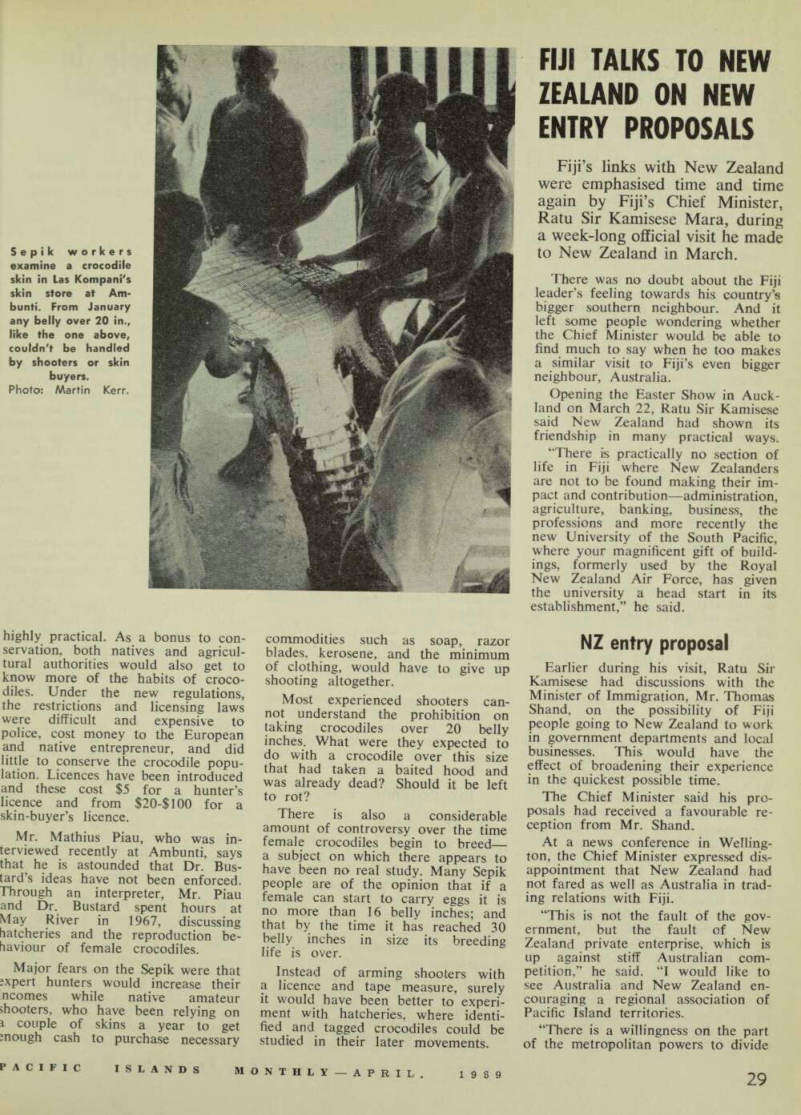
Sepik workers
examine a crocodile skin in Las Kompani's skin store at Am bunti. From January any belly over 20 in., like the one above, couldn't be handled by shooters or skin
buyers.
Photo: Martin Kerr.