of NG's political movements
pp. 29-30 · Read in the full issue
Cracks appear in the fabric of NG's political movements
At the fourth meeting in Port Moresby of Papua-New Guinea’s second House of Assembly, which occupied two weeks of March, the Independent Group (the “party without a pro gramme”) continued to play it by ear with a considerable measure of success, but not without some signs of occasional distortion in its hearing aid.
The first notable split in its so far well-maintained solidarity was on a motion by Eastern Highlands’ ebullient Dennis Buchanan, calling on the Administration to budget for increased grants-in-aid to missions in respect of their school teachers’ salaries.
The motion was opposed on the ground that it sought to anticipate the findings of an expert committee which has only just embarked on a far-reaching inquiry into territory education, and supported on the ground that some interim relief was urgently needed to ensure that the mission school system, which pro vided half the territory’s educational effort, does not collapse altogether.
The motion went to a division and was lost 35-44.
The group was split right down the middle on this issue, as was, rather humorously, the two-man All People’s Group, whose founder, Jim McKinnon, voted against his solitary henchman’s motion.
Apart from this incident, there have been rumours of meetings be hind closed doors of indigenous members dissatisfied with the too jxclusively European leadership of he group. Time will show how real he cracks are, and how much truth here is in the rumours.
In the meantime, the group has :ertainly had quite a lot of its own vay. Early in the meeting it surpri singly supported the Government o pass the Evidence by Affidavit Sill, described by the South Pacific °ost as “trial by correspondence”.
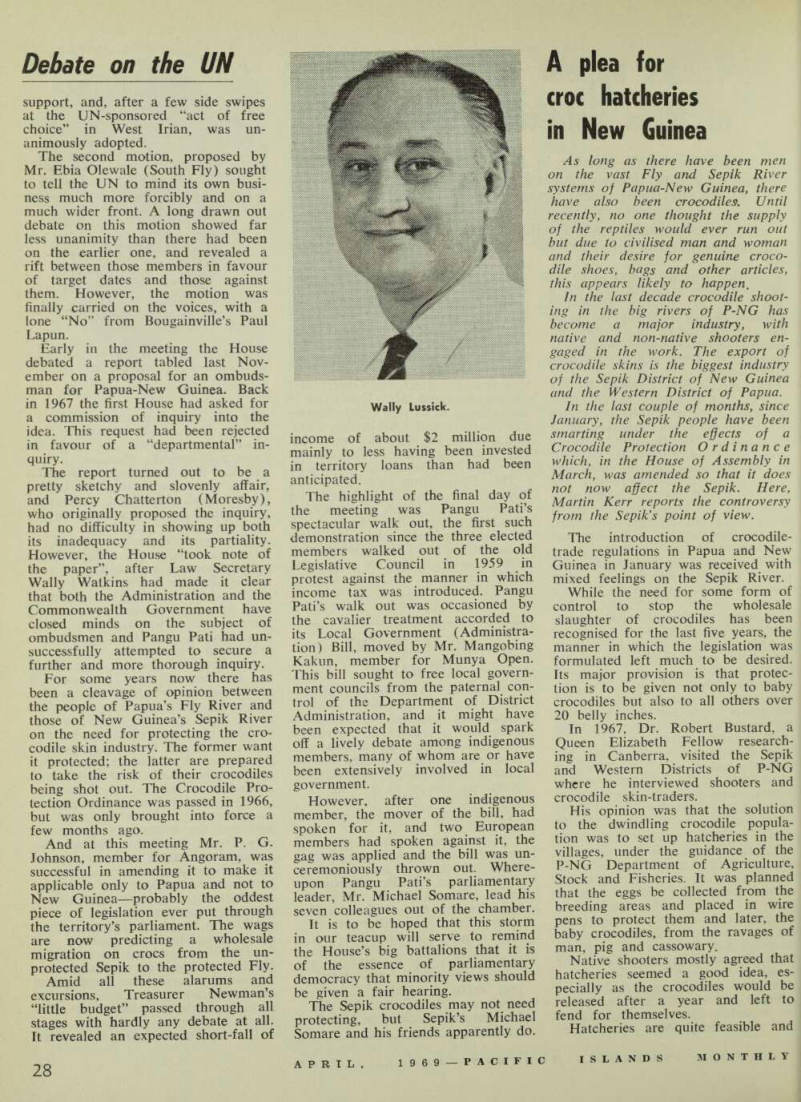
Surprisingly, because leading group icmber Wally Lussick later revealed hat independent legal opinion which ; had sought had advised against upport of the bill, and rather uaintly claimed that its support for le Government against this advice emonstrated its sense of responsi ility. Responsibility to whom, one 'onders.
Anyway, with its support the Gov mment had no difficulty in defeat ig repeated efforts by Pangu Pati nd some independent members to
secure limitation of the bill’s pro visions to civil proceedings and to courts presided over by judges and full-time magistrates. Even Percy Chatterton’s rearguard action failed to limit its applicability to criminal cases in which the accused was re presented by counsel.
A few days later, the Government meekly accepted Mr. Lussick’s amendments to its vital Public Service Conciliation and Arbitration Bill; cynics were not slow to infer that the group’s attitude on the earlier bill might have been a quid pro quo.
This Conciliation and Arbitration Bill was the climax of a long series of events which began on September 10, 1964, when the Minister for External Territories shattered New Guinea’s calm by promulgating austerity salary scales for indigenous public servants.
And since one of the effects of the new bill is to repeal Mr. Lussick’s
own bill, forced through the House against Government opposition last November and still awaiting the Governor-General’s pleasure, it was only fair that Mr. Lussick’s proposals for its amendment should be treated with respect. Moreover, they were well-thought-out amendments which deserved respect.
They provide for a tribunal of three members, with additional as sistant members who will participate in the tribunal’s deliberations but not in its decisions. This arrangement will provide an admirable training ground for Papuans and New Guineans in the working of the arbitration system.
Mr. Lussick is to be congratulated on his amendments, but not, it seems, on his attitude to those of his fellow members who also had ideas about how the bill might be im proved. He appeared to resent any one but himself having any part in the matter at all, which was rather unreasonable, and there was some muttering on this.
Anyway the bill went through, and as soon as it receives vice-regal as sent and the tribunal is set up we may expect the Public Service As sociation to embark on a brand new local officers’ case.
A great deal of time was consumed at this meeting by two elected members’ motions designed to put the UN in its place. The first, from the irrepressible Wally Lussick, con fined itself to resenting the UN’s call for free elections as an entirely un warranted aspersion on the freedom of the elections which seated the present elected members in the House.
This sentiment found unqualified
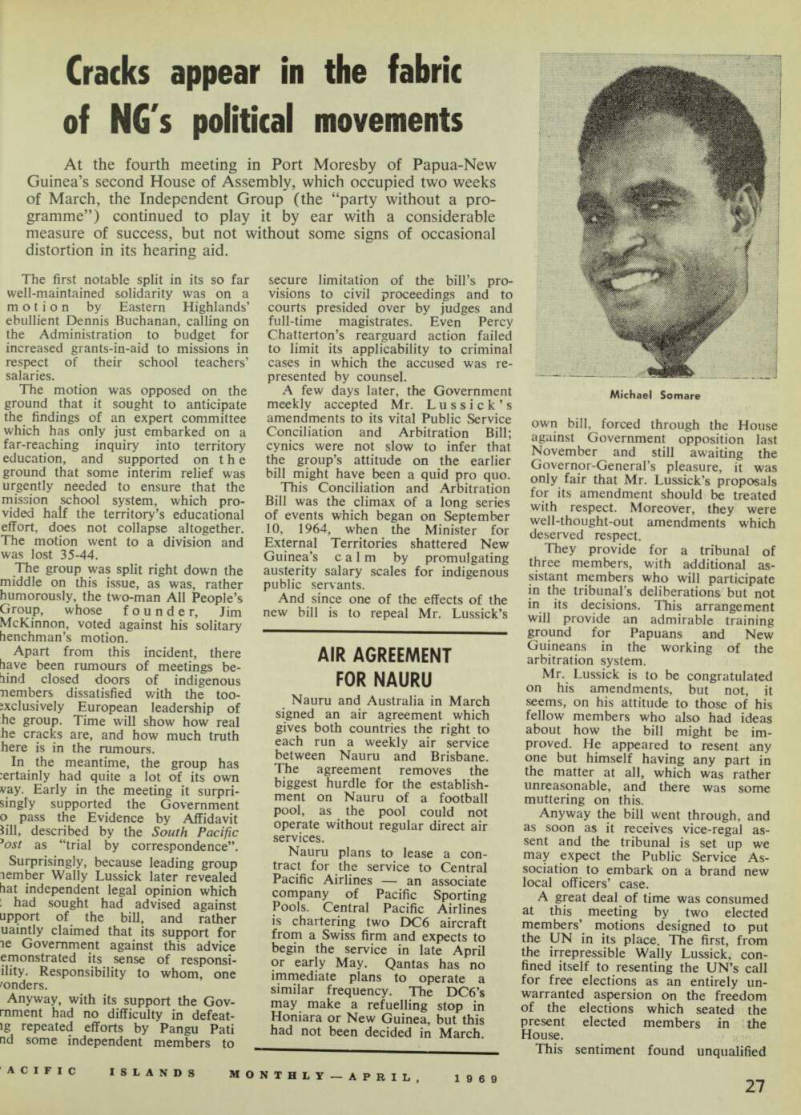
Michael Somare
Debate on the UN
support, and, after a few side swipes at the UN-sponsored “act of free choice” in West Irian, was un animously adopted.
The second motion, proposed by Mr. Ebia Olewale (South Fly) sought to tell the UN to mind its own busi ness much more forcibly and on a much wider front, A long drawn out debate on this motion showed far less unanimity than there had been on the earlier one, and revealed a rift between those members in favour of target dates and those against them. However, the motion was finally carried on the voices, with a lone “No” from Bougainville’s Paul Lapun.
Early in the meeting the House debated a report tabled last Nov ember on a proposal for an ombuds man for Papua-New Guinea. Back in 1967 the first House had asked for a commission of inquiry into the idea. This request had been rejected in favour of a “departmental” in quiry.
The report turned out to be a pretty sketchy and slovenly affair, and Percy Chatterton (Moresby), who originally proposed the inquiry, had no difficulty in showing up both its inadequacy and its partiality.
However, the House “took note of the paper”, after Law Secretary Wally Watkins had made it clear that both the Administration and the Commonwealth Government have closed minds on the subject of ombudsmen and Pangu Pati had un successfully attempted to secure a further and more thorough inquiry.
For some years now there has been a cleavage of opinion between the people of Papua’s Fly River and those of New Guinea’s Sepik River on the need for protecting the cro codile skin industry. The former want it protected; the latter are prepared to take the risk of their crocodiles being shot out. The Crocodile Pro tection Ordinance was passed in 1966, but was only brought into force a few months ago.
And at this meeting Mr. P. G.
Johnson, member for Angoram, was successful in amending it to make it applicable only to Papua and not to New Guinea —probably the oddest piece of legislation ever put through the territory’s parliament. The wags are now predicting a wholesale migration on crocs from the un protected Sepik to the protected Fly.
Amid all these alarums and excursions, Treasurer Newman’s “little budget” passed through all stages with hardly any debate at all.
It revealed an expected short-fall of
income of about $2 million due mainly to less having been invested in territory loans than had been anticipated.
The highlight of the final day of the meeting was Pangu Pati’s spectacular walk out, the first such demonstration since the three elected members walked out of the old Legislative Council in 1959 in protest against the manner in which income tax was introduced. Pangu Pati’s walk out was occasioned by the cavalier treatment accorded to its Local Government (Administra tion) Bill, moved by Mr. Mangobing Kakun, member for Munya Open.
This bill sought to free local govern ment councils from the paternal con trol of the Department of District Administration, and it might have been expected that it would spark off a lively debate among indigenous members, many of whom are or have been extensively involved in local government.
However, after one indigenous member, the mover of the bill, had spoken for it, and two European members had spoken against it, the gag was applied and the bill was un ceremoniously thrown out. Where upon Pangu Pati’s parliamentary leader, Mr. Michael Somare, lead his seven colleagues out of the chamber.
It is to be hoped that this storm in our teacup will serve to remind the House’s big battalions that it is of the essence of parliamentary democracy that minority views should be given a fair hearing.
The Sepik crocodiles may not need protecting, but Sepik’s Michael Somare and his friends apparently do.
Wally Lussick.